Guide:Trent/Apache/Kovaris
_(stbd).png)
| |
| Trent / Apache / Kovaris | |
|---|---|
| Class Overview | |
| Category | light destroyer / scout |
| Operational | 2205-2250, 2287-2295
|
| Constructed | 70 total:
|
| Dimensions | |
| Length |
|
| Beam | 76.8 m |
| Height |
|
| Mass |
|
| Performance | |
| Cruise Speed |
|
| Max Speed |
|
| Endurance | 2 years |
| Complement | |
| Officers | 11 |
| Enlisted |
|
| Tactical Systems | |
| Beam Weapons | Trent (both), Kovaris (Flts 1 & 2):
Horatio (both), NCC-418, Apache, Dace (both), NCC-823 (2214):
Kovaris Flt III:
|
| Missile Weapons | Horatio (both), Dace (both):
NCC-418:
Kovaris Flt III:
|
| Shields |
|
| Transporters | Trent (both), Horatio (both), NCC-418, Apache, NCC-823 (2214):
Kovaris (Flts 1 & 2), Dace (both):
Kovaris Flt III:
|
| Auxiliary Craft | Trent (both), Horatio (both), NCC-418, Apache, NCC-823 (2214):
Kovaris (all), Dace (both):
|
| Historical | |
| Ships of Note |
|
| Canonicity | |
| Design | SFB, FASA: Denial of Destiny |
| Name | Kovaris SotSF/SFB, Apache SFB, LUG |
| History | SotSF, SFB, Timo |
| Delta Dynamics | SRM #297 |
Background
Hobbyist's Guide

The Defense Command arsenal was, in the early 2200s, deemed adequate for present Federation defensive needs, even if insufficient were any expansion of Star Fleet’s area of responsibility to take place. While great attention was given to keeping the cruiser fleet up to the demands of the day, little in the way of advance planning and virtually nothing in terms of contingency plans existed for the destroyer force. The vaguest motion for procuring two or three dozen modern heavy destroyers to succeed the Marshall was waived on cost-effectiveness basis – such behemoths would merely directly compete with the light cruisers that were already struggling with affordability issues. As pressure gradually mounted for creating a viable defense for the outer holdings of the UFP, it thus was the lighter destroyer designs of yore that Star Fleet pondered as templates for the necessary attrition units. Yet by 2204, two rounds of requests for proposals had yielded little of consequence.
There were several inherent limits in the aerodynamic hull form, even when its warp-dynamic characteristics were well known and its manufacturing technologies perfected. Modern total conversion powerplants required considerable interior volume, which in the classic lifting body could only be provided by overall upscaling. This in turn would result in wasted volume and mass elsewhere on the ship, especially when the high output powerplant would allow the impulse engines to be run with less propellant than ever before. Supercruising warp engines would be too massive to cater for practical atmospheric operations anyway, and the optimal placement of coils should be dictated by warp field geometry concerns rather than center of gravity.
The new priorities in mind, Empress pointed out the obvious advantages of a separable space propulsion section, as employed in the Placido. All the shortcomings of the aerodynamic hull could be remedied simply by installing an all-new, volume-optimized element in its place! Once given a tentative go-ahead, Empress engineers modified the upper half of USS Neudorf to accommodate a Fairey total conversion main powerplant, and installed a single vertical pylon to sturdily mount a PB-17 warp nacelle. Its powerful coils, even if far from being state of the art, nearly doubled the field output from the Placido standard and brought cruise speed up to full warp four. Top speed would eventually be set at warp 6.0, there being potential for more but at the risk of excessive wear and tear. Impulse propulsion for the resulting bulk of nearly 100,000 tons was provided by SSMW’s C-2 engines, little modified from the previous century.
The propulsion hull was neatly plugged into a rectangular ‘socket’ segment of the new 75 m saucer hull (although in theory it could be attached to a Placido spaceframe as well, practical arguments against this were legion). The blocky structure held secondary power systems as well as supplies and support systems for detached, emergency-only operations. Twin shuttle landing bays and hangars flanked the drive section. Aft-facing rolling doors and full precision tractor beam approach control represented the most modern technology, finally in a working combination. The two shuttlepods were intended to give the type some Placido-like flexibility in replenishment and reconnaissance operations – a necessary expansion of capabilities considering the miserly procurement policies and the unlikelihood of any dedicated scouts or supply ships being fielded in the near future. Yet the ships were to feature transporter systems as the primary method of ship-to-ship or ship-to-surface transfer, and carried two twin-pad Mk I systems plus novel 22-pad, dematerialization-only evacuation units inside their primary hulls. Despite the saucer’s modest diameter, modern life support gear, sensors, command and control spaces and weapons systems could also effortlessly be accommodated there, as no propulsive or power generation machinery intruded to the mission-dedicated part of the vessels.
But what kind of actual mission equipment should the new destroyers carry? Forced-intermix torpedo technology was not yet reliable in the early 2200s, so a conventional fusion and photonic torpedo launcher was selected as the main long range armament. Yet advances in Federation shielding technology (no doubt mirrored by similar developments in Klingon and Romulan fleets, or so Star Fleet Intelligence insisted) had made fusion and even antimatter warheads of dubious worth in combat. Cruisers like Mann, Caracal and Horizon could carry heavy and complex phase cannon for ripping apart the enemy shields and letting the torpedoes in, but the modern destroyers had no room for such dual gear. Thus it was decided to equip a certain number of the new destroyers with Type L phased particle guns only, along with the associated power loops and batteries, while others would instead carry the torpedo launcher and its magazines. Common armament would include warp-accelerated nanometer lasers for close combat. In addition to port and starboard banks with good forward hemisphere coverage, the torpedo destroyers would feature a tail ‘stinger’ to compensate for the more restrictive cone of fire of their main weapon.
The destroyer program now crawled forward with a decided lack of enthusiasm. In the next three years, twenty Trents split evenly between the subtypes were completed in what was optimistically considered the initial batch, allowing the Marshall to finally retire. The next ten units were shunted to alleviating the scout shortage; they were armed with lasers only so that tactical sensors could be fitted in place of the heavy armament. The tooling was already being mothballed for ‘potential future needs’ when the altercation at Gamma Demetrius put haste to destroyer procurement again. Rather than produce more Trents, Star Fleet opted for a preplanned upgrade wherein the I pylon was replaced by a T one, and two PB-17 engines were mounted, less for the slight increase in dash speed and maneuverability and more for redundancy in case of deep space mishaps.
Forty of the (by new standards) lightweight vessels were ordered by Star Fleet. USS Kovaris (NCC-460) at 52,210 tons of hull mass was the first of twenty to be launched with phase cannon armament in October 2210, USS Dace (NCC-462) at 59,255 tons of hull mass the first of twenty to carry the torpedo launcher in March 2211. Yet there was more to escalation than the mere construction of ships. How should the art of flotilla operations be reintroduced to Star Fleet whose last real attrition units had been retired in the 2170s? Simulations and drills would only make the crews competent in waging the last war – how had the threat environment changed in the intervening half a century?
Rather than wait for an opportunity for meaningful flotilla action, Star Fleet decided to create one: in 2211, a heavy military and diplomatic task force was sent to Beta Rigel to secure the key strategic region from "piracy", the conventionally expected opening move of a hostile star empire. In claiming control of the Rigel system, Star Fleet brought about more confrontations than it could have imagined. Mere firepower could not uproot the Nausicaans, Orions and Elasi from their positions of power at Rigel. Even less feasible were attempts to challenge the anarchy of what had been the Delphic Expanse. Yet the strategic decision had been sound: beyond the veil of chaos, a mighty enemy from the past was indeed formulating its own designs on the future of the region. The Klingon Empire was finally recovering from the aimlessness and internal discord brought about by the prolonged interregnum and the Vulcanian misadventure. Examples of strong leadership had emerged, plans of conquest had been drawn, and representatives of the Empire once again approached the Rigelian despots in hopes of securing the funds that would make these plans a glorious reality.
The Orionite rulers were fully aware of the possibility of another destructive war, were the economic interests of the empires to come to an open conflict. Later studies of Rigelian archives have revealed that Rigel X in fact arranged an ingenious system of ‘alternate parking hours’ to keep the ships of the two empires from meeting each other and still allow for trade relationships with both regimes!
The fears of the Rigelian despots soon turned into grim reality. Even though the Rigel region was not to be the focus of the conflict launched in 2218, it would be touched by the war nevertheless. The battle of Arquin Pillar in 2223 was typical of the border skirmishes fought between expeditionary fleets of the empires, in which both sides tried to inflict damage on the enemy forces without endangering their precious cruisers. It was also something of a swan song for the Trent destroyers, which had become grossly outdated by the new threat. The battle serves as an excellent example of the radical changes in space warfare that took place during the lifetime of the Trent class.
The very fact that there were Trent and Kovaris vessels present at all is attributable to an engine refit effected in 2214-15. The Pleshun PB-25, a lighter counterpart (104,000 mt) to the Mann PB-20 propulsion system that had opened the warp four cruising era, was a supercruising engine destined for future greatness. Alas, the feeble powerplants of the refitted destroyers did not allow the engine to demonstrate its full potential. Despite the greater safety margins of PB-25, two out of nine Trents sent to Arquin had to perform an emergency venting en route, falling behind and missing the action.
The primary Star Fleet offensive weapon in the battle was the spatial torpedo, capable of use in warp engagements. First adopted by the United Earth Stellar Navy in 2111, with antimatter warheads developed in 2148, the weapon had behaved erratically since adoption. For the Trent, though, it was nothing short of a raison d’être. Far less dependent on a ship’s power output level than lasers or particle cannon, a torpedo launcher could keep an aged ship apace with an escalating threat simply by introducing newer and deadlier types of warhead. While the Trent retained some of the directed energy weaponry of the original design, this was of little use against modern Klingon shields. Thus, everything in the design was in practice dedicated to bringing the torpedoes to bear: the spectrum of sensors installed in the refit, the allocation of power and computing resources, the scope of the impulse drive and reaction control system upgrades. In other words, every tactical choice from engagement range to approach vector was already built into the ship.
Klingons taught Star Fleet the hard way that inflexibility and dissimilar combat equal disaster. The preferred weapon of the Klingon forces, the disruptor bolt, had shorter range than the Star Fleet torpedo, but engagement range was not for Star Fleet alone to decide. It also had a higher rate of fire; it cost a fraction of the torpedo per shot or per target destroyed; and while it could be evaded at long ranges, it could not be shot down by lasers or particle beams, knocked off course by jamming, or blocked by destroyer-level shields. The disruptor bolt could only be defeated by an ‘all-round’ warship, not one relying on a single superior weapon system.
Another milestone in the battle was the first massed use of sublight fightercraft by a Star Fleet task force. The first of Star Fleet’s gambles with unconventional fighting techniques was a dismal showing indeed. Mainly deployed from the brand-new carrier Queen Christina (NCC-446, Valkyr class), the various fighters were unable to inflict any damage on Klingon vessels, or even mount an effective defense. Using their traditional strafing attack technique, the Klingon forces simply warped in, fired disruptors and warped out before the fighters could react and gather for a strike. The captains of the destroyers Kwajalein (NCC-406) and Jacoubet (NCC-479) received posthumous Medals of Honor for their valiant protection of the cruisers of the task force when the fighter cover failed, having mounted daring ambushes for the Klingons and forced them to perform complex sublight maneuvers to get a clear shot at the Federation cruisers. By exploiting these moments of sublight movement, the Federation fighter force finally managed to cripple a Klingon cruiser of D4 type and, with the help of the Star Fleet cruisers, to kill two Klingon destroyers. The prolonged and ultimately indecisive battle left a bitter taste in the mouths of the fighter doctrine proponents, yet was not enough to condemn the concept altogether.
A third important turning point in the Arquin Pillar battle was the realtime communication with Fleet headquarters made possible by the improved subspace radio. The Trent class was fitted with the device and its adjoining relay buoy layer in conjunction with the engine refit, enabling the ships to contact starbases as far as 50 lightyears away with minimal delay. Smaller ships were still unable to carry the bulky and energy-hungry device, having to resort to subspace radio types that did not appreciably exceed 2150s performance. Still, the expanding relay network was gradually bringing realtime communications capacity to all UFP space.
In addition to Kwajalein and Jacoubet of Arquin Pillar fame, two other Trents made it to the history books. USS Targa (NCC-467) managed in 2222 to disperse a magnetic storm threatening Balaka III by using her experimental pulse wave warheads – a Vulcan technology briefly toyed with by Star Fleet, as the efforts to perfect the antimatter torpedo stumbled. On a grimmer side, USS Enderbury (NCC-480) became Star Fleet’s first pulse wave torpedo ‘kill’ when a defective warhead detonated right after leaving the launcher. The explosion ripped open the pressure hull of the destroyer and killed most of the test crew immediately; radiation took a further death toll, as hyronalyn treatment was still unknown to Federation science in early 2219.
After some five years during which the Trent and Kovaris flotillas desperately fought back the Klingon battle cruisers where they could, Star Fleet was finally able to field destroyers properly armed with forced-intermix antimatter torpedoes. The large Detroyat and Saladin classes quickly replaced the older types in all frontline operations; the lighter destroyers were relegated to Activation Class Two and sent to the now blessedly silent Romulan border. The nimble yet hardy combatants never saw action against Klingon forces again, to the great disappointment of their commanders and crews. Official retirement for the last Star Fleet Kovarises came in the ‘big sweep’ of 2250.
In the era of paranoia and over-escalation after the Organian disappearance, a handful of Kovaris destroyers were in 2287-88 reactivated and equipped with phaser V emitters. A single Common Claw torpedo tube similar to the Larson refit units was installed on each ship, to make better use of the effort put into developing these weapons. The hull modifications needed were minimal, since the Mk 8 assembly took only 35% of the space needed by the old Saladin-era launchers. Propulsion systems were refurbished and uprated for warp 5 cruising and warp 8.8 dash speed, the former achieved by respooling the coils with modern materials, the latter simply by reprogramming the limiters.
The reactivated if not revigorated Kovaris ships served in light destroyer duty during the height of the Klingon crisis, protecting the similarly anachronistic fusion-powered Titan carriers in one simulated planetary assault mission after another but luckily never seeing true action. The ships were mercifully decommissioned and scrapped in 2295.
Delta Dynamics
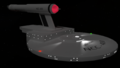
Trent class light phase gun destroyer
At the turn of the century, Star Fleet well understood the importance of cruisers—of all types—to both the military defense of the Federation and its growth through the soft power benefits the multi-mission vessels could provide. However, the distinct mission, roles, and value of destroyers were far less clear. There were certainly interested and informed parties, but no one doctrine could rise above the discussion. As a result, little in the way of advance planning and virtually nothing in terms of contingencies existed for the destroyer force.
The Marshall heavy destroyers, first commissioned by the United Earth Starfleet in 2156, were still the frontline vessels and there was no plan to replace them; the expense was deemed too high when the doctrinal focus was on much heavier vessels. Calls for a viable defense craft for frontier worlds mounted, but shipbuilders failed to provide anything that met Star Fleet’s requirements in the two requests for proposals submitted in early 2204. Empress Ship Design & Building presented an out-of-spec proposal later that same year: a mission-designated “attrition” craft that could still make use of the aerodynamic hull form seen as necessary for catastrophic survival of the crew in harsh locales. This light destroyer provided that lifting body in a saucer form, trailed by a detachable propulsion section, such as utilized by Placido class surveyors.
The issue of firepower was another area of concern: torpedoes, long a stalwart of destroyers of all eras, were no longer capable of pounding the hulls of target vessels that were defended by the advances in shielding technology; conventional fusion and photonic torpedoes provided the long-range hitting armament necessary to a modern destroyer’s survival, if they could get through the shields. Phased particle guns were a solid answer to this problem, chewing up a ship’s defensive screens for the arriving torpedoes to slip through, but no light destroyer could carry both space-intensive systems in any meaningful way.
Empress had an idea for this too: divide the small vessels into two types. The Type L cannon-equipped destroyers would work in a 1-for-1 relationship with identical—but torpedo armed—ships to harass the larger capitals. Two equally threatening targets could overwhelm, if the proper supporting fire & maneuvering tactics could be practiced and perfected by both crews. It was with this concept in mind that the Trent phase cannon destroyers began production in 2205, each set to be ”married” to a partner Horatio torpedo destroyer.
_(bow).png)
_(dorsal).png)
_(stern).png)
_(ventral).png)
Horatio subclass light torpedo destroyer
The Horatio subclass was the 2nd half of Empress Ship’s plan to revitalize the Star Fleet destroyer program (and the destroyer production program). The design phase of the ship required nearly no additional time at all: removing three Type L phase cannon mounts from the Trent plans and replacing them with one medium ventrally-embedded torpedo launcher, with two off-centerline magazines for the 30 conventional fusion and photonic torpedoes. A fifth 700 MW laser emitter was installed on the dorsal aft end of the propulsion hull, to compensate for the more restrictive cone of fire of the primary weapon.
.png)
.png)
.png)
.png)
.png)
USS Ascot prototype light torpedo destroyer
Star Fleet had briefly considered developing a two-nacelle variation of the Trent class light destroyer before the altercation at Gamma Demetrius demanded new destroyers off the lines. The initial proposal sought to bring torpedo technology to a higher level of output than could be sustained by the present Horatios. The concept had the T-Pylon crested by the fully-automated torpedo pod, with the two wing struts to the nacelles running through it. However, practical testing of the USS Ascot (NCC-418), a Trent chosen to serve as the test vessel, showed that the plasma wave guides interfered with the intended layout of the automated torpedo loading machinery, requiring Rube Goldberg-esque designs that only overly complicated the procedures to get the torpedoes from storage to the launcher. Moving to the default manned torpedo launcher freed up additional space to allow the inclusion of two additional (aft-firing) launchers, but the T-pylon could not adequately be widened to allow a turbolift access to the pod; the climb from the primary hull would be too slow to man the pod in emergency scenarios. Ascot was provided with a shuttlecraft docking port on the ventral side of the pod, but that was seen as impractical a procedure as climbing the ladder, especially in combat. Underpowered combat systems, when all three weapons systems were engaged, resulted in serious discussions on the feasibility of combining phase cannons and torpedoes on such a small platform, an issue that had already been resolved with the very concept of the sister classes.
Once the destroyers entered full demand, the Dace torpedo subclass became the spiritual successor of the Horatio, with the same limited inventory of torpedoes. Ascot was returned to her original configuration (though her T-pylon was disassembled and installed upon a later sister ship).
.png)
.png)
.png)
.png)
.png)
Apache subclass scout
The ease and rapidity in which the light destroyers had been built (construction concluded in 2208), and the alleviation of the dwindling destroyer numbers, led scouting proponents (including Empress Ships) to suggest a slight re-tooling of the Trent series production lines. Ten vessels were authorized in late 2209 to address the scout vessel shortage. The only weapons were to be defensive: the five 700 MW lasers were not backups to phase cannons or torpedo launchers. Instead, the heavier weapon spaces were replaced by re-configured work areas and computing assets that supported the three ventrally-mounted tactical sensors. All else remained the same as far as auxiliary craft, defensive shielding, and transporter systems; the only other notable difference was a slightly lesser number of assigned enlisted crew members.
The vessels performed primarily alongside their light destroyer brethren in small task forces or the occasional expeditionary reinforcement flotilla. Within the Trent series, the Apache subclass was the first to be completely decommissioned, with all ships removed from the active registry by 2235.
.png)
.png)
.png)
.png)
.png)
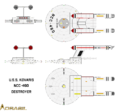
Kovaris subclass light phase gun destroyer
While the Trent and Horatio light destroyers took away some of the meager pressure to modernize small combatants, after their initial run was completed there was no serious intent to continue with another. An abbreviated attempt was made to explore upgrading the present ships into dual phase gun/torpedo destroyers, with the USS Ascot (NCC-418), but that was quickly proven to be a fool’s errand. The series’ specific tooling machinery was being readied for their own mothballs when Empress Ships employed its lobbyists to successfully call for the procurement of ten more ships with the Apache scout subclass.
However, in 2209, the loss of USS Sentry (NCC-1010, Advance battle cruiser) to Klingons over the refugee crisis of Gamma Demetrius (also known as Boreth) created a panic in Star Fleet to update contingency plans. Those plans required more attrition units than were presently listed in the registry. The exploration of two nacelles with the USS Ascot was deemed a favorable path and, so, rather than produce more Trents, Star Fleet opted for a preplanned upgrade of a new subclass, wherein the I pylon was replaced by a T one, and two PB-17 engines were mounted. This was less for the slight increase in dash speed and maneuverability than for redundancy in case of deep space mishaps.
As with the Trents and Horatios, the Kovaris light phase gun destroyers would be built concurrently and paired with the Dace light torpedo destroyers. The initial production run was ordered at 40, split equally among the two types. As the production started spinning up, present and future destroyer crews entered simulators and practiced attack drills, honing their long-atrophied flotilla skills. To test their readiness, Star Fleet created an opportunity for true flotilla action, by invading the Beta Rigel region in 2211, to “secure” the area from “rampant piracy”. Confrontations with Nausicaans, Orions, Elasi, and numerous invested small powers from the former Delphic Expanse soon outnumbered what had been perceived to be ideal “training” operations. However, the experience acquired was certainly a fair investment for the confrontations that were to occur with warships of the emerging Klingon Empire.
.png)
.png)
.png)
.png)
.png)
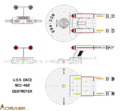
Dace subclass light torpedo destroyer
The Dace subclass light torpedo destroyer was a continuation of the dual-type production plan originating with the Trent/Horatio phase gun/torpedo series and produced in conjunction with the Kovaris subclass. Both of the latter types saw a slight maximum speed increase (from warp 6 to 6.3 on the Original Cochrane Unit scale) over that of the single-nacelle predecessors, but otherwise maintained the same crew complements, weapon packages, and magazine allotments as with the earlier vessels.
All of the destroyers would be upgraded with the more advanced PB-25 nacelles, starting in 2214.
.png)
.png)
.png)
.png)
.png)
Trent Flight II light phase gun destroyer
In 2214, Star Fleet took advantage of a miniaturization surge to introduce the PB-25 nacelle to its light destroyers. The slightly longer twin to the original PB-17s resulted in a significantly higher warp benchmark, 7.1, at dash speeds for nearly the same power requirement. This refit was also an opportunity for the destroyer types to focus on keeping their primary mission capability—that of torpedo delivery—up to technological parity with their primary aggressors, the Klingons. Updated sensors for both phase gun and torpedo types increased the spectrum range for detection and tracking, computers with faster firing solution algorithms were swapped in, power relays with a higher dedication to weapons systems were embedded, and maneuverability was tweaked through modifications to the impulse drive and reaction control systems.
However, where the PB-25 failed to deliver was at supercruising, i.e., sustained travel at warp 5. The powerplants were positively feeble when compared to the requirement to maintain power output at the minimums necessary to travel at that factor. This was a critical element to the heavy losses sustained at the Battle of Arquin Pillar in 2223. The conflict between the Klingon and Federation expeditionary forces was typical of the border skirmishes of the time, with neither wanting to put their valued cruisers at risk. Instead, frigates and destroyers feinted and prodded, attempting to pull the other’s assets out of their defensive formations. The prolonged battle was notable for several reasons, but specifically for the Trent series, the unreliability of the warp core to maintain sustained power at warp five meant two of the assigned ships had to fall out of formation, with their absence noted when the conflict was at its most violent.
On the positive side, the superior sensors of the ships outperformed those of the Klingons’ in the environment of the superdense nebula. USS Kwajalein (NCC-406) and USS Jacoubet (NCC-479, Dace Flight II) used the tendrils of the nebula to ambush the Klingons several times, disrupting the enemy’s attempts to get clear shots at the Federation cruisers. Their actions to protect the capital ships earned the commanding officers of both posthumous Medals of Honor.
_(stbd).png)
_(bow).png)
_(dorsal).png)
_(stern).png)
_(ventral).png)
Horatio Flight II light torpedo destroyer
The Horatio light torpedo destroyers, along with the sister ships of the Trent, Kovaris, and Dace subclasses, swapped out their PB-17 warp nacelles in 2214 and 2215 in exchange for the slightly longer PB-25s, adding around 5 meters to the length and nearly 4,500 metric tons (double that for the dual-nacellers) to the mass. As previously reported, the primary intent was to allow the vessels to finally achieve supercruise (warp 5) capacity, but the fusion-powered warp cores were just not able to sustain that level of required energy output. For dash speeds, the full warp factor (and more) pleased the crews when applied to exercise and operational scenarios.
In sub-light combat, the less mass of only one nacelle was a maneuverability advantage, when compared to that of the Dace. In the combined torpedo efforts of the paired classes, mobility options were embraced and crews assigned to Trent and Kovaris ships were extremely appreciative of being assigned a Horatio partner, as it was perceived that more firing solution options would present themselves at a faster rate (actual engagement analysis rarely supported this perspective). For Dace crews, however, knowing they had a larger statistical chance of maintaining warp capacity meant they would be more likely, in the military parlance, to “charlie-mike” (i.e., continue mission); in a combat mission, the loss of the only nacelle meant the chance to “RTB” (return to base) was less than likely for the unfortunate Horatio crew.
_(stbd).png)
_(bow).png)
_(dorsal).png)
_(stern).png)
_(ventral).png)
Kovaris Flight II light phase gun destroyer
Like the other light destroyers of the Trent series, the two-nacelle Kovaris phase cannon platforms were upgraded to make use of the aforementioned PB-25 nacelles, with the anticipation of a higher cruising speed of warp 5. Unfortunately, this proved unattainable with the endemic and underpowered warp core. Despite the other upgrades to sensors and maneuvering systems, the complex nature of two ships performing one mission (torpedo delivery upon enemy hulls) continued to be a sophisticated challenge, limiting the effectiveness of both the phase cannon and torpedo types.
Shortly after the frustrating “victory” of the Battle of Arquin Pillar in 2223, Detroyat and Syracuse destroyers began arriving in large enough production numbers to supplant the lighter craft. Their heavier weaponry (based around forced-intermix antimatter torpedoes) and greater mass allowed them to undertake longer uninterrupted attack passes on capital ships and stay engaged with their equals in ways that a pair of collaborating Trents could not. All four variants of the light destroyers were relegated to Activation Class Two and sent to the silent Romulan border for patrol duties. No member of the series would ever again engage a Klingon vessel. The one-nacelle variants started retiring in the mid-2240s, and the two-nacelle ships were all decommissioned (and some mothballed) in the “big sweep” of 2250.
_(stbd).png)
_(bow).png)
_(dorsal).png)
_(stern).png)
_(ventral).png)
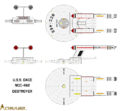
Dace Flight II torpedo light destroyer
Upgraded in 2214-2215 with the PB-25 nacelles, the Daces fully returned to active duty alongside their sister light destroyers. However, as with the three other mission platforms, effective use of their weaponry proved to be the most challenging endeavor.
The valiant efforts of the USS Jacoubet (NCC-479) were covered previously. However, the USS Targa (NCC-467) also has heroic credentials. As with the one-nacelle Horatio subclass, the Daces were built around the concept of the spatial torpedo, which was first adopted by the United Earth Stellar Navy in 2111 with conventional explosives; in 2148, antimatter warheads were developed and first deployed. By 2219, Star Fleet‘s efforts to perfect the effectiveness and reliability of antimatter torpedoes were so frustrated, the Vulcan’s proposed an alternate technology of warheads based upon pulse waves. The Targa had the fortune to be outfitted with those experimental devices and employed them against a magnetic storm menacing the inhabitants of Balaka III, with immediate success, dispersing the threat before any undue effects resulted. On a grimmer side, USS Enderbury (NCC-480) became Star Fleet’s first pulse wave torpedo “kill” when a defective warhead detonated right after leaving the launcher. The explosion ripped open the pressure hull of the destroyer and killed most of the test crew immediately; radiation took a further death toll, as hyronalyn treatment was not as effective as Federation science would eventually achieve.
_(stbd).png)
_(bow).png)
_(dorsal).png)
_(stern).png)
_(ventral).png)
USS Apache prototype scout
When Star Fleet decided to equip the Trent destroyer series with the longer Pleshun PB-25 nacelles, it considered—briefly—including the Apache scouts in on the refit. However, because the destroyer program had already started spooling down well before the latest bout of increased tensions with the Klingons, Pleshun had ceased production of the problematic nacelles and ready spares were projected to be too sparse to accommodate the less vital subclass. Nonetheless, USS Apache (NCC-823) was brought into the yards and had her single nacelle swapped out. While she would retain the nacelle, her sister scouts missed out on the resulting warp speed increase at Exploration Command's insistence on the more reliable PB-17.
.png)
.png)
.png)
.png)
.png)
Kovaris Flight III light destroyer
The era in which the Trents represented Star Fleet's top-of-the-line light destroyers dawned 82 years earlier, and in 2287, all the surviving vessels of the various variants had been decommissioned or mothballed for at least 37 years. However, now the Organians were unexpectedly gone and concerns that the cold war with the Klingons would re-flash were not only real, but probable. Despite the flurry of contracts for corporate shipyards and the ramping up of capacity in the state's fleet yards, hull numbers had to be increased immediately. Twelve two-nacelle Kovarises and Daces had their mothballs dusted off, their lasers ripped out, their targeting computers wiped and upgraded, and the latest in weaponry technologies thrust upon them. The existing nacelles were retained, simply having their coils re-spooled with modern materials and the limiters re-coded with higher tolerances, enabling the two subclasses (identified together as Kovaris Flight III now that they were identical) to achieve sustained warp 5 and maximum warp 8.8. Each now massed 238,200 metric tons due to the new coils and heavier Common Claw torpedo tube. The ships did not serve on what was conceived to be the front lines, but instead protected the equally aged fusion-powered Titan carriers in simulated planetary assault missions, not ever seeing direct action in the modern age.
USS Stenersen (NCC-499), named after a post-Romulan War merchant held in high esteem on Andoria, holds the distinctions of being the final Dace off the ways in 2215 and the last of the Trent series decommissioned in 2295.
_(stbd).png)
_(bow).png)
_(dorsal).png)
_(stern).png)
_(ventral).png)
Gallery
Orthos
-
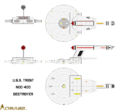 Trent (master)
 -
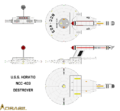 Horatio
 -
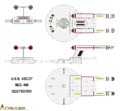 USS Ascot
 -
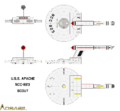 Apache
 -
 Kovaris
 -
 Dace
Dace -
 Trent Flt II
 -
 Horatio Flt II
 -
 Kovaris Flt II
 -
 Dace Flight II
 -
 USS Apache
 -
 Kovaris Flt III
.png)


Other images
-
 USS Trent
 -

-

-

-
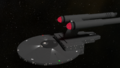 USS Dace
 -
 USS Stenersen, a 2287 refit of the Kovaris subclass
 -
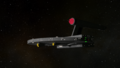 USS Apache


Supporting Documents
Notes
- The original article made the significant variants to be between the one-nacelle Trents and two-nacelle Kovaris subclass, with the Apaches a minor offshoot. However, I decided to further expand upon the difference between the phase cannon and torpedo platforms, essentially "adding" two additional subclasses with the Horatios and Daces.
- The Apache sub-class had a different series of hull numbers, due to the classification as a scout.
- To be clear, the Trent (and Apache) sub-class were not upgraded to the T-pylon double-nacelle configuration; this was left to the Kovaris sub-class new-builds.
- The reference to the battles of 2218 and 2222 appear intended to be a part of the Four Years War, but game-canon has this put off until the early 2240s.
- The paragraph detailing the use of torpedoes in the class has been changed (in description) to better align with the Spacedock construction rules. No dates were changed, but proper nouns for the technology were adapted.
- In response to the Flying Fortress ransacking, Star Fleet assigned Kovaris sub-class ships to escorting supercruising convoys.[1]
- USS Stenersen is, of course, my tribute to Marty.
- I've named the torpedo variant of the original series (Trent) the Horatio subclass. The first three ships of the Trents lineage will be of the phase gun variant, but thereafter, the two will swap out, with the Horatios odd-numbered, until the tenth phase gun variant is completed.
- I decided the mass of the individual PB-25 nacelle to be 104,400 mt, almost 25% lighter than its parent PB-20.
- I've removed the reference to navigational deflectors on the propulsion hull ventral bows, deciding the (formerly) auxiliary navigational deflector emitters on the saucer hull bow acted as the primaries.
- I've made Adrasil's torpedo destroyer prototype game-canon, with USS Ascot (NCC-418). The idea was that it was a 2209 predecessor to the Dace subclass two-nacellers, rejected as unreliable.
References