Guide:Placido
.png)
| |
| Placido | |
|---|---|
| Class Overview | |
| Category | surveyor (later scout) |
| Operational | 2170-2230 |
| Constructed | 18 |
| Dimensions | |
| Length | 153.2 m |
| Beam | 88.1 m |
| Height | 45.2 m |
| Mass |
|
| Performance | |
| Cruise Speed | w 3 |
| Max Speed | w 4.9 |
| Endurance | 2.3 years |
| Complement | |
| Officers | 8 |
| Enlisted | 53
|
| Tactical Systems | |
| Beam Weapons | Original
Refit 2202
|
| Missile Weapons | Original (only)
|
| Shields |
|
| Laboratories |
|
| Transporters |
|
| Auxiliary Craft |
|
| Historical | |
| Ships of Note |
|
| Canonicity | |
| Design | own |
| Name | SFC, FASA |
| History | SFC, FASA
|
The tiny Star Fleet research force, consisting mainly of auxiliary cruisers of various types, was being
strained to the extreme by the end of the 2160s. Demands for restarting the exploration program
were becoming more and more heated, but all Star Fleet could do was quote the well-known figures:
one couldn’t explore much with a fleet consisting of warp three nearspace assets, less than 40
operational deep space scouts and the handful of proper cruisers not currently engaged in post-war
troubleshooting or border patrol. Most UFP member navies had been unable to donate useful
research vessels, lacking the tradition of pure science operations far away from home space. Worse
still, the specialized Mercury and Doppler military scoutships were at the end of their viability.
Replacements were needed either in significant quantity, or possibly significant quality and speed
that would compensate for the lack of numbers.

The military scout designs were sound as such, but their compact hulls lacked room for upgrades and improvements. Nor would they be capable of atmospheric operations, which still held considerable scientific interest. For the project to be worth the effort, top speed and endurance also had to be increased over the auxiliary cruiser figures to cover the gaping holes in scoutship coverage. Finally, in order to pass budgetary muster, the type would have to be capable of a dual mission profile. In 2168, a committee led by Dr. Marton Bendes sat down to define the ideal Federation scientific scoutship, employable as a military reconnaissance asset in case of resurgence of hostilities. Some of the momentum of wartime R&D still survived, as after just nine weeks, the specifications were presented for the industry to compete on.
Two main contractors were chosen, for there were also two halves of the ship to be completed. One was the mission spaceframe, a traditional destroyer-category lifting body capable of planetary operations as well as multi-year deep space endurance. Empress could ride on its Ganges and Drexler experience and swiftly completed the initial test article. The other half was a separable warp propulsion module, complete with the main powerplant and fuel tankage plus a single 87,000 ton PB-8 nacelle, sturdily secured on triple pylons above the bulk of the module. CWD began systems integration work in early 2169, and could present a flight article by May 2170, giving Star Fleet half a year to test the mission spaceframe in atmospheric, orbital and sublight interplanetary conditions.
Integration of the propulsion module to the horseshoe adapter at the stern of the mission hull was performed on May 9th, with test flights commencing on May 22nd. Warp three was accomplished on June 3rd; on return to Martian orbit, the test vessel was met by a Star Fleet delegation carrying a bottle of champagne, a dedication plaque, and orders to commission the vessel under the name USS Placido, NCC-257. Full production of a total of twenty-four units was authorized at once, and several auxiliary cruisers recalled in order to provide experienced crews for the new surveyors. This commitment to the modern scout type, as well as to the extensive research and survey program on which the vessels were to be employed, bade well for the future of Federation exploration.
However, leaner times were ahead. Multiple simultaneous blows of block obsolescence shook Star Fleet in the seventies, and forced the cancellation of further Placido procurement. As funds were channeled to restoring the cruiser forces, and the last wartime scouts were stricken, the exploration program went back to basics. Auxiliary cruisers were once again purchased; Placido survey missions were continued with such modest resources that they were commonly known as ‘Placebo missions’ in Exploration Command. Star Fleet now had to pay a high price for its most versatile exploration vessels, even when their operating and maintenance costs were just as reasonable as originally projected: wear and tear forced the idling of ship after ship, halving lifetime estimates and doubling attrition from terminal structural fatigue.
None of this could occlude the glowing operational record gathered by the Placidos. Thanks to their speed and range, the scant eighteen vessels were seemingly everywhere. A cruiserlike top speed of warp 4.92 was recorded on USS Minstrel (NCC-272) in 2174, a new distance-from-Sol record of 370 ly on USS Harvey (NCC-258) in 2182. USS Bellweather (NCC-259) was among the first vessels to test tectonic manipulation by melting down a series of fault lines on g Spica III in 2174 – an action much acclaimed in its time, but later scorned as a mistake, and a gross Prime Directive violation, had General Order One been in existence at the time. Captain Jan Oonlander of USS Icarus II (NCC-263) had to endure much good-natured chaff over the fact that his aeronautically-named scout was the first to establish contact with a winged – and, indeed, truly airborne – sentient humanoid species on a Virginis II in 2193.
For the duration of overlapping service careers with wartime scouts and cruisers, the Placido class was the main means of keeping Star Fleet in the deep space exploration business. Not only did the scouts, compact in size and low in number as they may have been, spearhead the plunge into the unknown with their daring solo sorties. They also donated their design for use by the Castor and Lupus classes of auxiliary cruisers and the Shackleton support and supply type, all with different space propulsion modules of humbler performance and greater affordability, and with various mission-specific pods in tow.
The 2180s revamping of the Fleet allowed for the formulation of a different doctrine, one that tasked independent deep space missions solely on top-of-the-line cruisers. The Placidos had another role to fill now: tactical scouting ahead of fleets called for modern, high speed units. As long as none could be designed at lesser than light cruiser size, the only rational alternative was to utilize an existing and paid for warpship, and to expend minimal resources on making ‘modern’ and ‘high speed’ at least moderately fitting descriptions of the type.
The expenditure involved upgrading the lower phase gun to the heavier Type L standard and ripping out the old torpedo tubes (which had never packed destructive ordnance anyway) in favor of improved tactical sensors. Navigation and communications gear were updated as well, this being the only measure to improve the speed of the vessel, that is, to shorten the time of transit to battlefields or other theaters of operation. The refreshed scouts started their frontline service in 2204. There was little fear of them looking awkward or out of place in the hodgepodge fleets of the time, still featuring some ancient Marshall destroyers alongside three or four tentative lineages of light cruisers. What their presence did accentuate was Star Fleet’s lack of a modern light fighting vessel, a frigate or destroyer, in the Placido size category – a shortcoming to which yet another patch job based on the Placido spaceframe was the inadequate remedy, as described in the Kovaris entry later on.
Only one Placido made an impact in history during this second career: USS Akula, NCC-273, gave sterling service in the Battle of Arquin Pillar in 2223 and almost survived her ordeal, succumbing to a reactor implosion twenty minutes after the Klingon retreat. At the time, jettisoning of the space propulsion section and its antimatter reaction chambers was no longer a practicable option, the latchup and purge systems having been neglected for far too long.
Gallery
-
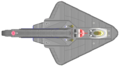 Dorsal
.png)
Notes
- The construction codes of most of these ships had to be adjusted, to allow for the preceding Drexler class.