Guide:Mann

| |
| Mann | |
|---|---|
| Class Overview | |
| Category | light cruiser |
| Operational | 2206-2244 |
| Constructed | 16 total: |
| Dimensions | |
| Length | 185.0 m |
| Beam | 101.7 |
| Height | 40.0 m |
| Mass | 334,000 tons (original) |
| Performance | |
| Cruise Speed | w 4 |
| Max Speed | w 4.5 |
| Endurance | 8 years |
| Complement | |
| Officers | 14 |
| Enlisted | 280
|
| Tactical Systems | |
| Beam Weapons | Original:
2218 Refit:
|
| Missile Weapons | Original:
2218 Refit:
|
| Shields |
|
| Laboratories | 2x GP |
| Transporters | Original:
2227 Refit:
|
| Auxiliary Craft |
|
| Historical | |
| Ships of Note |
|
| Canonicity | |
| Design | SFC |
| Name | SFC |
| History | SFC
|
The turn of the 23rd century was a time of introspection for Star Fleet. The auxiliary cruisers that had
kept the exploration program afloat were rapidly becoming unserviceable, and the wisdom of
equipping new vessels in this category was questioned. Fleet scouting capabilities were still grossly
insufficient. Research on faster drive systems was making no headway, as both the theoretical
understanding of the Tyme barrier phenomenon and the practical engineering solutions of better
powerplants were lacking. Amidst these troubles, few paid attention to the perhaps most obvious
gap in Star Fleet’s credibility: its combat strength in relation to the size of its theater of operations
was at an all-time low. With the potent but expensive Horizons largely dedicated to the constantly
expanding exploration mission, the defensive fleet lacked both the tactical muscle of effective
armament and the strategic freedom of high speed propulsion.
After the failure of the Tritium, funds would have been well spent on speeding up Horizon and Advance production. Unfortunately – due to what was considered a colossal strategic oversight by some, an inevitable limitation of general economic facts by others – the dockyards of the early 2200s simply weren’t up to the task of building the numbers of heavy cruisers required. When the production capability wasn’t there, allocation of the resources that did exist was an issue of hot debate. The Federation Council made it very clear that no further defensive cruisers would be built in large numbers at a time when there were no external threats worth mentioning. To make up for the inevitable shortage in quantity, Star Fleet again chose to field a design of superior quality, even if this meant even lower procurement figures than with lesser, cheaper designs. To satisfy Council-imposed limitations, Star Fleet officially specified the project as a light cruiser of no more than 50,000 tons of hull mass.
Several designs were considered, many of them simply miniature versions of the heavy Horizon cruisers. In 2200, Chiokis Corporation presented the most attractive plan so far: a cruiser in the warp 4.5 speed range, well within the 50,000 ton mass limits, yet with a hull ten times as voluminous as that of the classic saucer-hulled cruiser designs. The ovoid main hull of the ship, made of extremely lightweight pure trititanium, had a height to width ratio of 1:2.5425. This shape maximized available volume: the warp field would wrap tightly along the surface of the hull. No notch in the field existed to accommodate a secondary hull, and indeed none was needed, given the significant volume of the ovoid section. Warp engines of the ultramodern ‘Twenty Series’ would be mounted symmetrically, aft on the hull center-plane. No pylons would be used; as was typical of Andorian designs, the all-new engines were closely spaced and mounted directly and sturdily to the primary spaceframe. The forwardmost 40 meters of the 130 m, 140,000 ton PB-20 assemblies would actually be buried deep inside the hull ovoid.
Main power was to be provided by a SSWR-IX total conversion reactor, a system heretofore never applied on non-Andorian spacecraft. Without the benefit of dilithium regulation, fantastically complex containment and intermixing systems were required to support the 1:1 m/am ratio. Indeed, up to 40% of internal volume had to be dedicated to power production, meaning that every cubic centimeter of the large ovoid would be needed to allow the ship to carry the required mission gear.

The design still triumphed over competitors on its elegance of operation, although experienced Fleet designers expressed doubts on its practicality, especially on the structural strength of the vast yet featherweight hull. In a major break from the Not Invented Here tradition, Earth-dominated Star Fleet finally accepted the Andorian design and authorized the construction of ten light cruisers of Mann class, beginning in 2201 and aiming at a 2206 first launch. This order was later changed to twelve vessels as the number of Titan carriers was cut down from ten to eight – highlighting the practical problem of Star Fleet possessing only ten dockyards capable of processing tritanium-hulled vessels of this size and complexity at the time! The registry allocation system in fashion at the time resulted in numbers NCC-765-780 being assigned, although several other alternatives were also suggested.
The ships initially featured a centrally mounted twin torpedo launcher with a rapid-loading system and spacious magazines for modern, precision-guided photonic torpedoes. Four powerful phase cannon capable of penetrating the strongest of shields known to the Federation gave the ships their major offensive power, while four warp-accelerated lasers of immense power provided defensive strength along with the best shields Star Fleet could muster. Two compression fusion reactors powered the warp engines, while the impulse engine between the nacelles was powered by four smaller reactors that also delivered power to the particle cannon. The sensor suite was exceptionally diverse and capable as well, since the voluminous hull decreased the number of compromises the designers had to make in this respect. Calling these vessels ‘light’ cruisers began to sound less and less fitting, despite the fact that the original hull mass limit had been exceeded by mere 4,000 tons.
This generosity of design quickly ate up the available volume, though. Very little room was left for laboratories, and shuttle hangars were omitted, with four standard docking ports installed to compensate. Clearly, a purely combat-oriented mission profile was intended for the cruisers. Thanks to the potent directed energy armament, the design actually outperformed even the heaviest variants of Caracal light cruisers in battle. With their groundbreaking capacity for sustained warp 4 cruising, the Manns also were the first warship type capable of ‘strategic redeployment’, the prerequisite to territorial control on an interstellar scale. In several polls, UFP citizens considered themselves safe from Romulan aggressions, alien intrusions or space piracy; the Federation was becoming a true empire, no longer huddling around essentially isolated star systems, but actually in charge of the volume of space connecting the member systems.
But not everybody was happy with the growing military power of the UFP, nor with the continuing expansion of this new empire. A movement known variously as ‘Earth First’, the ‘Terra-return League’ or the ‘Back-to-Earth movement’ was born at this time, with the goal of ending space exploration and returning humans to the Sol system, and ultimately to Terran surface. Leading figures in the movement were colony leader Gwendolyn Illisen of Benecia and industrial tycoon Maxwell Grandisson III of Earth, but several other influential people were also attracted to the ideas of the league. In 2218, the movement gained new support and spawned similar groups across the UFP – in the naturally reclusive and isolationist Andorian population, on Tellar, and reputedly even among some Vulcans. The rampage of the Klingons led to interstellar panic, of a magnitude completely different from the minor anxiety caused by the distant Romulan War in the 2150s. The existing fleet of warp three spaceships would be no match to a determined enemy of equal technology: the mechanics of space warfare heavily favored the attacker, since intruders warping in could not be intercepted before they were within bombing range of planetary targets.

While the homefront considered the possibility of surrendering space to the Klingons and returning home, Star Fleet took a different approach. According to Vulcan calculations, the two alternatives for the defender were to build sixteen to twenty times as many ships as the attacker could field, or to introduce ships with a 30% speed advantage and warp intercept weapons. The less impossible of the two alternatives was chosen.*
Beginning in 2218, Mann class ships were upgraded with experimental modern torpedo systems. Loaders for forced-intermix photon warheads were installed on Deck 7. Heavier defense lasers were fitted, and the warp engines of Vickers manufacture uprated to the so-called third generation standard to squeeze out the promised top speed of warp 4.5 not quite attained by the original design. Humungous intercooler pods had to be substituted for the original sleek tubes to cope with increased power levels on the 160,000 ton engines. The uprated configuration was sometimes called the CT or ‘Cruiser Tactical’ upgrade; four final hulls were completed out of existing spares at this dire hour before attention switched to the improved Ranger class. Together, the light cruisers formed Star Fleet’s main defense against the Klingons in the early 2220s, ‘holding the fort’ until ships designed from the outset to oppose the warrior empire were fielded.
In retrospect, the fleet of Mann ships was quite insufficient for effective defense. What apparently saved the UFP from an early conquest was a series of cosmic coincidences, as is the case with most major historical turning points. The Klingon Empire, never quite united and always at war on several fronts, could not concentrate its forces against the newly found and attractive resources base because of troubles with other political entities; a race known as Kinshaya is mentioned in what little remains of Klingon historical records of that time. While almost nothing of this Beta Quadrant race is known to Alpha Quadrant cultures, it apparently managed to challenge the technologically advanced Klingon military for decades. Also, the Klingons were cautious not to harm their then-delicate trade relationships with the Beta Rigel area cultures, while at the same time trying to prevent the UFP from gaining too much of a foothold in the region. Finally, a minor race known as the Willall provided the Klingon scientists and politicians with a fascinating challenge, the significance of which would not be revealed until the 2240s. Until then, the two empires coexisted in an uneasy equilibrium behind their fleets of warp four cruisers.
Famous Mann class vessels include USS Endurance, the flagship of ADM Okuru Nelson in the herculean spacelift evacuation of ten million people from Bayard’s Planet in 2217; and USS Leonides, which in 2212 intercepted a group of pirates ransacking the armed transport Flying Fortress, and thus unknowingly threw a challenge to the Sta Mura dynasty that was to plunge the secular elements of the Klingon Empire to a heated conflict with the Federation as well. USS Sagan was the first Earth-built cruiser-sized ship to be adopted by the Andorians, with a fully non-human crew, in 2213. After this, several founding cultures began to adopt Earth-built ships for their local navies, initially leading to greater uniformity of Fleet equipment, but ultimately also to the relative scarcity of ships named after nonhuman persons or events.
Starship crew members will also fondly remember USS Poseidon which in 2219 discovered the paradise planet Hydra II in sector 16C, a fountain of enthralling shore leave stories, poems and songs. Reputedly, a Klingon opera on the subject was censored out of existence in the early 2250s, as its ridicule of the Poseidon crew was deemed not harsh enough – but another, highly popular romantic opera emerged in its place after the Khitomer peace, and has enjoyed widespread success wherever it performs. Few are the warriors today who cannot sing the part of Captain Marvin D. Goodwell by heart (in the original Klingon, that is).
* Actually, the impossible-sounding multiplication of Star Fleet strength by a factor of twenty was also done – or so it was supposed to appear to the Klingons. Several ships operating near the border received temporary NCC numbers far higher than their real ones, suggesting a far larger Star Fleet than actually existed. Thus, many Advances sported numbers in the 700 range, and some Horizons got registries of over 1500. Each time the registry was changed, the engines were also tuned to emit a slightly different warp signature. Klingon archives uncovered in the 2310s revealed that the trick was effective – Klingon naval strategists or ‘thought masters’ of that time had briefly estimated Star Fleet to be 1,500 capital ships in strength, while the actual number was nearer to 300!
Gallery
-
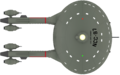
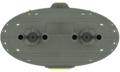
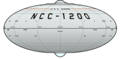 Mann light cruiser class bow view
 -
 Dorsal view
 -
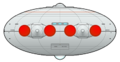 Stern view
 -
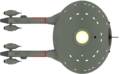
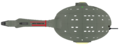 Mann (refit)
 -
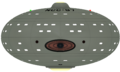
-
-
-
-
 Mann class entering orbit
 -
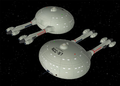 2-view


.png)
.png)
.png)
.png)
.png)

.png)
External Sources
- Vintage Starships: "2208 - Mann" includes 3D views
Notes
- Catullus and Poseidon have NCC numbers that were arbitrarily assigned.