Guide:Marshall
.png)
| |
| Marshall | |
|---|---|
| Class Overview | |
| Category | heavy destroyer |
| Operational | 2156 - 2207 |
| Constructed | 36 |
| Dimensions | |
| Length | 310.0 m (combined ship) 225.0 m (main hull, docking prongs retracted) |
| Beam | 117.0 m (combined ship, main hull) 37.7 m (command/attack hull) |
| Height | 45.5 m (combined ship, main hull) 20.8 m (command/attack hull) |
| Mass | 222,700 mt |
| Performance | |
| Cruise Speed | w 3 |
| Max Speed | w 3.8 |
| Endurance | 6.2 years (standard) 7.5 years (reduced-crew operations) |
| Complement | |
| Officers | 12 |
| Enlisted | 145
|
| Tactical Systems | |
| Beam Weapons |
|
| Missile Weapons |
|
| Shields |
|
| Transporters | 1 GP (4-pad); Mk I |
| Auxiliary Craft |
|
| Historical | |
| Ships of Note |
|
| Canonicity | |
| Design | Spaceflight Chronology, matching art and specifications rather than schematics |
| Name | Spaceflight Chronology |
| History | Spaceflight Chronology
|
Background: Hobbyist's Guide
Just before the outbreak of the Romulan War, Earth government had agreed on the futility of the ongoing attempts at peace overtures with the brutal pirates and other space menaces. Instead, it decided to add an incredibly heavily-armed ship based on emerging engine technology to Starfleet’s arsenal. The finesse of the Triton cruisers would be replaced by brute force, the optimized positioning of components by sturdy structures and heavy bracings. Four prototypes for the class were under construction when the Intrepid first reported on the Romulan raids. When the true extent of the Romulan threat was revealed, these ships had just been declared operational and the UE government immediately mounted an effort to complete ships of this class in greater numbers. In this effort, Andorian, and later Tellarite, economic help was important, a factor that led to strong popular approval on Earth of the proposed interstellar federation with these cultures.
The Marshall class destroyers relied on a Westinghouse twin-chamber, antimatter-spiced fusion reactor, rather drastically different from the unit used aboard the Enterprises. A matter-antimatter ratio of 10:1 at cruise meant huge energy expenditure compared with the Enterprise ratio of 227:1. The SEMT "Everest" coils were of conventional make, similar to the Triton units at 100,000 tons apiece, and offered a cruise speed of warp 3 and a dash speed of warp 3.8. For this dedicated combat application, they were housed in heavily armored nacelles of considerable diameter and the ramscoops were split in two by the robust pylons and canted inwards for whatever stealth and protection this would afford the delicate machinery.
While these systems represented a crude force approach and were soon outdated, the reaction drive was developed to such perfection that no further technical innovations would be needed for some 200 years. Its very narrow reaction engine nozzles were mounted in the fantail between the warp nacelles and combined unprecedented thrust with an emission profile smaller than in any prior design. Ahead of them, the twin powerplant, fuel tank, and adjoining machinery were housed inside a citadel of slanted, polarizable armor plates. In the lower part of the armored hull, a general storage area also featured a shuttle docking hangar, with large ventral entry doors rolling to the sides. The four shuttlepods sometimes gave way to up to six sublight fightercraft, found useful against certain types of Romulan threat.
Four aft-firing defense laser emitters were mounted at the stems of the nacelle struts, one up and onedown per side, and four more in pairs on the main hull top and bottom vertices amidships, all neatly behind standard circular gunports. Two phased particle cannon at the bottom of the aft hull, astern of the shuttle hangar, completed the defensive deterrent. But the main weaponry of the ships was directed forward. At the very bow was a hammerhead shape some 95 meters wide, with groupings of laser emitters, phase cannon, and torpedo tubes to the sides and a docking mechanism in the middle.
The modern command hull of the vessel was sturdily attached to this mechanism, yet was an independent spacecraft on its own right nevertheless, at 104 meters long and 37.7 meters wide, very similar to the business end of a Cavalry. In the event of catastrophic failure to the ship, the crew could be protected by jettisoning the nacelles, ejecting the antimatter, ammunition, and fuel and finally by severing the command hull from the rest of the ship. In theory, the gradual sequence would give the crew time to move into the separable section from their duties in the main hull, although more probably it would doom everybody in case of a rapidly spreading calamity. The main hull was therefore also provided with two rows of lifepods at the leading edges of the pylons and a further row down below, aft of the hangar doors.
Emergency escape or retreat was not the only purpose of the forward section, nor the most important one. Also going by the name "attack section", this unit could engage in atmospheric combat for which the rest of the giant vessel was particularly unsuited. Unlike the Cavalry, it was not burdened with warp coils of its own. Also, its sublight engines were mounted amidships for great agility and liftoff balance and it packed both phase cannon and lasers in abundance. There was an armored bridge atop and a series of folding fins astern. Landing legs and a planetfall ramp contributed to the tactical suite, as disembarking of surface combat teams was a very real option; although exercised at first, it tended to result in 100% casualties and was discouraged for most of the war. The Marshalls seldom embarked MACO teams in any case, any surface sortie thus bleeding the operating crew of the destroyer.

The major innovation introduced on the Marshall ships was the first truly effective operational version of the mass-repelling graviton/subspace shield, courtesy of the Andorian technological aid program. By countering both Romulan missile attacks and EM and particle beams, the shield was considerably more effective than the electromagnetic shields of the Romulan warcraft, which could not withstand kinetic-kill weapons. Attempts to refit this shield to older destroyers were unsuccessful, but the Triton and Enterprise cruisers were able to accommodate the heavy shield generators and thus gained a new lease on life. On the other hand, the Marshall enjoyed an unexpected advantage over the cruisers in featuring a less extensively integrated command and computing structure, making the destroyers more resilient to the Romulan cyber-attacks that caught much of the Fleet by surprise in the opening months of the war.
An incredibly heavy arsenal of warp-phased particle beam cannon (four Type A 125 GW and six Type B 80 GW weapons, rivaling cruiser armament) was carried on the Marshalls, but the primitive shields of the Romulan warcraft proved surprisingly effective against these weapons. It was generally felt that the added cost and complexity of the guns and their massive power systems outweighed their usefulness. All destroyers were crammed with weapons already, so later models eschewed use of phase guns, leaving these destructive but power-hungry weapons to cruiser-sized vessels—and to Starfleet’s one and only cruiser-sized destroyer class. Cruisers would continue to feature these cannon as primary or secondary armament until the advent of modern phaser technology (and so would the Marshall, for a surprisingly long twilight of a respected career).
Four warp torpedo launchers were carefully shrouded by layers of armor at the tips of the main hull hammerhead. Up to 400 shots were carried, not quite as potent as the heavier projectiles of the Enterprises and modified Tritons, but devastating nevertheless when fired in rapid salvoes of four. Romulan projectile weapons remained weak in comparison throughout the war, yet were far from impotent when properly applied. In 2156, the brand-new UESS Patton of Marshall class (NDH-2201) was the first UESF ship to fall prey to the Romulans, yet be able to report of it. The Patton had been patrolling the known Romulan areas rimwards of Triangulum Australe after the transmission of the first Earth peace offering and was attacked by three Romulan ships, apparently a carrier and her two cruiser escorts on their way to Beta Rigel. Perhaps overconfident, CAPT Spadora decided to engage them at low relative speeds and bring his ship’s total firepower to bear on the targets at once. But Romulan lasers swiftly brought down the new shields and two fusion detonations amidships reduced the ship to scrap. The Patton still had time to send a subspace message of the attack, resulting in a declaration of war by Earth.*

From 2156 on, ship after ship of Marshall class tried to push through Romulan defenses to attack their capital ships in numerous major confrontations. Operating in conjunction with Triton (or, if available, Enterprise) class heavy cruisers, and sometimes with older long range vessels, these ships were also essential in deep space operations directed at Romulan staging areas and supplying posts.
But Marshalls were expensive to produce. At the cost of a Marshall destroyer, the Romulans could field twenty small bird-feathered missile boats that could wear down the mightiest of Starfleet vessels before perishing. Desperate for a decisive battle, the UESF sought Romulan centers of production, finding none, and hunted for Romulan carriers, spreading out its forces in the process. Meanwhile, Romulan forces pressed on, threatening Tau Ceti with a daring deep-penetration maneuver and raising concerns about a massive attack on Earth itself. The brief victories of 2159 temporarily halted this onslaught, but did not make the quest for decisive battles any easier.
The war could only end in one way, UESF admirals and generals said: a direct attack at the twin Trianguli worlds themselves, a terror raid that would "bomb the bastards to the stone age", as the strategy was eloquently formulated.
At the conclusion of the Romulan War came the mopping up: the disbanding of units, attempts at locating those declared missing, relief efforts at former war zones—and answering the inevitable secondary challenges from opponents ranging from mere scavengers to opportunistic rising powers. The Federation had to cope with the Tarn, the Vrii, the Naten; history as written in the Federation still does not know whom the Romulans had to face. The challenges were minor compared to what had just taken place, however, and while Star Fleet was running its war legacy ships ragged in the new conflicts, there never emerged good enough a reason to add the costs of re-escalation to the Federation postwar budgets.
Especially the destroyer category of vessels was lacking in excuses for modernization. The aerodynamic Ganges and more vacuum-oriented Cavalries were allowed to deteriorate and then retire, as their warp performance did not permit them to operate on the new frontiers. The Marshall class was forced to fight on, in compensation. And that it did, with just a handful of attrition replacements joining the war veterans in the early sixties before purse strings were pulled tight. Nobody at the time would in their darkest and grimmest nightmares have thought that a follow-on type would not be fielded until well into the next century.
Ten of the Marshalls that survived the war went on serving in the UFP Star Fleet, with NCCs between 29 and 38; eight more continued service in Earth colors. In addition, ten attrition replacements (NCC 39-48) were completed and the class formed the backbone of UFP and Earth defenses against the Romulans (thankfully still the only substantial enemy known) until the introduction of more modern vessels in the size range. Ex-USS Hannibal (NCC-36), which served as Admiral Hamilton’s flagship during the war, is preserved at the Fleet Museum above Earth, partially refurbished to Romulan War era condition (with original NDH-2216 registry) and serving as a war museum.
* Curiously, neither the Romulans nor the newly formulated and not yet completely official Federation Council ever formally declared war. Officially, the fight was between the United Earth Starfleet and space pirates known as Romulans, not between the UFP and the Rihannsu Star Empire.
Gallery
-
 Dorsal with command hull
 -
 Dorsal, with detached command hull
 -
 Starboard, with detached command hull
 -
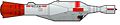 Side view, with command hull removed
 -
 Side view, with command hull removed
 -
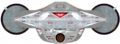 Bow view, with command hull removed
 -
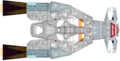 Dorsal view, with command hull removed
 -
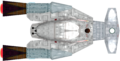 Ventral view, with command hull removed
 -
 Stern view
 -
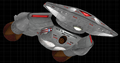 Forward ventral, with command hull removed
 -
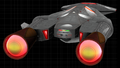 Stern dorsal, with command hull removed
.png)
.png)
.png)

.png)
.png)
.png)
.png)
.png)
.png)
.png)
Star Fleet Registry
- USS (NCC-29)
- USS (NCC-30)
- USS (NCC-31)
- USS (NCC-32)
- USS (NCC-33)
- USS (NCC-34)
- USS (NCC-35)
- USS Hannibal (NCC-36)
- USS (NCC-37)
- USS (NCC-38)
- USS (NCC-39)
- USS (NCC-40)
- USS (NCC-41)
- USS (NCC-42)
- USS (NCC-43)
- USS Marshall (NCC-44)
- USS (NCC-45)
- USS (NCC-46)
- USS (NCC-47)
- USS (NCC-48)
Notes
- Star Fleet ships (derived from The Starfleet Registry):
- USS Stephenson, NCC-26
- USS Russell, NCC-27
- USS Conway, NCC-28
- USS Potemkin, NCC-30
- USS San Francisco, NCC-31
- USS Independence, NCC-32
- USS Kolya, NCC-33
- USS Peterson, NCC-34
- USS Sullivan, NCC-35
- The prefix "USS" has been changed to "UESS" for ships of the United Earth Starfleet.
- The hull numbers of the ten pre-Federation ships in the Timo text above were changed from 34-43 to 29-38. The hull numbers of the ten post-war completed ships were changed from 44-53 to 39-48. USS Hannibal, therefor, had to be changed from NCC-39 to -36. This was all done to support Timo's assignment of NCC-28 to USS Christopher and NCC-63 to USS Pioneer. (There is still some flexibility to move the range towards the Pioneer.)
- The "fighting section" is derived from the Cavalry light destroyer.
- Twenty Marshalls served in the UFP Star Fleet. Ten of them were war veterans, while ten more were nearly completed by the time of the Federation's founding (in late 2161). For some reason, in-universe, these vessels were provided a direct range of standard NCC numbers (29-48), unlike other ships transferred to the new combined fleet. (UESS Marshall, the lead ship, was transferred to the new fleet.)