Guide:Valkyr
_plan.png)
| |
| Valkyr | |
|---|---|
| Class Overview | |
| Category | shuttlecarrier |
| Operational | |
| Constructed | 14 total: |
| Dimensions | |
| Length |
|
| Beam |
|
| Height |
|
| Mass |
|
| Performance | |
| Cruise Speed | w 3 (all) |
| Max Speed |
|
| Endurance | 2 years |
| Complement | |
| Officers |
|
| Enlisted |
|
| Tactical Systems | |
| Beam Weapons | Valkyr:
Titan:
Valkyr refit:
Titan refit:
|
| Missile Weapons | Valkyr refit:
Titan refit:
|
| Shields |
|
| Transporters | Valkyr:
Titan:
|
| Auxiliary Craft | Valkyr:
Titan:
|
| Historical | |
| Ships of Note |
|
| Canonicity | |
| Design | TNG, ST3, Ralph McQuarrie (SFC) |
| Name | Diane Duane, own |
| History | SFC, own
|
When first faced with the reality of the Klingon threat, the UFP Council was at loss of possible
responses. It seemed impossible to build the thousand-ship war fleet requested by Starfleet within
the next five years – the UFP economy could not have sustained a war effort of this scope. Instead,
the UFP Committee of Starfleet decreed that new technological solutions be sought, on the lines of the
recent introduction of forced-intermix antimatter torpedoes and accelerated lasers. Whatever
resources were available would then be poured on these untested designs; the resources would do no
good if wasted on insufficient numbers of tested but outdated ship types.
The success of the Mann class seemed to justify this initial decision. While the economy was being geared up for mass production of these at their time very modern cruisers, Starfleet next chose to go ahead with supermodern warp carriers for sublight fighters, hoping to pit the Klingons against an unexpected type of opponent. The warp carrier had been a primary weapon in the Romulan War, but mainly on the side of the Rihannsu. Starfleet thus did not have much war experience to draw from, which was seen as a blessing of kinds: whatever technologies or tactics would be chosen, they would assuredly take the enemy by surprise.
Scorning the bulky and slow-moving Romulan carriers, Starfleet chose as its goal a warp-dynamic design that combined the proven concept of primary and secondary hulls with new spaceframe shapes. Geering Space Structures was a natural choice for a primary hull provider, having offered stiff competition to veteran yards in recent projects, and representing Earth’s economic interests at a time of crisis where support from outside Sol was far from granted. Geering’s large saucer hull was a simple, lenticular structure relying on internal bracing rather than on the Chiokis stressed-skin techniques, and very much to Starfleet’s liking. Also adopted was an angular secondary hull flattened to the extreme, the prototypes of which had been tested by Geering since 2211. After brief experimentation with subscale prototypes, Starfleet moved on to the full-scale USS Robuste, an ultimately abortive experiment that in her two years of service evaluation (2214-16) nevertheless established valuable facts about the warp dynamics of extremely large structures.
Encouraged by the Robuste results, Starfleet proceeded with procurement of no less than eight vessels. The secondary hull would be extensively trimmed down, whereas the primary one would be adopted unaltered from the Robuste – literally so in the case of the first carrier to be completed. USS Valkyr was laid down in 2217; thanks to the use of modular building techniques and the pre-existing primary hull, she was ready for launching and final arming and equipping in barely two years, despite undergoing further design chances throughout the construction phase. Predictably, this haste in construction led to many early problems in operations.

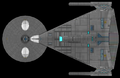
The ‘heritage’ primary hull of the Valkyr was welded of tritanium and plasteel into a perfect lenticular shape, with a bridge module inserted into a cutout at the top and a navigational sensor array into the bottom. Six decks were erected within the 92 m lens, and separate bays built for the computer core, two large flight control centers and a fusion reactor complex for auxiliary power. While the shape was nowhere as stable as the primary hulls of destroyers and light cruisers, Starfleet still judged it sufficient to withstand the aerodynamic stresses of an emergency landing (a ventral-first entry and deceleration followed by transition to edge-on gliding).
The secondary hull was as wide and almost twice as long as the primary lens, but tapered into a small auxiliary navigational deflector and sensor mount in front. The trailing edge featured a large opening for the flight deck, situated between the impulse engine nozzles; three fightercraft or shuttles could take off or be recovered side by side here. Six fighters could be launched at a time from dedicated launch tubes below the opening, even when the mothership cruised at warp. Inside, the cavernous flight deck some 50 m across flared into a series of service docks port and starboard. Elevators aft accessed the launch tubes; elevators forward, a vehicle deck for a broad assortment of ground combat gear. Modular multi-person and cargo transporters were installed forward of the vehicle deck, so that Marines and their vehicles could be beamed down to combat as efficiently as possible. Marine accommodation was above the transporter complex. The outer flanks of the hull were reserved for fuel tanks and ammunition magazines plus flight crew quarters. Two huge cylindrar engine nacelles were mounted on sturdy pylons at the tips of the hull, dubbed the PC-300 and sporting somewhat exotic shrouding systems around the ramscoops, navigational deflectors and field windows to better hide this inherently vulnerable vessel from enemy sensors.
To maximize useable hull volume, main warp machinery was located within the nacelles, with a linear fusion reactor in each nacelle bow, resulting in a very bulky and service-unfriendly system. Secondary power systems were routed through the connecting neck from the saucer auxiliary power units and along plasma conduits on the top surfaces of the secondary hull, to feed the impulse engines and to boost warp plasma feed. While the system worked adequately, Starfleet nevertheless began pouring resources into a system that could combine the warp dynamics of the new carriers with the more practical powerplant systems of the earlier generations of cruisers. One direct result of this research was the Baton Rouge class of advanced cruisers. Improved fusion power/solid-state warp coil propulsion technology was also utilized in the upcoming destroyer generations, and was rapidly becoming the most advanced warp propulsion system of its time in the known space when it got superseded by dilithium power systems in the 2240s.

For close-in defense, the secondary hull was originally dotted with rapid-fire plasma cannon. These were soon removed as inefficient, whereas the big laser cannon atop the nacelles, on both sides of the landing bay door and on saucer top were retained and modernized several times. Electronics were also upgraded no less than eighteen times between 2221 and 2270, when the last of the eight vessels was taken off active duty and partially replaced by modern through-deck cruisers of Coronado class. No shipwide duotronic systems were ever installed, nor were phasers substituted for any of the laser mounts. However, in 2234, two light photon torpedo tubes were added to both sides of the connecting dorsal, and the required antimatter handling systems installed within the dorsal. In an associated power system revamp, plasma conduitry was reinforced to essentially allow the auxiliary reactors to perform as main propulsive powerplants, while the nacelle reactors accepted auxiliary status in cruise mode. The patchwork arrangement was an engineering nightmare and required heavy surface armoring to be battleworthy, but did increase top speed by 0.4 warp factors and gave an appreciable power surge reserve.
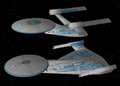
In 2228, the emboldened Starfleet added an enlarged, up-engined variant of the Valkyr design to its inventory. The Titan class of eight featured a drastically lengthened secondary hull that possessed twice the fighter-carrying capacity of the original design. The PC-400 warp engines, mounted lower and closer together atop stronger pylons, received larger if fewer coils in a somewhat more cumbersome nacelle structure. Plasma conduitry was significantly simplified and better buried within the armored hull. Warp acceleration and sublight maneuvering was greatly improved with this modification; even though top speed was reduced, the new ships demonstrated far greater survivability in planetary assault operations. This design underwent a refit similar to the Valkyrs in 2236, and was retired shortly after the original class.
A fleet of twelve carriers was a formidable deterrent thanks to its impressive planetary assault and siege capacity, and in the previous century would have been an effective anti-starship force as well. Unfortunately, the rules of the game had changed. While all ships of both sub-classes saw extensive action in patrol duty at the Klingon front, none actually managed to engage enemy capital ships in combat. To the contrary, a minor raid by three Klingon Raptor corvettes easily crippled USS Hercules (NCC-454), a Titan carrier in maneuvers near Donatu, in late 2229. The fighters deployed by the carrier provided scant protection, and only the intervention of a nearby Andorian missile cruiser and her escorts forced the Klingons to break off their attack. Starfleet’s desperate gamble with the carriers had failed: the offensive might of the carrier fleet was not the answer to the problem of defense. More than 130 lives aboard the Hercules were lost and the ship put into mothballs awaiting possible later repairs and reactivation.
It was to be a long wait. In 2285, in preparation for possible Marine maneuvers against Klingon forces during a period of heightened tensions, two Titans were finally called to duty. The Hamilton and the Ark Royal received minor upgrades to their communications and transporter systems, some fuel lining and power conduit overhauls, and a full if hasty refurbishing of main powerplants. Fusion power specialists had to be drafted from local defense fleets utilizing less advanced propulsion systems than Starfleet main forces, to run the antiquated engines; for example Tellarite engineers were extensively employed in the reactivation program. All weapons were removed as obsolete, and modern tactical craft and fully equipped Marine platoons stacked aboard. No assaults were actually performed, but both ships practiced fleet operations for such a contingency.
Even these two ships were re-mothballed in 2287. Scrapping orders followed in the early nineties; the first ships to go were the ones closest to operational readiness, to comply with Khitomer treaty limitations. The Hypsipyle (NCC-444) of Valkyr class and the Hamilton (NCC-452) of Titan class were spared from scrapping only because they proved practical as orbital storage facilities at the Qualor II fleet depot.
Gallery
-
 Valkyr class
bow plan -
 Dorsal plan
 -
 Stern plan
 -
 Ventral plan
 -
 Valkyr class in orbit
 -
 Valkyr class flyby
 -
 Valkyr & Titan
_plan.png)
_plan.png)
_plan.png)
_plan.png)


Notes
- As Timo's Guide sidebar has the Titan sub-class getting and then loosing the phase cannons before the class was even started, the weapons have no been transferred to the Valkyr sub-class (as per the Timo text).
- The number of provided photon torpedoes was decided as a balance between the overall vessel size and number of launchers, alongside the role of the ship.
- The NCC for Ark Royal was randomly determined within the Titan range.
- The text comment regarding the electronic upgrades has been extended through the 2270 date range for the Titan sub-class. Similarly, the text has been changed to indicate similar but different decommissioning years.
- The image of the USS Robuste is stylistic representation of its construction and is not a true image of the facility that built it.
- Guide: Talion indicates the Talion sublight fightercraft flew off both Valkyrs and Titans.