Guide:Caracal
.png)
| |
| Caracal | |
|---|---|
| Class Overview | |
| Category | command cruiser / attack cruiser / light cruiser |
| Operational | 2189-2239 (2250-2251) |
| Constructed | 16 |
| Dimensions | |
| Length | 197.2 m |
| Beam | 106.1 m |
| Height | 52.0 m |
| Mass |
|
| Performance | |
| Cruise Speed |
|
| Max Speed |
|
| Endurance | 2 years |
| Complement | |
| Officers |
|
| Enlisted |
|
| Troops | Attack variant
|
| Tactical Systems | |
| Beam Weapons | Original:
Refit 2221:
|
| Missile Weapons | Original:
Refit 2221:
|
| Shields |
|
| Laboratories | Command & Attack variants:
Light variants:
|
| Transporters | Command & Attack variants:
Light variants:
|
| Auxiliary Craft | Command variants:
Attack variants:
Light variants:
|
| Historical | |
| Ships of Note |
|
| Canonicity | |
| Design | SSA/Todd Guenther, own |
| Name | SSA/Todd Guenther |
| History | SSA/Todd Guenther, own
|
In the 2170s, the infamous decade of block obsolescence, funds for Fleet expansion were running
low. The grim reality of some 150 truly spaceworthy combat ships, of which less than 40 were of
cruiser size, did not meet the requirements of the newly defined role of the force. Extra cruisers
were sorely needed for effective exploration, but also for defense and support roles, especially as the
design lives of the already grossly overworked Daedalus, Marshall and Almeida ships in the
respective categories were predicted to end within a decade or at most two. Since the results of the
Texas light cruiser program were expected to alleviate the problems, however, other remedies were
delayed till the 2180 defense review.

When the as-such quite useful Texas ships failed to provide sufficient capacity, mainly due to their low speed that translated to low frontline availability, choices had to be made on further procurement. It was generally agreed that the solution lay in faster ships, not in greater numbers of slow ones. Search for a successor to the Enterprise class was ongoing, but a smaller design of equal speed would also be needed. The important decision of balance was made in 2185: Star Fleet chose to procure twenty heavy and only sixteen light cruisers. The first were to follow the technological path opened by the Enterprises; the latter would be of simpler design but modern armament. The modest light cruiser program was given the name Caracal, and initial plans were submitted in early 2187 for approval.
Meanwhile, internal stabilization of the UFP led to an economy upturn that in turn was reflected on Star Fleet funds. Since the basic Caracal design and the number of hulls were already frozen by May 2187, the additional funding allocated for the project was mainly channeled to improved onboard equipment. The crucially important modern PB-14 warp engines got a lion’s share of the funds. The engineers also wanted to test the limits of new materials, however, and the Caracal hull became an ideal springboard for applications. The basically cylindrar structure let the titanium-molybdenum surface take some 50% of dynamic and 85% of static loads, allowing for reduced internal bracing and better utilization of interiors. This construct type was to be further developed for the heavy cruiser project.
Most systems and functions were contained within the eight-deck main hull. Accommodation for 220 crew was provided, as well as ample room for an advanced medical facility and a pair of laboratories in addition to the weapons systems and usual support systems. The ventral midsection was reserved for a compression fusion powerplant. An SUE M-2136 impulse engine assembly, complete with two small auxiliary reactors of its own, took most of the space aft of this, leaving just a small central cavity for a shuttle hangar opening astern. Two groups of three nozzles were used, their thrust fully vectorable by forcefields even past the bulky primary hull thanks to innovative nacelle placement. A ventrally mounted two-deck extension housed e.g. the main deflector and navigational sensor assembly, ventral defense lasers, tractor beam and shuttle hangar support facilities.
The warp coil nacelles were slung low below the main hull, spread by an elegantly curving pylon assembly. The layout produced a flat, agility-improving field, as well as healthy separation of warp coils to increase survivability. High capacity plasma conduits traversed the pylons. Enhanced tubular intercoolers were installed in the nacelle aft ends, compensating for the increased plasma energy levels and freeing some room within the main hull engineering section. Drive plasma purge verniers and flux chillers could be significantly downsized from earlier designs. Total mass per nacelle was roughly 145,000 tons.
However, the pylon arrangement was structurally inferior to the simple straight pylons of earlier cruiser classes, at least with the materials available at the time. While the initial tests of USS Caracal (NCC-750) revealed no problems, significant fatigue was reported on several ships after the first three years in operational status. Apparently, the sublight maneuvering system, which was scaled for the more massive original hull design based on older materials, was tearing apart the new, lightweight and agile ships. Atomic matter piles aboard USS Matanzas (NCC-755) were damaged and a plasma coupling severed during a violent maneuver in 2195; the plasma and radiation leaks claimed fifteen lives. After this, strict flight envelope limitations were enforced on the whole Caracal fleet.
In contrast, warp performance was quite remarkable and the warp engines highly reliable. In the original configuration, USS Saphir (NCC-756) achieved warp 4.9 in post-delivery testing. A powerplant upgrade was performed in 2205, based on research done for the Mann project. The installation of a new type of flux guide enabled the ships to more carefully manipulate their warp fields and sustain warp 4 maximum cruise speed, with surge reserves for acceleration to warp 5.2. Fuel economy was not quite as satisfying, though, and the ships in general did not operate at high warp except in emergencies.
An effective weapons balance was found by downplaying the role of heavy lasers and concentrating on torpedo and particle cannon firepower. Two twin 500 GW phase cannon were installed on the forward hull, offering a somewhat limited cone of fire that was to be compensated by maneuverability. A modular bridge was located at the top of the tapering bow. The three torpedo tubes ran below the bridge and the main cannon, each with double loaders and magazines safely buried inside the main hull. Secondary 750 MW (later 950 MW) lasers were installed on various positions on the hull.
A single docking port was located on Deck 6, where the hull sloped down to the impulse engines. A humble contingent of two to four shuttlepods was normally carried within the hangarette between the engines; minimal service facilities were provided.
After a round of budgetary evaluations in 2188, Star Fleet found it had enough funds to equip a few of the ships far more lavishly than originally planned. The class was thus built in three variants: command cruiser, attack cruiser and light cruiser. The heavy command variant (8 ships) featured the maximum number of weapon systems, including a total of eight defense lasers mounted on various spots of the main hull exterior. She thus provided almost as much firepower as a full-fledged Horizon cruiser, although with smaller energy reserves. However, five of the ships had to make do with reduced-size torpedo magazines due to the voluminous command and control facilities installed aboard. Their principal role was to provide sensing and coordination for destroyer formations. Although the ships were equipped with versatile orbit-to-surface underpylon sensor turrets for battlefield awareness, their secondary role in support of planetary assault operations was relatively seldom practiced.
The attack cruiser variant (5 ships) was dedicated to this type of operations, however. The type eschewed with four defense lasers, and could embark two platoons of Marines and berth four light assault barges below the hull, in a modified ventral extension. Thanks to the M-2156T engine enhancement, she also had the highest impulse performance, especially when not carrying an assault force.
The light cruiser variant (3 ships) carried only single particle cannon mounts and four defense lasers, but was dedicated to auxiliary exploration and support missions with the inclusion of advanced sensors and enlarged laboratory and cargo facilities. The limiting shuttle hangarette reduced exploration potential somewhat, especially compared with the Texas class.
Unexpected drainage of funds to starbase construction and maintenance made Star Fleet reconsider this up-gunning. For a while, the plan was to build only ten Caracals, mostly of the light cruiser variant, since there seemed to be little need for warships in the category of command cruisers. Luckily, if one forgives the expression, the brief emergence of the Romulan threat in 2190 changed this, and all sixteen ships were funded and built after all. Registries for the cruisers ranged from NCC-750 to NCC-765, as Star Fleet realized the originally intended 900-999 niche was too limiting even for 22nd century procurement plans, and the 700-799 one would never be filled with pure survey ships in these political conditions. Indeed, were the Romulans to attempt a breakout, Star Fleet was prepared to build fifty additional units of both Caracal and Texas classes.
The departure from the registry scheme was not completely misleading. Due to the silence of the Romulan front after the brief false alarm, the light Caracals were mainly pressed to exploration duty: although not carrying as much special gear as the Ventures, they could provide meaningful support to the assorted auxiliary cruisers in the efforts to expand the UFP borders of knowledge. Strike cruisers in turn expanded the borders more literally, establishing Federation claim on worlds rimward of the Romulan space. In this mission, USS Audace fell victim to unknown enemies in 2223 – most likely prey to Klingon disruptor cannon. Despite the availability of improved shipboard subspace transceivers, the cruisers spent most of their missions outside realtime communications range, and the disappearance of the Audace was only noticed months after the fact; no flight recorder marker was found. The command variants dutifully served on the Romulan front, efficiently coordinating the movements of destroyer and frigate fleets.
The class received a steady string of overhauls and modifications. After the engine upgrade of 2205, the most important of these was the installation of a torpedo loader system compatible with forced intermix warheads in 2221. The upgrade, based on experiences from the Mann class, was supposed to extend the lifetime of the Caracals beyond the 2230s. The refit got off to a bad start, however: unknown to the public for many years, USS Allegany (NCC-754) was lost in an early test of the antimatter handling systems in 2215. Even though the explosion killed 86 people and ripped open a spacedock on Arcturan orbit, the incident was played down for counter-intelligence reasons and referred to as a problem with the ship’s fusion reactors. This was the last time a Star Fleet Incident Investigation Board would attempt dishonesty on such a large scale, and backlash from the inevitable exposure in 2218 did significant damage to public relations.
The mounting fatalities only harmed the reputation of the Caracal class within Star Fleet, however. Klingons were still suitably impressed by the new warhead type, and it was initially to UFP strategic advantage to keep the Caracals in service, for what amounted to destroyer-level deterrent. The ships still were not what Star Fleet expected of its cruiser force in the 2230s, and relegation to lesser duties was proposed at the beginning of the decade. Fleet disinterest in the proposal did not stem merely from the poor reputation of the class; common sense also dictated that conversions to auxiliary roles be performed exclusively on the more numerous Texas light cruisers rather than be needlessly spread across multiple dissimilar classes. Retirements of Caracals began in 2232, with the last unit gone by 2239.
Despite the logistic considerations, circumstances forced a brief postscript to the Caracal story. In 2250, the decommisioned command cruisers Palomar, Long Beach, Tayi, Dominium and R’Sah-Dan were taken out of reserve to make up for a shortfall in second-tier cruiser numbers. The ships were only minimally refitted for duty as planetary assault command centers in the final campaigns against Klingon-minded pockets of resistance. They were removed from service in 2251 when more modern ships again became available for the role. Several interested parties made offers for ‘efficient disposal’ of the vessels, which ultimately were re-engined for service in the Ktarian defense fleet.
Gallery
-
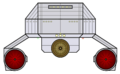 Bow
Bow -
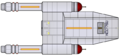 Dorsal
.png)
.png)
Notes
- When Adrasil and I get to this class, I urge going with the rounded look within the Jan 2017 edition of Timo's. Additionally, that version of the ship has very different nacelles than depicted on the "blocky" form of the Caracal.