Guide:Texas refit
.png)
| |
| Texas (refit) | |
|---|---|
| Class Overview | |
| Category | light cruiser / light survey cruiser / commando cruiser / minesweeper / drone cruiser |
| Operational | |
| Constructed | 101 total:
|
| Dimensions | |
| Length |
|
| Beam | 85.3 m |
| Height |
|
| Mass |
|
| Performance | |
| Cruise Speed |
|
| Max Speed |
|
| Endurance | 3 years |
| Complement | |
| Officers |
|
| Enlisted |
|
| Tactical Systems | |
| Beam Weapons | Navigator, Mojave:
Texas (II):
Negev, Duquesne:
|
| Missile Weapons | Navigator, Mojave:
Voyager
Eagle
Texas (II):
|
| Shields |
|
| Laboratories |
|
| Transporters | Navigator
original Mojave
Texas (II), Negev
|
| Auxiliary Craft | standard Navigator, Mojave
Texas (II)
NCC-956
Duquesne
Negev
|
| Historical | |
| Ships of Note |
|
| Canonicity | |
| Design | SFB/Steve Cole & Richard Kerr |
| Name | SFB, own |
| History | SFB, SFC, Voyda McIntyre
|

Starfleet’s three early 23rd century destroyer programs, Kovaris, Saladin and Detroyat, gave the organization a fighting chance against the Klingon menace. The Baton Rouge and Proxima cruisers offered promise of actual qualitative high ground. New sensors, improved antimatter warheads, modern shields and transporters and the possible triumphant return of phased particle beam technology were all promoted as decisive elements in managing the deepening crisis. However, despite the optimistic public face, Starfleet understood very well that its greatest weakness lay in its low numbers. The desperation of the situation is best reflected in the 2228 decision to start refitting old Texas class light cruisers for frontline duty.
Dating back to 2175, the Texas cruisers were inadequately shielded, and had a miserable top speed of warp 4.13, the second decimal being included in official records out of pity. Most were relegated to in-system, sublight patrol duty by the 2220s. Yet thanks to this absence from the front lines, all fifty were still structurally sound and, at 72,000 tons hull mass and 190 m length, offered greater potential for refitting than the newer 50,000 ton, 150 m Caracals. The first vessel to be pulled in for the sorely needed updating was USS Rub al Khali (NCC-926), the former guardian of Vega.
The first order of business was to boost power generation for the needs of the systems soon to be installed. The Fairey FTL-3 reactor upgrade offered more power than the Caracal powerplants, at lower total mass than the original FTL-1 low intermix ratio assembly. Channeling the power to PB-35 engines, fully modern solid-state units of increased field strength (official redline at 1.18 kc, allowing theoretical speeds up to w 9.5 with sufficient power generation and thereby offering significant growth potential), gave the Rub al Khali a supercruise capability and a dash speed of w 5.7. Beam weapons on the primary hull were brought to newer standard yet not altered in placement. Instead, several modern targeting system elements were added at the bow, and long range sensors in the lateral deflector shrouds were significantly improved and increased in number and variety.
Shield generator swap from DS5 to SE standard brought protection to tactically acceptable levels – yet since the existing shield grid served the new generators so well, the engineers saw no need to alter the hull plating. As the polarizer rotors were also retained initially, the Rub al Khali enjoyed two-layer protection. The practical increase in combat persistence in case the main shields failed would have been five to eight seconds; the corresponding psychological value was immeasurable.
Changes to the interior included subdivision of the laboratory spaces to six discrete areas, upgrading of the main Labin-Escher optronic computer core to the Mk 3 standard, overhauling of all secondary and tertiary power grid elements, and a partial aesthetic-functional revamp of corridor and cabin spaces closer to 23rd century benchmarks. The ancient VR interfaces were finally replaced by retina projection displays, and plasma screens by lightfilms. At the relaunch of the Rub al Khali in December 2230, representatives of the media could be given an unashamed and uncensored tour of the vessel.
Conversion of nineteen more units followed. The ships swiftly accumulated an operational record of successful frontline patrol, escort and interdiction missions, alone or with formations of destroyers. Even more to the public’s liking during the uncertain thirties were survey missions securing new resources for the Federation. With five hundred planets and sixty-nine member societies already under its wing, the alliance sorely needed every possible benefit the federal government could offer. The members themselves began to have different views of their needs, and mere promise of military protection no longer was sufficient to hold the Federation together – especially since the effectiveness of that protection had now been so visibly challenged by the Klingon Empire.
Due to the surprisingly good performance yet high costs of the Rub al Khali refit, a further twenty-three units were ordered in 2233 as newbuilds. USS Navigator (NCC-950) spearheaded the batch in 2236, and donated her name to the entire subclass soon thereafter. The naming scheme now moved away from the wastelands and deserts of Earth, to more esoteric directions. The mission class designation of four specially-equipped ships was also adjusted, to ‘light survey cruiser’, even though the upgraded design was far above an auxiliary cruiser in capabilities. Of these, USS Voyager (NCC-974) was the first to be completed, converted from the much-abused USS Alaska by introducing larger holds, better-equipped laboratories and more versatile sensor suites and by removing one torpedo tube. She thus became the ‘sub-subclass’ namesake, with the other conversion Viking (NCC-962) and the newbuilds Deerslayer (NCC-963) and Orleans (NCC-966) following soon thereafter.
A special operations support vessel or ‘commando cruiser’ was also introduced, in the form of USS Eagle (NCC-956). The vessel carried warp-to-warp transporters, assault shuttles, atmospheric-tuned lasers and a single stun-type phase cannon, and had several low observability features and covert surveillance capabilities that still remain classified. She was also reputedly capable of tactically meaningful planetfall and takeoff, unlike her clumsier sisters for whom the latter feat involved considerable time and anguish. A supposed decommissioning in 2248 and the subsequent transfer of the name to a Constitution heavy cruiser were but counterintelligence ruses; the actual retirement date of this vessel is unknown, as is the extent of upgrades performed on her. Her known service record includes Operation Grey Ghost, Starfleet’s 2276 adventurist Romulan expedition, which also became the last hurrah for half a dozen other Navigators from the border fleets.
A further thirty Texas hulls still remained unconverted and, for the time being, inactive. Questions and suggestions regarding the status of the vessels were seemingly ignored by Starfleet. In reality, intense planning was underway for converting the light cruisers for dilithium power. In 2241, such plans could finally be made public, and USS Mojave (NCC-927) was the first vessel to receive the FWB dilithium reactor and matching PB-45B solid-state engines. The mass penalty was worth paying: warp six cruising and warp 7.5 dash speed brought the light cruiser on par with Starfleet’s most modern types. The conversion process was found to be especially awkward and costly, however, and the funding for a total of thirty refits was redirected at 23 newbuilds instead. Although this number exactly avoided overlap of registry numbers with the Horizon class, Starfleet officially quoted less frivolous budgetary and tactical concerns for the procurement decision. Yet a certain degree of arbitrariness was involved when, for a change, the name of the converted ship was chosen for the subclass.
Few system upgrades were performed in the refit or introduced for the newbuilds, and few frontline duties were assigned in the conflict of 2241-2245 as a consequence. Substitution of phaser armament in place of the laser cannon in 2259-60 required a host of modifications and upgrades, however: duotronic computers and new targeting scanners, reinforced second stage plasma conduits and reconfigured power distribution systems were introduced, at a cost almost as high as that of the original dilithium refit. The design still stayed in budgetary favor in the post-Axanar decade of relative peace, thanks to its inherent exploration prowess.

The greatest hour of the Mojave class coincided with the return of the Klingon menace, yet did not involve combat with Klingon adversaries. Throughout the early 2260s, these vessels were tasked with what the politicians back on Earth fondly called the best crusade: an intense hunt for Orion pirates and slave traders. While most of Starfleet was tied up with the increasing tension on the Klingon border, the outdated second-line combatants did their best and beyond in executing the new active anti-piracy policy. Virtually every light cruiser in the force got to participate in searches, arrests and sometimes in heated battles with pirate forces. Most engagements took place in deep space in the Rigel sectors, pitting single light cruisers against often grossly superior vessels. This in turn required superior command skills from the Mojave captains.
Deep space duty quickly wore down the engines, reducing cruise and top speeds to warp 5 and ‘at the captain’s discretion’, respectively. Active operations everywhere were discontinued soon after the Klingon cease-fire of 2267. As the 2270s approached, and the Organian peace appeared to hold for the time being, the light cruiser force was allowed to dwindle rapidly. The surviving Navigators, definitely no longer representing ‘sensitive technology’, were generally sold abroad to allies of secondary import, but most of the Mojave units were floated directly to dismantling yards. The colorful history of the latter subclass was not completely over yet, though. The Duquesne and the Pacific, having survived the pirate hunt virtually unscathed, were reactivated and converted to drone control platforms in the 2280s. The Mojave herself became the sole museum specimen for the entire Texas family in 2277, refurbished for the role after a decade of bitter preservation battles. The Sutherland, destroyed in the Ghioghe crisis, is immortalized in a different way, being remembered forever as the first independent command of the legendary Starfleet hero James T. Kirk.
The final major upgrade performed on the light cruisers was the conversion of 26 of the remaining original standard vessels to phaser-armed, PB-45E-engined dilithium cruisers in 2258-60. The resulting Texas (II) subclass would score two important victories. The first, in which the titular vessel defeated a Klingon D6 cruiser at Iota Eridani in early 2260, made possible the second, in which the subclass triumphed budgetarily over Amchitka/Kearsarge procurement. The more durable coils of the E model engine admittedly provided a slight speed edge over the original Kearsarge. Yet in terms of overall performance, the Texas offspring remained humble vessels, only useful in second- or third-line duties. It was only through lesser structural fatigue that the Texas (II) units managed to outlast their elder sisters, and even then only by less than a decade.
Behind even Texas (II) in prestige were the unrefitted units. Eight were brought out of mothballs in 2262 and converted to Negev minesweepers; although PB-45E propulsion was retrofitted for commonality reasons, maximum performance was limited to warp 7.0 due to neglecting of relevant SIF upgrades and the desire to minimize power signature without investing in advanced masking technologies. Six more might have been turned into assault transports if not for Organia, yet others into escorts if not for the much cheaper Remora class. The brief tightening of the budgetary screw in 2287 was required before Starfleet finally agreed to scrap all remaining Texas spaceframes. The Duquesnes were retired in 2295. The Negevs held on the longest, and were used for mopping up the Tomed disaster zone in 2311 before deactivation.
Notes
- The dates of the "conflict" have been changed to match game-canon's 2241-2245, from the text's 2246-2250.
- The decommissioning of the Negevs is presumed to be in 2312, as the text only mentions 2311 for their use in the Tomed incident.
- The construction period of the Navigator sub-class is extended to 2241, as 2236 (the original construction end year) is also the year USS Navigator itself was completed.
- The Voyager sub-class is being added, wedged in-between the Navigator and Mojave ones, to match the text.
- Navigator numbers were reduced to account for the 2 refitted and 2 new-build Voyagers and the one new-build Eagle.
Gallery
-
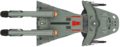
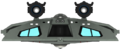
 Bow
Bow -
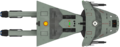
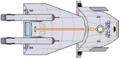 Dorsal
 -
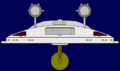 Stern
Stern
.png)
.png)
.png)
-
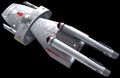 Dorsal view
 -
 Dorsal bow view
 -
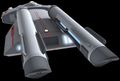 Dorsal stern view
 -
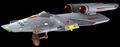 Port view
 -
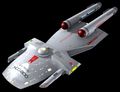 Port dorsal view
 -
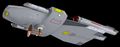 Port ventral view
 -
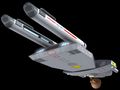 Starboard ventral view
.jpg)
.jpg)
.jpg)
.jpg)
.jpg)
.jpg)
.jpg)
-
 Unidentified variant
 -

-
-
-
_alt_(stbd).png)
_alt_(bow).png)
_alt_(dorsal).png)
_alt_(stern).png)
_alt_(ventral).png)