Guide:Constitution
.png)
| |
| Constitution | |
|---|---|
| Class Overview | |
| Category | Heavy cruiser |
| Operational | 2241-2279, 2286-2289 |
| Constructed | 36 total
|
| Dimensions | |
| Length |
|
| Beam |
|
| Height |
|
| Mass |
|
| Performance | |
| Cruise Speed |
|
| Max Speed |
|
| Endurance |
|
| Complement | |
| Officers |
|
| Enlisted |
|
| Passengers | 222 (cadets, NCC-1371)
|
| Tactical Systems | |
| Beam Weapons | Testbeds/ Republic prototype: n/a Constitution prototype
Standard; NCC-1017, 1700, 1371 (operational)
Constitution Flt II, Bonhomme Richard ("Type 1")
Bonhomme Richard (Type 2), Constitution Flt III, Victory
Bonhomme Richard (Type 3)
NCC-1371 (training ship)
|
| Missile Weapons | Testbeds/ NCC-1371 (prototype/training ship): n/a Standard; NCC-1017, 1700, 1371 (operational)
Bonhomme Richard, Constitution Flt III
Victory
|
| Shields | Testbeds/NCC-1371 (all standards)
later standards
|
| Laboratories | Testbeds/Prototypes
later standards
|
| Transporters | Testbeds/Prototypes
later standards
|
| Auxiliary Craft | Testbeds/Prototypes/NCC-1371 (all standards)
NCC-1700 (operational standard)
Standard
|
| Historical | |
| Ships of Note |
|
| Canonicity | |
| Design | TOS, ENT |
| Name | TOS, Franz Joseph (Star Fleet Technical Manual), Todd Guenther (Ships of the Star Fleet, Volume One), FASA |
| History | TOS, Todd Guenther (Ships of the Star Fleet, Volume One), FASA |
| Delta Dynamics | SRM #298 |
Background
Hobbyist's Guide

In the early 2240s, the Constitution class heavy cruiser program could easily have been considered a spectacular failure. More than twenty years behind the schedule, five times past the budget, the behemoths taking shape in distant construction yards were apparently hidden from publicity because of the embarrassment of major program setbacks. Hull components were reportedly being gleaned from past shipbuilding programs, two decades out of date. Yet, those who had seen the Bonaventure demonstration knew better. What was emerging was nothing less than a revolution in spaceflight, the first operational incarnation of Project Starship.
The basis of the new cruiser design could be found in studies made way back in 2210 for an improved Horizon-size cruiser. Undisturbed by the poor propulsive performance of the Indomitable battle cruiser upgrade, Chiokis had promised that combining a Horizon secondary hull with the company’s trademark saucer section and modernized engines would result in significant warp performance increases. In 2222, Star Fleet had granted Chiokis the use of two relatively low-fatigue Horizons; first USS Constellation (NCC-1017), which had suffered major battle damage to her bow structures three years earlier, and later also USS Republic (NCC-1371), the victim of a rampant internal fire and extensive contamination from fire suppressants shortly after her commissioning. Their command saucers, as well as their mounting structures, the navigational deflectors, and the main weapons array, were removed.
After two years of iterative design effort, Chiokis managed to mount a new connector structure to the engineering hull, making possible the attaching of a new command section in the most optimal position for hull and warp field interaction. At first, mere placeholder hulls were used for dynamic testing, and no actual ship’s systems were installed. The warp engines were removed from pylon stems outward, and new, long and spindly yet immensely strong pylons mated to the respective positions on the hull; then, structural testing was performed with a pair of inert engine nacelles. All Horizon weaponry was naturally removed from the secondary hull prior to refitting.
In 2226, after favorable yet badly delayed test results, the Constellation received a finalized version of the primary hull and the first set of PB-30A third-generation nacelles with massive ramscoops, finlike intercoolers, and extremely modern and hideously expensive 17-section, solid-state warp coils. Drive plasma was channeled from an advanced compression fusion main powerplant in the engineering hull, the largest yet built, and the ship set sail for early trial runs.
Results from early trials dealt a major blow to Chiokis. Apparently, the hull form did not agree with optimal warp fields after all. Inaccurate (indeed, outright faulty) computational models had failed to predict a potentially disastrous resonance that could be generated in at least three locations, namely the saucer topside and two areas aft of the secondary hull bottom vertex. Solutions were sought using further computer simulations, subscale models and a structural test article for a remodeled secondary hull. Economics precluded the altering of existing Horizon hulls, so Star Fleet suggested that Chiokis leave the designing of an optimized configuration for a future production batch and proceed with the existing hardware in the meantime. Despite this, precious time had been wasted, especially as it was in 2235 finally shown that the Horizon hull configuration was perfectly use-able with a slight altering of engine placement. Computer models of warp dynamics in the 2230s simply were not up to the task of accurately predicting such solutions – only the test flights of the Bonaventure finally verified the results.
By 2238 the program was back on track, with a crucial improvement: a dilithium-regulated antimatter reactor had been substituted for the original 4:1 m/am spicing, compression fusion powerplant. As design details were being finalized, USS Constellation was reactivated as NX-1017. The Horizon type secondary hull was used as intended, yet its structural interfaces modified, now featuring reshaped and lengthened engine pylons for the PB-31 engine, and a strengthened connecting fin for mounting the primary hull. The streamlining of dorsal superstructure immediately below the bridge was also performed, while the development and installation of a new lower-profile bridge module was dropped for budgetary reasons. The test runs with this vessel were successful, and the pre-production standard (still lacking main armament) was—in essential parts—applied on USS Republic as well, validating all construction machinery and methods. Based on this finalized design, Star Fleet dockyards in May 2239 received a go-ahead for a production model of the new heavy cruiser class.
It took some 36 months to complete USS Constitution (NX-1700). In the meantime, refitting of Baton Rouge cruisers with the new power system gave Star Fleet confidence in the dilithium-based technology, as well as a much-needed breather in the struggle against the Klingons. This by no means amounted to a cease-fire; xenoanalysts expressed doubt as to whether the Klingons even recognized such a concept. In February 14th, 2242, a distress call from the Donatu system sent Star Fleet scrambling for ships to defend the frontier colony. A piecemeal battle of attrition developed, claiming the cruisers Endeavor and Yorkshire before Star Fleet’s trump card could be played. Hastily diverted from an evaluation cruise, the Constitution fought off almost single-handedly a succession of D5 and D6 battle cruisers, buying time for the main contingent of Star Fleet reinforcements to arrive.
The badly hurt starship would spend three long years licking her wounds, while Star Fleet reconsidered its investment – and the San Francisco dockyards toiled on an improved cruiser that featured the wider secondary hull after all. Other long-delayed improvements included a more capable impulse engine and radically improved torpedo armament and computational systems. This was to be the definite production standard: USS Enterprise (NCC-1701) was a nearly 700,000 ton vessel capable of warp 6 cruising, armed with heavy lasers and a mixture of phased particle cannon and torpedo systems and the latest-standard shields, and equipped with hypermodern sensors and navigation equipment. The official launch for the vessel came in 2245, and commissioning ceremonies were held almost concurrently with those of the Constitution.*
The Constellation was reworked close to this production standard as well, in order to establish the costs and difficulties of altering the Horizon hulls. Both proved quite prohibitive, and Chiokis had to abandon the plan of using Horizon components for further cruiser production. The Republic received a far less extensive overhaul and was utilized in defensive missions until relegated to training duty in 2248. The remaining badly outdated Horizon class vessels were in turn all retired by 2249, as Star Fleet was fully convinced that the new cruiser class would be a perfect replacement for them.
There was some debate as to which of the four ships initially completed would have the honor of becoming the class ship. The working name, ‘Project Starship’, had been used on the dedication plaques of the two Horizon conversions, and was applied as a placeholder class name to the first two production ships as well. The third newbuild off the dockyards, USS Farragut (NCC-1702), was thus the first to carry the official nomer of ‘Constitution class’.
Once the agonized development and prototyping stage was over, the veil of secrecy was finally lifted from the Starship design. Official commissioning ceremonies for the initial four vessels were public events and propaganda triumphs for Star Fleet, and extensive onboard tours were provided to UFP representatives and dignitaries. Procurement of twelve production models was secured largely thanks to the unconventional yet thorough demonstration cruises arranged by CAPT Robert April, commander of the Enterprise and strong proponent of her use in expanding the nonmilitary role of Star Fleet.
The finalized Constitutions incorporated two hulls of roughly equal volume but different configuration and role. The primary saucer hull contained main crew quarters, weapon systems, sensors and multiple laboratories as well as impulse engines, and the ovoid secondary hull housed engineering facilities, the shuttlecraft hangar and some redundant habitation and research functions.
The two PB-31 warp nacelles were mounted on exceptionally long, straight Bonaventure-style pylons extruding from the top of the secondary hull in a side angle of about 45 degrees, far enough from the crew compartments to protect onboard personnel from the effects of the field and to ensure unobstructed jettisoning. The actual reasons for this placement were dictated by warp field geometry, though, and Star Fleet even issued multiple statements reaffirming the safety of the more traditional nacelle configurations. The coils of the production model were certified for warp 6 cruising and a top speed of warp 8 with dilithium-regulated, total-conversion antimatter power – fusion power was no longer available for warp propulsion in this or later designs.
On top of the saucer was the main bridge of standard Class One design, well protected by the forcefield shields and an outer buffering shell of sensor access spaces. Below this was a two-deck weapons station. Originally intended to hold two to four Saladin-type Mk 1 photon torpedo launchers, the station instead came to feature forward and aft particle cannon; later variants that eschewed with these weapons substituted other facilities, typically including a laboratory complex and a scientific airlock. The torpedo system was still included at a corresponding ventral saucer position, and provided the second spike of the deadly trefoil of the superships. On the widest levels of the saucer were crew facilities, with sickbay, auxiliary control and the computer core best-protected in the middle. The extreme bow held a multi-emitter secondary navigational deflector, as in other Chiokis designs.
Two twin projected-energy weapon banks at the top and one at the bottom of the saucer comprised the standard main armament of this type, originally featuring 4 GW lasers. In a sense, referring to this final component of the trefoil as the ‘main’ armament is misleading, since the phased particle cannon and the improved photon torpedoes actually offered greater destructive potential against most targets. Yet starship captains generally preferred engaging the enemy with lasers whenever possible; and when phaser VII banks in the 2250s replaced the lasers, the saucer emplacements indisputably secured their position as the main combat system of the cruisers. Nonstandard weapon fits were common, even more so than ‘standard’ weapon complements. For example, USS Republic retained laser armament until her deactivation in 2257, mainly due to her training ship status, and was stripped of energy weapons altogether with her reactivation for school ship use in the late 2280s, save for a single saluting gun.
At the aft end of the saucer was the impulse engine unit, in NCC-1700 essentially a Saladin SBE impulse system with four accelerator coil assemblies placed together. From NCC-1701 on, the system was scaled up to almost double the original size and power, to the SBA standard, firing through only two forcefield-vectorable nozzles. Two fusion generators provided both auxiliary power and helium propellant. Main power came from the antimatter reactor via a primary power trunk on connector fin trailing edge, but limited impulse power was available even when mains were off-line.
The secondary hull front end was reserved for the powerful primary navigational deflector system. The compartments behind this featured engineering subsystems, main engineering with the still highly classified dilithium reaction chamber, multilinear antimatter bottles, and a large shuttle landing bay and hangar. The latter facility was considered something of a relic when the first ships were completed – it was originally intended as a flight deck for defensive sublight fightercraft and various shuttles, but the former were already obsolete and the latter were to be replaced by transporters. Later, when the persistence of transporter technology limitations despite the duotronic improvements became obvious, the engineers would congratulate themselves for being farsighted enough to retain the hangar. Indeed, a variant would later be built with a ‘through-deck’ shuttlebay for carrying of fighters, assault shuttles and miscellaneous auxiliary craft.
Several laboratories were located around main engineering, forward of the shuttle hangar; workshops were clustered below the hangar. At the bottom of the ship were antimatter tanks refuelable and jettisonable through access doors on the ventral surfaces, and the main tractor beam assembly. In a mid-2250s refit, select vessels would receive two aft-firing torpedo launchers in specifically prepared compartments above the shuttlebay, while twin phaser emitters would appropriate some of the space originally reserved for an auxiliary cargo hold in the fantail. These weapons were intended to help cover the blind spots not within the cone of fire of the ventral primary hull phaser bank, and to compensate for the lack of heavy rear armament created by the omission of rear particle guns. However, they never really proved satisfactory in solving the blind spot problem; future designs derived from the Constitution class would feature phaser emitters atop and at the bottom of the secondary hull for a better overall solution.
Since the Constitutions were the fastest ships available, they were given facilities to respond to all kinds of emergencies on the remote colony worlds they were to protect. Thus, capacious holds in the secondary hull usually held everything from genetically improved grain seeds to temporary habitats and atmospheric regulators. The ships could be let to conduct colonization missions because, for the first time, they would have the speed to respond to more urgent military crises elsewhere. The element of ‘bringing in the reinforcements’ was thus reintroduced to space combat, as demonstrated dramatically at Axanar.
The Constitution class was upgraded and overhauled several times; in the 2250s, a major upgrade was accompanied by the fielding of fourteen newbuild ships, the first of which was USS Bonhomme Richard (NCC-1712). The main systems to be upgraded were the early PB-31 engines, replaced by PB-32 mod 3 units. Lasers were replaced by Type VII phasers, emitter by emitter. The early Lockheed 447 series units were rather unreliable and delicate pieces of equipment that could seriously overheat after just two or three shots. As the Agusta RI series became something of a fleetwide standard, RIN-8 was considered for the heavy cruisers as well. Such plans never bore fruit, however: the necessary physical modifications, either to the integrated, closely spaced twin emitter assembly or to the more widely separated weapon berths of the ship, were deemed prohibitively expensive.
The separate particle cannon were removed, the loss more than compensated by installing a six-tube Selenia ‘Wolf’ Mk 2 photon torpedo battery on Decks 8 and 9. A few years later, the ships received the Mk 12 upgrade, introducing loaders compatible with improved direct-annihilation warheads. Select units were also given additional phaser coverage, in the form of two single phaser VI emitters at the bottom of the secondary hull; these compact, modular weapons were referred to as amidship phasers. Although Star Fleet also experimented with installing emitters on the superstructure below the bridge, only the amidship phasers went on to become a permanent fixture of future starship generations.
The Bonhomme Richard configuration was found highly satisfactory in all respects; so satisfactory, in fact, that further upgrading of the Baton Rouge-era cruiser fleet was discontinued, and two more Bonhomme Richards completed. Also, all the surviving first-batch Constitutions except the Republic and Potemkin went from original standard through three or four routine overhauls to Bonhomme Richard standard. Finally, the commonalized fleet was in the mid-2260s reinforced by six vessels known as the Victory (NCC-1760) subclass, featuring every possible element of the ‘optional’ upgunning and going straight to the TacFleet special military response force. An accompanying battle cruiser modification with sturdy horizontal pylons and a significantly increased torpedo armament, the Richelieu (NCC-1750), was abandoned without any keels laid, however.
During the fifty years of conflict with the Klingons, a total of 35 heavy cruisers of the Constitution family (plus 13 export variants of the slightly less capable Achernar standard) were thus completed for Star Fleet and its allies. Of these, six were lost in action and a handful of others damaged but later salvaged. The ill-omened Valiant was the first to go, following her three immediately preceding namesakes to ‘missing in action’ records just eight months after her commissioning. Ten years later, the Farragut lost almost half of her crew to a barely physical yet utterly lethal lifeform. Yet the successes of the exploration program offset the defeats, and deep space sorties continued uninterrupted.
Fate was kind to the cruisers again for a decade thereafter, but took cruel vengeance on the original Constitution batch in the first year of Organian peace. The Constellation and the Intrepid were attacked by leviathans of possible extragalactic origin, and the Excalibur devastated by a bizarre computer malfunction during wargames. The crew of the Exeter was all but wiped out by a deadly pathogen; the intact but contaminated vessel had to be withdrawn from service. The Defiant and the Rivoli were subsequently lost in TacFleet service at the rimward frontier, and the Kongo would yet suffer a crippling onboard explosion in 2277 – but surprisingly, none of the Constitutions was ever destroyed by Klingons. Space proved to be dangerous enough even without this menacing enemy. The McLaren administration, already wary of increasing Star Fleet expenditures, considered the losses indicative of a misguided exploration policy, and major cutbacks were suggested and in some cases also effected in the late 2260s. Fleet Admiral Heiharchio Nogura, veteran of the prolonged Klingon conflict and strong proponent of the Constitution exploration program, resigned in protest.
There were valid arguments against the program, however. More and more power was being concentrated on starship captains distanced from the councils of the Federation by gulfs of space and ideology. Moralizing, even patronizing, attitudes towards less driven cultures were assumed, and a type of techno-protectional imperialism began to grow within the ranks of Star Fleet. Several captains of the new starships grossly exceeded their authority, bending the letter and defying the very purpose of the protective Prime Directive adopted early on in UFP history. This could be seen as an effort to forge a closer union with near-human races, a natural counter-reaction in the aftermath of Axanar. On the other hand, this protectionism was also an important factor in quietly establishing Earth as the political and economic ‘strong man’ within the Federation, while officially following the principles of ‘one world, one vote’.
Central to all these arguments was the fact that the Constitutions represented a quantum leap in power, speed and range – a leap so great that they could not help but shape anew the goals and policies of the UFP. Indeed, it was the ultimate success of the exploratory program, embodied by the heroics of surviving starships Enterprise, Hood, Lexington and Yorktown, that finally prompted the McLaren administration to agree on the extensive refit project that would in the early 2270s introduce the LN series of linear engines and ultimately reinvigorate the entire Star Fleet.
*Hidden from the public eye, NCC-1701 had already performed a covert mission in the direction of the Romulan border. This apparent validation run of engines and navigational system is rumored to have included weapons testing as well, but full details are yet to be released as of 2375.
Delta Dynamics
Development
Constellation (NX-1017) fusion testbed
The challenges encountered during the operational lifespan of the Horizon heavy cruiser and its variants are provided in that series of articles. However, the 2210 failure of the dual SSWR-IX fusion reactors to reliably power the ginormous PB-19 nacelles into supercruise ranges was not seen as a block to developing a class of cruiser that could not only match the increasing Klingon threat, but surpass it in combat. Up-and-coming Andorian-based Chiokis Starship Construction Corporation promised the Horizons could be modified with their newly developed saucer hull and modernized warp nacelles to achieve the speed performance such a vessel would need in order to respond promptly to varied threats and requirements associated with the expanding Federation borders.
In 2222, Star Fleet provided two low-fatigue Horizons to the shipbuilder, with the presumption they would have these heavy cruisers, developed under the classified term “Project Starship”, by the end of 2225 at the latest. Operational plans were already being drawn up to employ these yet-undefined super vessels throughout the Federation and its territories; Star Fleet’s plans would remain largely unfulfilled until 2245. However, progress—even when languid and uncertain—was being made over those 23 intervening years.
USS Constellation (NCC-1017) had suffered major battle damage to her bow structures in 2219, while USS Republic (NCC-1371), newly commissioned, had received heavy internal damage in the bow from a large, rampant fire that was largely unimpeded by the damage control efforts, though with considerable contamination from the ineffective usage of fire suppressants. Despite the respective lightyears of distance and calamities suffered, the ships overall were still seen as viable platforms, with little structural stress of the secondary hulls. The bow saucers and their mounting structures, navigational deflectors, and weapons arrays were all removed, leaving two headless warp bodies floating in their remote drydocks.
Primary developmental focus was on the (former) Constellation. Republic would be saved to recreate the final design as a method of developing procedures for upgrading the rest of the Horizon family to that standard. Constellation, however, would be the proverbial guinea pig that would lead to the final design. After years of considerable effort, a non-functional saucer and connection neck were gamma-welded onto the forward dorsal of the engineering hull so that dynamic testing could be undertaken. Computer simulations of the conjoined hulls were also conducted, with various real and hypothetical warp nacelles indicating their interactions against the hull surfaces.
In 2226, the ideal nacelle for the original pylon placements was realized: the third-generation PB-30A, with much more petite—though longer—pylons placed on the original respective hull mounts and at the same angle. An extremely large but advanced compression fusion powerplant was installed in the engineering hull and a relatively non-descript but fully-functional saucer, with an advanced impulse bank, replaced the dummy one. The ship was alive once again.
Unfortunately, the trial runs proved rather disappointing. Potentially disastrous resonances were detected in three different locations—one for the saucer, two for areas under and behind the secondary hull—that had not been anticipated by the preceding computer simulations. Apparently, the metrics gathered by the sensors suggested several possible solutions, including major modifications to the engineering hull, a path Star Fleet sought to avoid for both economical and scheduling reasons. However, additional testing of differing nacelle placements could still be pursued. Also, there lay the possibility of newbuilds, which would allow the Horizon class to remain fully functional in the meantime. Chiokis was authorized to begin parallel studies.
_(stbd).png)
_(bow).png)
_(dorsal).png)
_(stern).png)
_(ventral).png)
Constellation (NX-1017) dilithium testbed
By 2238, the Federation’s first natural dilithium source on Deneva was in the opening stages of full mining and refining of the most critical component of a truly efficient annihilation core, with Star Fleet’s Project Starship a targeted recipient. The NX Constellation had the previous 4:1 matter/antimatter spicing compression fusion powerplant replaced by a custom-fitted dilithium-regulated antimatter reactor and the ship was formally re-activated (though not yet re-commissioned) as NX-1017.
The Bonaventure flight tests had determined the optimum nacelle placement for a resonance-free flight test and the new dual PB-31s were placed in positions elevated and further back than the PB-30As utilized during the fusion testing phase. The pylons were reshaped and lengthened, as was the saucer’s interconnecting dorsal, which added considerable internal volume for machinery, laboratories, and workspaces. The Constellation remained an experimental flight platform, so was equipped with defensive and navigational deflectors, but no weapons.
The test runs were considered successful, a major confidence boost for the collaborating teams. As a result, the Republic was towed into the refit yard to closely track the changes that would be necessary to upgrade the remaining Horizons to similar standards. Concurrently, a new-build prototype (Constitution) was ordered, as there was considerable faith that the ships were far more capable than had been envisioned necessary in 2210, and thus the expense of greater numbers would provide far more utility.
_(stbd).png)
_(bow).png)
_(dorsal).png)
_(stern).png)
_(ventral).png)
Prototyping
Republic (NX-1371) production prototype
With the success of Constellation’s flight runs, ex-Republic was brought into the refit yards as a final examination of the feasibility of converting other Horizons to the new heavy cruiser specifications. She had been inactive since the conflagration in 2222 and floating lifeless without the forward command saucer and mounting structure. The yard completely stripped what remained of her internal spaces and a dilithium-regulated antimatter reactor (similar to that of her sister) was embedded in her newly-redesigned engineering spaces. The yard workers leveled off the upper slope of the secondary hull, placing a domed structure in its place—ribbed for added stress tolerance—with a limited-capacity shuttlebay immediately aft of amidships.
Pylons supporting PB-31s were gamma-welded into the Bonaventure-proven configuration for maximal warp efficiency and a pre-manufactured custom saucer, with a less extensive interconnecting dorsal (in comparison to the Constellation) mated in the upper forward position. The profile, now suggesting only slightly her Horizon origin, gave the Republic a personality not just re-designed, but reborn. Where aficionados of the older class described a ship always surging forward even while at rest, the Republic was said to project a grace of stately power, seemingly always in a peaceful condition even when moving at high warp.
In 2238, she began her flight tests, unarmed but well defended with a conformal forcefield and a large deflector dish forward of the secondary hull. Astern, the subspace displacement monitor array relayed the detected warp field results not just to engineering consoles within Republic, but also to the trailing starship and the operations office back at the yard.
The Republic design team was rather confident that, of the two differing ships, theirs was the one that would seize the production standard. Afterall, if the economics bore out, there were at least ten more ships that were ready to be converted and the Republic project detailed just how that was to be done.
.png)
.png)
.png)
.png)
.png)
Constitution (NX-1700) production prototype
Emerging technologies had jump-started Project Starship—the intended plan to rejuvenate the primary fleet of Horizon class heavy cruisers—though missing the target timeline of the mid-Twenties. By the late Thirties, the fully-emerged technical achievements, as well newly discovered sources of reliable power, had allowed the entire concept of heavy cruisers to leapfrog ahead. All indicators pointed to a ship-of-the-line that was far more capable than originally conceived, one capable of area domination and not just simple projection of power.
Based upon the finalized form of the Republic, along with a few innovations slipped in, Constitution (NX-1700) was authorized for construction as a prototype in May of 2239. As with her transitional sister, every detail of construction was precisely logged in order to increase the efficiency and economy of mass production of the later ships at multiple shipyards.
The Chiokis saucer from the Siva subclass was adopted; though the saucer was less voluminous in internal space, the embedded deflector plating was well-tested and highly expected to fare well in combat situations. While the heavy cruiser design was envisioned to have far more personnel aboard than the destroyers, they would make up for the reduction in space (compared to the Republic) by triple-racking the enlisted personnel assigned living quarters in the primary hull. Additionally, the saucer already had a triple-set of auxiliary navigational deflectors in the forward array, a feature considered rather important with the average velocity the vessels were expecting to maintain. The saucer’s triple-ported impulse engines provided almost 8% more thrust than the Republic’s quadruple set, due to the efficiency of the more compact design. A strengthened interconnecting dorsal provided additional comparative space, some of which was assigned to living quarters, with the remainder to the operations, weapons, and engineering departments.
Over two years of dedicated construction passed before the first fully new-built heavy cruiser of Project Starship left the yards for initial trial runs. A fully seasoned test crew of over 450, comprised of Star Fleet officers and enlisted, engineers, warp theoreticians, and researchers, took her through the regimented paces of the evaluation cruise, including high speed warp flights, impulse braking, weapons testing, and natural interstellar stresses, such as charted ion storms, subspace eddies, and Cerulean (Class K) type nebulae. With pride and little surprise, the ship performed magnificently.
However, during a layover at Starbase 12 in July 2241, Constitution’s command was unexpectedly assumed by Captain Kelvar Garth, who’s own new command, USS Xenophon (NCC-558, Marklin light destroyer) was crippled by a dockside explosion. Intelligence indicated that the sabotage was Klingon in origin and related to the developing tensions in the vicinity of Axanar. Garth and the Constitution were ordered to assess the situation. In late August, as the ship approached the system, Axanar declared its secession from the Federation and a subsequent alliance with the Klingon Empire. Garth transmitted a Code One call for help upon detecting the approach of three Klingon destroyers, the first of a larger task force. Cruisers USS Connecticut and USS Saint Louis were the first to arrive and Garth, using ingenious hit-and-run tactics, prevented the Klingons from using their increasingly numerical advantage to concentrate their fire upon the Star Fleet blockade. With the arrival of two Baton Rouge cruisers and four Saladin destroyers a week later, the numbers changed, concluding the First Battle of Axanar in the Federation’s favor.
Captain Garth returned the victorious Constitution to the test team, but as she transited to Earth, a vengeful Klingon force ambushed the lone vessel in the vicinity of Lea. Once again, the ship bravely fought off her attackers but absorbed significant damage. After a few months, shipyard repairs were completed and follow-on trial runs scheduled. However, an emergency signal for help received from the former Federation colonists still surviving on nearby Donatu V prompted Star Fleet to finally send help in strength in February 2242. The engagement with the Klingon conquerors led to the dramatic loss of cruisers USS Endeavor and USS Yorkshire. Star Fleet retasked Constitution, still uncommissioned, with assisting the surviving task force. Upon her arrival, she promptly engaged a running series of Klingon D5 and D6 battle cruisers almost single-handedly, buying time for the main contingent of Star Fleet reinforcements to arrive.
The again-tremendously damaged starship limped back to the development yards for another three years in a cold status, but supplying an equally tremendous amount of combat data upon which to improve damage repair techniques and combat effectiveness. This information was instrumental in the development of the ordered vessel, Enterprise (NCC-1701), already engaged in initial vehicle frame layout.
.png)
.png)
.png)
.png)
.png)
USS Enterprise (NCC-1701) production prototype
Project Starship, initiated in the century’s first decade, had a plan: take the Horizon secondary hull and transform it into an advanced generation heavy cruiser design. To do this, two ships from the Horizon class—USS Constellation (NCC-1017, Advance Flight II) and USS Republic (NCC-1371, Archon subclass)—were assigned as test vessels for the development project. Constellation was the sole recipient of the various redesign iterations in the project’s early years, with the endgame having the ship be the first to meet the final production standards. Republic would be held in reserve until that standard was established and then upgraded, with every effort meticulously catalogued to develop the procedures necessary to transform the rest of the Horizon type.
When the design team firmly established the exact parameters for the dilithium-regulated antimatter reactor and the proper placement for the warp nacelles, their plans were approved and signed off to the Republic’s reconstruction crew. This second team came to a quick and significant realization: the Constellation had gone through so many yard periods to install new equipment and reinforce this hull section or that structural member, that there was really no point in tearing apart each and every Horizon to meet the exact same standards. Afterall, the intent was to adapt a given Horizon hull in order to save both time and costs and come out with a better ship than had gone in. Therefore, some aspects of the Constellation were streamlined with the Republic’s redesign to ensure that only the necessary components, members, and equipment were overhauled. The result was a ship that was noticeably different externally from the Constellation, but had the same performance characteristics as the dilithium testbed.
However, time had marched on and an independent commission on Fleet strength strongly suggested it was not efficient nor logical to depend on upgrading a Horizon fleet that was nearly 15 years older than originally envisioned for the overhaul. Instead, a production run of 12 newbuild ships was authorized, based upon the Republic prototype. As previously detailed, the prototype Constitution faced unexpected combat challenges that tested her capabilities to the extreme and provided valuable and informative data for improvements. What was to be the first of the production run vessels of Project Starship would now herself be a production prototype. While the Constitution was undergoing both repairs and upgrades, the Enterprise was in a nearby drydock going through her own keel-to-yardarm construction to very similar standards.
Production/Operations
Constitution production standard
In late 2244 and into 2245, Project Starship had four vessels undergoing operational overhauls, repairs, or construction: Constellation, Republic, Constitution, and Enterprise. Each was slightly different than the other and it was not yet clear which would be the production standard for the remaining 10 authorized ships and, consequently, the class ship. Even before commissioning, Enterprise was tasked with a covert mission in the direction of the Romulan border (of which full details are yet to be released), a strong sign of the confidence Captain Robert April, the project’s final and longest serving manager, had in her capabilities. He formally took command of USS Enterprise (NCC-1701) on her commissioning day, April 11, 2245, with USS Constitution (NCC-1700) being commissioned mere days later. USS Republic (NCC-1371) and USS Constellation (NCC-1017) would be re-commissioned in May and June respectively; each of the four had “Project Starship” emblazoned in place of a class name on their respective dedication plaques. Ride-along evaluation teams from Project Starship critiqued each vessel during their post-commissioning crew familiarization work-ups, checking or striking off closely-held line items on their PADDs.
Before the end of the year, the decision was made: the production standard would be that of the Enterprise. In a concession to Constitution’s original authorization, the class would take on her name. USS Farragut (NCC-1702), in late 2247, would be the first commissioned Constitution heavy cruiser with the class name on her own dedication plaque.
-
 USS Enterprise (production prototype)
 -
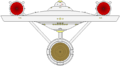
-

-
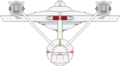
-

.png)
.png)
.png)
.png)
.png)
-
 USS Farragut (first production vessel)
 -
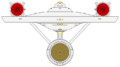
-

-
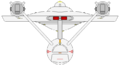
-

.png)
.png)
.png)
.png)
USS Constitution (NCC-1700) operational standard
Constitution had a rough start: three battles against the Klingons, two of which were significant in the history of the Four Years War, and all before she was commissioned. Following the battle of Donatu V in 2242, she returned to Earth, transferred her combat sensor tapes to Star Fleet Tactical, and received onboard a swarm of damage control teams. However, instead of being repaired to her pre-war configuration, she was sealed off, shut down, and towed into drydock.
Her experience at the Battles of (First) Axanar, Lea, and Donatu V were absolutely the catalyst for the transformation occurring within that shipyard and it dictated that for her sister ship, Enterprise. Externally, they were similar except for the impulse engines and armament. She retained her Siva impulse engines, even though they produced less thrust per nozzle; her saucer had not been replaced with the improved standard, but rebuilt. Her team had every intention of having her awarded the class ship designation and retaining the barely-employed propulsion equipment would be a time saver, if not a space saver. Similarly, during the reconstruction, it was decided she would keep her weapons loadout of six 4.0-gigawatt laser emitters and 2 Type L phased particle cannons, because they had already proven to not only work, but work very well in combat situations. The Enterprise would have more visible weaponry (with 2 additional Type L and 2 more powerful Type M cannons), but it was argued that as the Federation’s future flagship, discretion would be the better part of valor.
Constitution and Enterprise would be commissioned and inscribed within Star Fleet’s registry within days of each other, though it was the sister ship’s very similar configuration that would be the standard for the remaining 10 vessels of the production run. Apparently, the decision to keep the larger impulse engines was one of the deciding factors: both ships required a crew of 461 and the inspection team immediately recognized the value of the larger personal space onboard Enterprise in comparison. However, to honor her valiant efforts during the recently concluded war and acknowledge that it is generally the lead newbuild ship that loans the name to the class, “Constitution” was chosen for the heavy cruisers’ shared name. She would remain in this configuration until converted into a Flight II in the 2250s.
.png)
.png)
.png)
.png)
.png)
USS Constellation (NCC-1017) operational standard
Constellation was the original “lead” vessel of Project Starship, having served around 17 years as an Advance class battle cruiser, before being removed from active service in 2219 due to severe battle damage. Granted to the Chiokis shipbuilders in 2222, over the next 23 years she was dismantled, reconstructed, tested, and warp-ran, and then reconstructed again. That last prototypical rebuild bore light on the silhouette of what would become the epitome of a Star Fleet starship for decades.
At the time of sister test ship Republic’s own conversion into the prototype third-generation heavy cruiser, it was thought that Constellation’s time in reconstruction did not provide a solid basis for determining what lengths and costs would be associated with converting a typical Horizon to the new standards. Instead, because of great faith in her physical superstructure, it was decided she would “join” the future class as a one-off variant, possibly serving alongside the production vessels or (more likely) as a training ship for those crews that would be trusted to take those same vessels out to the frontiers of Federation space. In mid-2239, she entered the shipyard once again in order to be equipped with the sensors, living spaces, weaponry, and propulsion necessary to truly make her operational.
However, mere months before her early-2243 scheduled re-commissioning, work efforts were ordered halted. Early analysis of the Constitution combat sensor tapes suggested the Republic design could undoubtedly be improved upon and it would be intuitive to include such improvements on Constellation. By the time the re-finalized production plans were completed, the external shapes—specifically of the secondary hull—were far more similar to the originating Horizon class, which Constellation had retained—until 2239. The reconversion of Constellation, Republic, and Constitution began in 2244, alongside the continuing construction of Enterprise (NCC-1701). Of note, in order to commit due diligence, a last study was made to again catalog every difference between the finalized Constellation and Republic designs in order to properly ascertain how difficult and costly it might be to convert the remaining Horizons to the Starship standard. With little surprise to anyone, it would be unfeasible to conduct such a conversion on what was noted to be a class of ship designed and first fielded almost sixty years prior.
USS Constellation was re-commissioned in June 2245 and served in her initial Constitution production standard variant—in a primary exploration and diplomacy role—until Flight II configuration in the 2250s. In the mid-Sixties she would be overhauled into the Bonhomme Richard standard, just prior to her 2267 loss—and that of the highly decorated Commodore Matt Decker—to a leviathan of possible extragalactic origin.
.png)
.png)
.png)
.png)
.png)
USS Republic (NCC-1371) operational standard
With the finalization and subsequent selection of the Enterprise production standard, Star Fleet had the opportunity for one more “free” vessel (from the two testbed hulls), above the twelve authorized for Project Starship. The logical choice was the Republic (NX-1371), having been only months into her commission as an Archon subclass heavy cruiser when she suffered fire damage to her saucer, and then idled for years until tested as a project prototype. However, the Constellation (NX-1071) design and conversion teams made a convincing argument with their high confidence in the sustainability and structural strength of their ship, based on the tens of thousands of metric tons in hull and support improvements made through numerous test conversions.
Project manager Robert April directed the Republic conversion team to stand down until the Constellation was proven to be up to the challenge, and tasked the Republic’s design team with developing two courses of action: one in which the ship was selected to be converted to production standard, following the lessons from the same conversion made for Constitution (NX-1700), and the other to provide a “simplified” example of the Starship class, that had most of the same characteristics—such as maneuvering, weaponry, and sensors. With the foreseen success of the Constellation teams’ conversion in early 2244, the latter option for the Republic was directed.
Upon her re-commissioning in May 2245, USS Republic (NCC-1371) served in a defensive role, until formally assigned to training status in 2248. With the completion of USS Farragut (NCC-1702), the remaining production ships of the now-officially named Constitution class were arriving and Star Fleet’s best crews of command, engineering, science, medical, and operations personnel were being assembled to take them out. Republic performed three- and four-month familiarization cruises for overlapping commissioning crews, demonstrating the advanced functions of the bridge, the superiority in maneuvering and speed, and—very importantly—the operational and maintenance procedures for the newest in dilithium-regulated antimatter annihilation drives.
USS Republic would maintain this configuration until her (relatively early) deactivation in 2257. As she was not seen as a viable candidate for either Constitution Flight II or Bonhomme Richard configurations (over the authorized construction of a newbuild), and her internal spaces limited her operational capacity, it was decided to mothball her for the time being.
.png)
.png)
.png)
.png)
.png)
Constitution Flight II heavy cruiser
By 2249, the Constitution production run had been completed; fourteen Project Starship heavy cruisers were either pushing the far-flung borders of the Federation or making their way in those directions. Around thirty years after initial conception, the plan had been fully realized and Star Fleet was moving on with its adopted policies of power projection, complete defense, exploration, and diplomacy. One vessel, USS Valiant (NCC-1709), had gone missing in action early in her post-commissioning familiarization run in 2247, but the remainder had reported no technical concerns that would impact survivability. Point-in-fact, the ships were already receiving a great deal of attention domestically and externally, from the press, in the diplomatic corps, and by many disparate scientific circles that were quite impressed with the data streaming back in from the distant voyagers.
While there had been little concern with major technical issues on board the ships, technological progress had marched on; advancements in phased energy rectification introduced a new generation in directed-energy weapons. The newer, more precise phasers made moderated use of the rapid nadion effect of subatomic particles—via plasma—interacting within atomic nuclei to put a wide range of energy effects on a target, from stun (on certain organisms) to heating or even complete disruption of a cellular structure through disintegration. These weapons were now determined to be viable replacements, or—more specifically—far better successors to the centuries’ old use of lasers. The development of the heavy phased particle cannons was appearing to plateau at the same time and the decision was made to remove both systems from the Constitutions.
Several other technical concepts had been suggested for the heavy cruisers; their apparent popularity as a multi-mission platform had led to tremendous support for a second production run of another 14 vessels with those improvements built in. The logical process would be to build the new vessels and then swap them out with the deployed ones, but the high confidence (and demand) for the advanced phasers led to a plan wherein the original ships would be brought in for upgrade periods that were scheduled to take no longer than 3 months, pulling out the lasers and plasma cannons, installing the phaser banks, and keeping the off-station time of the individual vessels to a minimum. This would allow these upgraded vessels to return to their patrols and missions months before the planned Bonhomme Richard subclass would be operational.
USS Excalibur (NCC-1705), operating antispinward of the Federation in the direction of the Klingon Empire, was the first to be re-called to her operating starbase in 2250. The weapons conversion teams had been training for her arrival, and within 12 hours of the ship being placed into cold status (depowering her warp core and relying on the station to provide shore power to systems other than tactical and propulsion), they were prying the 4.0 GW lasers out and installing six Type VII phaser emitters into new retractable bays on the dorsal sides and a pair of smaller bays flanking the ventral torpedo launcher. The heavy plasma cannons were removed shortly thereafter, with new hull sections rapidly welded to cover the gaps. Three engineering teams also took on the challenge of removing the antimatter storage facility located on the ventral secondary hull (along with the ejection port) and installing more traditional fueling apparatus in the nacelle pylons, all within the allotted time. While—again—none of the Constitutions’ commanding officers nor chief engineers reported any concerns with new equipment not being ready, one theory was that the inexplicable loss of Valiant might have been because of a faulty transmission function within that system. Better remove it than risk the entire series of ships, it was thought.
By the end of 2256, USS Constitution (NCC-1700) and USS Constellation (NCC-1017) had gone through extensive upgrade periods to achieve full parity with the nine other ships of the Flight II standard. USS Republic (NCC-1371) was not deemed a viable candidate for inclusion, as she was wrapping up her assignment as the class training vessel and scheduled for decommissioning the next year. Due to operational commitments, USS Potemkin (NCC-1711) would skip this intermittent step to the Bonhomme Richard standard.
.png)
.png)
.png)
.png)
.png)
Bonhomme Richard subclass heavy cruiser
The USS Bonhomme Richard (NCC-1712) headlined a subclass of the Constitution heavy cruisers because it was not yet clear if, at the time of funding appropriation in 2249, the 13 members of the original builds would be converted into the new standard or remain within their own branch of upgraded flights. The 14 ships authorized under the new subclass had the identical directed energy weapons upgrade as the concurrent Constitution Flight IIs, but also an expanded torpedo bay supporting an additional launch tube in the ventral saucer. Some modernized equipment that would not be easily installed on pre-existing ships was also included, such as the dorsal-mounted MAUM sensor suite, updated inertial stabilizers, and more powerful auxiliary navigational deflectors.
The subclass entered Star Fleet service in 2251, and as the final ships were nearing completion in 2254, their dependability was so appreciated the decision was made to bring the Constitution Flight IIs up to the same standard. Enough time was scheduled for the more extensive yard periods necessary to add in the updated equipment and two more new-builds (USS Krieger and USS Essex, NCC-1726 and -1727, respectively) were also authorized. Six select units of the original ships were given additional phaser coverage: three vessels, referred to as Type 2, received two single type VI phaser emitters on the ventral secondary hull, and another set (Type 3) had four type VII phaser mounts installed on the saucer: two singles on the dorsal sides and one forward bank located directly beneath the bridge. The Type 3 mounts were discontinued with the follow-on Constitution Flight III configuration.
Because the subclass was authorized prior to the decision to include USS Constitution by almost 11 full years, the name did not change when she was herself upgraded to the standard in 2260.
.png)
.png)
.png)
.png)
.png)
Bonhomme Richard subclass heavy cruiser Types 2 & 3
The flexibility of the relatively new phaser technology offered an enormous number of tactical choices, both offensive and defensive. A Star Fleet tactical review board chose to explore the potential of differing weapons loadouts on the Bonhomme Richard subclass for possible inclusion with future configurations of the Constitutions (and others). Of the ideas suggested, only two were approved for test runs on the Constitution Flight IIs being upgraded to the Bonhomme Richard standard. Three vessels were selected for each different loadout, with the ships sub-categorized as either Type 2 or Type 3 (the original production run and remaining upgraded vessels were referred to simply as Bonhomme Richards).
The Type 2 added two single phaser mounts (of the type VI variety) to the ventral side of the secondary hull, providing additional protective coverage to that critical portion of the ship’s engineering superstructure. These were known as the amidships mounts. The Type 3 was a bit more radical: phaser VI emitters were added—as a twin bank—onto the dorsal saucer, further back from the standard position on the Constitution series, but located between decks 2 & 3, directly beneath the bridge. The Type VII phaser bank was separated, with one mount placed on either side of the bridge module, on the saucer proper. It was thought this would provide better coverage against attackers moving fore-to-aft or aft-to-fore, as well as bringing another full bank to bear at some point on the attacking exchange. However, only the amidships phasers went on to become a permanent fixture of future starship generations.
-
 Type 2
 -

-

-

-

.png)
.png)
.png)
.png)
.png)
-
 Type 3
 -

-

-

-

.png)
.png)
.png)
.png)
.png)
Constitution Flight III heavy cruiser
The Constitution series of heavy cruisers existed in four different iterations, each succeeded by the next, over a period stretching from 2245—when USS Enterprise (NCC-1701) was unveiled—until 2265, when the Victory subclass, all newbuilds, arrived on the scene. The final upgrade configuration, that of the Constitution Flight III standard, served the longest as the predominant archetypal heavy cruiser with the most members, 28. The primary upgrade it received was the installation of PB-47 nacelles, which propelled it a full factor higher, to warp 9. However, there were several other significant and minor changes that served to unite the entire series under this configuration, such as the inclusion of the exact weapons loadout as tested with the Bonhomme Richards Type 2.
This configuration was also the one that took the heaviest losses, though that fact must be viewed through a lens of knowledge before judging the design. No vessels had been destroyed or listed as missing in action since the first, USS Valiant (NCC-1709), in 2247. However, in 2267, that safe period ended with the intentional sacrifice of the USS Constellation (NCC-1017), the grand-dame of the Constitution series, in order to stop a planet-destroying juggernaut. The following year was far more devastating, not only to the class but to Star Fleet itself: USS Excalibur (NCC-1705) was devastated by a bizarre computer malfunction during wargames, USS Intrepid (NCC-1708) lost to yet another leviathan, and USS Defiant (NCC-1764) and USS Rivoli (NCC-1765) were both lost while in (markedly different) missions with TacFleet. The last two were of the Victory subclass, so do not count against the Flight III’s total registry. However, these high number of back-to-back losses contributed to the McLaren administration’s perspective of a misguided exploration policy and the subsequent major cutbacks, as well as the resignation-in-protest of Fleet Admiral Heiharchio Nogura. Common—but incorrect—knowledge has only the USS Enterprise returning from the completed 5-years exploration program, when in actuality 23 experienced line vessels (7 from the original production run) were accepted for refit with the new linear warp nacelles. (USS Kongo suffered a crippling onboard explosion in 2277, precluding her own upgrade.)
.png)
.png)
.png)
.png)
.png)
Victory subclass heavy cruiser
In 2261, the Constitution series had reached its fourth incarnation with the Flight III configuration and operational reviews were reporting top marks along almost every criteria point. TacFleet, the starship administrative chain of command that oversees the utilization of assets for the defense of the United Federation of Planets, took note of the versatility of the class, as well as the successful conclusions of those limited number of tactical missions completed by heavy cruisers temporarily assigned to the Echelon III Star Fleet component. Because TacFleet was generally tasked with missions of a timelier and combat-oriented nature, there often wasn’t a Constitution class vessel close enough or otherwise available to address situations that were sometimes well-aligned with those ships’ capabilities. TacFleet successfully lobbied for six newbuilds based upon the Flight III configuration to ensure dedicated access to these ships.
The most obvious modification from the exploration-minded Constitutions was the addition of two aft-firing medium torpedo tubes installed upon the dorsal side of the secondary hull, to discourage pursuit (in those scenarios where retreat was the proper course of action). Cargo spaces peripherally located to these launchers were re-designed as munition bunkers, providing an additional 70 photon torpedo capacity. The two single phaser mounts that originated on the Bonhomme Richard Type 2 were particularly applicable with the type of classified missions in which TacFleet vessels are often engaged, as some opponents made use of smaller and more numerous vessels in swarming attacks. Accordingly, the tactical suites of the Victories were enhanced and tertiary relays insured that more phaser banks could be charged and fired, and provided additional rerouting options in the event of combat damage. Lastly, the retraction gear for the directed energy weapons was removed, with each mount affixed directly on the surface of the hull: diplomacy and discretion were not tools TacFleet called upon and the response time was now limited to charging the phasers.
The vessels would serve through 2279 in what was termed ambiguously as “detached duty” until relieved by later tactical classes, and were not themselves refitted to a more modern standard. Two vessels were lost: USS Defiant (NCC-1764) went missing into an interdimensional rift in the direction of Tholian space, while the USS Rivoli (NCC-1765) was lost in a reported combat situation that has not yet been declassified (or even acknowledged).
.png)
.png)
.png)
.png)
.png)
USS Republic (NCC-1371) Academy training vessel
USS Republic (NCC-1371) was an old ship, but not a well-traveled one, when she was de-commissioned in 2257. She had been originally commissioned in 2222 as an Archon heavy cruiser, a subclass of the Horizon series, when she suffered a terrible conflagration in her forward bow’s internal spaces during acceptance trials. Star Fleet had considered putting her back in the yards for repair, but she seemed the best overall candidate for Chiokis’ experiments in designing a new heavy cruiser. When she was de-commissioned for the project by the end of that same year, it was the former USS Constellation (NCC-1017, Advance subclass heavy cruiser) that was designated as the primary testbed. One rationale was Republic, having almost no warp stress (compared to Constellation’s 17 years of service) would be a “cleaner” vessel in which to establish the modifications necessary for the other Horizon vessels that were intended to be refitted to the new standard. Constellation would test the various articles of new equipment, such as nacelles, deflectors, and—very importantly—the warp core.
Republic was stripped of all salvageable equipment—to be repurposed for ready spares—and left bow- and nacelle-less in a mothballed status for almost 15 years. Late in 2237, she was towed back into the shipyard and rebuilt, retaining only the structure of her secondary hull as the basis of the new supership. As detailed in the earlier article on her prototype status, she performed what were initially perceived by her design and engineering teams to be the new class’ flight tests, maintaining warp 8 for considerable lengths of time without any indications of nacelle or core stresses.
However, it was the Constitution (NX-1700), built to very similar standards (but with a Siva class saucer) that showed the weaknesses that were only apparent with the unique stress of sustained combat over three serious battles. Automatic damage control procedures needed considerable refinement and the weapon systems’ power routing required additional redundancies. The Republic standard had done well in battle, but there was now verifiable room for improvement. These new standards affected both internal and external spaces, most visibly with the shuttlebay, and were eventually unveiled on USS Enterprise (NCC-1701), the production prototype for what would become known as the Constitution heavy cruiser class.
Instead of being refitted again to the production standard, Project Starship manager Robert April directed the Republic teams to bring her up to simplified operational standards in an example of the new class, making her fully active as soon as possible. Because of the introduction of so many technological advances, especially with the warp core and the maneuverability it afforded the vessels, he wanted a ship set aside to train the new hand-selected crews for the entire class. His Project Starship teams provided the re-commissioning crew in 2245, which performed defensive and first responder missions in the vicinity of the core worlds until 2248. From then until 2257, she was a platform for future Constitution class crews (and for the newer Flight II and Bonhomme Richard variants). By the latter part of the Fifties, there were enough experienced crews to allow direct assignment to these power horses of the fleet. It was decided USS Republic would be mothballed, for the cost to bring her up to the present operational standards was too great. Despite barely 14 years with warp experience, the ship was now 35 years old.
She was called again to service in 2285, when Star Fleet Academy’s training vessel, USS Enterprise, was lost to enemy action in the Mutara sector. Without a ready and prepared vessel for the training and education role, it was decided to re-commission USS Republic. Because of the limited time frame to get her operational again and provide Academy cadets the necessary space hours for their graduation, she was not equipped with modern weaponry. Instead, all combat exercises would be computer simulated, with the one ceremonial exception of an original 4.0-gigawatt laser emitter that was moved laterally to the centerline, embedded in the location of the original photon torpedo launcher. The Academy logo was emblazoned on her dorsal hull and school shuttle pilots made it a matter of course that the cadets’ first beauty passes of the ship was one of that visage, as they made their arrival approaches.
While she served for only four years as the Academy’s training vessel, before being relieved by a series of far more modern starships, USS Republic (known affectionately and humorously as “the Pub”) was often spoken of fondly by members of the seven classes that got underway with her.
_(stbd).png)
_(bow).png)
_(dorsal).png)
_(stern).png)
_(ventral).png)
Registry
Constitution Flight I
| Hull # | Name | Builder | Laid Down | Commissioned | Status |
|---|---|---|---|---|---|
| NCC-1017 | Constellation (Advance class, {2198}) |
June 2245 | converted to Constellation fusion testbed {2226}; converted to Constellation dilithium testbed {2238}; converted to Constellation operational standard {2245}; converted to Constitution Flight II {2250-2256} | ||
| NCC-1371 | Republic (Archon class, {2222}) |
May 2245 | converted to Republic heavy cruiser prototype {2238}; converted to Republic operational standard {2245}; assigned training ship status {2248}; mothballed {2257}; assigned Academy training ship status {2286}; decommissioned {2289} | ||
| NCC-1700 | Constitution | 2239 | April 14, 2245 | launched as Constitution production prototype {2241}; converted to Constitution operational standard (2245); converted to Constitution Flight II {2250-2256} | |
| NCC-1701 | Enterprise | April 11, 2245 | launched as the Constitution production prototype (2245); converted to Constitution Flight II {2250-2255} | ||
| NCC-1702 | Farragut | 2247 | converted to Constitution Flight II {2250-2255} | ||
| NCC-1703 | Lexington | 2247 | converted to Constitution Flight II {2250-2255} | ||
| NCC-1704 | Yorktown | 2247 | converted to Constitution Flight II {2250-2256} | ||
| NCC-1705 | Excalibur | 2247 | converted to Constitution Flight II {2250-2256} | ||
| NCC-1706 | Exeter | 2247 | converted to Constitution Flight II {2250-2255} | ||
| NCC-1707 | Hood | 2247 | converted to Constitution Flight II {2250-2255} | ||
| NCC-1708 | Intrepid | 2247 | converted to Constitution Flight II {2250-2255} | ||
| NCC-1709 | Valiant | 2247 | missing (2247) | ||
| NCC-1710 | Kongo | {2247-2248} | converted to Constitution Flight II {2250-2255} | ||
| NCC-1711 | Potemkin | 2248 | converted to Bonhomme Richard Type 1 (2256) |
Constitution Flight II
| Hull # | Name | Builder | Laid Down | Commissioned | Status |
|---|---|---|---|---|---|
| NCC-1017 | Constellation (operational standard) |
{2250-2256} | converted to Bonhomme Richard Type 1 {2256-2260} | ||
| NCC-1700 | Constitution (operational standard) |
{2250-2256} | converted to Bonhomme Richard Type 1 {2256-2260} | ||
| NCC-1701 | Enterprise (Flt I) |
{2250-2255} | converted to Bonhomme Richard Type 2 {2256} | ||
| NCC-1702 | Farragut (Flt I) |
{2250-2255} | converted to Bonhomme Richard Type 2 {2256} | ||
| NCC-1703 | Lexington (Flt I) |
{2250-2255} | converted to Bonhomme Richard Type 2 {2256} | ||
| NCC-1704 | Yorktown (Flt I) |
{2250-2256} | converted to Bonhomme Richard Type 1 {2256-2260} | ||
| NCC-1705 | Excalibur (Flt I) |
{2250-2256} | converted to Bonhomme Richard Type 1 {2256-2260} | ||
| NCC-1706 | Exeter (Flt I) |
{2250-2255} | converted to Bonhomme Richard Type 3 (2256) | ||
| NCC-1707 | Hood (Flt I) |
{2250-2255} | converted to Bonhomme Richard Type 3 (2256) | ||
| NCC-1708 | Intrepid (Flt I) |
{2250-2255} | converted to Bonhomme Richard Type 3 (2256) | ||
| NCC-1710 | Kongo (Flt I) |
{2250-2256} | converted to Bonhomme Richard Type 1 {2256-2260} |
Bonhomme Richard Type 1
| Hull # | Name | Builder | Laid Down | Commissioned | Status |
|---|---|---|---|---|---|
| NCC-1017 | Constellation (Flt II) |
{2256-2260} | converted to Constitution Flight III {2260-2265} | ||
| NCC-1700 | Constitution (Flt II) |
{2256-2260} | converted to Constitution Flight III {2260-2265} | ||
| NCC-1704 | Yorktown (Flt II) |
{2256-2260} | converted to Constitution Flight III {2260-2265} | ||
| NCC-1705 | Excalibur (Flt II) |
{2256-2260} | converted to Constitution Flight III {2260-2265} | ||
| NCC-1711 | Potemkin (Flt I) |
2256 | converted to Constitution Flight III {2260-2265} | ||
| NCC-1712 | Bonhomme Richard | 2248 | 2251 | converted to Constitution Flight III {2260-2265} | |
| NCC-1713 | Monitor | {2251-2252} | converted to Constitution Flight III {2260-2265} | ||
| NCC-1714 | Hornet | {2251-2252} | converted to Constitution Flight III {2260-2265} | ||
| NCC-1715 | Merrimac | {2251-2252} | converted to Constitution Flight III {2260-2265} | ||
| NCC-1716 | Endeavor | {2251-2252} | converted to Constitution Flight III {2260-2265} | ||
| NCC-1717 | Defiance | {2251-2252} | converted to Constitution Flight III {2260-2265} | ||
| NCC-1718 | Excelsior | {2251-2252} | converted to Constitution Flight III {2260-2265} | ||
| NCC-1719 | Eagle | {2251-2252} | converted to Constitution Flight III {2260-2265} | ||
| NCC-1720 | Lafayette | {2251-2252} | converted to Constitution Flight III {2260-2265} | ||
| NCC-1721 | Wasp | {2251-2252} | converted to Constitution Flight III {2260-2265} | ||
| NCC-1722 | El Dorado | {2251-2252} | converted to Constitution Flight III {2260-2265} | ||
| NCC-1723 | Ari | {2251-2252} | converted to Constitution Flight III {2260-2265} | ||
| NCC-1724 | Saratoga | {2251-2252} | converted to Constitution Flight III {2260-2265} | ||
| NCC-1725 | Tori | {2251-2252} | converted to Constitution Flight III {2260-2265} | ||
| NCC-1726 | Krieger | {2251-2252} | converted to Constitution Flight III {2260-2265} | ||
| NCC-1727 | Essex | 2252 | converted to Constitution Flight III {2260-2265} |
Bonhomme Richard Type 2
| Hull # | Name | Builder | Laid Down | Commissioned | Status |
|---|---|---|---|---|---|
| NCC-1701 | Enterprise (Flt II) |
2256 | converted to Constitution Flight III {2260-2265} | ||
| NCC-1702 | Farragut (Flt II) |
2256 | nearly half the crew killed over Tycho IV (2257); converted to Constitution Flight III {2260-2265} | ||
| NCC-1703 | Lexington (Flt II) |
2256 | converted to Constitution Flight III {2260-2265} |
Bonhomme Richard Type 3
| Hull # | Name | Builder | Laid Down | Commissioned | Status |
|---|---|---|---|---|---|
| NCC-1706 | Exeter (Flt II) |
2256 | converted to Constitution Flight III {2260-2265} | ||
| NCC-1707 | Hood (Flt II) |
2256 | converted to Constitution Flight III {2260-2265} | ||
| NCC-1708 | Intrepid (Flt II) |
2256 | converted to Constitution Flight III {2260-2265} |
Constitution Flight III
| Hull # | Name | Builder | Laid Down | Commissioned | Status |
|---|---|---|---|---|---|
| NCC-1017 | Constellation (Bonhomme Richard T1) |
{2260-2265} | destroyed (2267) | ||
| NCC-1700 | Constitution (Bonhomme Richard T1) |
{2260-2265} | converted to Constitution Flight IV {2271-2277} | ||
| NCC-1701 | Enterprise (Bonhomme Richard T2) |
2265 | converted to Enterprise subclass (2272) | ||
| NCC-1702 | Farragut (Bonhomme Richard T2) |
{2260-2265} | converted to Enterprise subclass {2271-2279} | ||
| NCC-1703 | Lexington (Bonhomme Richard T2) |
{2260-2265} | converted to Enterprise subclass {2271-2279} | ||
| NCC-1704 | Yorktown (Bonhomme Richard T1) |
{2260-2265} | converted to Constitution Flight IV {2271-2277} | ||
| NCC-1705 | Excalibur (Bonhomme Richard T1) |
{2260-2265} | destroyed (2268) | ||
| NCC-1706 | Exeter (Bonhomme Richard T3) |
{2260-2265} | entire crew (except CO) killed over Omega IV (2267); fumigated & mothballed (2267); renamed USS Indomitable {2271-2279}; converted to Enterprise subclass {2271-2279} | ||
| NCC-1707 | Hood (Bonhomme Richard T3) |
{2260-2265} | converted to Enterprise subclass {2271-2279} | ||
| NCC-1708 | Intrepid (Bonhomme Richard T3) |
{2260-2265} | destroyed in Sector 39J (2268) | ||
| NCC-1711 | Potemkin (Bonhomme Richard T1) |
{2260-2265} | converted to Endeavor subclass {2271-2274} | ||
| NCC-1712 | Bonhomme Richard (Bonhomme Richard T1) |
{2260-2265} | converted to Enterprise subclass {2271-2279} | ||
| NCC-1713 | Monitor (Bonhomme Richard T1) |
{2260-2265} | converted to Constitution Flight IV {2271-2277} | ||
| NCC-1714 | Hornet (Bonhomme Richard T1) |
{2260-2265} | renamed USS Marat (2275); converted to Constitution Flight IV (2275) | ||
| NCC-1715 | Merrimac (Bonhomme Richard T1) |
{2260-2265} | converted to Constitution Flight IV {2271-2277} | ||
| NCC-1716 | Endeavor (Bonhomme Richard T1) |
{2260-2265} | converted to Endeavor subclass (2272-2273) | ||
| NCC-1717 | Defiance (Bonhomme Richard T1) |
{2260-2265} | converted to Constitution Flight IV {2271-2277} | ||
| NCC-1718 | Excelsior (Bonhomme Richard T1) |
{2260-2265} | converted to Constitution Flight IV {2271-2277} | ||
| NCC-1719 | Eagle (Bonhomme Richard T1) |
{2260-2265} | converted to Endeavor subclass {2272-2274} | ||
| NCC-1720 | Lafayette (Bonhomme Richard T1) |
{2260-2265} | converted to Endeavor subclass {2272-2274} | ||
| NCC-1721 | Wasp (Bonhomme Richard T1) |
{2260-2265} | damaged at Babel Conference (2267); repaired {2267-2268}; converted to Endeavor subclass (2271-2273) | ||
| NCC-1722 | El Dorado (Bonhomme Richard T1) |
{2260-2265} | converted to Enterprise subclass {2271-2279} | ||
| NCC-1723 | Ari (Bonhomme Richard T1) |
{2260-2265} | converted to Endeavor subclass {2272-2274} | ||
| NCC-1724 | Saratoga (Bonhomme Richard T1) |
{2260-2265} | converted to Endeavor subclass {2272-2274} | ||
| NCC-1725 | Tori (Bonhomme Richard T1) |
{2260-2265} | converted to Endeavor subclass {2272-2274} | ||
| NCC-1726 | Krieger (Bonhomme Richard T1) |
{2260-2265} | converted to Enterprise subclass {2271-2279} | ||
| NCC-1727 | Essex (Bonhomme Richard T1) |
{2260-2265} | training ship assignment (2289) |
Victory subclass
| Hull # | Name | Builder | Laid Down | Commissioned | Status |
|---|---|---|---|---|---|
| NCC-1760 | Victory | 2263 | 2265 | decommissioned (2279) | |
| NCC-1761 | Oomaru | 2263 | 2265 | decommissioned (2279) | |
| NCC-1762 | Yaan | 2263 | 2265 | decommissioned (2279) | |
| NCC-1763 | Temir | 2263 | 2265 | decommissioned (2279) | |
| NCC-1764 | Defiant | 2263 | 2265 | lost (2268) | |
| NCC-1765 | Rivoli | 2263 | 2265 | destroyed (2268) |
Gallery
Master Sheets
Alternate source
Supporting Documents
- Blueprints
- Constitution Registry: tracking each ship's conversion history
- Starship Recognition Manual #298 - Report: Constitution Heavy Destroyer
Notes
- Changed the years of several mentions, to allow Republic to be constructed as an Archon before being given over to the project in 2222.
- When the text first introduces the Bonhomme Richard variant, it specifically indicates that 14 ships were initially constructed; 2 more would be built later (per the text), supporting the sidebar's 16.
- The text seems to indicate (with the word "accompanied" that the Bonhomme Richards are different, and that the original Constitutions were updated at the same time. In discussion with Adrasil, I'm interpreting this to be the 1st Pilot Enterprise (or Constitution Flt II). This is confirmed later when it is stated that all original surviving Constitutions (with the exceptions of Republic and Potemkin) eventually met the Bonhomme Richard standard.
- The registry code for USS Constitution is changed to NX-1700, to reflect what it was reported to be, following the battle of Donatu.
- The caption for one of the images was modified to elaborate on which battle of Axanar is depicted.
- The Constitution is proving to be a busy beaver prior to and just after her commissioning; this is the order of events in her early career:
- May 2238: Construction begins on Constitution.
- May 2241: Construction on Constitution is completed; class trials begin.
- July 12th, 2241: CAPT Garth assumes command of Constitution, while it is pierside at Starbase 12.
- August 22nd-29th, 2241: First Battle of Axanar
- Post-Axanar: Constitution ambushed at Lea, taking on additional damage.
- February 14th, 2242: a distress call from Donatu is received; Constitution diverts from her evaluation cruise to assist other Star Fleet vessels.
- Post-Donatu: repairs are re-started.
- April 2245: Constitution commissioned.
- Post-commissioning: USS Constitution, USS Enterprise, USS Constellation, and USS Republic are dressed up to appear damaged or incomplete, and transferred to the forward repair base at Axanar, to lure Klingons.
- Final Battle of Axanar
- Adrasil and I have decided to re-write the weapons loadouts for a number of the variations, to better fit alpha-canon (though with some compromises).
- The originally operational Constitution was, at first, shown as massing 598,400 mts; however, because it was based on the later Constellation, but uprated (with the PB-31 nacelles), it should have been more massive. The mass is now listed as 698,400 mts.
- The Republic was re-activated in the late 2280s; game-canon dates added to sidebar.
- The construction period for the original Constitution newbuilds was changed from ending in 2245 to 2248 (when the Bonhomme Richard began production). because there was no way all 12 newbuilds were completed in the same year.
- The sidebar's operational period for the overall class was changed from 2275 to 2279, since two instances in the text and captions indicated active vessels after that year.
- I've decided Potemkin skips the Constitution Flt II standard and is the first ship to be converted to the Bonhomme Richard standard in 2260 (hence why the original Constitution flight is operational until then).
- For clarity, after the Enterprise production prototype was approved:
- the Constitution production run (starting with USS Farragut) began, ending in 2248
- the Bonhomme Richard subclass started building new vessels in 2248, and finished in 2252, with the USS Bonhomme Richard entering service in 2251
- The Constitution Flight II started conversion (with USS Excalibur) in 2250, over 3-month upgrade periods, though the USS Constellation and USS Constitution (with differing operational standards) started last, took longer, and didn't complete their conversions until 2256. USS Potemkin was not upgraded to Flight II. (This is when USS Enterprise achieves her 1st Pilot standard.)
- After the last Constitution Flight II was completed, the older ones began converting first to the Bonhomme Richard standard, which lasted from 2256 (starting with USS Potemkin) through 2260. (This is when USS Enterprise achieves her 2nd Pilot standard, i.e., before 2265.)
- Following the final Constitution Flight II-to-Bonhomme Richard conversion (2260), the oldest newbuild Bonhomme Richards (followed by the converted ones) began conversions to Constitution Flight III standard. USS Enterprise would be converted in late 2265/early 2266 (to the TOS Series standard). The final conversion would be completed by 2267.
- In 2263, the Victory subclass begins construction, with USS Victory (and the remainder) entering service in 2265.
- This article says USS Kongo suffered a crippling onboard explosion in 2277, suggesting it was still of the Constitution Flight III configuration, and not yet refitted into the TMP era. Therefore, the ships were still active at least into 2277.