Guide:Bonaventure (testbed)
.png)
| |
| Bonaventure | |
|---|---|
| Class Overview | |
| Category | dilithium power testbed |
| Operational | 2231 |
| Constructed | 1 |
| Dimensions | |
| Length | 137.2 m |
| Beam | 82.0 m |
| Height | 54.9 m |
| Mass | 334,200 tons |
| Performance | |
| Cruise Speed | w 3 |
| Max Speed | w 5.2 |
| Endurance | 1 year |
| Complement | |
| Crew | 81 |
| Passengers | 8
|
| Tactical Systems | |
| Shields |
|
| Auxiliary Craft |
|
| Historical | |
| Ships of Note |
|
| Canonicity | |
| Design | TAS |
| Name | TAS |
| History | Timo |
| Delta Dynamics | SRM #294 |
Background
Hobbyist's Guide
In the beginning of the 2220s, Star Fleet had faced repeated demands of increased performance of both its warfleet and exploration forces. The application of third-generation stardrives to new destroyers, cruisers and scouts was a major effort, and produced some increases in defense capabilities, but the numbers of new ships stayed low and the performance still only barely on par with Klingon weapons technology. Even warp 4 cruise speed was too slow for any hope of effective defense for the far-flung UFP. The doctrine of that time called for last-ditch defenses of the core worlds and abandoning of colonies in case of an invasion, although this was naturally not made public.
The low rate of modern ship production was not entirely due to lack of resources, however. The Admiralty knew well that the UFP’s survival thus far was mainly due to pure good fortune, and that no shipbuilding program could save the Federation in case of a massive invasion. What was needed was a miracle – and that is exactly what the Admiralty relied on. ‘Miracle factories’ throughout the Federation were its best chance of survival. Fantastic plans for new weapons and strategies were being created every week, usually to be abandoned as unrealistic after a short briefing.
At the moment of greatest darkness, three miracles did emerge: the phaser, the duotronic computer, and the red coral crystal. The first was the result of slow and tedious perfection and consolidation of subspace, phased particle beam and coherent EM technology into a flexible weapon system on par with Klingon disruptors. The second was the brainchild of a single man, yet thanks to it, centuries of careful studies and bold concepts by multiple races were suddenly blooming into working applications. And the third was a coincidence of literally cosmic scale.
A new mineral first analyzed on the mining hubworld of Deneva, the red coral crystal was at first considered just another alien gemstone of a lot of decorative but little practical value. A thorough inspection performed by Federation Customs Service laboratories in connection with a simple smuggling case soon changed that view of the material: in a few weeks, it became clear that the shard of crystal was a highly complex matrix of mainly lithium, silicon and iron, with the primitive cell formula 2<5>6 dilithium 2<:>1 diallosilicate 1:9:1 heptoferranide – that is, naturally occurring dilithium! Just like its fragile and astronomically expensive semi-synthetic form, this crystal was both a sponge of almost all types and frequencies of radiation energy, and an excellent moderator for annihilation reactions. And it could be dug up in quantity from Federation soil!
A starship utilizing this moderator in her power systems would bring about a revolution in the economics and strategy of interstellar war. A technology more reliable and less prone to disaster than the old ‘Archer drive’ naturally had to be developed first, but now that the strategic incentive was there, perfecting the technology was just a matter of applying enough resources, time and expertise. In 2229, Star Fleet began to construct an appropriate testbed for warp engines regulated by natural dilithium. The goal was set at creating a scale model of the upcoming heavy cruiser design, to keep the interactions of warp field and hull geometries as true to the ultimate cruiser reality as possible. This placed strict and at times conflicting requirements on the three main elements of the vessel: the warp nacelles that would explore the new field shapes, the secondary hull where the advanced power systems would be housed, and the primary hull which would mainly serve as an impulse engine test mount and representative shape.
Material technology improvements made possible the mounting of heavy experimental nacelles on long, spindly pylons, quite unlike the broad-chord structures of the previous century. Four different configurations of steadily increasing pylon length were established, expanding the asymmetry envelope to its very limits. The engine of choice for these initial tests was a minimally modified PB-14, or the ‘099 engine’. On the fourth and final pylon configuration, three sets of novel warp coil layouts were to be tested, but the ‘moderately safe, moderately performing’ phase two or ‘101’ engine was dropped from the program in 2231, and a direct leap made to the ‘102’ high-risk venture. The distinguishing external feature of this engine, its bloated aft section, held an oversized off-axis field controller that would make possible emulation of the heavier field loads and stress patterns a full-size starship would encounter. In time, Star Fleet hoped to introduce such flexibility into its service engines as well, but the technological solutions of the 2230s remained prohibitively expensive.
Dilithium-controlled annihilation called for a reactor assembly with an extremely compact actual reaction area yet extensive and expansive support systems. The configuration chosen for the experiments featured four parallel reactor tubes; a direct growth version was to be adopted for Project Starship, although some fundamental changes would eventually be made. All secondary mission systems save the shuttle hangar were omitted from the secondary hull to give room for the new powerplant and its ventrally mounted antimatter containment pods. The hull was provided with multiply redundant sliding/blowaway panels, ejectors and purge mechanisms for rapid and efficient jettisoning of the systems saturated with the volatile fuel.
A navigational deflector of significant power was added late in the design process, to allow for testing at full speed range in case the engines did work as planned. Its fitting into a cylindrar protrusion of the secondary hull bow was not free of problems, but end result still represented a level of aesthetics unseen in prior testbeds.
Testing of the Starship impulse system at representative scale required a bulky aft extension to the command saucer. The trapezoid shape, forming some 35% of overall primary hull volume, held all the basic elements of the SBA engine: twin fusion reaction chambers, advanced exhaust accelerators, integrated driver coils and dechargers, and fully vectoring nozzle fields. An exceptionally robust connector neck box extended through the impulse decks, curving to blend with the command superstructures at the upper end, and welded to secondary hull upper and lower surfaces and central keel box. In addition to deuterium tanks, the structure also held plasma conduits for feeding primary annihilation power to the impulse driver coils. This system would play a major role in future ship types, but in the test rig it was a deliberately underpowered proof-of-concept showpiece only. The minimum operating crew of 81 was already at risk from the high-power systems running through the interiors, and from working in the still poorly known emission environment of the annihilator assembly. Cabins were provided for most of the crew in the relative safety of the primary saucer, but some crew quarters were necessarily located in the secondary hull as well.

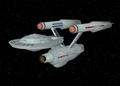
Commissioning ceremonies were performed in early January 2231. The ship was given the registry NX-B1, and the name Bonaventure as a good omen for future achievements. The outsized nacelles, the distorted saucer and the undercut secondary hull all added up to a somewhat comical appearance. Many of the observers of the closely guarded ceremony later remarked that their first impression had been one of watching a baby starship, her rounded features only faintly suggesting the sleek lines of cruisers to come. The baby face belied the abilities of the ship: in her maiden warp flight, the Bonaventure managed to accelerate from zero to warp three in 11.9 seconds and maintain warp 5.2 for sixteen hours. The immediate success of the design gained the vessel a permanent commission in April, and operational warp engine development status in May.
Three long performance evaluation cruises were performed between May and September 2231. The test program was cut short, however, when contact with the ship was lost just outside Deltan space. Subsequent searches by cruiser Savannah revealed no debris or ion trails, nor the antimatter residue characteristic of the vented plasma of the experimental ship. All 89 persons aboard were declared missing, and considered lost three years thereafter. However, the antimatter powerplant development program continued at full pace and several Baton Rouges, Saladins and Hermeses began conversion to this powerplant type.
In 2269, heavy cruiser Enterprise (NCC-1701, Constitution class) accidentally entered an interspatial anomaly in the Delta Triangle region. Inside the anomaly, the cruiser located the derelict Bonaventure among hundreds of other lost spacecraft of varying origin. Joint efforts by the Enterprise and IKV Klothos enabled the cruisers to escape the anomaly, but very little information was gathered on the actual fate of the Bonaventure. Her crew is believed to have survived inside the anomaly essentially unharmed and unaltered by the passage of time, as had the crews of various other vessels. However, the Enterprise was unable to establish contact with representatives from the Bonaventure. Further excursions into the anomaly have ended in failure – apparently, the interspace portal changes position and characteristics rapidly and unpredictably.
Delta Dynamics
The young Star Fleet was struggling. Outwardly, it was a rapidly growing, enthusiastic, and successful merging of the founding states’ space-going assets, visibly developing and shaping the academic, martial, and economic avenues for the United Federation of Planets’ interests in exploration, defense, trade, and technology. However, a critical decision made fifty years previously was impacting the ability of Star Fleet to defend the Federation as it added new members and settled virgin worlds with enthusiastic colonists.
This challenge, an existential concern, was kept tightly internal (with the exception of the President and the Security Council), because it was a problem of Star Fleet’s own making. In 2169, the United Earth’s reluctance to continue with dilithium-regulated reactors heavily influenced the design of Star Fleet’s second-generation starships. Dilithium had proven critical to the achievement of warp 5 for the pre-Federation Earth, but at great cost: the reactors were fragile and often resulted in the loss of the entire vessel when stresses—combat or natural—resulted in the focus of the dilithium being disrupted. Additionally, the dilithium crystals were beyond rare, with no natural depository found; they tended to work their way into the trading sectors of larger states haphazardly and in a nearly perfectly refined state, as if removed from previous vessels from outside the geopolitical knowledge of the Federation. For the newly-completed starships entrusted with such reactors, the workup cycles were extremely prolonged, as focusing the crystals was so very critical to achieving the high warp speeds capable by the expensive reactors. This was a considerable setback for getting combat-capable ships out into the warzones being contested with the Romulan Empire and that learning experience influenced the defensive doctrines of the nascent UFP Star Fleet.
Instead, the reduction of nearly a full warp factor was the sacrifice for safe and dependable starship development for over a generation. However, in the 2220s, the costs of that decision were becoming apparent. The adoption of the more complex and larger peristaltic forcefield antimatter feed constrictors—in lieu of dilithium regulation—also meant that more space was needed to carry fuel, since antimatter (antideuterium) was now required at a 1:1 ratio with matter (deuterium). This larger space, along with the reduced warp capability, meant that Star Fleet was simply unable to project its defensive might as far as the Federation required it. Strategists recognized that warp 4 was far too incapable of defending the further afield member worlds and colonies and so, quietly, defense doctrines built to respond to a potential massive invasion were predicated upon the abandonment of those distant territories and the encircled—albeit last-ditch—defense of the core planets.
However, within a few years of the adoption of this fatalistic strategy, hope emerged. While new technologies were always being hyped and promised as leaps forward, three such promises seemed to stand out from all the others: continuing development of phased particle beams and the merging with coherent electromagnetic technology promised a weapon system flexible enough to challenge Klingon superiority in this field; a published mathematical study on the relationship between subatomic structure and data processing—by a ten-year old human boy, oddly enough—indicated fantastic advances in computing technology, with the ability to quickly and consistently maintain dilithium focusing, was on the horizon; and a source of unrefined dilithium was discovered, proving the crystal did occur naturally and only needed refineries to be established. The overlapping of these three scientific developments shone like a beacon on those same Star Fleet strategists, who collectively corralled the leadership into the immediate development of a starship—preferably of the cruiser type—that would incorporate all three of these potential discoveries into a platform of speed, strength, flexibility, and independence.
From this, Project Starship was given new and promising life.
Note: this depiction of the Bonaventure (as yet un-commissioned) is of her first flight-ready test configuration. Outfitted with minimally modified PB-14 nacelles, the intent was to test different asymmetric flight envelopes, in order to stress the science of the viability of multi-lobed warp bubbles. The 8-degree cant and tucked-in location of the pylons was considered a safe baseline for follow-on pylon setups.
.png)
.png)
.png)
.png)
.png)
A (Very) Brief History of Dilithium Use in the Federation
In 2009, the historic inaugural mission of the Grand Tours was begun, when the Lewis and Clark, an Aventeur exploration craft—sublight in propulsion—was launched from Earth in a joint mission of two of the planet’s space agencies. The ship was crewed by the (now) famous Commander Shaun Geoffrey Christopher, Dr. Marcus O'Herlihy, Mission Specialist Alice Fontana and 12 scientists of varying specialties. Their mission was to visit and explore the planetary systems of both Jupiter and Saturn, landing and mapping the moons and rings of both, where suitable. It was one of six planned missions to the outer worlds, intending to put Human explorers where only robotic ones had gone before.
However, unrevealed (by mission commander decree) until the mission’s return to Earth in 2039, the teams discovered something that changed the heliocentric view of Humanity, at least within the scientific community: at landing sites on the Saturnian moons of Enceladus and Dione existed clear and unmistakable signs of mining operations. And these were not the remains of Khan’s Augments, as the equipment and other detritus recovered by Lewis and Clark were clearly not of Earth origin. There were even examples of compounds and traces of elements seen never before, including numerous samples of something later identified (on Earth) as ununennium, with the atomic number 119 and an atomic weight of 87, a previously theoretical element. However, to the crew of the explorer, the samples were simply referred to as “the red coral crystals.”
The existence of an alien presence—even if in the past—was not released to the general public. However, select scientists, both individuals and teams of labs, were brought in on the discoveries, in order to best understand what Christopher and his team had retrieved. In 2049, an extremely young (but post-doctoral) Zefram Cochrane had the opportunity to examine one of the red coral crystals at length, whereupon he realized this sample of ununennium was exhibiting attributes of the (extremely) theoretical hypersonic series. After a number of open and then covert experiments, he decided his hypothesis was correct and began researching applications of the element, leading to his now famous invention of the continuum distortion propulsion engine, or warp drive. The historic testing of the drive in 2063, of course, led to first contact by a Vulcan geologic survey expedition.
The Vulcans had been using the coleopteric (aka, ring) warp drive since the 19th century (upon their post-Time of Awakening return to space), achieving warp 7 (on the OCU scale) by the mid-22nd century. However, their drive was built for the speeds necessary to traverse large distances—during a time with far less aggressive space-going species—and were less maneuverable as a result. They, also, had not found a reliable, natural source for dilithium, concluding it was of artificial manufacture, and had restricted the use of the limited procured samples to their few combat cruisers. Their slower vessels, including the explorers, utilized bulkier and slower fusion reactors.
When the Humans and the Tellarites simultaneously met each other in their respective systems in 2073, the alien traders were very open (with reasonably “bartered” exchanges, of course) with their technology, though far less advanced than that of the Vulcans. Plasma derived from fusion power was the preferred energy source for their warp coils and the porcine fleets made up for the slow attributes of their drives with sheer quantities of smaller trade ships flitting about known space.
The territorial Andorians were less open with their technological prowess. Forcefully introducing themselves to Humanity in 2151, they clearly had the ability to stand face-to-face with Vulcan combat cruisers, with their own battle cruisers of similar size. They, too, used only fusion reactors, but were able to increase the efficiency through the use of variable compression nozzle technology, which utilized peristaltic forcefields to increase the energy output of the plasma.
Determined to stand on their own collective feet, Humanity sought to break free of the Vulcans’ technological and sociological restrictions by going further out than their present fleet was capable, and to do that they needed velocity. To break the warp 5 barrier, the United Earth Starfleet worked to develop their own non-Vulcan dilithium-focus annihilation core, which was the primary and key component of the Archer Warp Five engine. However, the equipment was complex, prone to mis-alignment with any significant jostling of the vessel, and maintenance-intensive. The UESS Enterprise, the first vessel to go forth outside the radius of Earth’s colonies, appreciated the speed, when it was available, but Captain Archer would not be the last to describe it as temperamental.
The original dilithium moderators came from the Saturian samples, but more had to be procured. Using tips gleaned from their Vulcan overseers, United Earth diplomatic agents bought and bartered with the Tellarites (who did not use the crystals themselves, but understood their value) and any other race—most notably Orions—that would make them available. All, however, proclaimed ignorance as to the ultimate source. Dilithium crystals were thus acquired at considerable expense to moderate the Earth fleet, both within the Enterprise/Columbia class, and in the classes that followed shortly thereafter.
Yet, Starfleet was soon to realize another cost associated with the dilithium-focused annihilation core. Despite the range and speed the engine allowed, the time needed in workups for ships following construction was extremely prolonged. Within a few years, when Earth was embroiled in conflict with the enigmatic Romulans, getting combat-equipped vessels within the warzone was critical. Be that as it may, the admiralty was realizing newly constructed ships were being delayed by months, just in order to enable the Warp 5 drives to get them to the battlespace. Once there, the same ships were being lost at a higher rate than slower vessels and with less damage, and there was more than enough evidence that failure of the antimatter containment within the chamber was the cause. The fleet soldiered on, finally persevered, and then took stock: dilithium was too difficult to keep focused in a way that made it more viable than typical fusion-derived plasma or the Andorian method of using complex forcefields to enable greater plasma pressure.
In 2169, following the full consolidation of the founding fleets into the UFP’s Star Fleet, the collaborative leadership team decided to shut down the dilithium reactors. Newer classes, such as the Almeida cruisers, were given a grace period—to expire in 2188—while other ships, such as the Columbias, were used as testbeds for the Andorian fusion-driven peristaltic warp drives, until war-era ships too were stood down in 2192. Star Fleet struggled with patrol ranges and response times, while desperately reviewing any and all research areas for answers to regain the advantages that came with warp 5 capabilities. The self-protective Andorians had opened themselves to the greater altruistic philosophy of the Federation and were providing greater insight into their forcefield advancements. Propulsion experts throughout the Federation began exploring the use of antimatter fed into total conversion warp reactors, by the same large and complex peristaltic forcefields previously used on Andorian fusion warp reactors. Repeatable warp milestones were being met again, and even broken, with warp 6 a reliable achievement no later than 2194, at conversion rates that moved steadily down to 10:1, then 5:1, and finally 1:1, after 2207. Antimatter was now the standard “fuel” for the entire fleet and rapidly being adopted by the larger shipping lines, as well.
Then, in 2222, the discovery of dilithium as a natural resource was made, and the first source proved to be extremely convenient: the Federation colony world of Deneva. The Federation realized now how the unrefined element presented as; all that had to be done was to set up infrastructure for mining, refining, and surveys for discovering additional sources. While the lode on Deneva was relatively substantial, when compared to dilithium’s presence within Federation territory prior to the discovery, it was well understood that one source was not enough. A complete revolution of spaceflight was about to occur and it would not be limited to the UFP.
Note: this depiction of the Bonaventure (as yet un-commissioned) is of her second flight-ready test configuration. Outfitted with minimally modified PB-14 nacelles, the intent was to test different asymmetric flight envelopes, in order to stress the science of the viability of multi-lobed warp bubbles. The 14-degree cant and 61.2 meter extension of the pylons were in the first attempt to gauge the external range of the warp field layers.
.png)
.png)
.png)
.png)
.png)
FCS Historian suggests new "origin story" for today's Star Fleet
- By MIDN 2/C Felydia Vafit, SD 2288.7885
Last night at the Star Fleet Academy Annex on Catulla, Deputy Historian Craonnaav lorin Charn of the Federation Customs Service spoke to the members and guests of the Academy Historical Society. While the focus of the presentation was on the FCS, Historian Charn presented an interesting thesis: that smuggling was directly responsible for the modern Star Fleet.
During a question and answer portion of the evening, Charn was asked how he had come to serve in the FCS in his present capacity. While explaining his background as an investigative officer, he made a statement that caught the attention of a majority of the members. “I started as an agent with a sense for smuggling cases on my native Tellar, and because of the early state of the colony on Deneva, there was a great deal of concern that natural resources were being stolen from that planet. So, in late 2221, I was transferred there. Though a very disagreeable and unpleasant man—feel fortunate you never had to waste your time with him—Head Agent Jin had us move our offices from the governor’s building out to the basic spaceport in early 2222, the idea being that we had to catch the easy grubs first, the ones operating out of legal trade spaces, before we could identify those bypassing the spaceport altogether. An uncommonly wise decision on his part, as that is what enabled us to find the first natural dilithium, which we did not at first recognize. We had a low-level grub with a small storage space filled by obviously mid-valuable items, including the property of deceased colonists, with no transfer claims attached. But in the back was this medium-sized bin with these raw, unrefined crystals. Jin argued that I was to find out why the grub had these trinkets, despite my obvious and known skill at tracking down smuggling trails for more valued commodities. Never one to belabor a point, I decided to send the samples off to the FCS regional lab. If I hadn’t, instead if I had just filed the paperwork on the supposedly illegal mining operation from which the worthless crystals must have originated from, then the chemists would never have tagged the samples for greater study—from which their hypersonic properties were registered—then natural dilithium would not have been discovered so soon in history, and Star Fleet would still be the barely-acceptable search and rescue service is was back in the Twenties.”
With that statement, the rest of the evening was derailed with vehement questions and loudly-proclaimed responses, as retired Star Fleet members debated with Historian Charn about the role of Star Fleet, the course it took after the discovery of natural dilithium, and the likelihood of dilithium remaining unrealized as a conversion moderator. Charn’s position was that the dilithium’s discovery at that point in time coincided with the Daystrom paper on computing. If it had not been for the discovery of that paper, when Daystrom’s first multitronic computer debuted it would not have been as eagerly anticipated and would have instead been used only by the other emergent technologies of the time. However—with the realization of natural dilithium—funding and planned use of the new computing technology ensured its rapid completion, and new warp cores making use of finely controlled dilithium-moderated reactions were designed alongside ships with the capacity to make use of the resulting power and warp speeds.
Campus security had to be called with CDR Jarkund blasch Thaag (SF, Ret.) and Historian Charn began hotly debating the merits of...
.png)
.png)
.png)
.png)
.png)
The Warp Nacelles of the Bonaventure Test program
The immediate jumpstart of the dilithium-focused annihilation core testing came about for three reasons: 1) dilithium was proven to be a naturally-occurring element and the Federation had a source, 2) a new type of computer (duotronic) capable of the precise calculations to ensure safe & consistent dilithium focusing was on the near-horizon, 3) Star Fleet was keenly aware of its inability to ward off a massive invasion. As to the third reason, the key to solving this was the ability to project firepower far beyond the core worlds and the sooner a viable cruiser could slip the ways in meaningful numbers, the better.
That was the main reason for the Bonaventure’s design. Never intended to become a production class itself, the intent of the test was to resolve not the ability to annihilate dilithium focusing for all of Star Fleet, as the faith in duotronics was solid. It was to skip straight to the expensive spaceframes of a dilithium-powered fleet and get the cruisers going. By focusing on the interactions of warp fields and hull geometries needed by a long-ranging cruiser design, the sooner those cruisers would be out there proclaiming the Federation’s endurance. The smaller ships-of-the-line and auxiliaries would follow, of that there was no concern.
So, the intent was to get the data necessary to develop a potent design for as heavy a cruiser as possible and do it right the first time. The testbed ship—again, not intended for production—would therefore be unconventional in its dimensions, as it would be testing the influences of the hulls, the pylons, and the nacelle shapes themselves on the potential warp fields the available nacelles would provide. The best candidate nacelle for the test program would be the adaptable PB-14, most often utilized by the Venture and Caracal light cruisers. A number of advances had been made in both warp coil production methods and their layouts within a nacelle; as the PB-14s were largely made available with the older classes retiring, this gave the machining labs plenty of candidates with which to work.
The nacelle that was used to establish the ultimate pylon configuration to best test the concept of multi-lobed warp bubbles around a general heavy cruiser design was designated as PB-14-099, a minimally modified mainline PB-14. Sensors were added directly to the nacelle to determine both baseline field results and deviations from the differing pylon lengths and placements. At least eight such nacelles were altered to the same specifications, different only in the weld locations for the external connections to the pylons.
The PB-14-100 never actually entered the workshop’s doors, remaining conjectural. Based on the initial flight tests of the Bonaventure in her baseline configuration, it was realized that the interspersed nature of the -100’s coils would be slower to achieve the multiple warp field lobes and was dropped.
The PB-14-101 was seen as promising, with two examples completed and ready for mounting. The warp fields in the labs were strong and, most importantly, stable. Every step of the way in design and production development indicated this warp nacelle would move the test ship steadily through each of the warp factors with nary a shudder, providing a moderately safe, moderately-performing warp experience. But they would never be mounted.
The ultimate nacelle to be tested, the PB-14-102 was seen as a high-risk nacelle, but it provided something the -101 could not: an in-flight capacity to adapt the emulations of the possible heavy cruiser design permutations, as well as the heavier field loads and stress patterns such a ship might be expected to encounter. This came about because of the addition of an oversized off-axis field controller. Because of the importance of developing a production heavy cruiser sooner than later, it was decided to recognize the pylon lengths had been fully explored and instead focus on nailing down these multiple mission factors. This is the nacelle pair with which the ill-fated Bonaventure is most associated.
Note: this depiction of the Bonaventure (as yet un-commissioned) is of her fourth and penultimate flight-ready test configuration. Still powered by the PB-14-099 nacelles, the extended 227.2 meter pylons on the 56-degree cant may have been a bit “too far”, but the heavy testing of the PB-14-102 was foreseen by this point and there was the need for additional testing with the -99s, in order to identify the deviations expected with the final pair.
.png)
.png)
.png)
.png)
.png)
The second famous Bonaventure was a commissioned Star Fleet ship for less than nine months before she was lost, but she was critical in the development of the Constitution class heavy cruiser—and the modern Star Fleet.
Known even here by the full label of “USS Bonaventure Dilithium Power Testbed”, it is often misunderstood that she was not testing the viability of dilithium as an annihilation moderator. It was fully comprehended that nothing excelled at reducing the fuel load of antimatter than the perfect conversion that occurred within a warp reactor moderated by dilithium. Nor was it a test of conducting high-reliability dilithium focusing (of that matter/antimatter stream). The capacity was not there yet: the duotronic computer wasn’t even in the test phase yet, just past the well-supported peer review stage of a paper by the impossibly young Richard Daystrom. No, the computer necessary to safely regulate the dilithium was not installed onboard the Bonaventure and containment was very much a concern of the mixed Star Fleet/contracted R&D engineering staff (and her commanding officer, no doubt).
No, what the “dilithium” in “dilithium testbed” referred to was that this was the first heavy cruiser of the third-generation of warp-capable space vessels to utilize dilithium; “testbed” instead referred not to the testing of the red coral crystals but the study of multi-lobed warp fields to surpass the Ishakawa-Dell warp 6 barrier and ultimately break through the Tyme Warp 7 barrier. While the Bonaventure was never going to hit up against those barriers in 2231, the intention was to study the effects of ships utilizing two hulls and two nacelles to achieve the higher speeds without the prohibitive energy requirements previous test platforms had failed against.
The ship had less than heroic lines. She was not intended to be a heroic ship-of-the-line. Instead, she was intended to test the capacity for a future heavy cruiser production class to travel at high warp speeds and at a great distance. Strange looking, seemingly idiosyncratic protuberances bulged from her hulls and her dimensions were...off. At her commissioning ceremony in January 2231, many of the select observers remarked upon the impression they were watching a “baby starship” being honored, due to her rounded features. She was a scale model of what progressive heavy cruiser designs suggested was the proper path to research.
She never had the crew of a ship-of-the-line. Aside from a few medical staff, she was instead heavy on the operations and engineering specialists, with more than a few warp physicists thrown in. Not all of them were Star Fleet either, as she was an experimental craft. The primary hull housed the test mount for impulse engine candidates, while the secondary hull provided the engineering spaces for the advanced power systems. The nacelle pylons—over her operational life—varied from small and out-flung to long and overhead, through each of the pre-commissioning nacelle placement test phases. All other mission spaces that would be considered secondary on any other ship were omitted or stunted (such as the medical bay) and quarters for the crew were spread throughout the ship’s two hulls. The ship was equipped with a very small shuttlebay, however, so that hull inspections could be conducted while downrange.
The final configuration, with the PB-14-102 off-axis field-controlled nacelles, was 137.2 meters in length, 82 meters wide, 54.9 meters high, and massed 334,200 metric tons. In her first flight in this final configuration test, she achieved her warp 3 cruise speed in a very respectable 11.9 seconds, and maintained warp 5.2 for sixteen hours. Over the next three, prolonged, performance evaluation cruises, she would test her range, speed variables, and maneuverability in multiple ways, but none slated to stress the dilithium-focused warp reactor. Therefore, it was a complete surprise when, in September of 2231, she simply vanished. No indications of distress were received nor found, and no evidence existed of any fault within the containment resulting in complete craft disintegration. Three years of searches and investigation were concluded without satisfaction; all 89 souls were declared dead. It was only 38 years later that USS Enterprise (NCC-1701, Constitution class heavy cruiser) observed USS Bonaventure, wholly undamaged, alongside hundreds of other spacecraft trapped within an interspatial and temporal anomaly. No contact with the vessel could be made, and no rescue attempt was possible before the rift into the anomaly departed.
Despite her loss, cruiser and power testings continued—at full pace with the production of the Mark I duotronic computer—and quickly led to the conversion of older classes, such as Baton Rouges, Syracuses, and Hermes, to the new powerplant type. And, shortly thereafter, the Great Leap Forward revealed the favored child, the Constitution class heavy cruiser.
.png)
.png)
.png)
.png)
Gallery
Orthos
-
 Test configuration #1
 -
 Test configuration #2
 -
 Test configuration #3
 -
 Test configuration #4
 -
 USS Bonaventure
.png)
.png)
.png)
.png)
_(ortho_master).png)
Other Images
-
 Commissioning Day
 -
 2-view

.png)
Supporting Documents
External Sources
- Vintage Starships: "2166 - Bonaventure I": includes 3D viewer
Notes
- All mentions of the year 2233 were changed to 2231, to reflect the only year in which she was operational, before being lost.
- Images (as much as possible) and text have been changed to support a ship registry code of NX-B1, as this highly anticipated and experimental ship should absolutely be labeled as such.
- "Officers" and "Enlisted" were replaced by "Crew" and "Passengers", to reflect the mixed Star Fleet/civilian contingent working on the ship.