Guide:Horizon/Advance
.png)
| |
| Horizon/Advance | |
|---|---|
| Class Overview | |
| Category | heavy cruiser / battle cruiser |
| Operational | 2193-2297
|
| Constructed | 40 total |
| Dimensions | |
| Length |
|
| Beam |
|
| Height |
|
| Mass |
|
| Performance | |
| Cruise Speed |
|
| Max Speed |
|
| Endurance |
|
| Complement | |
| Officers |
|
| Enlisted |
|
| Tactical Systems | |
| Beam Weapons | Horizon:
Advance:
Whorfin:
Indomitable:
Horizon/Advance refit 2218/Essex/Archon:
|
| Missile Weapons | Horizon:
Advance:
Whorfin:
Indomitable:
Horizon/Advance refit 2218/Essex/Archon:
|
| Shields |
|
| Laboratories | Horizon, Archon:
Advance, Whorfin:
Indomitable:
|
| Transporters |
|
| Auxiliary Craft | 2200s, typical:
Advance, Whorfin, Essex:
2240s, typical:
|
| Historical | |
| Ships of Note |
|
| Canonicity | |
| Design | SFC battle cruiser, ST: Legacy computer game Yorktown |
| Name | FSRC, SFC |
| History | FSRC, HCE, own
|
Background
Timo
Although the heavy star cruiser was recognized as the mainstay of Star Fleet’s strategy of exploration and the de facto capital starship of the defense force early on, keeping the Fleet continuously supplied with even two dozen heavy cruisers of modern type seemed beyond the scope of the organization. In theory, resources would be very efficiently used in building these large, long range ships capable of independent action in all conceivable situations. In practice, allocating the required funds would beggar the rest of the Fleet, which still needed its destroyers, tenders and transports. Star Fleet had to strike an undesirable balance between quality and quantity, stressing the former to an unhealthy degree, and to keep hoping that circumstances would eventually allow for improving the latter as well.

In the 2180s, as the careers of the wartime capital ship classes began their inevitable downturn, it was again time to develop a heavy cruiser of superior attributes. Despite the problems with the dilithium-regulated powerplants, the basic designs of the preceding cruiser generation had proven completely satisfactory for both exploration and defense purposes. Yet there was a pressing need for more internal volume, which Star Fleet felt could no longer be provided by increasing primary hull size.
A new approach called for new blood. Invited to participate was the newcomer Chiokis Corporation of Andor, a junior partner at this point. Wartime shipbuilders still did a lion’s share of the work regarding both design and construction. When the first Horizon class heavy cruiser, NCC-1000, emerged from the dockyards in 2193, family resemblance to preceding capital ship classes was thus clear. Even to a casual observer, the two-hulled monster gliding out of the dock was obviously the old Yorktown battle cruiser – whether ‘slightly reworked’, or ‘finally done right’, opinions varied.
Standing in for the original primary hull was a leaner and meaner Geering saucer 117.1 m across and 8 meters thick on the rim, with a dorsal bridge superstructure offset to bow, and with a ventral torpedo tube bulge. Courtesy of Chiokis, the secondary hull was significantly enlarged in depth and width but at the same time streamlined with sleek, curving shapes and a stern undercut. The two short and broad pylons on the connecting section now sloped down for an improved positioning of the warp engine nacelles.
Internal arrangement took full advantage of the double hull configuration. Ten decks within the command hull held improved accommodation, uprated laser and particle cannon weaponry, high-tech laboratories, two computer cores, and a powerful navigational deflector backed up by steerable twin auxiliary units on the engineering hull. Protected conduits distributed power from the engineering section to these systems. The main phase cannon had two single retractable mounts aft of the bridge and two more aft of the ventral bulge; the main 120/1.2 laser mounts were paired ahead of the upper and lower protrusions. A twin-tube torpedo launcher with magazines for 80 shots could sustain a high rate of fire from the classic location at the bottom of the saucer. Two shield generators were also nested inside the saucer; the Horizon was the first major Star Fleet vessel to be entirely protected by subspace/graviton fields and omitting armor altogether. The generators were of Andorian Raakuv LHH manufacture in the first three vessels to be built, but Hycor systems of Earth origin were introduced for all later units.
The secondary hull was organized much like the Yorktown one, save for the difference in scale; shuttle hangars, workshops, fuel tanks and reactor systems were in their familiar locations. The shuttlebay introduced precision tractor beams for approach control, yet the devices proved so unreliable at this point that their use was discontinued for flight safety reasons. The uncluttered landing deck, free of mechanical docking and securing aids, nevertheless represented a quantum leap in auxiliary craft operations. The extensive hangars and workshops allowed up to fourteen craft of various types to be operated from onboard the cruiser.
In addition to the thoroughbred Sternn augmented fusion main reactor of 10:1 m/am ratio and peristaltic feed, two slightly more mundane auxiliary powerplants were housed in the secondary hull. Total power production was increased almost twofold over the Achilles, 30% over the Yorktown. Fuel reserves provided an endurance of four years, and a theoretical maximum operational radius of some 400 lightyears. In practice, far longer missions could be mounted even in primitive fuel replenishment conditions, as the reactors were provided with filtering systems that could accept virtually anything from seawater vapor to gas giant upper atmosphere wisps.
The Scarbak GPM impulse engines cowled onto the lower secondary hull produced almost three times as much thrust as the contemporary Caracal impulse units, and avoided all the complications and compromises of the two-stage Enterprise arrangement. The gigantic (200,000 tons, 163 meters) yet sleek and smoothly cowled PB-18 nacelles represented another drastic increase in propulsive power. New flux guide systems enabled vertical off-axis control of the field, and facilitated the change in nacelle positioning. Large tubular intercoolers were mounted in pairs atop nacelle aft ends, powerful deflectors in turn at the center of the forward domes. Hemispherical plasma exhaust diffusers astern could be retracted for rapid purging. In a 2199 test run performed by USS Scotia (NCC-1006), maximum power enabled warp 5.9 for two minutes, although a more reasonable warp 5.3 was set as the official limit. The fact remained that the Scotia had grazed warp six, and would indeed have exceeded it with just a 5% increase in power output, rather than the at least 45% suggested by contemporary engineering experience. However, the state of the art at the time did not allow for such power levels, so the slight but sudden drop in power requirements near warp 6 was not observed.
The initial design was fielded in large numbers for a capital ship of this size, 12 more cruisers being completed after the prototype in 2196-99 and even more being planned. Independent exploratory deployments outside known space were typical assignments, even though the capable vessels were also called to perform various military duties. The Horizon herself had a distinguished career of exploration under the command of Captains Mann, Gatulla and Broderick. The three-year expedition under Captain Mann established first contact with no less than 12 civilizations, a feat no longer believed to be possible after the early days of Enterprise exploits on a virgin quadrant.
Yet this mode of heavy cruiser deployment brought up critique as well. The defensive commitments of Star Fleet were as much compromised by block obsolescence as the exploratory ones, and the feline Xindi unrest of 2196-97 made ‘Where Is Star Fleet?’ a burning question in mass media headlines. The Commission for Star Fleet had no choice but to reconsider its procurement policy, and several Horizon contracts were pre-empted in favor of a type optimized for hearth world security duty. On the positive side, the Council released significant funds for increasing the total number of cruiser hulls from eighteen to twenty-six, now evenly divided between exploratory and defensive types.
The Advance subclass (with a scatter-shot range of registries from NCC-1008 on the inaugural ship to NCC-1022 on the final vessel) made use of the Horizon design and even of some partially completed spaceframes, yet carried a completely rethought tactical suite featuring new targeting systems, a heavier particle cannon fit and additional dorsal torpedo launchers. Most of the laboratory facilities were displaced by the new weaponry, and the shuttle hangar was rearranged to accommodate a small flight of tactical craft. The battle cruiser designation could now openly be applied on this subclass, built in delightful quantity yet at a relatively leisurely pace as military threats once again receded. The type turned out to be something of a disappointment when finally pressed to battle; the loss of USS Sentry (NCC-1010) to newly belligerent Klingons in 2209 put construction on hold before numerous tactical shortcomings (mainly concerning secondary hull armament, protection and power routing) could be remedied for the final three vessels.
At the resumption of the Advance run, the flawed original hull NCC-1023 was left uncompleted, yet in practice lacking little else besides warp propulsion and tactical systems. She was the ideal subject for an experimental upgunning when the Klingon offensive began: not pulled off the front lines at a critical moment, nor hogging any of the capacity used in construction of modern combatants, yet offering promise of reinvigorating a design that existed in decisive numbers. Key to the Chiokis/Armscor/CWD upgrade was PB-19, a 180 m monster engine capable of pushing a Horizon to supercruise. Changes to exterior included longer, stronger pylons that held the nacelles far apart, beyond saucer width; three nozzles per pylon for the impulse system; and significant expansion of the secondary hull, to 140 m total length. The latter was an absolute prerequisite for the major internal change, the installation of two Mann-class SSWR-IX reactors in parallel. Power aplenty could now be used to fire up enhanced shields and an increased number of main lasers. Some secondary weapons were replaced by phase cannon, and two more torpedo tubes added.
The weapon upgrade was an unqualified success, at least in test firings. However, the Indomitable (as NX-1023) did not get the chance to try the deadly arsenal on Klingon vessels. Trials of the drive system gave disappointing results, not so much because of design flaws but because of the disturbing unreliability of the overcharged power system. Star Fleet dared not send the ship to the battlefield, even had the embarrassed powerplant provider relinquished her. Nevertheless, the steps forward in weapons integration proved useful in virtually all the following military ship construction and upgrade programs – including that of the Horizons.
In 2218-19, a thorough weapon system upgrade was performed on all members of the Horizon and Advance classes. The entire torpedo loader assemblies of the surviving ships were removed and replaced with ones compatible with modern forced-intermix warheads, for which the Horizons were priority recipients. Also, laser fire control was upgraded to Indomitable standard, and the particle cannon were given better surge suppressors for 20% overcharging.
New units were added to Fleet strength as well, the lead ships USS Essex (NCC-1350) and USS Archon (NCC-1370) of the respective battle cruiser and heavy cruiser batches becoming further salutes to acclaimed Daedalus ships in 2222. These newbuilds incorporated the PB-22 engine, a rather minimally improved direct successor of the now dated PB-18. Yet thanks to adopting a version of the Indomitable secondary hull, with its vast volumes for fuel and supplies, they enjoyed an endurance and range advantage over the converted older cruisers, and represented a higher standard of accommodation as well. They are thus often considered subclasses distinct from the upgraded Advances and Horizons, respectively. For a few glorious years before the full operational introduction of the Baton Rouge class, they actually formed the defensive strongback of Star Fleet. Yet when the more modern alternatives became available, production of both Essex and Archon types was cut short at seven vessels.
None of the armament changes would have transformed the venerable heavy cruisers into invincible fighting machines anyway, as power systems still were unable to feed terawatt lasers or rapid-fire particle cannon. Nor did the acceleration, agility, speed or range of even the latest Horizon variants quite meet modern military standards or ambitions. While the significant research capabilities of the Horizons did give them an edge against Klingon cruisers by providing high-quality intelligence and analysis of enemy tactics and capabilities, a further boost in power and propulsive performance was decidedly needed.
Even though the class was nowhere near the end of useful service life, Star Fleet thus began considering a significantly more extensive upgrade option, mainly as an economical alternative to all-new dilithium supercruisers. In this prolonged process, modern hardware was mated to Horizon secondary hulls, as USS Constellation and USS Republic went through a series of experimental refits to find the ideal way of replacing the command hull with a larger and stronger concave-type saucer, and the old PB-18 or PB-22 nacelles with significantly more capable PB-3X series solid-state units. These refits are discussed in the Constitution entry in more detail.
On this foundation were laid the plans for innumerable later generations of ships. The basic design philosophy of the Horizon class has endured for almost 200 years now, both within Star Fleet and among many foreign space forces. It is only fitting that no examples of the class survive in museums or surplus depots – the continuing influence of the Horizons on today’s starship designers is heritage enough for the venerable design.
Delta Dynamics
Horizon class heavy cruiser
In the 2180s, capital ships from the Romulan War—comprised of myriad designs from the founding states—entered periods of inspection and surveys, with expected results: they were tried, tired, and increasingly out-of-date. Star Fleet responded with a call for a new heavy cruiser design. While "quantity" was a constant demand for the expanding service, the requirement for destroyers, tenders, and transports meant that this new generation capital ship had to stress "quality" foremost.
Chiokis Corporation of Andor, a sub-contractor on previous designs, introduced as its first ever primary submission what was immediately declared to be an updated Yorktown battle cruiser. A monster of a ship (at 562,000 metric tons), it was comprised of two hulls and bracketed by nacelles of significance, the PB-18s. The ship's length was an impressive 294.1 meters, with a beam of 117.1 and a height of 46 meters. The primary saucer hull, the broadest part of the ship, had a thickness of 8 meters at the rim, allowing not only quarters and weapon emplacements in the impressive 10 decks, but also six high-tech laboratories. The secondary hull had a clear lineage with that of the Yorktown, though it was enlarged both in depth and length, providing a sense of streamlining with its curving shapes and the undercut stern. The two outrigged pylons slightly sloped downward in order to provide improved positioning for the nacelles. The PB-18s allowed the ship to cruise at warp 3 and attain a maximum velocity of 5.3. The massive Scarbak GPM impulse engines cowled onto the lower secondary hull avoided all the complications and compromises of the two-stage Enterprise/Columbia arrangement.
The ship itself was equipped to sustain its crew of 35 officers and 278 enlisted on four-year missions over 400 light-years, protecting them with 2 banks of dual laser emitters in the 1.2 gigawatt range, eight Type I phased particle cannons (900 gigawatts), and two Type H (700 gigawatts) covering the aft. Eighty photonic torpedoes were also carried in the primary hull, fired from the battery on the ventral side. The Horizon was Star Fleet's first capital ship to go out sans any armor, fully confident in the ship's reliance on two shield generators to wrap the crew with a blanket of subspace/graviton fields.
Thirteen cruisers of this initial design were fielded, with more planned. The ships were respected for their capacity for independent exploratory deployments outside known space, as well as their various military duties. The Horizon herself had a distinguished career of exploration under the command of Captains Mann, Gatulla, and Broderick. The three-year expedition under Captain Mann established first contact with no less than 12 civilizations, a feat no longer believed to be possible after the early days of the Enterprise exploits. However, shortcomings were identified, especially in regards to "hearth world defense," which would be addressed with the follow-on Advance subclass battle cruiser.
.png)
.png)
.png)
.png)

Gallery
Whorfin subclass battle cruiser
.png)
.png)
.png)
.png)
.png)
Indomitable experimental battle cruiser
.png)
.png)
.png)
.png)
.png)
Horizon Flight II heavy cruiser
_(stbd).png)
_(bow).png)
_(dorsal).png)
_(stern).png)
_(ventral).png)
Advance Flight II battle cruiser
.png)
.png)
.png)
.png)
.png)
Essex battle cruiser
.png)
.png)
.png)
.png)
.png)
Archon heavy cruiser
.png)
.png)
.png)
.png)
.png)
Other Images
-
 USS Indomitable above
 -
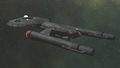 USS Scotia
 -

-

-

-
-
-


Supporting Documents
Notes
- Numerous surplus secondary hulls were constructed, as noted in Guide: Constitution and Guide: Achernar.
- Jumped the completion of USS Horizon to 2193, to match the operational dates. The initial construction year was also changed to 2190.
- Construction of contracts 1023-1025 were halted with the loss of USS Sentry in 2204. NCC-1023 would be re-tasked in 2210 as the NX-1023 USS Indomitable following damage during initial production, while construction on NCC-1024 & -1025 would re-start as the first two Whorfin classes. A third Whorfin (NCC-1029) would be finally ordered in 2212.
- The original Spaceflight Chronology image for the Horizon has been replaced with the current style of images.

- The construction of Guardian and Warrior is detailed in Guide: Byrd.
- Text suggests only one dorsal torpedo launcher was added for the Advance, suggesting a single one only or the addition of one to match an existing one. However, the sidebar suggests the Horizon only had ventral tubes and that the Advance had 2 dorsal ones (n addition to the ventral), so the text has been amended.
- The PB-21 nacelle was re-designated as PB-22, because of the very different design with the same designation in use with the Burke class.
- Timo says the final Advance subclass had a registry of NCC-1029, but I've changed that to NCC-1022 (USS Warrior).
- After some careful thought and a good deal of reluctance, I've raised the Advance production run to 10 (from 9), in order to fill in some empty NCCs left unexplained.
- I arbitrarily determined the Essex class had an endurance of 3 years, primarily due to its enlarged secondary hull.
- USS Essex comes very close to sharing the same commissioned period as the USS Essex of the Indianola subclass. Recommend the Indianola one not get converted/re-commissioned until after 2251.
- Following decommissioning, the secondary hull of USS Southern Cross (NCC-1376) was used for USS Sirius (NCC-Txxx), one of the export heavy cruisers of the Achernar class.[1]
References