Guide:Hermes/Monoceros/Indianola
.png)
| |
| Hermes / Monoceros / Indianola | |
|---|---|
| Class Overview | |
| Category | scout |
| Operational | 2225-2313 |
| Constructed | 29 total: |
| Dimensions | |
| Length |
|
| Beam |
|
| Height |
|
| Mass |
|
| Performance | |
| Cruise Speed |
|
| Max Speed |
|
| Endurance | 3 years |
| Complement | |
| Officers |
|
| Enlisted |
|
| Tactical Systems | |
| Beam Weapons | Hermes:
Monoceros:
Indianola:
|
| Missile Weapons | Indianola:
|
| Shields |
|
| Laboratories | 1x GP, 1x signal processing |
| Transporters | Hermes:
Monoceros:
Indianola:
|
| Auxiliary Craft | Hermes, Monoceros:
Indianola:
|
| Historical | |
| Ships of Note |
|
| Canonicity | |
| Design | STII/Franz Joseph |
| Name | FJ, SotSF |
| History | FJ, SotSF
|
Star Fleet’s transitioning from the solo combat doctrine of cruisers back to joint fleet action did not
happen easily, nor quickly. Even in the era of relatively practical shipborne subspace communicators,
keeping a fleet coherent at warp cruise required significant skill and experience. Also, in order to be
efficient, the fleet would have to know where to strike and when – requiring long-range sensor
platforms in addition to low-observable scouting systems. Mere fleet navigation at warp factor four
stretched the sensor capabilities of cruisers to the extreme, and posed major difficulties for the
destroyers. A dedicated sensor ship of high capacity and fleet speed would help alleviate the problems;
developing a new spaceframe for the ship was deemed unnecessary when the mission was one of
tagging along with existing destroyers.

To meet Star Fleet’s requirement for a Deep Space Fleet Coordination Ship with advanced sensors and high speed, the Saladin design was, in 2224, modified to create the Hermes class. The dorsal phase cannons were omitted along with the torpedo launcher and the ventral mount was moved to the forward quarter. The cleared space was dedicated to sensors of various types. Down-scaling of fire control systems in turn provided space for various C3I facilities. Propulsive systems, shielding and life support remained unaltered from the destroyer standard. A shuttle hangar, essential for exploration operations, was still missing from the design, even though solo exploration was to be a secondary mission profile for the vessels if peacetime ever returned. Various plans were made to add an Einstein style dorsal pod, but in the end, the class was fielded with only the two standard shuttlepods inside saucer docking berths.
Fifteen vessels were built to this standard between 2224 and 2228. While the scouts were theoretically to be the tactical-level eyes and ears of defense fleets patrolling the Klingon border, they were often pressed to use as strategic reconnaissance assets as well. But the loss of two Hermes scouts in 2231 to light Klingon ships on such long range solo missions prompted Star Fleet to narrow down the role of these vessels. It became evident that the inflexible one-nacelle engine system made the scouts perfect targets for more nimble vessels – the high top speed of the scouts was of no use in close warp combat. At loss of a remedy to the performance problem, Star Fleet decided never to deploy the scouts outside protective fleets, and instead used them solely as sensor platforms in conjunction with destroyers and cruisers.
As the Klingon threat receded somewhat after the 2240s, Star Fleet began to regret its major investments in the scouts. Destroyer procurement cutbacks threatened to leave many of the vessels without a mission. As all had already received the powerful PB-31 solid-state/dilithium engines, Mk II transporters, expanded primary hulls and superstructures, and the new low-profile bridge modules, the scouts were now virtually new-model Siva subclass destroyers without torpedoes. Also, fourteen newbuild ships of this standard (named the Monoceros subclass after the first of these newbuilds, but sometimes also known as Hermes II) had been constructed just before the post-Axanar moratorium on destroyer production.*
To restore the balance between destroyers and their accompanying scouts, Star Fleet decided in 2249 to modify eight of the Monoceros vessels (NCC-608-615) into Siva II standard. The scouts received torpedo launchers, targeting computers and sensors, and three double phaser VIIs (one simply inserted to the existing phaser VI berth, two requiring the re-installation of berths in place of former sensor mounts). Some internal differences to the orthodox Siva II destroyer remained; but then again, all ships tended to be individuals due to the flexible internal configurations. Thus, rather than go by the subclass name Indianola (the new identity of the erstwhile Lynx), Star Fleet decided to eschew a special designation for the retro-refits.
The fusion of Hermeses into the Saladin main body can be seen as the first sign of the new Star Fleet trend of simplifying ship lineages. Subclass designations and names were quickly falling into disuse, and general class identifiers were used instead. While it may initially have caused some confusion that three different standards of destroyers served under the same name, many of the readers are probably relieved by Star Fleet’s decision in 2287 to collectively call the 15 different standards and seven official subclasses of heavy cruisers Constitution class instead of using specific sub-variant names. After mid- 23rd century, and due to increasing flexibility of technology, every starship would practically have formed her own subclass as far as internal configuration, engine performance and equipment standards were concerned!
Quite the opposite political environment resulted in another mission swap in the early 2280s. Of the eight destroyers converted from Monoceros scouts, four were returned to scouting duty, as the value of their torpedo launchers in self-defense against the newly bellicose Klingons was acknowledged. Corresponding cuts were made in the now highly vulnerable remains of the original Monoceros fleet. The vessels retained the individual names they had earned in destroyer service, but again were absorbed into ‘parent’ class continuity without the systematic Indianola subclass distinction (which is used in this entry merely for sake of clarity). Such painless transfers back and forth stand further proof of the increasing flexibility of the Fleet, as well as of the ever greater degree of technological standardization.
The Hermes design briefly resurfaced in the 2320s in the Merced class scout concept, and later made a more successful comeback in the era of the Border Wars. However, this configuration has not found much use in other Star Fleet roles. The main attraction of single-engined ships, that of low construction and operating costs, still holds – while the main drawback, poor warp maneuverability, also remains.
* A fifteenth vessel, tentatively named Aries and slotted to receive the registry NCC-602, was damaged beyond salvage during construction phase in 2245. What at first seemed like a tragic accident was later revealed to have been just one of several Romulan acts of sabotage on starship construction that year. The events left both the name and the registry of the lost vessel unused for several years.
Gallery
-
 Hermes subclass
 -
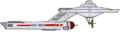 Monoceros subclass
 -
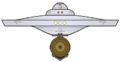 Bow plan
 -
 Dorsal plan
 -
 Monoceros starboard cutaway
 -
 Indianola subclass
 -
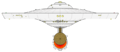 Bow plan
 -
 Dorsal plan
_destroyer_saladin_pro1.png)
_ortho.png)
_ortho.png)

.png)
.png)
.png)
-
 USS Crockett on the frontier
 -
 Scouting out foreign incursions
 -
 "A One and A Two"
 -
 "Unusual Neutrino Emissions"
 -
 Indianola in orbit


External Sources
- Starship Handbook (Combined)
- Vintage Starships: "2242 – Hermes": includes 3D viewer
Notes
- Like the preceding Saladin class to which it is closely tied, the Hermes class will see some objective and critical changes made to the text and sidebar.
- Total numbers of the family build reduced from 50 to 29, to match intent of the article's other facts.
- For clarification purposes:
- The Hermes class was built using the exact same hull and much of the same equipment as the Saladin subclass.
- Starting in 2243, the surviving Hermes and fourteen additional hulls were built along the Siva subclass design, but also with scout equipment in the place of some weaponry. These make up the Monoceros subclass.
- Starting in 2249, eight of the Monoceroses were converted fully to the Siva II standard, becoming destroyers of that line.
- In the early 2280s, four of the former Monoceroes returned to scouting duty, losing their destroyer title. With no actual changes made, they in essence becoming the Indianola subclass of the Hermes family.
- Original primary laser mounts made phase cannons and the numbers increased to 2 (from 1).
- Some references to phasers are changed to phase cannons.
- The Hermes subclass appears to be names after both fictional and historic scouts, while the Monoceros subclass is named for constellations. The Indianola subclass appears to have been re-named after the US riverine ironclads: Indianola, Benton, Essex, Chillicothe, Eastport, Choctaw, Lafayette and Tuscumbia.
- References to different sidebar stats between "early" Monoceroses and "later" ones for height and speeds has been dropped, due to being unsupported within the text (and the timeline not easily supporting such changes).
- The Operational years were pushed back (from 2224 to 2225) to allow for construction and first completion after the first completion of the USS Saladin.
- USS Essex comes very close to sharing the same commissioned period as the USS Essex of the Essex subclass. Recommend the Indianola one not get converted/re-commissioned until after 2251.
- USS Monoceros (NCC-601) was referenced in Guide: Constitution (refit) as having tested the LN-52 warp nacelle in a dorsal configuration, while still equipped with the ventrally-mounted PB-31, which would be removed in 2270. I've decided the testing took place over the 2268-2269 period.