Guide:Byrd
.png)
| |
| Byrd | |
|---|---|
| Class Overview | |
| Category | galactic survey cruiser |
| Operational | 2234-2278 |
| Constructed | 3 |
| Dimensions | |
| Length | 347.0 m |
| Beam | 117.1 m |
| Height | 46.0 m |
| Mass | |
| Performance | |
| Cruise Speed | |
| Max Speed | |
| Endurance | 25 years |
| Complement | |
| Officers |
|
| Enlisted |
|
| Tactical Systems | |
| Beam Weapons | Original
Refits 2259-63
|
| Missile Weapons | Original
Refits 2259-63
|
| Shields |
|
| Laboratories | 16x, in varying configurations
|
| Transporters |
|
| Auxiliary Craft | Exploration phase
Smith second mission
Smith carrier refit I
Smith carrier refit II
Smith commando carrier refit
|
| Historical | |
| Ships of Note |
|
| Canonicity | |
| Design | SFB Napoleon, SFC battle cruiser modified |
| Name | SFB |
| History | SFB
|
When the Archon improved heavy cruiser construction program was cut short in 2224, this was to
the satisfaction of a surprisingly diverse group. Defense Command was eager to divert funds to
cruisers of decisive performance, such as Baton Rouge and Icarus. The UFP Council found delight
in being able to impose ‘cutbacks’ on Starfleet for once. Exploration Command in turn held hopes
that the Archons would be found unfit for front line combat duty and would become available for
long-neglected research, survey and charting projects in deep space. Perhaps the most surprisingly
of all, the major starship design bureaus and shipyards involved in Archon production also
welcomed the news, as it meant resources freed for meatier projects.
For Rapier of New Aberdeen, the only extraterrestrial contractor in the entire Horizon program as manufacturer of USS Guardian and USS Warrior of the Advance subtype, cancellation of the would-be USS Gjöa meant disaster. Dockyards geared for production of heavy cruisers, thousands of professionals still clinging on to expertise from decades past, and material resources already obtained – the massive misinvestment would collapse the corporation and beggar the colonial government. Pleas for replacement contracts were sympathetically received in the UFP Council, where a slight and diminishing majority tried to fight for a policy of unity and support for fringe areas; yet Starfleet could present no useful application for Rapier’s services. While Archon components might be of use in Project Starship, New Aberdeen did not possess the required skills or clearance, and the hull of the Gjöa was in any case too far completed already.
Yet with new cruisers and destroyers finally pouring onto the battlefields in sufficient quantity, Defense Command could take a breather and allow some funding to flow to the competing divisions. Plans on re-engining existing survey cruisers with PB-29 were already in motion, and the Gjöa might well be rescued the same way. Within five years, Exploration Command had funded to completion the design effort on three heavy survey cruisers based on the Archon template, to be constructed in parallel with the Cahuya refits. All three contracts went to Rapier, legitimizing the years of work already conducted on the first vessel.
In all due economy of design, USS Richard Evelyn Byrd (NCC-1381) still represented a challenge of powerplant and drive system integration. While PB-29 was no more massive than the preceding PB-18, it would have to be mounted significantly farther aft to provide proper field interaction between the port and starboard units. Pylon re-positioning meant internal changes, but these were necessitated anyway by a key upgrade criterion: a 70% increase in power production, for the ability to sustain a cruise speed of warp 5 until fuel exhaustion. In practice, this meant replacing the "Sternn" main reactor with a novel and largely untested Kiratovani twin system of 7:1 antimatter augmentation.
At warp, little power was left for armament, of which four lasers and two torpedo tubes were retained and two phase cannon of modern 800 GJ type were introduced. The main tools of trade for the Byrd were her sensors, of fairly conventional make but carried in quantity and provided with bountiful onboard processing and data storage resources. The Byrd cruisers were expected to spend a high percentage of their mission in transit to extremely distant targets, then conduct brief but comprehensive surveys at these locations inaccessible to vessels of lower performance. To reflect this, the balance of sensors was on deep space navigation and charting systems, while planetary survey equipment was less prevalent than in the Cahuya class. A degree of flexibility was built in, though: after establishing orbit around the target, the ship would rapidly reconfigure the sensors, and interior spaces dedicated to habitation during transit would become laboratory spaces.

At completion in April 2234, the Byrd was assigned a mission towards the galactic core, with six targets of interest and a quarter of a century to visit them. The crew of 450 was all-volunteer, their morale high, their equipment first rate. By the October launch date, it had also become evident that they would not be deserting a Federation besieged by superior foe: not only were the new heavy cruisers making a difference on every battlefield, but Klingon military activity overall was rather mysteriously dropping. Hopes of truce and peace negotiations escorted the Byrd on the first leg of her journey. Then communications ceased as the thin ‘breadcrumb’ line of communications relays was expectedly severed.
On schedule, Rapier finished work on the second keel and laid a third. The Charles Kingford Smith (NCC-1382) and Albert Cushing Read (NCC-1383) set out for their 25-year voyages in 2236 and 2238, respectively. By the time of their departure, hopes of Klingon peace were dashed, their momentary weakness over, presumably an artifact of infighting in the Empire. The Babel of 2238 would soon leave the UFP internally divided as well, even if actual dissolutionary attempts were suppressed for the time being. There would be no more Byrds; the spares caches of the completed vessels were confiscated on the assumption that no repairs would ever be performed on any of them.
Yet 2257 saw the Byrd return to communications range of a Federation once more unified in a solid front, easily holding back a dispirited Klingon Empire, and on the verge of launching a massive exploration initiative using the technology of the Great Awakening. The limping survey cruiser would indeed have no need for spare PB-29s, as solid state warp engines of PB-32 type were awaiting her 2259 arrival. Scientific results from the odyssey were eagerly received, while the debriefing of the handful of officers involved in the secret mission of securing new UFP military alliances and technologies was conducted as a dry formality. There would be no need for anyon inversion beams or merculite warheads now that the dockyard crews were installing Type VI phasers and forced-intermix photon torpedoes onto the recuperating Byrd. Nor would the Lyrans become a crucial ally when their association with the UFP would strain recently established relations with the more useful Hydran kingdoms.
A similar reception would await the other two cruisers, and all three would be refitted for a second mission of galactic survey. Yet the Smith would not be launched on one outright; a round of experimental modifications in 2261 would see her trailblaze the cruiser-carrier concept, of which the prototype Napoleon (NX-1384) would emerge in 2265. This awkward design was fated to be easily defeated by through-deck variants of the Constitution type, and saw no further production – two keels were actually cancelled in mid-build. The Smith in turn was able to mount a final mission to galactic north in 2265-78, being the last Byrd to resign her commission at completion of the task.
The success of six exploration sorties of extreme endurance would directly inspire a follow-on class of even more ambitious scope, described in the later Draco entry. Such missions would still remain a rarity in the Starfleet of late 23rd and early 24th centuries, as its new multimission cruisers would often be tied down with defensive assignments. The fairly special circumstances that produced the Byrd class and those that made its Draco successor reality were an opportunity for Starfleet’s exploration arm to extend itself, yet they highlight the limitations under which this branch had to operate even in times of relative peace. In final analysis, the leaps and bounds of Starfleet technology evolution still originate in its military commitments and challenges.
As of this writing, all major missions of deep space exploration are being conducted by dual-purpose ships. Special deep space propulsion arrangements are a rarity, and recent acquisition of advanced technologies in that field is more likely to see general rather than dedicated exploratory application.
USS Richard E. Byrd remains in orbit around Aldebaran as an exhibit of the history and exploits of the entire class.
Gallery
-
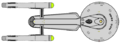 Original exploration phase
 -
 Smith carrier cruiser conversion (starboard)
 -
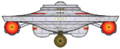 Bow of Smith conversion
 -
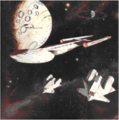 USS Napoleon (NX-1384), the abortive 2260s experiment at a new type of carrier
.png)
.png)
.png)

Notes
- The Smith would undergo a series of modifications, as part of the design process for the carrier-cruiser concept. The first (refit I) would occur in early 2261, with the second (refit II) in late 2262. In mid-2263, refit III would test the idea of commando carrier concept. In 2265, the ship was launched on her second mission, still in the commando form, with exploration-minded auxiliary craft. (Game canon)