Guide:Constitution

| |
| Constitution | |
|---|---|
| Class Overview | |
| Category | Heavy cruiser |
| Operational | 2239-2279, 2286-2289 (NCC-1371) |
| Constructed | 36 total
|
| Dimensions | |
| Length |
|
| Beam |
|
| Height |
|
| Mass |
|
| Performance | |
| Cruise Speed |
|
| Max Speed |
|
| Endurance |
|
| Complement | |
| Officers | |
| Enlisted |
|
| Tactical Systems | |
| Beam Weapons | Testbeds/ Republic prototype: n/a Constitution prototype
Standard (2251-2270), (except for NCC-1371)
|
| Missile Weapons | Testbeds/ Republic prototype: n/a Standard (2241-2251)
Constitution Flight II
Additional for NCC-1700-1, NCC-1708, Victory (2255-2270)
|
| Shields | Testbeds/Republic prototype
later standards
|
| Laboratories | Testbeds/Prototypes
later standards
|
| Transporters | Testbeds/Prototypes
later standards
|
| Auxiliary Craft | Testbeds/Prototypes/NCC-1371 (operational)
NCC-1700 (operational standard)
Standard
|
| Historical | |
| Ships of Note |
|
| Canonicity | |
| Design | TOS, ENT |
| Name | TOS (SFTM, SotSF, FASA) |
| History | TOS (SotSF, FASA)
|

In the early 2240s, the Constitution class heavy cruiser program could easily have been considered a spectacular failure. More than twenty years behind the schedule, five times past the budget, the behemoths taking shape in distant construction yards were apparently hidden from publicity because of the embarrassment of major program setbacks. Hull components were reportedly being gleaned from past shipbuilding programs, two decades out of date. Yet, those who had seen the Bonaventure demonstration knew better. What was emerging was nothing less than a revolution in spaceflight, the first operational incarnation of Project Starship.
The basis of the new cruiser design could be found in studies made way back in 2210 for an improved Horizon-size cruiser. Undisturbed by the poor propulsive performance of the Indomitable battle cruiser upgrade, Chiokis had promised that combining a Horizon secondary hull with the company’s trademark saucer section and modernized engines would result in significant warp performance increases. In 2222, Star Fleet had granted Chiokis the use of two relatively low-fatigue Horizons; first USS Constellation (NCC-1017), which had suffered major battle damage to her bow structures three years earlier, and later also USS Republic (NCC-1371), the victim of a rampant internal fire and extensive contamination from fire suppressants shortly after her commissioning. Their command saucers, as well as their mounting structures, the navigational deflectors, and the main weapons array, were removed.
After two years of iterative design effort, Chiokis managed to mount a new connector structure to the engineering hull, making possible the attaching of a new command section in the most optimal position for hull and warp field interaction. At first, mere placeholder hulls were used for dynamic testing, and no actual ship’s systems were installed. The warp engines were removed from pylon stems outward, and new, long and spindly yet immensely strong pylons mated to the respective positions on the hull; then, structural testing was performed with a pair of inert engine nacelles. All Horizon weaponry was naturally removed from the secondary hull prior to refitting.
In 2226, after favorable yet badly delayed test results, the Constellation received a finalized version of the primary hull and the first set of PB-30A third-generation nacelles with massive ramscoops, finlike intercoolers, and extremely modern and hideously expensive 17-section, solid-state warp coils. Drive plasma was channeled from an advanced compression fusion main powerplant in the engineering hull, the largest yet built, and the ship set sail for early trial runs.
Results from early trials dealt a major blow to Chiokis. Apparently, the hull form did not agree with optimal warp fields after all. Inaccurate (indeed, outright faulty) computational models had failed to predict a potentially disastrous resonance that could be generated in at least three locations, namely the saucer topside and two areas aft of the secondary hull bottom vertex. Solutions were sought using further computer simulations, subscale models and a structural test article for a remodeled secondary hull. Economics precluded the altering of existing Horizon hulls, so Star Fleet suggested that Chiokis leave the designing of an optimized configuration for a future production batch and proceed with the existing hardware in the meantime. Despite this, precious time had been wasted, especially as it was in 2235 finally shown that the Horizon hull configuration was perfectly use-able with a slight altering of engine placement. Computer models of warp dynamics in the 2230s simply were not up to the task of accurately predicting such solutions – only the test flights of the Bonaventure finally verified the results.
By 2238 the program was back on track, with a crucial improvement: a dilithium-regulated antimatter reactor had been substituted for the original 4:1 m/am spicing, compression fusion powerplant. As design details were being finalized, USS Constellation was reactivated as NX-1017. The Horizon type secondary hull was used as intended, yet its structural interfaces modified, now featuring reshaped and lengthened engine pylons for the PB-31 engine, and a strengthened connecting fin for mounting the primary hull. The streamlining of dorsal superstructure immediately below the bridge was also performed, while the development and installation of a new lower-profile bridge module was dropped for budgetary reasons. The test runs with this vessel were successful, and the pre-production standard (still lacking main armament) was—in essential parts—applied on USS Republic as well, validating all construction machinery and methods. Based on this finalized design, Star Fleet dockyards in May 2239 received a go-ahead for a production model of the new heavy cruiser class.
It took some 36 months to complete USS Constitution (NX-1700). In the meantime, refitting of Baton Rouge cruisers with the new power system gave Star Fleet confidence in the dilithium-based technology, as well as a much-needed breather in the struggle against the Klingons. This by no means amounted to a cease-fire; xenoanalysts expressed doubt as to whether the Klingons even recognized such a concept. In February 14th, 2242, a distress call from the Donatu system sent Star Fleet scrambling for ships to defend the frontier colony. A piecemeal battle of attrition developed, claiming the cruisers Endeavor and Yorkshire before Star Fleet’s trump card could be played. Hastily diverted from an evaluation cruise, the Constitution fought off almost single-handedly a succession of D5 and D6 battle cruisers, buying time for the main contingent of Star Fleet reinforcements to arrive.
The badly hurt starship would spend three long years licking her wounds, while Star Fleet reconsidered its investment – and the San Francisco dockyards toiled on an improved cruiser that featured the wider secondary hull after all. Other long-delayed improvements included a more capable impulse engine and radically improved torpedo armament and computational systems. This was to be the definite production standard: USS Enterprise (NCC-1701) was a nearly 700,000 ton vessel capable of warp 6 cruising, armed with heavy lasers and a mixture of phased particle cannon and torpedo systems and the latest-standard shields, and equipped with hypermodern sensors and navigation equipment. The official launch for the vessel came in 2245, and commissioning ceremonies were held almost concurrently with those of the Constitution.*
The Constellation was reworked close to this production standard as well, in order to establish the costs and difficulties of altering the Horizon hulls. Both proved quite prohibitive, and Chiokis had to abandon the plan of using Horizon components for further cruiser production. The Republic received a far less extensive overhaul and was utilized in defensive missions until relegated to training duty in 2248. The remaining badly outdated Horizon class vessels were in turn all retired by 2249, as Star Fleet was fully convinced that the new cruiser class would be a perfect replacement for them.
There was some debate as to which of the four ships initially completed would have the honor of becoming the class ship. The working name, ‘Project Starship’, had been used on the dedication plaques of the two Horizon conversions, and was applied as a placeholder class name to the first two production ships as well. The third newbuild off the dockyards, USS Farragut (NCC-1702), was thus the first to carry the official nomer of ‘Constitution class’.
Once the agonized development and prototyping stage was over, the veil of secrecy was finally lifted from the Starship design. Official commissioning ceremonies for the initial four vessels were public events and propaganda triumphs for Star Fleet, and extensive onboard tours were provided to UFP representatives and dignitaries. Procurement of twelve production models was secured largely thanks to the unconventional yet thorough demonstration cruises arranged by CAPT Robert April, commander of the Enterprise and strong proponent of her use in expanding the nonmilitary role of Star Fleet.
The finalized Constitutions incorporated two hulls of roughly equal volume but different configuration and role. The primary saucer hull contained main crew quarters, weapon systems, sensors and multiple laboratories as well as impulse engines, and the ovoid secondary hull housed engineering facilities, the shuttlecraft hangar and some redundant habitation and research functions.
The two PB-31 warp nacelles were mounted on exceptionally long, straight Bonaventure-style pylons extruding from the top of the secondary hull in a side angle of about 45 degrees, far enough from the crew compartments to protect onboard personnel from the effects of the field and to ensure unobstructed jettisoning. The actual reasons for this placement were dictated by warp field geometry, though, and Star Fleet even issued multiple statements reaffirming the safety of the more traditional nacelle configurations. The coils of the production model were certified for warp 6 cruising and a top speed of warp 8 with dilithium-regulated, total-conversion antimatter power – fusion power was no longer available for warp propulsion in this or later designs.
On top of the saucer was the main bridge of standard Class One design, well protected by the forcefield shields and an outer buffering shell of sensor access spaces. Below this was a two-deck weapons station. Originally intended to hold two to four Saladin-type Mk 1 photon torpedo launchers, the station instead came to feature forward and aft particle cannon; later variants that eschewed with these weapons substituted other facilities, typically including a laboratory complex and a scientific airlock. The torpedo system was still included at a corresponding ventral saucer position, and provided the second spike of the deadly trefoil of the superships. On the widest levels of the saucer were crew facilities, with sickbay, auxiliary control and the computer core best-protected in the middle. The extreme bow held a multi-emitter secondary navigational deflector, as in other Chiokis designs.
Two twin projected-energy weapon banks at the top and one at the bottom of the saucer comprised the standard main armament of this type, originally featuring 4 GW lasers. In a sense, referring to this final component of the trefoil as the ‘main’ armament is misleading, since the phased particle cannon and the improved photon torpedoes actually offered greater destructive potential against most targets. Yet starship captains generally preferred engaging the enemy with lasers whenever possible; and when phaser VII banks in the 2250s replaced the lasers, the saucer emplacements indisputably secured their position as the main combat system of the cruisers. Nonstandard weapon fits were common, even more so than ‘standard’ weapon complements. For example, USS Republic retained laser armament until her deactivation in 2257, mainly due to her training ship status, and was stripped of energy weapons altogether with her reactivation for school ship use in the late 2280s, save for a single saluting gun.
At the aft end of the saucer was the impulse engine unit, in NCC-1700 essentially a Saladin SBE impulse system with four accelerator coil assemblies placed together. From NCC-1701 on, the system was scaled up to almost double the original size and power, to the SBA standard, firing through only two forcefield-vectorable nozzles. Two fusion generators provided both auxiliary power and helium propellant. Main power came from the antimatter reactor via a primary power trunk on connector fin trailing edge, but limited impulse power was available even when mains were off-line.
The secondary hull front end was reserved for the powerful primary navigational deflector system. The compartments behind this featured engineering subsystems, main engineering with the still highly classified dilithium reaction chamber, multilinear antimatter bottles, and a large shuttle landing bay and hangar. The latter facility was considered something of a relic when the first ships were completed – it was originally intended as a flight deck for defensive sublight fightercraft and various shuttles, but the former were already obsolete and the latter were to be replaced by transporters. Later, when the persistence of transporter technology limitations despite the duotronic improvements became obvious, the engineers would congratulate themselves for being farsighted enough to retain the hangar. Indeed, a variant would later be built with a ‘through-deck’ shuttlebay for carrying of fighters, assault shuttles and miscellaneous auxiliary craft.
Several laboratories were located around main engineering, forward of the shuttle hangar; workshops were clustered below the hangar. At the bottom of the ship were antimatter tanks refuelable and jettisonable through access doors on the ventral surfaces, and the main tractor beam assembly. In a mid-2250s refit, select vessels would receive two aft-firing torpedo launchers in specifically prepared compartments above the shuttlebay, while twin phaser emitters would appropriate some of the space originally reserved for an auxiliary cargo hold in the fantail. These weapons were intended to help cover the blind spots not within the cone of fire of the ventral primary hull phaser bank, and to compensate for the lack of heavy rear armament created by the omission of rear particle guns. However, they never really proved satisfactory in solving the blind spot problem; future designs derived from the Constitution class would feature phaser emitters atop and at the bottom of the secondary hull for a better overall solution.
Since the Constitutions were the fastest ships available, they were given facilities to respond to all kinds of emergencies on the remote colony worlds they were to protect. Thus, capacious holds in the secondary hull usually held everything from genetically improved grain seeds to temporary habitats and atmospheric regulators. The ships could be let to conduct colonization missions because, for the first time, they would have the speed to respond to more urgent military crises elsewhere. The element of ‘bringing in the reinforcements’ was thus reintroduced to space combat, as demonstrated dramatically at Axanar.
The Constitution class was upgraded and overhauled several times; in the 2250s, a major upgrade was accompanied by the fielding of fourteen newbuild ships, the first of which was USS Bonhomme Richard (NCC-1712). The main systems to be upgraded were the early PB-31 engines, replaced by PB-32 mod 3 units. Lasers were replaced by Type VII phasers, emitter by emitter. The early Lockheed 447 series units were rather unreliable and delicate pieces of equipment that could seriously overheat after just two or three shots. As the Agusta RI series became something of a fleetwide standard, RIN-8 was considered for the heavy cruisers as well. Such plans never bore fruit, however: the necessary physical modifications, either to the integrated, closely spaced twin emitter assembly or to the more widely separated weapon berths of the ship, were deemed prohibitively expensive.
The separate particle cannon were removed, the loss more than compensated by installing a six-tube Selenia ‘Wolf’ Mk 2 photon torpedo battery on Decks 8 and 9. A few years later, the ships received the Mk 12 upgrade, introducing loaders compatible with improved direct-annihilation warheads. Select units were also given additional phaser coverage, in the form of two single phaser VI emitters at the bottom of the secondary hull; these compact, modular weapons were referred to as amidship phasers. Although Star Fleet also experimented with installing emitters on the superstructure below the bridge, only the amidship phasers went on to become a permanent fixture of future starship generations.
The Bonhomme Richard configuration was found highly satisfactory in all respects; so satisfactory, in fact, that further upgrading of the Baton Rouge-era cruiser fleet was discontinued, and two more Bonhomme Richards completed. Also, all the surviving first-batch Constitutions except the Republic and Potemkin went from original standard through three or four routine overhauls to Bonhomme Richard standard. Finally, the commonalized fleet was in the mid-2260s reinforced by six vessels known as the Victory (NCC-1760) subclass, featuring every possible element of the ‘optional’ upgunning and going straight to the TacFleet special military response force. An accompanying battle cruiser modification with sturdy horizontal pylons and a significantly increased torpedo armament, the Richelieu (NCC-1750), was abandoned without any keels laid, however.
During the fifty years of conflict with the Klingons, a total of 35 heavy cruisers of the Constitution family (plus 13 export variants of the slightly less capable Achernar standard) were thus completed for Star Fleet and its allies. Of these, six were lost in action and a handful of others damaged but later salvaged. The ill-omened Valiant was the first to go, following her three immediately preceding namesakes to ‘missing in action’ records just eight months after her commissioning. Ten years later, the Farragut lost almost half of her crew to a barely physical yet utterly lethal lifeform. Yet the successes of the exploration program offset the defeats, and deep space sorties continued uninterrupted.
Fate was kind to the cruisers again for a decade thereafter, but took cruel vengeance on the original Constitution batch in the first year of Organian peace. The Constellation and the Intrepid were attacked by leviathans of possible extragalactic origin, and the Excalibur devastated by a bizarre computer malfunction during wargames. The crew of the Exeter was all but wiped out by a deadly pathogen; the intact but contaminated vessel had to be withdrawn from service. The Defiant and the Rivoli were subsequently lost in TacFleet service at the rimward frontier, and the Kongo would yet suffer a crippling onboard explosion in 2277 – but surprisingly, none of the Constitutions was ever destroyed by Klingons. Space proved to be dangerous enough even without this menacing enemy. The McLaren administration, already wary of increasing Star Fleet expenditures, considered the losses indicative of a misguided exploration policy, and major cutbacks were suggested and in some cases also effected in the late 2260s. Fleet Admiral Heiharchio Nogura, veteran of the prolonged Klingon conflict and strong proponent of the Constitution exploration program, resigned in protest.
There were valid arguments against the program, however. More and more power was being concentrated on starship captains distanced from the councils of the Federation by gulfs of space and ideology. Moralizing, even patronizing, attitudes towards less driven cultures were assumed, and a type of techno-protectional imperialism began to grow within the ranks of Star Fleet. Several captains of the new starships grossly exceeded their authority, bending the letter and defying the very purpose of the protective Prime Directive adopted early on in UFP history. This could be seen as an effort to forge a closer union with near-human races, a natural counter-reaction in the aftermath of Axanar. On the other hand, this protectionism was also an important factor in quietly establishing Earth as the political and economic ‘strong man’ within the Federation, while officially following the principles of ‘one world, one vote’.
Central to all these arguments was the fact that the Constitutions represented a quantum leap in power, speed and range – a leap so great that they could not help but shape anew the goals and policies of the UFP. Indeed, it was the ultimate success of the exploratory program, embodied by the heroics of surviving starships Enterprise, Hood, Lexington and Yorktown, that finally prompted the McLaren administration to agree on the extensive refit project that would in the early 2270s introduce the LN series of linear engines and ultimately reinvigorate the entire Star Fleet.
*Hidden from the public eye, NCC-1701 had already performed a covert mission in the direction of the Romulan border. This apparent validation run of engines and navigational system is rumored to have included weapons testing as well, but full details are yet to be released as of 2375.
Gallery
-
 Constellation, original prototype with PB-30 nacelles (see Project Starship notes)
-
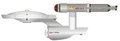 Republic, original prototype with Horizon saucer and (what should be) PB-30s (see notes)
-
 Constellation and (new-build) Constitution, with PB-31 nacelles (see notes)
-
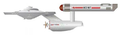 Constellation and (repaired) Constitution, with the near-production standard hull and PB-31 nacelles (see notes)
-
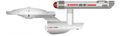 Republic, in it's operational configuration with (what should be) PB-31 nacelles (see notes)
-
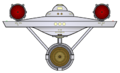
 Constitution class, production
-
-

-
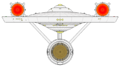
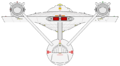
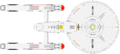
 USS Constitution (NCC-1700), operational refit
-
-

-
-
-
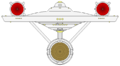
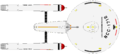
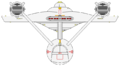
 Bonhomme Richard subclass
-
-
-
-

-
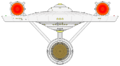
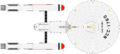
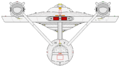
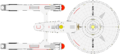
 Victory tactical subclass
-
-
-
-


Additional Images
-

-

-

-
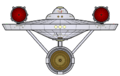
 Constitution (2245)
-
-
-
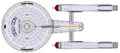
 Constitution (2255)
-
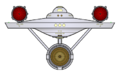
-
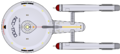
-
 Constitution (2265)
-
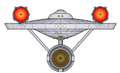
-
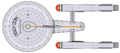


Notes
- Changed the years of several mentions, to allow Republic to be constructed as an Archon before being given over to the project in 2222.
- When the text first introduces the Bonhomme Richard variant, it specifically indicates that 14 ships were initially constructed; 2 more would be built later (per the text), supporting the sidebar's 16.
- The text seems to indicate (with the word "accompanied" that the Bonhomme Richards are different, and that the original Constitutions were updated at the same time. In discussion with Adrasil, I'm interpreting this to be the 1st Pilot Enterprise (or Constitution Flt II). This is confirmed later when it is stated that all original surviving Constitutions (with the exceptions of Republic and Potemkin) eventually met the Bonhomme Richard standard.
- The registry code for USS Constitution is changed to NX-1700, to reflect what it was reported to be, following the battle of Donatu.
- The caption for one of the images was modified to elaborate on which battle of Axanar is depicted.
- The Constitution is proving to be a busy beaver prior to and just after her commissioning; this is the order of events in her early career:
- May 2238: Construction begins on Constitution.
- May 2241: Construction on Constitution is completed; class trials begin.
- July 12th, 2241: CAPT Garth assumes command of Constitution, while it is pierside at Starbase 12.
- August 22nd-29th, 2241: First Battle of Axanar
- Post-Axanar: Constitution ambushed at Lea, taking on additional damage.
- February 14th, 2242: a distress call from Donatu is received; Constitution diverts from her evaluation cruise to assist other Star Fleet vessels.
- Post-Donatu: repairs are re-started.
- April 2245: Constitution commissioned.
- Post-commissioning: USS Constitution, USS Enterprise, USS Constellation, and USS Republic are dressed up to appear damaged or incomplete, and transferred to the forward repair base at Axanar, to lure Klingons.
- Final Battle of Axanar
- Adrasil and I have decided to re-write the weapons loadouts for a number of the variations, to better fit alpha-canon (though with some compromises).
- The originally operational Constitution was, at first, shown as massing 598,400 mts; however, because it was based on the later Constellation, but uprated (with the PB-31 nacelles), it should have been more massive. The mass is now listed as 698,400 mts.
- The Republic was re-activated in the late 2280s; game-canon dates added to sidebar.
- The construction period for the original Constitution newbuilds was changed from 2245 to 2248 (when the Bonhomme Richard began production). because there was no way all 12 newbuilds were completed in the same year.
- The sidebar's operational period for the overall class was changed from 2275 to 2279, since two instances in the text and captions indicated active vessels after that year.
- I've decided Potemkin skips the Constitution Flt II standard and is the first ship to be converted to the Bonhomme Richard standard in 2260 (hence why the original Constitution flight is operational until then).