Guide:Syracuse/Saladin/Siva/Einstein
.png)
| |
| Syracuse / Saladin / Siva / Einstein | |
|---|---|
| Class Overview | |
| Category | destroyer |
| Operational | 2223-2303 |
| Constructed | 59 total:
|
| Dimensions | |
| Length |
|
| Beam |
|
| Height |
|
| Mass |
|
| Performance | |
| Cruise Speed |
|
| Max Speed |
|
| Endurance |
|
| Complement | |
| Officers |
|
| Enlisted |
|
| Tactical Systems | |
| Beam Weapons | Syracuse
Saladin (original)
Boston/Einstein (original)
Siva
Einstein Flt II
Siva Flt II, Siva Flt III
Pompey
|
| Missile Weapons | Syracuse
Saladin
Siva
Siva Flt II, Siva Flt III
Pompey
|
| Shields |
|
| Transporters | Syracuse, Saladin, Boston/Einstein
All classes
Siva
Siva Flt II, Pompey, Siva Flt III
Select ships
|
| Auxiliary Craft | Syracuse
Saladin, Siva (all)
Boston/Einstein (all)
Pompey
|
| Historical | |
| Ships of Note |
|
| Canonicity | |
| Design | STII/Franz Joseph, STXI, ST:Axanar |
| Name | STXI, FJ, Goodman Federation: The First 150 Years |
| History | STXI (FJ) |
| Delta Dynamics | SRM #292 |
Background
Hobbyist's Guide
As Geering continued to provide Star Fleet with its most powerful modern ships in every category, Chiokis was forging a reputation as the most dependable designer of affordable warships to be produced in large numbers. This was actually quite contrary to the company’s aims and ambitions, but helped support the company while it waited for its big break in the Horizon upgrade program where its true hopes were placed. Star Fleet in turn benefited from having two parallel sources for saucer-hulled ship designs, in addition to always keeping at least two different engine manufacturers and shipyards sufficiently employed and funded.
When the upper-tier Detroyat destroyers were ordered from Aurora, Geering for once had to settle on the parallel lower-tier contract. There was little cause for disappointment, as the lighter destroyer was intended for an at least fourfold production run. By 2221, the first two vessels for a planned inaugural batch of 26 were undergoing impulse tests and establishing beyond doubt the structural integrity of the new destroyer workhorse. The primary hull was of obvious Burke pedigree, with a flat, single-deck main disk topped by a terraced superstructure and an aft spine featuring a small shuttlebay above the centerline SAB impulse engine.

Yet an angled ventral ‘neck’ now supported a single PB-29 nacelle – the last although, at 148 meters and 170,000 tons, not the largest of the third generation spooled engines to be designed. At the bow of the nacelle, a Hycor deflector system provided a FTL graviton stream that could sweep clear the flightpath of the ship up to a speed of warp eight—a safe margin in terms of true maximum speeds in the 2220s. The beam was effective up to forty-seven light seconds against 5,000 kg objects, and up to two light minutes against smaller obstacles. The nacelle also contained most of the warp machinery of the ship, and distributed power to various other systems, including a booster feed to the impulse system. A lift and ship’s ladder connected the lower engineering levels to the primary control facility in the main hull, and an airlock complex halfway along the neck provided EV access. Also included in the neck area were workshops and some temporary bunking and rest facilities for the engineering crew.
Armament, while still geared for frontal offense at the deliberate expense of all-around defense, was intended to be quite different from that of the Detroyats. A dorsal pod would house four paired torpedo launchers of small caliber but high rate of fire. The saucer was to be provided with four berths for phase cannon, two dorsally and two ventrally, as well as up to three plus three point defense laser emitters, even though filling of all the berths was never considered the preferred option. Centralized production commenced at Almaz factories on the required weaponry, as various dockyards completed the initial ten hulls. Names honoring ancient cities that had successfully resisted assaults and sieges were chosen; registries for the Syracuse class began at NCC-420, as these lighter vessels were in no way cruiser-like and had no place next to the Detroyats in the registry charts.
After the first combat engagements, it became evident the ship type should not be positioned next to Detroyat formations in more concrete terms, either. Delays in delivery of torpedo systems were not the major problem. Rather, the smaller single-engine configuration resulted in range and maneuverability shortcomings that hindered strategic deployment and made Star Fleet re-estimate its needs. Valuable dockyards could not be wasted on inferior products in this time of ever-heightening crisis. Thus, even though Syracuse production continued within the bounds of already allocated resources, an order was placed on an improved model - a vessel that would become the definitive single-engine destroyer for the better part of the century.
Being slow to reach the thick of battle, the Syracuse group could be expected to suffer lighter combat losses than its successors. Yet Star Fleet was positively surprised that the 2220s and 2230s went by almost without casualties. A second batch originally intended for attrition replacement was nevertheless funded and likewise managed to avoid both combat and wear and tear for the next decade (there being tongue-in-cheek references to divine protection as the vessels in the batch were named after classic Terran gods and demigods). The class thus was deemed fit for receiving the hypermodern PB-45 engine - just in time for the next major Klingon offensive. Lamentably, little else could be modified under the tight schedule and tighter funding, and casualties now began to mount.
Among the first to fall was the Triton (NCC-439), blown up by a Klingon privateer in an early test of Star Fleet mettle in 2241. Axanar casualties here. The Troy (NCC-423) and the Hellas (NCC-426) succumbed in 2245 to Klingon forces at Delta Leonis, but helped evict the fleet of Admiral Kkorhetza from Federation space for good, rendering its Axanar expedition null and void; the destroyer names were honorably assigned to brand-new Loknars soon thereafter. Ten years later, USS Alexandria (NCC-422) was destroyed and the Carthage (NCC-428) and Massilia (NCC-421) damaged in an audacious ramming attack by Klingon special forces at Starbase 19; losses of personnel were light, but material damage too great to warrant repairs of the crippled destroyers. Finally, USS Pompeii (NCC-424) was in 2270 destroyed with all hands by heavy cruiser Enterprise, as part of the ‘dreadnought incident’ that was among the first Star Fleet counter-reactions to the onset of relative peace.
Back in the 2220s, modification work on the Syracuse design had proceeded with rearranging of the primary hull stern. Former shuttle handling spaces were now taken over by additional power generation machinery and fuel tanks. The light twin torpedo launchers had been found disappointing, yet continuing shortages of the heavy Keindoffer-Klaatsen torpedo launchers prevented their adoption at this stage. The existing dorsal pod was thus fitted with a twin-tube unit of novel design and 700 mm caliber instead. The projectiles were still much humbler than the Detroyat torpedoes, no different in dimensions from the 22nd century ordnance and sustaining warp for just four seconds. Yet it was to be this design and not the Detroyat or Syracuse ones that would be further developed for fleetwide use. Built by Selenia of Rome, Earth, the weapon soon propelled its manufacturer to success and fame, and was grandiosely known as the Mk 1 heavy photon torpedo system.*
Within the saucer hull proper, there were four twin laser emitters, two firing from above and two from below the hull. This austere arrangement proved very efficient in comparison with the previous multi-port configurations, a development analogous to that of Earth nautical warships in the 1970s. Also in line with the historical precedent was the armchair expert reaction to the innovation: the gigantic saucer hull was declared "underarmed" and "excessively sized" for its task. Yet the rationale for this was also to be found by a retrospective look. At the threshold of major technological and tactical breakthroughs, Star Fleet wanted to invest in vessels that could easily be fitted with the newest equipment—even when nothing was known in advance about the nature of this yet to be invented gear. The "oversized", internally easily re-configurable Class 1A hull was to become a Fleet standard for ships varying from scouts to heavy cruisers.
Test runs established a top speed of warp 5.5 for the inaugural modified destroyer Saladin, allowing her to be commissioned in 2225 for full military service. Her performance still lagged behind that of the Detroyat class, but not so badly that Star Fleet wouldn’t have taken advantage of the lower acquisition price of the single-naceller. A final distinction from the original, less than stellar design came with the adoption of a registry number somewhat higher up the range, NCC-500.
Several batches of Saladin class destroyers were completed to boost the Syracuses. Twenty ships, all named after Earth warrior leaders, were built to the original standard with conventional total conversion powerplants, and 26 more were originally planned. Yet construction was halted at this point, pending the introduction of the radically new dilithium-regulated antimatter propulsion system. Sixteen ships of the Syracuse standard were converted to this type of power in 2239-42. Instead of the mediumweight PB-45 used in the comparable Saladin sub-class, sophisticated PB-31 nacelles with either FWD-1 or FWD-1A solid-state coils were introduced in the conversion that turned the sluggish Syracuse destroyers into high speed war machines of unprecedented power – worthy stablemates to the emerging heavy cruiser and heavy frigate classes which also utilized this futuristic warp engine type. The more powerful engines were not larger as such, and only increased the overall dimensions of the vessels because their mounting neck was almost tripled in length, for proper coil placement and for housing externally those power systems no longer fitting inside the nacelle. They also increased mass by mere ten percent, despite the greater density of the new coils.
In the end, the original flat saucer proved incapable of accommodating the required internal refits, and Chiokis was called in to perform the necessary modifications. The upper and lower superstructures had to be extended to house an improved, internally carried torpedo system with enlarged magazines, an all-new fire control system, and a sensor array within a prominent dorsal dome. In a further volume-adding move, the saucer was bulged more extensively on the dorsal side, and acquired an additional semi-deck around its ventral rim for the field guides of the Hycor DS-20 shield generator, the combined effect being to give the hull a distinct ventral concavity. This hull form was quite deliberately chosen for its advantageous aerodynamic properties, allowing for increased stability during emergency landings. Within the externally unchanged hull areas, armament was revamped from four individual phase cannon mounts to three paired banks. The laser emitters were removed, as the improved shields already provided superior defenses against proximity threats.
The navigational deflector was remounted on a ventral support strut. A limited mechanical steering capacity allowed for sweeps of 15 degrees in each direction, compared with the maximum 5 degrees of the earlier fixed installations, or the 28 degrees of the Detroyat sensor/deflector dish assembly. However, the whole assembly could also be made to slowly swivel for special purposes, like close-quarters debris sweeping. This modernized system was once again a non-vital item tested for future use. The power output of the destroyer’s total conversion reactor (or even that of the later dilithium powerplant) was not sufficient for the use of the pressor beam as a weapon at warp speeds, but such capacity was planned for the more powerful cruisers that were to follow. The standard forcefield component of the deflector system was a practical defense against kinetic energy weapons.
Since ten new ships were also built to this standard, beginning with USS Siva, the variant is sometimes named the Siva subclass. Three vessels of the original run were left unconverted (2 others having been lost), though, as they had been given a thorough mission and configuration revamp nearly a decade prior. Addition of a dorsal pod similar to that of the Ranger light cruisers had turned USS Boston (NCC-425), USS Drona (NCC-431) and USS Rahman (NCC-434) into destroyer leaders, giving them significantly boosted sensing capabilities, a useful load of auxiliary craft, and spacious C3I facilities. The modification had not decreased warp performance, but it carried an impulse maneuverability penalty.
The conversion had been a qualified success at best, and refitting of old Texas light cruisers to destroyer leader tasks was quickly deemed the better way of spanning the gap left by Ranger losses and retirements. This left the converted single-nacellers free for solo assignments. By 2235, after they had all been renamed after scientists and engineers and dubbed the Einstein sub-class, their registries had been given an O prefix to reflect observation duties in contested space, rather than their intended one as destroyer leaders.
In a mirror image of this move, several Hermes scouts would later be converted to destroyers and in turn have their constellation names changed to those of battle sites. The economical nature of single-engined attrition warships thus offered Star Fleet unprecedented flexibility and allowed timely responses to changing strategic priorities. Few twin-engined classes were available in sufficient abundance to cater for such radical and quick-paced changes until the very last decades of the Klingon conflict.
A further upgrade standard introduced in 2249 gave the Sivas phaser VII armament, forced-intermix warheads for the torpedoes, a lower-profile bridge structure and a tractor beam mounted on the connecting fin’s trailing edge midway between the saucer and the nacelle. This modification (sometimes referred to as the Siva II subclass or the Siva Mk II design, since no new keels were built, and the class ship was the first to be modified), helped the ships stay apace with the latest Klingon threat developments and served until the 2280s as the ultimate standard of Saladin-family ships.
For the first three decades of Saladin destroyer operations, there was little need to introduce major modifications to the basic design. Although suffering from maneuvering problems inherent in the single-engine configuration, the class had been built not only to exceed all the performance requirements of the 2220s, but to easily accommodate future upgrades. From the first keel on, space had been set aside for installing a dilithium-regulated total conversion reactor. Extensive weapon and sensor upgrades were also facilitated by a modular construction approach. There was room to spare for un-predicted innovations as well – the Class 1 primary hull had been built to about 170% its initially needed size for this exact reason. A Siva Flight II vessel from the late 2250s would thus be familiar to an officer from a Saladin from the early 2220s, yet match the modern Larson class in all aspects of performance.
As the 2260s approached, though, time was about to catch up with the veteran design. With destroyers in general disfavor due to de-emphasis on offensive operations, Star Fleet was denied the construction of further vessels of Saladin design. This served the existing destroyer fleet well, as funds were freed for experimentation that would hopefully restore the Saladins to the forefront of the combat force. Even the most advanced models of the class were separated from that position by shortcomings in warp maneuverability, propulsive reliability and redundancy, directed energy armament and sensor technology. The obvious solution for most of the issues was application of multiple engine nacelles. A move that would have made no sense back when the destroyers served as offensive attrition units was now considered reasonable; in the post-Axanar lull, even the Saladins were to be utilized as high-tier ‘multipurpose’ vessels.
Reassigning USS Pompey (NCC-506) from the Klingon border to propulsive research was a simple matter in 2260. Obtaining two PB-32 engine sets presented no problems, either; these were quietly taken from the Nelson scoutship spares cache. The deep space engines offered an excellent speed range, endurance and economy, but were slightly less flexible in terms of field shapes than the new PB-47. A conservative configuration was therefore chosen, and the nacelles were attached to a horizontal pylon in approximate Detroyat or Surya style. Multilinear containment systems were installed largely within the broad midsection of the single-piece pylon box, while vertical power trunks connected the pylon to the engineering control area in the primary hull, ahead of the impulse engines. Between the vertical sections, there was enough room for a hangarette that could accommodate a single light warp shuttle, as well as offer full maintenance facilities and precision tractor beam approach control for the craft.
More significant additions to mission gear were the two phaser VII emitters of FH-11 type installed ahead of the bridge, to bring the total to four twin banks. Auxiliary navigational deflectors were bolstered by two extra emitter dishes, and shielding was upgraded to Hycor CS-60 standard. Such off-the-shelf upgrades held promise of an affordable rejuvenation for the entire destroyer fleet. Two other Sivas were taken in for similar modification as the Pompey in January 2262 began her propulsive trials.
Largely satisfactory test results nevertheless failed to gain the appreciation of the financiers. In comparison with the similarly configured heavy frigates, the Pompey remained a modestly performing starship. Flexible mission profiles still could not be shouldered on the type: laboratories were missing, shuttle facilities minimal, sensor and computing suites limited to combat essentials. While it was obvious that the type would excel in deep space escort duties – once again a significant part of Star Fleet frontier operations – there was no obvious replacement for the original single-nacellers in the offensive-defensive role. Rather than weaken the latter aspect to strengthen the former, Star Fleet chose to place its bets on heavy frigate upgrades. The option for further Pompey conversions was deferred to indeterminate future.
Increasing Klingon tensions in the latter half of the decade brought Star Fleet close to ordering the conversion of ten more vessels. However, the unexpected outcome of the Organian confrontation put such plans on limbo again. The involuntarily adopted ‘garrison strategy’ on the Klingon border lessened the need for independent medium range combat assets, and major shifts in funding left the entire destroyer fleet high and dry. The three Pompey vessels were sent on escort duty, but the great pirate hunt was already winding down; general convoy was discontinued, and the destroyers found themselves riding shotgun to individual Star Fleet transports on high-risk routes. In this role, they enjoyed an intriguing advantage: as the only escort vessels in Star Fleet service to utilize the PB-32 engine, they could masquerade as Ptolemy transports from a distance. Many a raider was lured to his doom by the distinct warp signature, combined with transport-like mass figures—and in some cases even a suitably altered silhouette. The Pompeys could accept a ventral cargo grapple, this in turn mounting a single standard cargo container. Rarely utilized for actual cargo runs, the destroyers instead carried lightweight mock containers or armed ‘Q-pods’, necessary force multipliers when facing the sort of pirates that still dared operate in the late sixties and early seventies.
The Pompey and the Suleiman (NCC-508) were retired in 2277, the Sargon (NCC-504) in 2292. The decommissioning dates were directly tied to PB-32 lifetime. The engine was all but gone from the cruiser and tug/tender fleets already, and casting of new coils had long since been discontinued. Priority to PB-32 spares and maintenance was given to the once-wronged Nelson class. There never were any direct replacements for the Pompeys; the refitted Larsons and new Cochises filled the original limited-endurance destroyer niche instead, and the later Polaris destroyers emerged from a completely independent project. From the technological viewpoint, there was little to be learned from the circumferential-engined Pompey when the linear-engined Polaris class was conceived. Operational experiences emphasized the aspects neglected or unachievable in the Pompeys, and marked a shift towards true multi-mission starships.
No modification, however, could address the main problem of this at its time extremely innovative and modern design. The narrow cylindrar warp field generated by the single set of coils within the single nacelle did allow the ships to reach speeds up to warp 8, but the maneuverability of the vessel at such speeds was minimal. Early on, this practically forced the ships to drop to sublight and use impulse thrust maneuvering to reach firing positions in close combat situations, making them virtually powerless in one-on-one combat against more maneuverable vessels.

The relatively bloodless solution to the Axanar crisis meant that Star Fleet’s ambitious shipbuilding programs became grossly oversized. There was little real military action between Axanar and the 2280s, and very few of the Saladins ever saw combat in that time period. Still, Star Fleet trained aggressively for the use of the destroyers both in defense and offense. The earlier slow-paced combat tactics of warp speed deployment runs and impulse maneuvering gave way to high speed engagements where the destroyers only occasionally dropped to sublight speeds. Given the poor warp maneuverability of the early types, extreme skill was required in these operations. Not surprisingly, major casualties were soon suffered in practice maneuvers. In 2259, USS Iblis (NCC-528) hit the battle cruiser USS Newton (NCC-1127) with her navigational deflector, killing 23 aboard the latter ship. In the 2262 exercise Have Gun, USS Azrael (NCC-527) sprang a major leak and lost 12 crew when she loitered too close to the black star TNC 65823, and in disorientation collided with the shields of the dreadnought Dominion (NCC-2115).
Many a hotshot Star Fleet captain received her or his initial command experience and combat training in the Saladin fleet, which despite the problematic handling qualities was ideal for the role: no other assignments tied down the offensive force in the late fifties or sixties. On the other hand, the absence of glorious battles meant that UFP saw less and less need to build dedicated capital ship killer vessels like the Saladin and later Larson classes. After the final Larson batch of 26 was procured in 2261, destroyer funds were redirected to experiments intended to address the inherent shortcomings of the single-nacelled configuration. The attempted remedies were somewhat un-innovative, though. Adding a second nacelle to USS Pompey (NCC-506) and two sisters in 2262 merely resulted in a disproportionately expensive destroyer or a poorly performing frigate. The Siva III dorsal-nacelle experiment performed on NCC-520 would in 2275 give the same results at even greater expenses.
Yet so poor was the reputation of the single-engine configuration at this point that the order for a final 26 Saladin destroyers in the late sixties was turned down by the Council a phenomenal six times in a row. The two-nacelled Akula class based on Siva III was funded instead, in one of the worst procurement blunders of the late 23rd century. It would take a completely new engine and a renewed Klingon threat to give Star Fleet back its confidence in the abilities of single-engined vessels, as described in the later Cochise entry. The original Syracuse lineage would be all but gone by the 2287 détente, and only the most extensively modified variants would see the turn of the century.
At the time of the writing, sixteen Siva II ships still reside in surplus depots in near-operational condition. Star Fleet has not activated these vessels for the better part of a century mainly because of lack of trained personnel to handle the utterly antiquated power systems – spares could readily be manufactured by replicators, of course. While many political entities have long expressed interest in purchasing the dormant vessels, and while the technology aboard the ships no longer suffers from export limitations, the act of selling the ships themselves is contrary to UFP Council decisions in the aftermath of the Altair VI sales fiasco.
* Even though the Selenia launcher in the 2220s was dubbed a ‘heavy’ weapon, this work systematically follows the practice introduced in 2271, where weapons of this caliber are know as ‘medium’ systems. Actual ‘heavy’ weapons by current standards would be first introduced in the 2280s, while ‘light’ systems would remain comparable from the 2220s to the 2370s. The introduction of mini- and microtorpedoes has further muddled the waters during the past century. Yet the remarkable degree of standardization in Star Fleet torpedo weaponry warrants the continued use of this simplistic-sounding, now five-tiered system.
Delta Dynamics
Syracuse class destroyer
Though in serious competition for the more complex heavy destroyer Detroyat design, in a bid to break out as the predominate military shipbuilder in the Federation, Geering lost out to Aurora. However, this was far from a critical setback, as the company had been recently awarded the Burke frigate contract and received the lower-tier Syracuse destroyer one immediately following the Detroyat announcement. Since there were at least four times as many hulls associated with this particular victory, the other loss to Aurora was not a large cause of disappointment.
The Syracuse was relatively simple to take on, as it used the Burke-type saucer with relatively few modifications to it. It borrowed the hangerette/spinal attachment that was well underway for the forthcoming Aldrin subclass deep space frigate, and incorporated Geering's developing concept of a weapons pod, though with a permanent presence and an established torpedo tube arrangement. The nacelle pylon design was also similar, though only one nacelle was incorporated into this design.
The PB-29 warp nacelle had proven—in the initial warp tests—the capability of getting this anti-capital ship platform up to warp 5.1, with a cruise speed of warp 4. The nacelle itself massed 148,000 metric tons and came in at a length of 148 meters. Similar to the PB-21 series, it also had a Hycor deflector system built ahead of the stunted Bussard collector, providing an FTL graviton stream out forty-seven light-seconds ahead of the vessel, for obstructions up to 5 tons and up to two light-minutes for considerably smaller objects. It also carried most of the warp power generation equipment, though the nacelle pylon shared some of this responsibility.
The weapons pod was a concept developed for the Burke class nearspace frigates which Geering promoted as an installable option when heavy firepower was needed for an emergent threat. The off-hull pod idea was explored with the Syracuse, though it was not removable on this vessel, since the torpedoes served as the primary weapons system. Unfortunately, the tight space and still-developing technology meant that the pod was restricted to two forward and two rearward light torpedo tubes (though a total complement of 60 photonic torpedoes were loaded in the magazine).
Early combat engagements demonstrated the class was just not a worthy combatant alongside the Detroyats, not only because the warheads were under-inspiring, but largely due to the lack of maneuverability associated with a single nacelle warp field. Range also proved to be a considerable barrier to strategic deployment of the Syracuse assets and all three shortcomings forced Star Fleet planners to re-examine the needs of the fleet. While production of the first two runs remained authorized, Star Fleet ordered an improved model be identified and produced.
The Syracuse destroyers' first production run honored ancient cities that had successfully resisted assaults & sieges, while the second run were named after classic Terran gods and demigods.
.png)
.png)
.png)
.png)
Saladin subclass destroyer
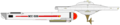
Due to the numerous disappointments that severely limited the Syracuse class in serving alongside its intended sister-in-arms, the Detroyat, the third production run was delayed in order to incorporate lessons learned. Intending to honor Earth warriors of the past, the subclass was designated as Saladin, after the lead new-build. Additional power generation machinery and the requisite fuel tanks replaced the hangerettes in the stern (the smaller contingent of two shuttlepods and one work pod were stored in small concealed cargo bays accessed ventrally), while the “peashooter” torpedo tubes in the weapons module were replaced with (only) two forward-facing Selenia 700mm Mk 1 heavy photon torpedo launchers. These were deemed marginally more effective, but less so than the Detroyat’s much heavier Keindoffer-Klaatsen warp launchers, which were in production shortage.
To the disappointment of the armchair admirals, who claimed the saucer was too large to be under-defended, the Saladin subclass also had two fewer defensive lasers than the Syracuse, with the phase cannons also removed. The rationale, later proven, was the twin bank arrangement was more efficient than the single emplacements and the removed (and unnecessary) weaponry freed up space in the saucer for future equipment, even though the nature of those additions were not yet realized.
Test runs of the PB-45 nacelle on USS Saladin brought the top speed up to warp 5.5, which finally allowed the light destroyers to exceed the more massive Detroyat’s 5.2 (at least until the latter’s refit in 2230), and cruise at warp 5. The ship was commissioned in 2225, with a greater length (than the Syracuse) of 226 meters, though the height and beam dimensions remained the same. The endurance, afforded by the increased fuel, was a year longer. Two additional officer billets replaced the four enlisted ones removed.
Forty-six hulls were initially planned, over four to five runs, but production was halted after the second batch was completed in 2227. Radically new dilithium-regulated antimatter technology was on the cusp of being released and it was decided that the next variant of Syracuse destroyers would be able to make efficient use of this new interpretation on variable matter conversion propulsion.
.png)
.png)
.png)
.png)
.png)
Boston subclass destroyer leader
In 2230, USS Boston (NCC-425), the sixth Syracuse-class destroyer—about six years after her commissioning—re-entered drydocks for a radical modification. The weapons pod was removed and a pre-built secondary hull was attached, via a strengthened spinal extension and pylon, to the dorsal side of the saucer. The intention, experimental in nature, was to address some of the shortcomings of the single-nacelle class from which she originated. The class had been faulted—amongst other issues—as being too slow to the “fight”, arriving well behind established task force doctrine. This, along with the ships’ lack of warp maneuverability, was to be addressed by the installation of a considerable amount of command, control, communications, and intelligence (C3I) apparatus that would enable a lead ship to focus on the battle (or other situation) already in progress and bring in the late arrivals (usually operating in formation) at exactly the angle and attitude to instantaneous advantage.
Typically, in blue navies of old, a destroyer leader was a destroyer of larger displacement than other similarly-designated warships with which it operated, usually significantly better armed and/or armored, but still fulfilling the role of capital ship engagement. However, Star Fleet chose the appellation “leader” literally, by providing dedicated and precise combat control for generally three other Syracuse destroyers nominally assigned to a specific task force, when that task force could not be expected to “spare the horses” in order to allow the slower ships to maintain the larger formation. The removal of the primary weapon for a destroyer, the torpedo launchers, was seen as necessary in order to provide the deemed level of battlespace awareness for the delayed entrants. Instead of designing an entire new class, seen as throwing additional credits at an unplanned tactical shortfall, the Boston, Drona (NCC-431), and Rahman (NCC-434) were selected to step out of their original roles and take on the compensatory one of guiding their sisters.
The modification, surprisingly, had not decreased the ships’ original warp performance, though it did have a significant impulse maneuverability penalty. This, along with the “de-fanging” of the main weapons systems, usually meant the destroyer leader held station outside or orbited the battle, continuing to provide battlespace data updates to the friendly combatants. The addition of a useful load of auxiliary craft (18 light or 6 heavy shuttles, 2 shuttlepods, and 4 work pods) also allowed the Boston subclass ships to provide search, rescue, recovery, and repair capabilities both during and in the aftermath of a confrontation.
.png)
.png)
.png)
.png)
.png)
Einstein subclass observation ship
The C3I role undertaken by ships Boston, Drono, and Rahman starting in 2231 was deemed a qualified success. It also opened the door for a similar re-tasking of 18 of the old Texas class light cruisers (re-designated as Navigator subclass) shortly thereafter. Because there were six times as many Navigators as Bostons, it was decided to take the destroyer leader role completely from the trio and assign them, with their superior sensor suites, to the (generally) solitary observation role.
The new mission—patrolling suspect areas of hostile borders or other contested space—was an easy fit for the Bostons and by 2235, in an act normally not condoned in naval tradition, the three vessels were all re-named after scientists and engineers: Einstein, Gray, and Kelvin, respectively. To further differentiate them from the destroyer registry range in which they were embedded, they were given a prefix of the letter “O” as a reflection of their observation duties. Despite the added letter, the three were often affectionately referred to as the “zero-” or “aught-leaders”, in recognition of their brief but forward roles as destroyer leaders.
.png)
.png)
.png)
.png)
.png)
Siva subclass destroyer
Starting in 2239, the Syracuse class destroyers began a program to modernize, with the primary intent to adopt the radically new dilithium-regulated propulsion systems, much as the Burke class frigates would attempt five years later. Unlike the frigates, however, the effort was a complete success, and definitely worth the expense and time. The new solid-state coils led to the introduction of the sophisticated PB-31 nacelle, which was only about 10% more massive, despite the increased density of the FWD-1 (and later FWD-1A) coils.
These powerful new nacelles were not themselves directly responsible for the overly different vertical dimensions of the Siva subclass, when compared to its parent. This was attributed to the nacelle pylon—more of a mounting neck—that placed the nacelle almost three times as far from the saucer, for proper coil placement and for housing the power systems that would be normally found installed within older, spooled coil housings.
The changes to support the revolutionary new take on dilithium power required a new profile of the role of the saucer. Space would have to be appropriated in the main superstructure, more than the neck could spare, in order to provide the power the nacelle required. To also accommodate all of the operational, tactical, and support equipment the ship needed meant that the saucer would have to be redesigned. Andorian shipbuilding company Chiokis was brought in to handle the re-design.
These saucer changes were also an opportunity to adopt all new manners of other fabulous technological improvements, which helped guide the overall change in shape. Upper and lower decks were extended, allowing the addition of a prominent dorsal sensor array and the inclusion of internal torpedo launchers; this allowed the weapons sled to be jettisoned permanently. An additional partial deck was added to the rim for the Hycor DS-20 shield generator’s field guides; now, the laser emitters could be removed, since the shields were far superior in proximity defense. This, in turn, opened up additional weapons space for two more phase cannons, with the entire complement re-located into three paired banks. The navigational deflector was remounted on the ventral bulge, from a steerable strut. While not powerful enough to serve as a warp weapon, this was the intent for a cruiser design yet to be developed, and the Sivas’ could serve as an operational testbed.
Confidence was so high that not only were ten new-built Sivas funded, but all of the remaining original Syracuse ships were ordered to begin conversion, on a staggered schedule. (Three Syracuses had already been converted to the Boston/Einstein subclass, and two others had been lost in the line of duty.) By 2242, the Syracuse configuration was historical only, with its mission fully met by the Siva subclass.
.png)
.png)
.png)
.png)
.png)
Siva Flight II destroyer
In 2249, the Siva subclass was both refitted and enlarged in overall numbers, but with no new-builds. Instead, the USS Siva herself initiated the upgrades of both propulsion and tactical equipment, starting with a clean sweep of the external hull, warp nacelle, and accompanying pylon. The PB-32 nacelle provided cruise and maximum speeds of warp 6 and warp 8 (from 5 and 5.8, respectively). The weaponry was completely replaced: the torpedo systems were modified to support forced-intermix warhead supply equipment and the six phase cannons were replaced by an equal number of less massive—but far more adaptive—Type VII phaser emitters. The bridge was provided a lower target profile by being “sunk” half a deck into the surrounding deck 2 superstructure. And, for utilitarian purposes, a powerful tractor beam emitter was mounted on the pylon’s trailing edge, midway between the saucer and the nacelle.
The Siva Flight II became the iconic image of the single-nacelle destroyers, not only because of its familiar external heritage shared with the Constitution class heavy cruisers, but also largely due to their sheer force of presence: the 26 original Sivas were joined by the remaining 20 Saladins in the Flight II configuration and—crossing class identification lines—eight Monoceros (of the Hermes family). This decision to add these “cousin” ships was largely based on the need to re-balance the scout/destroyer ratio, but the pre-existing similarity between the Sivas and Monoceros played a large part in the determination. Their yard periods were longer, due to the installation of torpedo launchers, targeting computers, and six phaser emplacements and the removal of specialized sensors, and they were recommissioned with new names (though they retained their construction codes).
Despite the stellar speed performance afforded by the PB-32, the single nacelle design was still severely hampered in the maneuverability arena; the ships had to drop from warp outside the battlespace, to adjust for close combat situations at impulse—jeopardizing their survivability in one-on-one combat against more maneuverable opponents. Still, knowledge is power and awareness of these limitations helped keep the ships from finding themselves in such dire straits. Historically, the more famous casualties involved the USS Iblis (NCC-528), which—in 2259—struck USS Newton (NCC-1127) with her navigational deflector, killing 23, and the USS Azrael, which sprung an atmospheric leak pulling away from a miscalculated approach on a black star, losing 12 crewmembers.
.png)
.png)
.png)
.png)
.png)
Pompey subclass destroyer
The Syracuse/Saladin/Siva family of destroyers was developed and operated as a source of attrition units, during a time of near-certainty of total war with the Klingon empire. This is not meant to say they were constructed haphazardly by any means, but that the intent of the class was to engage larger capital ships in acts of harassment, in order to allow Star Fleet’s own capital ships to press advantages that might not be available in a more symmetric battle. If ships were to be lost, better it to be the smaller ones that sacrificed themselves in order that the more capable cruisers survived and persevered.
One of the well-documented weaknesses of these “cheaper” ships was its lack of maneuverability while at warp speeds. One of its proven strengths was adaption, so in the late 2250s, considerable effort was made to make these ships “multi-mission capable”, a more valued attribute than a combat-focused single mission. One of the ways this was explored was by adding an additional nacelle to improve the maneuverability weakness. USS Pompey (NCC-506), a Siva Flight II, was pulled off the Klingon border and reassigned to the propulsion research group established to improve the destroyer assets. An additional PB-32 was acquired from the Nelson class spares cache and both nacelles were attached via a horizontal pylon bar meeting in a junction platform installed on the bottom of the now-shortened neck pylon.
A hangerette was slotted into the neck (at the expense of the tactical tractor) to allow more rapid deployment of the warp-enabled light shuttle (than from the previous ventral saucer cargo hatches). An additional bank of FH-11 Type VIII phasers was added to the forward dorsal saucer and two more deflector emitters joined the pre-existing array on the saucer rim. Defensive shielding was upgraded to the Hycor CS-60 standard. As the Pompey approached completion, and the low cost of such a conversion warranted further ships being upgraded, USS Sargon (NCC-504) and USS Suleiman (NCC-508) were also taken off the line for similar yard periods.
And the Pompey subclass destroyers would only ever number three. Though 10 more were on the verge of being ordered (also as conversions) in the late 2260s as Klingon tensions mounted, the Organian peace treaty put a stop to that. The reasoning for not changing all of the Syracuse family to this variant was simple: “it’s not enough.” Yes, the increased maneuverability was substantial and appreciated, but in the end the ship did not have the multiple redundancies that larger classes carried as a matter of course; such installations would actually reduce the present capabilities of the destroyers at considerable expense in shipyard time. Additionally, there was no way to shoehorn the laboratories, minimal auxiliaries, sensors, and supporting computing power a true multi-mission platform required. The Pompeys would excel at deep space escort, without a doubt, but such conversions of mission would then leave Star Fleet without the “damage sponge” role for fleet actions. Instead, it was decided to enhance the multi-mission need of the fleet with upgrades to the heavy frigates and allow the Sivas to continue in their traditional role.
Pompey Q-pod
The Pompey, Sargon, and Suleiman would continue to operate in the deep-space escort role for a minimum of 15 years (30, for the Suleiman). Another advantage that came with the double nacelle design was the ability to masquerade as just another under-defended Ptolemy transport at both long and medium sensor ranges. When outfitted with its own container, it maintained the façade even at visual ranges—until it dropped the pod, opened fire and took offensive maneuvers. Early in the design phase, it was realized that a customized tow module could be easily attached at the pylon box and the ship could carry an empty container with barely any drop in efficiency, and even a full container at speeds still in excess of the Ptolemies.
It was not long before missions to draw raiders out were proposed and Q-pods were provided to the Pompeys: powered by the mothership, a set number of the doors on the container’s 11 false hangers would open to reveal a full-powered Type VI phaser bank, manned by the ship’s own crew at local stations. These opening barrages were often enough to surprise and scare away some raiders, but it also gave the convoy the opportunity to draw in the mass of smaller vessels, disable a few, and allow the Pompey to release the pod and sweep up the retreating ships. Dedicated turbolift stations enabled the pod crew to quickly return to the Pompey before disengagement.
The primary downside to the Q-pods was that the Pompey could only charge two of the available banks at the same time, while keeping the ship’s own phaser armament fully primed. However, a simple hierarchical algorithm allowed the ship’s helmsman to quickly assign routed power to another of the pod’s phaser stations between the raider passes, if necessary.
Pompey torpedo module
Additional attachment systems were also proposed for the Pompeys when the viability of a container tow module was first realized. Though neither would enter service—because of the decision to not continue the conversion of the Sivas—modules of each were manufactured.
The first was a torpedo pod of enormous relative size. The odd dimensions were a necessity; the pod had to be quickly attached with a station’s own work pods (no need for a drydock facility), but the Pompey’s underslung navigational dish was an obvious impediment to torpedo launch. The workaround was to have either a dedicated extension to the pylon box to place the torpedo module well under the dish—which would take longer to install and require additional support infrastructure to be stored in a near-ready status—or to widen the module itself to launch the torpedoes around the sides. The latter was the preferred option, as it allowed for the inclusion of the automated machinery necessary to support the heavy torpedo launchers. The width also allowed for a considerable number (55) of torpedoes in the embedded module armory.
The inclusion of rear-firing launchers was, literally, an afterthought in the planning process. The initial pod was smaller than the mounting plate for the container tow module, therefore it had to be extended by a fair bit; it already had enough heat radiators and adding in another 45 torpedoes seemed like an unnecessary expense and drain on the ship’s armory upkeep procedures. Rear-firing launchers required just a bit more of a pod hull than was necessary for the former and were not seen as providing anything other than an added and valued weapons arc.
Pompey scanning array
The subspace scanning array was another component meant to take advantage of the container tow module on the Pompey subclass destroyers. Like the torpedo pod, it would not enter service—because of the decision to discontinue the conversion of the Sivas. However, two were manufactured and tested by the Suleiman.
The pod had an advanced Mk IX (later designated Type I) subspace scanner array on every side, except for the dorsal (as that would be covered by the module attachment point). The sensors themselves provided both active and passive detection capabilities out to 5 and 15 lightyears, for high and low resolutions respectively. The initial pod experienced considerable interference (and even disruptive electronic feedback in other ship’s systems, in one event) because the full forward sensor array reacted poorly with the ship’s navigational deflector. However, that was quickly resolved with an adaption that put two much smaller arrays that “peeked” around the dish, but coordinated their emissions with the uprated sensor computers installed within the pod.
-

-
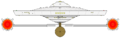
-
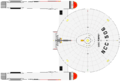
-
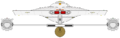
-
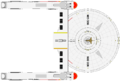
-
 With tow module
 -
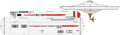 With Q-pod
 -
 With torpedo module
 -
 With sensor module
.png)
.png)
.png)
.png)
.png)
.png)
_(stbd).png)
.png)
.png)
Einstein Flight II observation ship
Starships are designed with a specified lifespan; a starship that exceeds this target usually requires a tremendous investment in maintenance costs, which is often a stated reason classes are retired en masse. If, however, the class is valued enough, the ships may receive refits which extend the lifespans an equivalent period of time (i.e., generally matching the initially programmed lifespan), significantly reducing those costs. A comprehensive review of equipment and structure, involving the planned replacement of any item lacking appropriate levels of technical capability expected of the present era, takes place, often with an accompanying and considerable change both internally and externally. A refit usually takes between 6 months and a year to complete and is often tied to a change of command.
In 2262, the Einstein, Gray, and Kelvin—each about 40 years old—entered the yards for a long-scheduled refit period. Chiokis had already performed superbly in updating the other members of the Syracuse class from the Geering saucer, so it was decided to give them a crack at updating the capabilities of the Einsteins, with the introduction of the Flight II configuration. The ships were lengthened (by the swapping out of the PB-29 with the PB-32) to almost 245 meters and heightened to 66 meters. The new warp nacelle enabled the ships to cruise at warp 5 (a full factor increase) and achieve the maximum speed of warp 7.5 (from 5.1), with only an additional 28,000 tons added overall. The phase cannons and laser emitters were all replaced by the six underpowered Type V phasers (in 3 banks), though the weapons’ adaptability was well appreciated for their defensive capacity. Lastly, the vastly improved deuteron wake detectors were increased in surface area and moved to the hull’s pylon (in order to keep shuttlebay activities from interfering).
The ships continued to operate in their observation role well into the 2280s.
.png)
.png)
.png)
.png)
.png)
Siva Flight III (testing model)
In the early 2270s, two members of the Siva Flight II configuration—USS Siva (NCC-520) and USS Jenghiz (NCC-501)— were re-assigned to separate propulsive research groups. The latter was provided in the study of furthering single-nacelle propulsion for future destroyers and scouts (as detailed in the Cygnus series), while the former was given up for the intent of once again modernizing the large numbers of Siva destroyers. Geering, the lead corporation on this task, started by removing the ship’s single PB-32 and replacing it with the ultra-modern LN-64.
While this would clearly enhance the ship’s cruise and warp speeds, even with the relatively antiquated warp core of the Siva, the full intent was to increase the maneuverability of destroyers in general, making them more effective in their anti-capital mission. So, following the successful integration and testing of the ventral LN-64 (placed in an inverted position for optimum multiple warp field integration), the ship returned to drydock for a radical change in its overall superstructure: the ventral pylon was replicated by a dorsal one to a high degree of similarity, with a second nacelle installed atop it. Flight testing immediately followed.
Unfortunately, the highly expensive modification was no more effective in either warp speed nor maneuverability than the horizontally-modified ships of the Pompey configuration. The physics of subspace displacement fields, as it was thought to be understood, could not account for this failure. Surely—it was reasoned—the problem lay in the technical engineering of the Siva class when married with linear warp technology. Thus, the path to the development of the two-nacelle Akula was paved with hopeful intentions.
.png)
.png)
.png)
.png)
.png)
Siva Flight III (operational upgrade)
Like with the Pompey modernization program of a decade earlier, the Siva herself was still seen as a viable platform. While she would not once again be the vanguard for her sisters, she was still seen as a ship fully capable of continuing fleet escort assignments, as her warp performance envelope had increased. Star Fleet authorized the removal of the two (now) light torpedo tubes from her dorsal saucer and a single heavy torpedo launcher was added low on her ventral pylon. The ventrally-mounted dish clearly had to be removed and some old, familiar equipment of the long-ago Syracuse/Saladin days was broken out of storage: the deflector emitters were installed at similar locations on the Siva. Though antiquated and prone to electronic failures, there were plenty of parts to draw upon from the caches and they worked well enough.
USS Siva remained operational in her solo Flight III configuration, including as a reserve and then training vessel, until 2301.
Note: USS Siva kept the Flight III moniker from her research period through the operational upgrade for two reasons: 1) she was not operational during the propulsion testing, therefore not yet recognized as a production version, and 2) as she would never be visually compared to the Siva Flight IIs (being the only ship to be so modified) for identification purposes.
.png)
.png)
.png)
.png)
.png)
Ship Registry
| Registry | Ship Name | Original Configuration |
1st Overhaul | 2nd Overhaul |
|---|---|---|---|---|
| 420 | USS Syracuse | Syracuse | Siva | Siva (Flt II) |
| 421 | USS Massilia | Syracuse | Siva | Siva (Flt II) |
| 422 | USS Alexandria | Syracuse | Siva | Siva (Flt II) |
| 423 | USS Troy | Syracuse | Siva | (destroyed) |
| 424 | USS Pompeii | Syracuse | Siva | Siva (Flt II) |
| 425 O425 |
USS Boston | Syracuse | Boston/Einstein USS Einstein |
Einstein (Flt II) |
| 426 | USS Hellas | Syracuse | Siva | (destroyed) |
| 427 | USS Leningrad | Syracuse | ||
| 428 | USS Carthage | Syracuse | Siva | Siva (Flt II) |
| 429 | USS Stalingrad | Syracuse | Siva | Siva (Flt II) |
| 430 | USS Lovech | Syracuse | Siva | Siva (Flt II) |
| 431 O431 |
USS Drona | Syracuse | Boston/Einstein USS Gray |
Einstein (Flt II) |
| 432 | USS Starplotter | Syracuse | Siva | Siva (Flt II) |
| 433 | USS Adad | Syracuse | Siva | |
| 434 O434 |
USS Rahman | Syracuse | Boston/Einstein USS Kelvin |
Einstein (Flt II) |
| 435 | USS Melqart | Syracuse | Siva | Siva (Flt II) |
| 436 | USS Shaitan | Syracuse | Siva | Siva (Flt II) |
| 437 | USS Gilgamesh | Syracuse | Siva | Siva (Flt II) |
| 438 | USS Sarpedon | Syracuse | Siva | Siva (Flt II) |
| 439 | USS Triton | Syracuse | (destroyed) | |
| 440 | USS Clymene | Syracuse | Siva | Siva (Flt II) |
| 500 | USS Saladin | Saladin | Siva (Flt II) | |
| 501 | USS Jenghiz | Saladin | Siva (Flt II) | |
| 502 | USS Darius | Saladin | Siva (Flt II) | |
| 503 | USS Alaric | Saladin | Siva (Flt II) | |
| 504 | USS Sargon | Saladin | Siva (Flt II) | Pompey |
| 505 | USS Xerxes | Saladin | Siva (Flt II) | |
| 506 | USS Pompey | Saladin | Siva (Flt II) | Pompey |
| 507 | USS Kublai | Saladin | Siva (Flt II) | |
| 508 | USS Suleiman | Saladin | Siva (Flt II) | Pompey |
| 509 | USS Attila | Saladin | Siva (Flt II) | |
| 510 | USS Tamerlane | Saladin | Siva (Flt II) | |
| 511 | USS Alexander | Saladin | Siva (Flt II) | |
| 512 | USS Hannibal | Saladin | Siva (Flt II) | |
| 513 | USS Ahriman | Saladin | Siva (Flt II) | |
| 514 | USS Cyrus | Saladin | Siva (Flt II) | |
| 515 | USS Julius | Saladin | Siva (Flt II) | |
| 516 | USS Scipio | Saladin | Siva (Flt II) | |
| 517 | USS Hamilcar | Saladin | Siva (Flt II) | |
| 518 | USS Sun Tzu | Saladin | Siva (Flt II) | |
| 519 | USS Trajan | Saladin | Siva (Flt II) | |
| 520 | USS Siva | Siva | Siva (Flt II) | Siva (Flt III) |
| 521 | USS Lucifer | Siva | Siva (Flt II) | |
| 522 | USS Molock | Siva | Siva (Flt II) | |
| 523 | USS Hathor | Siva | Siva (Flt II) | |
| 524 | USS Ares | Siva | Siva (Flt II) | |
| 525 | USS Mars | Siva | Siva (Flt II) | |
| 526 | USS Tyr | Siva | Siva (Flt II) | |
| 527 | USS Azrael | Siva | Siva (Flt II) | |
| 528 | USS Iblis | Siva | Siva (Flt II) | |
| 529 | USS Loki | Siva | Siva (Flt II) | |
| 608 | USS Indianola | (converted) | Siva (Flt II) | |
| 609 | USS Benton | (converted) | Siva (Flt II) | |
| 610 | USS Essex | (converted) | Siva (Flt II) | |
| 611 | USS Chillicothe | (converted) | Siva (Flt II) | |
| 612 | USS Eastport | (converted) | Siva (Flt II) | |
| 613 | USS Choctaw | (converted) | Siva (Flt II) | |
| 614 | USS Lafayette | (converted) | Siva (Flt II) | |
| 615 | USS Tuscumbia | (converted) | Siva (Flt II) |
Gallery
Other Images
-
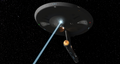 USS Saladin fires her forward phaser bank at a planetary target during her shakedown/systems tests
 -
 A Siva on colony escort assignment
 -
 A Siva on patrol
 -
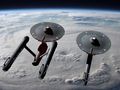 "Sister Flight": USS Enterprise and USS Saladin come alongside in orbit
 -
 "The Other Frying Pan"
 -
 "The Saladin Returns Too"


Master Sheets
-
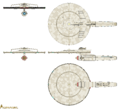 Syracuse
 -
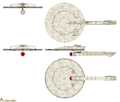 Saladin
 -
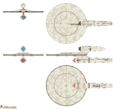 Boston/Einstein
 -
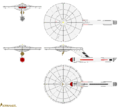 Siva
Siva -
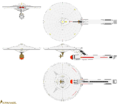 Siva Flight II
 -
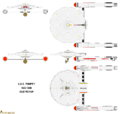 Pompey
 -
 Pompey
(with sensor module)
non-master -
 Pompey (with torpedo module)
non-master -
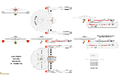 Pompey
(with tow module & Q-Pod)
non-master -
 Einstein Flight II
 -
 Siva Flight III (test model)
 -
 Siva Flight III (operational)
.png)
.png)
.png)
.png)
.png)
.png)
_(final).png)
_(final).png)
.png)
.png)
.png)
.png)
Supporting Documents
External Sources
Notes
- The name of the article has been changed to reflect the four major sub-classes (of seven) associated with this build, from the original Timo's Guide focus on Saladin.
- Extensive changes to descriptions in the text and the sidebar have been made in order to resolve the radical differences between the Prime and NuTrek type imagery. This means the weaponry will more likely match the Spacedock rules in regards to equipment nomenclature. These changes include:
- Syracuse sub-class:
- The provision of operational years (to 2242), based upon a refit to the Siva configuration
- The loss of 2 ships (because only 19 are accounted for when discussing conversions)
- Plasma cannon being replaced by phase cannon
- Laser emitters becoming point-defense weapons, rather than the primary armament (which is now provided by phase cannon)
- Saladin sub-class:
- The provision of operational years (to 2253), based upon a refit to the Siva II configuration
- Length increased due to newer nacelle
- Aft saucer torpedo launchers removed
- Plasma cannon being replaced by phase cannon and placed in banks
- Laser emitter quantity increased to eight and placed in banks
- Boston/Einstein sub-class:
- The three ships initially form the Boston subclass, based on modification of the first ship; all re-named and redesignated as Einstein subclass observation ships prior to 2235.
- The provision of operational years (to 2282), chosen based upon service following a documented refit
- Decided upon the refit as occurring in 2263; extra mass representative of conversion to Chiokis (i.e., TOS) style.
- Established cruise and max speeds, endurance and enlisted crew.
- Determined same beam weapons as the Syracuse, but only two forward torpedo launchers, because of dorsal pod spine
- Siva subclass:
- The provision of operational years (to 2253), based upon a refit to the Siva II configuration
- the reference of plasma cannon operating in a point-defense role has been changed to lasers
- phasers have been replaced by phase cannon
- Siva II subclass:
- Pompey subclass:
- Timo created a separate article for the three ships of the Pompey subclass, even though he provided (differing) specs for it in the original article. However, despite the large difference in the vessel's image from the originating Siva Flt II, I've incorporated that article into this one, by providing its own section.
- The first paragraph of the Pompey section declares an external similarity between a Siva Flt II and the much earlier Saladins. However, Timo was quite clear that the Saladins had the Geering KT-verse externals, which suggests the Pompey article was not updated. That part of the paragraph, upon incorporation into the Syracuse article, is re-written to suggest it is the operations (and maybe internals) that remain familiar.
- Specs changed to show 1 light warp shuttle (to match the Pompey section and 2 work pods, from the previous 2 shuttle pods and 1 work pod.
- Specs changed for length, beam, and height from 242.5/237.7, 156.8/160.1, and 57.8/53.4 meters respectively. Mass was also reduced to that of the Pompey article, from 607,000 mt.
- Einstein Flt II subclass:
- Specs changed for length, beam, and height from 217.7, 124.6, and 49.6 meters respectively.
- Siva Flt III:
- Max warp changed from w 8.0 to 8.2, to match Pompey performance.
- Specs changed for length, beam, and height from 243.1, 127.1, and 78.3 meters respectively.
- Syracuse sub-class:
- Pompeii (of Syracuse sub-class) is named for the Italian city; Pompey (of Saladin sub-class) is named for the leader of the Roman Republic.
- Changed the hull numbers for Massilia and Rahman to match naming structure.
- Changed Xerxes and Eztel to Boston and Drona to match naming structure.
- The loss of Troy and Hellas is now a year earlier, to be a part of (game-canon) Four Years War.
- Syracuse sub-class enter service a year earlier (2223) and the Saladins a year later (2225).
- The reference to the USS Newton as a tender has been changed to that of a battle cruiser, to match the Proxima class ship in service at the time.