Guide:Larson: Difference between revisions
No edit summary |
|||
| (19 intermediate revisions by the same user not shown) | |||
| Line 1: | Line 1: | ||
{{Sidebar Guide ship | {{Sidebar Guide ship | ||
|image=[[|250px|''Larson'' destroyer]] | |image=[[File:Larson (2245)(side).png|250px|''Larson'' destroyer]] | ||
|classname= ''Larson'' | |classname= ''Larson'' | ||
|category= destroyer | |category= destroyer | ||
|years= [[2240]]-[[2283]] | |years= [[2240]]-[[2283]] | ||
|constructed= 89 total<br> | |constructed= 89 total:<br> | ||
* Mk Ia: 9 ([[2240]]-[[2242]]) | * Mk Ia: 9 ([[2240]]-[[2242]]) | ||
* Mk Ib: 10 ([[2240]]-[[2242]]) | * Mk Ib: 10 ([[2240]]-[[2242]]) | ||
| Line 64: | Line 64: | ||
|historicalships=<br> | |historicalships=<br> | ||
* ''USS Alesia'' (NCC-4454) | * ''USS Alesia'' (NCC-4454) | ||
* ''USS Coral Sea'' (NCC-4402) | |||
* ''USS Cromwell'' (NCC-4477) | * ''USS Cromwell'' (NCC-4477) | ||
* ''USS Guadalcanal'' | |||
* ''USS Larson'' (NCC-4400) | |||
* ''USS Sheridan'' (NCC-4463) | * ''USS Sheridan'' (NCC-4463) | ||
* ''USS Thelenth'' (NCC-4405) | * ''USS Thelenth'' (NCC-4405) | ||
| Line 71: | Line 74: | ||
|history= own, FASA | |history= own, FASA | ||
}} | }} | ||
The first half of the 2240s was the climax of | The first half of the [[2240s]] was the climax of [[Star Fleet]]’s attempt to close the gap between Klingon | ||
and UFP military strength. The Saladin program had provided the fleet with large numbers of | and [[UFP]] military strength. The ''[[Guide: Saladin|Saladin]]'' program had provided the fleet with large numbers of anti-ship | ||
weapon platforms, but even after the dilithium upgrade these vessels could be considered | weapon platforms, but even after the dilithium upgrade these vessels could be considered | ||
attrition units at best. The more potent Detroyats were in theory more to | attrition units at best. The more potent ''[[Guide:Detroyat|Detroyats]]'' were in theory more to Star Fleet’s liking, but were | ||
built in low numbers due to their complexity. In 2239, | built in low numbers due to their complexity. In [[2239]], Star Fleet initiated the development of a | ||
dilithium destroyer that would finally combine the affordability of the Saladins and the potential of | dilithium destroyer that would finally combine the affordability of the ''Saladins'' and the potential of | ||
the Detroyats, and become a worthy stablemate for the Constitution heavy cruisers. | the ''Detroyats'', and become a worthy stablemate for the ''[[Guide:Constitution|Constitution]]'' heavy cruisers. | ||
It was still argued that the warp maneuverability of a two-nacelle system would not be required in | It was still argued that the warp maneuverability of a two-nacelle system would not be required in | ||
destroyer operations; the task of intercepting could be handled by photon torpedoes. Even though | destroyer operations; the task of intercepting could be handled by photon torpedoes. Even though | ||
still rather clumsy and inaccurate, the most recent torpedo designs far outperformed the Detroyat | still rather clumsy and inaccurate, the most recent torpedo designs far outperformed the ''Detroyat'' | ||
main weaponry and would thus compensate for the lack of warp agility of the launching vessel. A | main weaponry and would thus compensate for the lack of warp agility of the launching vessel. A | ||
less expensive one-nacelle configuration would then arguably be cost-efficient and battleworthy. | less expensive one-nacelle configuration would then arguably be cost-efficient and battleworthy. | ||
Performance goals were set at an initial-standard cruise speed of warp 5 and a rather high top speed | Performance goals were set at an initial-standard cruise speed of warp 5 and a rather high top speed | ||
of warp 8. The ships would be fielded in relatively large numbers to accompany the already | of warp 8. The ships would be fielded in relatively large numbers to accompany the already | ||
numerous Saladins; the new cruisers and heavily armed twin-nacelle frigates, both featuring | numerous ''Saladins''; the new cruisers and heavily armed twin-nacelle frigates, both featuring | ||
groundbreaking technology from Project Starship, would add to | groundbreaking technology from Project Starship, would add to Star Fleet’s torpedo firepower as | ||
well. | well. | ||
Even though the PB-31 engines were lifted directly from the latest Saladin upgrade program, the | [[File:No Photo Available.jpg|left|200px|thumb|''USS Larson'' (NCC-4400, here ‘ghosting’ as NCC-3702 for an assignment to the [[Epsilon sector]] of the Klingon border) pays honors to an entire lineage of [[Star Fleet]] heroes, from Admiral William Larson, the distinguished leader of [[Earth]]’s first true interstellar war, to Captains Glen and Penelope Larson of contemporary career years. The class was virtually the only one in [[UFP]] Star Fleet to follow the past custom of honoring recent military leaders. Explicit decisions against such naming schemes have never been made, but it is the tacit policy of Committee for Star Fleet to avoid the controversy of ‘rewarding large-scale acts of violence’, no matter how just these seem from the viewpoint of the era.]] | ||
original Saladin field configuration was modified by inverting it and flattening it slightly to imitate | |||
Even though the PB-31 engines were lifted directly from the latest ''Saladin'' upgrade program, the | |||
original ''Saladin'' field configuration was modified by inverting it and flattening it slightly to imitate | |||
a two-lobed field. The nacelle was supported above the primary hull by two triangular struts that | a two-lobed field. The nacelle was supported above the primary hull by two triangular struts that | ||
each housed extensive cooling arrays in addition to the plasma conduits. Antimatter power | each housed extensive cooling arrays in addition to the plasma conduits. Antimatter power | ||
| Line 101: | Line 106: | ||
The ships were armed with three powerful twin 2 GW laser emitters, again in an inverted | The ships were armed with three powerful twin 2 GW laser emitters, again in an inverted | ||
arrangement in comparison with the Saladin systems. Primary firepower was to be provided by a | arrangement in comparison with the ''Saladin'' systems. Primary firepower was to be provided by a | ||
four-tube Mk 2 ‘Wolf’ torpedo system, much developed from the Mk 1 Saladin incarnation. This development did not proceed without problems, though. The first six-tube ‘Wolf’ systems tested | four-tube Mk 2 ‘Wolf’ torpedo system, much developed from the Mk 1 ''Saladin'' incarnation. This development did not proceed without problems, though. The first six-tube ‘Wolf’ systems tested aboard heavy cruisers had a prodigious rate of misfires, and the four-tubers introduced the further | ||
aboard heavy cruisers had a | idiosyncrasy of mechanically jamming when commanded to disarm. [[Selenia]] struggled hard to make | ||
the systems behave; still, many of the destroyers were initially fielded with a ''[[Guide:Baton Rouge|Baton Rouge]]''-type | |||
the systems behave; still, many of the destroyers were initially fielded with a Baton Rouge -type | |||
particle cannon in place of the torpedo system. When the Mk 2 launcher finally was delivered to | particle cannon in place of the torpedo system. When the Mk 2 launcher finally was delivered to | ||
frontline units, it still proved bulky and somewhat unreliable. Highly capable growth variants were | frontline units, it still proved bulky and somewhat unreliable. Highly capable growth variants were | ||
nevertheless soon mounted on the Surya, Coventry and Constitution classes. | nevertheless soon mounted on the ''[[Guide:Surya|Surya]]'', ''[[Guide:Coventry|Coventry]]'' and ''[[Guide:Constitution |Constitution]]'' classes. | ||
A crew of 195 operated the ship, their living quarters sharing the space on the seven decks with | A crew of 195 operated the ship, their living quarters sharing the space on the seven decks with | ||
| Line 114: | Line 118: | ||
for the crew behind jettisonable hull hatches, but actual onboard auxiliary craft were limited to work | for the crew behind jettisonable hull hatches, but actual onboard auxiliary craft were limited to work | ||
pods; four six-pad transporters were installed for personnel transport needs. A planetary landing | pods; four six-pad transporters were installed for personnel transport needs. A planetary landing | ||
could be performed with the nacelle jettisoned. One such emergency landing did take place in 2261, | could be performed with the nacelle jettisoned. One such emergency landing did take place in [[2261]], | ||
when USS Cromwell (NCC-4477) took refuge on d Canaris VI after the nacelle was ripped out and | when ''USS Cromwell'' (NCC-4477) took refuge on [[d Canaris VI]] after the nacelle was ripped out and | ||
life support compromised by a relativistic-speed meteoroid cloud (perhaps extragalactic visitors, | life support compromised by a relativistic-speed meteoroid cloud (perhaps extragalactic visitors, | ||
perhaps projectiles from an ancient war | perhaps projectiles from an ancient war). Recovery and repairs were successful and returned the | ||
vessel to service by 2263. USS Sheridan (NCC-4463) had fared worse, losing all but three of the | vessel to service by [[2263]]. ''USS Sheridan'' (NCC-4463) had fared worse, losing all but three of the | ||
crew on her maiden voyage to a power system explosion that could not be contained. Nacelle | crew on her [[2261|maiden voyage]] to a power system explosion that could not be contained. Nacelle | ||
jettison systems were indeed notoriously unreliable even in the case of the largely self-contained | jettison systems were indeed notoriously unreliable even in the case of the largely self-contained | ||
mid-23rd century circumferential engines – and problems are confounded in the modern distributed | mid-[[23rd century]] circumferential engines – and problems are confounded in the modern distributed | ||
designs where high-energy plasma leads to the nacelle have to be cut, sealed and purged before | designs where high-energy plasma leads to the nacelle have to be cut, sealed and purged before | ||
jettisoning. | jettisoning. | ||
As many as eighty-nine of the modern destroyers were built under the class name '''''Larson''''', in four | |||
As many as eighty-nine of the modern destroyers were built under the class name Larson, in four | |||
distinct batches, although just nineteen were procured in the initial configuration, divided more or | distinct batches, although just nineteen were procured in the initial configuration, divided more or | ||
less evenly between phase cannon and torpedo types. Each ship was named after a famous Earth – | less evenly between phase cannon and torpedo types. Each ship was named after a famous [[Earth]] – | ||
or, in the single case of USS Thelenth (NCC-4405), Andorian – military commander, later also after | or, in the single case of ''USS Thelenth'' (NCC-4405), Andorian – military commander, later also after | ||
famous battle sites. Registries were frequently changed, warp signatures fiddled with, and ships | famous battle sites. Registries were frequently changed, warp signatures fiddled with, and ships | ||
shuffled and reshuffled between starbases to hide the true numbers of these ships, the ‘ghost | shuffled and reshuffled between starbases to hide the true numbers of these ships, the ‘ghost | ||
numbers’ ranging from low 3700s to high 4400s. While the trick was beginning to lose its | numbers’ ranging from low 3700s to high 4400s. While the trick was beginning to lose its | ||
effectiveness as Klingon intelligence forces gained in experience, later examining of Klingon | effectiveness as Klingon intelligence forces gained in experience, later examining of Klingon | ||
archives has revealed that the Empire did initially overestimate the number of Larsons by an impressive hundred hulls. Apart from the perimeter ship deceptions, this was the greatest such | archives has revealed that the Empire did initially overestimate the number of ''Larsons'' by an impressive hundred hulls. Apart from the perimeter ship deceptions, this was the greatest such counterintelligence victory against the Klingons, but also among the last. | ||
counterintelligence victory against the Klingons, but also among the last. | |||
Even when not backed up by ‘ghost ships’, the destroyers provided | Even when not backed up by ‘ghost ships’, the destroyers provided Star Fleet with considerable anti-ship | ||
attack power at minimum possible cost and maximum effectiveness. Some 34 were added to | attack power at minimum possible cost and maximum effectiveness. Some 34 were added to | ||
fleet strength in the early [[2250s|fifties]]. However, the wisdom of ''Larson'' procurement was repeatedly | |||
brought to question in reviews ordered by the | brought to question in reviews ordered by the [[Sariv]] administration of [[2250]]-[[2253|53]]. Despite initial high | ||
hopes and continuing insistence, the destroyers were quite unsuitable for exploration, research or | hopes and continuing insistence, the destroyers were quite unsuitable for exploration, research, or rescue operations. Also, as materials and transporter-fabrication technologies advanced, questions were raised about the necessity of such "contingency" warships in general. Thanks to the new technology, many formerly prohibitively expensive designs like the twin-engine frigates of ''[[Guide:Miranda|Miranda]]'' family were now available for the role of "attrition units". Finally, the mission requirement of | ||
rescue operations. Also, as materials and transporter-fabrication technologies advanced, questions | challenging enemy capital ships of superior strength began to sound hollow in view of continuing Romulan isolation and post-[[Axanar]] Klingon aimlessness. Again, there were factions that claimed that the ships would be useless against the Klingons and over-armed for anything else. As a result, three attempts at further production were deferred between [[2253]] and [[2261]]. | ||
were raised about the necessity of such | |||
technology, many formerly prohibitively expensive designs like the twin-engine frigates of Miranda | [[File:No Photo Available.jpg|left|200px|thumb|A ''Larson'' destroyer cruising placidly against a nebula background is by no means a typical sight. Long patrol cruises were not part of the destroyer mission profile, and single deployments of ''Larsons'' on deep space missions were exceedingly rare in the [[2260s]] when this picture of ''USS Coral Sea'' (NCC-4402) was taken. The Fleet never used its own ''Larsons'' in anti-piracy or local defense duties, either. However, as distribution of retired ''Larson'' vessels to allied fleets was authorized after a token ‘neutering’, many foreign operators subsequently pressed them to independent combat and patrol duty. The Orions were also quick to utilize this design as they had used numerous others, creating true ‘pirate copies’ for their usual purposes.]] | ||
family were now available for the role of | |||
challenging enemy capital ships of superior strength began to sound hollow in view of continuing | |||
Romulan isolation and post-Axanar Klingon aimlessness. Again, there were factions that claimed | |||
that the ships would be useless against the Klingons and | |||
three attempts at further production were deferred between 2253 and 2261. | |||
In the early sixties, all remaining ships were gradually brought to full phaser VII standard and | In the early [[2260s|sixties]], all remaining ships were gradually brought to full phaser VII standard and | ||
equipped with duotronic systems. With a simple change of some plasma seals and MHD turbines, | equipped with duotronic systems. With a simple change of some plasma seals and MHD turbines, | ||
the engine system was uprated to warp 6 operations, of which the coils were already capable. At the | the engine system was uprated to warp 6 operations, of which the coils were already capable. At the | ||
same time, newly militant Klingon attitudes led to growing support of | same time, newly militant Klingon attitudes led to growing support of Star Fleet escalation, and the | ||
opposition to destroyer-class ships diminished. However, the period of Klingon aggressions | opposition to destroyer-class ships diminished. However, the period of Klingon aggressions | ||
culminated not in a war, but in the Organian peace treaty; this soon brought back to surface the | culminated not in a war, but in the Organian peace treaty; this soon brought back to surface the anti-destroyer | ||
sentiments. The Larson class was among the classes most affected by budgetary cutbacks, | sentiments. The ''Larson'' class was among the classes most affected by budgetary cutbacks, | ||
first by the bleeding off of funds for the Defender program, then by the early years of the McLaren | first by the bleeding off of funds for the Defender program, then by the early years of the McLaren | ||
administration austerity: requests for engine upgrades to PB-47 standard were categorically denied, | administration austerity: requests for engine upgrades to PB-47 standard were categorically denied, | ||
as were sensor updates. By 2268 the class seemed certain to be retired almost entirely within the | as were sensor updates. By [[2268]], the class seemed certain to be retired almost entirely within the | ||
next five years. | next five years. | ||
The introduction of linear warp engine technology briefly brought promise of a less gloomy future. | The introduction of linear warp engine technology briefly brought promise of a less gloomy future. | ||
In a refit begun in 2268, a baker’s dozen of Larsons were pulled in for the so-called Mk VII modification that would equip them with LN series warp engines and modern sensors. This | In a refit begun in [[2268]], a baker’s dozen of ''Larsons'' were pulled in for the so-called Mk VII modification that would equip them with LN series warp engines and modern sensors. This extensive upgrade is described later in an [[Guide:Larson refit|entry]] of its own. Despite its advanced features, the | ||
extensive upgrade is described later in an entry of its own. Despite its advanced features, the | modernized design did not find a niche in the now frigate-permeated Star Fleet. It ended up playing a | ||
modernized design did not find a niche in the now frigate-permeated | relatively minor role during the [[2270s]] - [[2280s|80s]] and was relegated to reserves according to Khitomer | ||
relatively minor role during the 2270s - 80s and was relegated to reserves according to Khitomer | treaty cutbacks in the mid-[[2290s]]. | ||
treaty cutbacks in the mid-2290s. | |||
The heyday of the Larson class was definitely the period between the 2260 upgrade and the | The heyday of the ''Larson'' class was definitely the period between the [[2260]] upgrade and the | ||
Organian peace treaty. The very existence of the ships is credited for keeping the Klingons at bay in | Organian peace treaty. The very existence of the ships is credited for keeping the Klingons at bay in | ||
most fronts. The class enjoyed a ‘threshold weapon’ status similar to that of the Detroyats and | most fronts. The class enjoyed a ‘threshold weapon’ status similar to that of the ''Detroyats'' and | ||
Apaches in the 2220s-40s, presenting the aggressor with an unsolvable equation: how to penetrate | ''[[Guide:Icarus/Ashanti/Apache|Apaches]]'' in the [[2220s]]-[[2240s|40s]], presenting the aggressor with an unsolvable equation: how to penetrate | ||
the swarms of medium-cost destroyers to inflict damage to the actual enemy capital ships and | the swarms of medium-cost destroyers to inflict damage to the actual enemy capital ships and | ||
installations, without losing disproportionate numbers of one’s high-cost strike units? Neither the | installations, without losing disproportionate numbers of one’s high-cost strike units? Neither the | ||
Saladins nor the Larsons alone could not have created such a deterrent, not with their poor warp | ''Saladins'' nor the ''Larsons'' alone could not have created such a deterrent, not with their poor warp | ||
maneuverability – but a modern destroyer still was quite capable of forcing a Klingon battle cruiser | maneuverability – but a modern destroyer still was quite capable of forcing a Klingon battle cruiser | ||
out of warp with her torpedoes, exposing her to other types of defensive fire. Indeed, no fewer than | out of warp with her torpedoes, exposing her to other types of defensive fire. Indeed, no fewer than | ||
sixteen Larsons are credited with warp intercepts of Klingon ships during the frequent raids these | sixteen ''Larsons'' are credited with warp intercepts of Klingon ships during the frequent raids these | ||
aggressors made to UFP territory between 2260 and 2265; all these engagements ended in Klingon | aggressors made to UFP territory between [[2260]] and [[2265]]; all these engagements ended in Klingon | ||
retreat and minimal | retreat and minimal Star Fleet casualties. | ||
Offensive success using flotilla tactics was limited. | Offensive success using flotilla tactics was limited. A five-ship expedition was lost in contested | ||
space near Romulan territory in 2263, only the severed warp nacelle of USS Alesia (NCC-4454) | space near Romulan territory in [[2263]], only the severed warp nacelle of ''USS Alesia'' (NCC-4454) | ||
remaining to tell of its demise; this brought total losses for the class to eight hulls. | remaining to tell of its demise; this brought total losses for the class to eight hulls. Star Fleet reports | ||
cited poor long range sensing and signal analysis capabilities as the main vulnerabilities. Clearly, | cited poor long range sensing and signal analysis capabilities as the main vulnerabilities. Clearly, | ||
the destroyers were far better suited for mixed-type fleet operations where the sensing and analysis | the destroyers were far better suited for mixed-type fleet operations where the sensing and analysis | ||
power of coordination ships or cruisers would be available. | power of coordination ships or cruisers would be available. | ||
The Larsons survived the Organian cutbacks slightly better than the older Saladin lineage. About | The ''Larsons'' survived the Organian cutbacks slightly better than the older ''Saladin'' lineage. About | ||
half the surviving fleet was put in mothballs in the mid-seventies, leaving two flotillas to serve | half the surviving fleet was put in mothballs in the mid-[[2270s|seventies]], leaving two flotillas to serve | ||
alongside the Mk | alongside the Mk VII–modified units. This force was allocated two ''[[Guide:Monoceros|Monoceros]]'' scouts for | ||
coordination and sensing, efficiently pairing like performances. The flotillas were disbanded by the | coordination and sensing, efficiently pairing like performances. The flotillas were disbanded by the | ||
end of the decade, however, for the days of the circumferential warp drive were over, in the | end of the decade, however, for the days of the circumferential warp drive were over, in the | ||
destroyer force at least. | destroyer force at least. | ||
Star Fleet has never officially regretted its decision to scrap the vast numbers of decommissioned | |||
destroyers. Admittedly, the Larsons were technically outdated, represented a poor balance of | destroyers. Admittedly, the ''Larsons'' were technically outdated, represented a poor balance of | ||
offensive and defensive systems for the post-Khitomer environment, provided inadequate crew | offensive and defensive systems for the post-Khitomer environment, provided inadequate crew | ||
accommodation standards and were economically | accommodation standards and were economically nonviable. Granted, a conversion to linear warp | ||
drive had been attempted and found wanting. And to be sure, the factual scrapping only took place | drive had been attempted and found wanting. And to be sure, the factual scrapping only took place | ||
after certain Khitomer clauses made it both mandatory and verifiable by Klingon and impartial | after certain Khitomer clauses made it both mandatory and verifiable by Klingon and impartial | ||
observers. But many starship enthusiasts have expressed anguish over the totality of the extinction: | observers. But many starship enthusiasts have expressed anguish over the totality of the extinction: | ||
not a single Larson remains for display in the Fleet Museum, nor are there recoverable hulls on any | not a single ''Larson'' remains for display in the [[Star Fleet Museum|Fleet Museum]], nor are there recoverable hulls on any | ||
of the Fleet surplus depots or junkyards. The three generations of starship captains trained to | of the Fleet surplus depots or junkyards. The three generations of starship captains trained to | ||
command this type of vessel are long gone, and no good literature has been written on the subject. | command this type of vessel are long gone, and no good literature has been written on the subject. | ||
Thus, the exploits of this significant part of | Thus, the exploits of this significant part of Star Fleet strength in the mid-[[23rd century]] remain mostly | ||
undocumented and unavailable to the public. | undocumented and unavailable to the public. | ||
| Line 234: | Line 216: | ||
File:Larson (2265) (bow).png | File:Larson (2265) (bow).png | ||
File:Larson (2265) (dorsal).png | File:Larson (2265) (dorsal).png | ||
</gallery> | </gallery> | ||
==Notes== | ==Notes== | ||
* The "baker's dozen" of the Mk VII is not a typo; the Mk VII is explored in the [[Guide:Larson refit|article on the ''Larson'' refits]]. | * The "baker's dozen" of the Mk VII is not a typo; the Mk VII is explored in the [[Guide:Larson refit|article on the ''Larson'' refits]]. | ||
* The year [[2261]] was added to the loss of ''Sheridan'', due to it happening during it's maiden voyage. ''Cromwell'', a later ship, crashed the same year and was built ''after'' ''Sheridan'', and since the registry range started in [[2161]], the incidents have to be contained within that year. | |||
* The Marks Ia and Ib were produced near-simultaneously, as phase cannon and torpedo variants, as the torp variant was not yet ready when the design was needed. | |||
* ''USS Guadalcanal'' comes from the image text on [[Guide: Belknap]]. The choice of class was between the ''[[Guide:Siva|Siva]]s'' and the ''[[Guide:Larson|Larson]]s''; the former had already been fleshed out and published by [[Delta Dynamics]]. | |||
* The original Timo account says, "ordered by the Ixan administration of 2247-53". However, SFC now has [[Paula Christenson]] and [[Kaj Sariv]] in their respective terms for that range of years, so it has been adjusted for the Sariv(-only) administration (of 2250-2253). This pairs nicely with the Mark II production run. | |||
==Alt Sources== | |||
* [https://www.ststcsolda.space/federation/larson/larson.html STSTCSOLDA] | |||
<br> | <br> | ||
Latest revision as of 11:44, 18 July 2026
(side).png)
| |
| Larson | |
|---|---|
| Class Overview | |
| Category | destroyer |
| Operational | 2240-2283 |
| Constructed | 89 total: |
| Dimensions | |
| Length | 268 m |
| Beam | 133.6 m |
| Height | 62.9 m |
| Mass |
|
| Performance | |
| Cruise Speed |
|
| Max Speed | w 8.0 |
| Endurance | 2 years |
| Complement | |
| Officers | 45 |
| Enlisted |
|
| Passengers |
|
| Tactical Systems | |
| Beam Weapons | Original
Refit 2250
Refit 2260
|
| Missile Weapons | Original
Refit 2250
Refit 2260
|
| Shields |
|
| Transporters |
|
| Auxiliary Craft |
|
| Historical | |
| Ships of Note |
|
| Canonicity | |
| Design | FASA |
| Name | FASA |
| History | own, FASA
|
The first half of the 2240s was the climax of Star Fleet’s attempt to close the gap between Klingon
and UFP military strength. The Saladin program had provided the fleet with large numbers of anti-ship
weapon platforms, but even after the dilithium upgrade these vessels could be considered
attrition units at best. The more potent Detroyats were in theory more to Star Fleet’s liking, but were
built in low numbers due to their complexity. In 2239, Star Fleet initiated the development of a
dilithium destroyer that would finally combine the affordability of the Saladins and the potential of
the Detroyats, and become a worthy stablemate for the Constitution heavy cruisers.
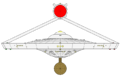
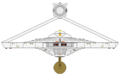
It was still argued that the warp maneuverability of a two-nacelle system would not be required in destroyer operations; the task of intercepting could be handled by photon torpedoes. Even though still rather clumsy and inaccurate, the most recent torpedo designs far outperformed the Detroyat main weaponry and would thus compensate for the lack of warp agility of the launching vessel. A less expensive one-nacelle configuration would then arguably be cost-efficient and battleworthy. Performance goals were set at an initial-standard cruise speed of warp 5 and a rather high top speed of warp 8. The ships would be fielded in relatively large numbers to accompany the already numerous Saladins; the new cruisers and heavily armed twin-nacelle frigates, both featuring groundbreaking technology from Project Starship, would add to Star Fleet’s torpedo firepower as well.

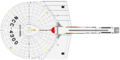
Even though the PB-31 engines were lifted directly from the latest Saladin upgrade program, the original Saladin field configuration was modified by inverting it and flattening it slightly to imitate a two-lobed field. The nacelle was supported above the primary hull by two triangular struts that each housed extensive cooling arrays in addition to the plasma conduits. Antimatter power machinery, which had become more compact in three years of development, was housed within the saucer hull and a slightly protruding dorsal compartment at the stern. All ships immediately received dilithium drives with multiply-redundant warp core ejection and nacelle jettison systems. However, there was a small deuterium-tritium fusion reactor system for auxiliary power and also for production of impulse engine power and propellant.
The ships were armed with three powerful twin 2 GW laser emitters, again in an inverted arrangement in comparison with the Saladin systems. Primary firepower was to be provided by a four-tube Mk 2 ‘Wolf’ torpedo system, much developed from the Mk 1 Saladin incarnation. This development did not proceed without problems, though. The first six-tube ‘Wolf’ systems tested aboard heavy cruisers had a prodigious rate of misfires, and the four-tubers introduced the further idiosyncrasy of mechanically jamming when commanded to disarm. Selenia struggled hard to make the systems behave; still, many of the destroyers were initially fielded with a Baton Rouge-type particle cannon in place of the torpedo system. When the Mk 2 launcher finally was delivered to frontline units, it still proved bulky and somewhat unreliable. Highly capable growth variants were nevertheless soon mounted on the Surya, Coventry and Constitution classes.
A crew of 195 operated the ship, their living quarters sharing the space on the seven decks with weapons, impulse and warp powerplants, sensors and support machinery. Lifeboats were provided for the crew behind jettisonable hull hatches, but actual onboard auxiliary craft were limited to work pods; four six-pad transporters were installed for personnel transport needs. A planetary landing could be performed with the nacelle jettisoned. One such emergency landing did take place in 2261, when USS Cromwell (NCC-4477) took refuge on d Canaris VI after the nacelle was ripped out and life support compromised by a relativistic-speed meteoroid cloud (perhaps extragalactic visitors, perhaps projectiles from an ancient war). Recovery and repairs were successful and returned the vessel to service by 2263. USS Sheridan (NCC-4463) had fared worse, losing all but three of the crew on her maiden voyage to a power system explosion that could not be contained. Nacelle jettison systems were indeed notoriously unreliable even in the case of the largely self-contained mid-23rd century circumferential engines – and problems are confounded in the modern distributed designs where high-energy plasma leads to the nacelle have to be cut, sealed and purged before jettisoning.
As many as eighty-nine of the modern destroyers were built under the class name Larson, in four distinct batches, although just nineteen were procured in the initial configuration, divided more or less evenly between phase cannon and torpedo types. Each ship was named after a famous Earth – or, in the single case of USS Thelenth (NCC-4405), Andorian – military commander, later also after famous battle sites. Registries were frequently changed, warp signatures fiddled with, and ships shuffled and reshuffled between starbases to hide the true numbers of these ships, the ‘ghost numbers’ ranging from low 3700s to high 4400s. While the trick was beginning to lose its effectiveness as Klingon intelligence forces gained in experience, later examining of Klingon archives has revealed that the Empire did initially overestimate the number of Larsons by an impressive hundred hulls. Apart from the perimeter ship deceptions, this was the greatest such counterintelligence victory against the Klingons, but also among the last.
Even when not backed up by ‘ghost ships’, the destroyers provided Star Fleet with considerable anti-ship attack power at minimum possible cost and maximum effectiveness. Some 34 were added to fleet strength in the early fifties. However, the wisdom of Larson procurement was repeatedly brought to question in reviews ordered by the Sariv administration of 2250-53. Despite initial high hopes and continuing insistence, the destroyers were quite unsuitable for exploration, research, or rescue operations. Also, as materials and transporter-fabrication technologies advanced, questions were raised about the necessity of such "contingency" warships in general. Thanks to the new technology, many formerly prohibitively expensive designs like the twin-engine frigates of Miranda family were now available for the role of "attrition units". Finally, the mission requirement of challenging enemy capital ships of superior strength began to sound hollow in view of continuing Romulan isolation and post-Axanar Klingon aimlessness. Again, there were factions that claimed that the ships would be useless against the Klingons and over-armed for anything else. As a result, three attempts at further production were deferred between 2253 and 2261.
In the early sixties, all remaining ships were gradually brought to full phaser VII standard and equipped with duotronic systems. With a simple change of some plasma seals and MHD turbines, the engine system was uprated to warp 6 operations, of which the coils were already capable. At the same time, newly militant Klingon attitudes led to growing support of Star Fleet escalation, and the opposition to destroyer-class ships diminished. However, the period of Klingon aggressions culminated not in a war, but in the Organian peace treaty; this soon brought back to surface the anti-destroyer sentiments. The Larson class was among the classes most affected by budgetary cutbacks, first by the bleeding off of funds for the Defender program, then by the early years of the McLaren administration austerity: requests for engine upgrades to PB-47 standard were categorically denied, as were sensor updates. By 2268, the class seemed certain to be retired almost entirely within the next five years.
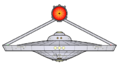
The introduction of linear warp engine technology briefly brought promise of a less gloomy future. In a refit begun in 2268, a baker’s dozen of Larsons were pulled in for the so-called Mk VII modification that would equip them with LN series warp engines and modern sensors. This extensive upgrade is described later in an entry of its own. Despite its advanced features, the modernized design did not find a niche in the now frigate-permeated Star Fleet. It ended up playing a relatively minor role during the 2270s - 80s and was relegated to reserves according to Khitomer treaty cutbacks in the mid-2290s.
The heyday of the Larson class was definitely the period between the 2260 upgrade and the Organian peace treaty. The very existence of the ships is credited for keeping the Klingons at bay in most fronts. The class enjoyed a ‘threshold weapon’ status similar to that of the Detroyats and Apaches in the 2220s-40s, presenting the aggressor with an unsolvable equation: how to penetrate the swarms of medium-cost destroyers to inflict damage to the actual enemy capital ships and installations, without losing disproportionate numbers of one’s high-cost strike units? Neither the Saladins nor the Larsons alone could not have created such a deterrent, not with their poor warp maneuverability – but a modern destroyer still was quite capable of forcing a Klingon battle cruiser out of warp with her torpedoes, exposing her to other types of defensive fire. Indeed, no fewer than sixteen Larsons are credited with warp intercepts of Klingon ships during the frequent raids these aggressors made to UFP territory between 2260 and 2265; all these engagements ended in Klingon retreat and minimal Star Fleet casualties.
Offensive success using flotilla tactics was limited. A five-ship expedition was lost in contested space near Romulan territory in 2263, only the severed warp nacelle of USS Alesia (NCC-4454) remaining to tell of its demise; this brought total losses for the class to eight hulls. Star Fleet reports cited poor long range sensing and signal analysis capabilities as the main vulnerabilities. Clearly, the destroyers were far better suited for mixed-type fleet operations where the sensing and analysis power of coordination ships or cruisers would be available.
The Larsons survived the Organian cutbacks slightly better than the older Saladin lineage. About half the surviving fleet was put in mothballs in the mid-seventies, leaving two flotillas to serve alongside the Mk VII–modified units. This force was allocated two Monoceros scouts for coordination and sensing, efficiently pairing like performances. The flotillas were disbanded by the end of the decade, however, for the days of the circumferential warp drive were over, in the destroyer force at least.
Star Fleet has never officially regretted its decision to scrap the vast numbers of decommissioned destroyers. Admittedly, the Larsons were technically outdated, represented a poor balance of offensive and defensive systems for the post-Khitomer environment, provided inadequate crew accommodation standards and were economically nonviable. Granted, a conversion to linear warp drive had been attempted and found wanting. And to be sure, the factual scrapping only took place after certain Khitomer clauses made it both mandatory and verifiable by Klingon and impartial observers. But many starship enthusiasts have expressed anguish over the totality of the extinction: not a single Larson remains for display in the Fleet Museum, nor are there recoverable hulls on any of the Fleet surplus depots or junkyards. The three generations of starship captains trained to command this type of vessel are long gone, and no good literature has been written on the subject. Thus, the exploits of this significant part of Star Fleet strength in the mid-23rd century remain mostly undocumented and unavailable to the public.
Gallery
-
 Larson (2245)
 -
-
-
-
 Larson (2265) (side)
 -
-
(bow).png)
(dorsal).png)
(stern).png)
_(side).png)
_(bow).png)
_(dorsal).png)
Notes
- The "baker's dozen" of the Mk VII is not a typo; the Mk VII is explored in the article on the Larson refits.
- The year 2261 was added to the loss of Sheridan, due to it happening during it's maiden voyage. Cromwell, a later ship, crashed the same year and was built after Sheridan, and since the registry range started in 2161, the incidents have to be contained within that year.
- The Marks Ia and Ib were produced near-simultaneously, as phase cannon and torpedo variants, as the torp variant was not yet ready when the design was needed.
- USS Guadalcanal comes from the image text on Guide: Belknap. The choice of class was between the Sivas and the Larsons; the former had already been fleshed out and published by Delta Dynamics.
- The original Timo account says, "ordered by the Ixan administration of 2247-53". However, SFC now has Paula Christenson and Kaj Sariv in their respective terms for that range of years, so it has been adjusted for the Sariv(-only) administration (of 2250-2253). This pairs nicely with the Mark II production run.
Alt Sources