Guide:Miranda
.png)
| |
| Miranda | |
|---|---|
| Class Overview | |
| Category | heavy frigate |
| Operational | 2242-2295 |
| Constructed | 50 total: |
| Dimensions | |
| Length | 237.4 m |
| Beam | 127.1 m |
| Height |
|
| Mass |
|
| Performance | |
| Cruise Speed | w 6 |
| Max Speed | w 8 |
| Endurance | 4 years |
| Complement | |
| Officers | 55 |
| Enlisted | 265
|
| Tactical Systems | |
| Beam Weapons | Miranda Flt I
Surya Flt I
Miranda Flt II
Surya Flt II
Miranda Flt III
Surya Flt III
|
| Missile Weapons | Miranda Flt I
Surya Flt I (not NCC-1885)
Miranda Flt II
Surya Flt II (not NCC-1885)
Miranda Flt III
Surya Flt III (not NCC-1885)
|
| Shields |
|
| Laboratories | Miranda
Surya
|
| Transporters | Miranda, Surya Flights I & II
Miranda, Surya Flights III
|
| Auxiliary Craft |
|
| Historical | |
| Ships of Note |
|
| Canonicity | |
| Design | SotSF/aridas sofia |
| Name | Omnipedia/SotSF |
| History | SotSF
|

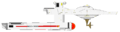
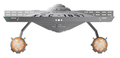
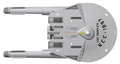
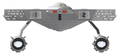
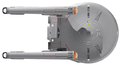
A quarter of a century of military escalation against the Klingons altered many of the basic concepts of Star Fleet. Many mission classes were neglected during the arms race, while others changed much in description. Especially the frigate mission underwent drastic changes. When Star Fleet found itself in need of fifty to seventy antimatter-powered deep space escort vessels in 2238, the ship type it chose for the mission was a potent mixture of frigate, destroyer and cruiser properties – multiple-tube torpedo launchers, heavy lasers, sizeable shuttlebays and advanced fire control systems seldom seen in ships smaller than cruisers, as well as many navigation and computing technology innovations stemming from Project Starship. The new ships were a good deal heavier and more capable than the Detroyat destroyers from which they descended. But destroyers were no convoy escorts in the Star Fleet scheme of mission classes, so the designation chosen for the type was ‘heavy frigate’.*
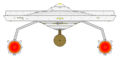
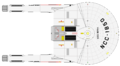
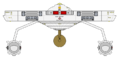
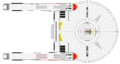
Two programs were run side by side to create the heavy frigates. A new keel was laid in 2239 for USS Miranda, based on Detroyat blueprints but introducing a refined hull form and new PB-47 nacelles mounted on simplified Anton-style vertical pylons. The antimatter powerplant for the ship was of completely new design, optimized solely for the type. Simultaneously, the old powerplant assemblies of the Detroyat class USS Resolution were ripped out and partially replaced with a modern power system. The plasma conduitry and auxiliary power systems were retained, though. Here, too, the nacelles were changed to the more economic PB-47 system, and the control facilities were housed in a reconfigured aft section in the saucer hull. The boxlike ventral extension was cut off, and engine pylons reshaped to curve farther down in a ‘two-kink’ configuration. With the modifications, there was now plenty of room for two midsize flight decks around the power machinery, enabling the frigates to carry numerous small craft for patrol and liaison duties.
The old, bulky laser machinery of the destroyer was replaced with more efficient double laser units, and a twin ‘Awalt’ torpedo launcher by Racal FMC of Ardana was installed in the specialized torpedo deck under the main bridge, replacing the former single-tube main weapon and giving the Resolution an exceptionally heavy weapons complement for a frigate. For the Miranda, the suite was heavier still, as the vessel was fitted with a podded triple mount that featured an aft tube in addition to the two forward-firing ones. The navigational deflector dish at first received a support strut for mounting directly under the saucer, as well as a new series of emitters and control software. The system was eventually trimmed down to fit between the bow sensor units, and standard navigational shields applied by using normal hull grid systems; the ventral dishes disappeared from the ships in 2265-66, taking with them some long range sensing capabilities.
USS Miranda (NCC-1833) was completed first, leaving her drydock in May 2241. Her internal arrangement was highly modular and lent itself to the installation of various experimental sigint and CCM systems, a dozen combinations of which were tested during the test runs in 2241-42. Extensive tests were also performed by the half-finished Resolution, now reshaped closer to the Miranda hull form and re-registered as NCC-1850. The tests verified the viability of the configuration (even though discrediting the economy of converting further Detroyats) and gave Star Fleet confidence to order the construction of as many as 72 heavy frigates, initially divided evenly between the two sub-configurations. The Resolution donated her registry number to USS Surya, the first newbuild of the ex-Detroyat configuration and thus the first member of the Surya class; the Miranda initiated a class of her own when she was finally commissioned in February 2242.
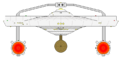
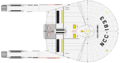
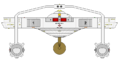
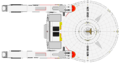
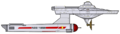
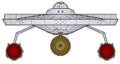
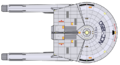
By 2242, it had become clear that the initial order for 72 vessels had been grossly oversized, and that the balance between the heavy frigates and the lighter Loknar class should favor the latter. Hull numbers NCC-1833-42 were now assigned to the Miranda class, and NCC-1850-89 to the Surya class. The external differences between the classes ranged from gross to subtle. The Mirandas featured a lower hull profile due to the shorter and simpler pylon assemblies, yet always carried the podded torpedo launchers high above the stern; they also had slightly differing navigational deflector strut and antimatter venting systems, as well as a more acute, Constitution-like teardrop shape for their torpedo-less superstructure. Internally, the Suryas carried a heavier selection of equipment, including magazines for 50 torps to the 30+10 of the Miranda pods, the inclusion of seven short-range targeting scanners to Miranda’s three, a range of 11 ly for the main navigational sensor to Miranda’s 8 ly, all amounting to a total mass of 539,000 tons vs. Miranda’s 535,000 tons (both minus nacelles). On the winning side, the Mirandas had superior astrogation and sigint systems and were more readily reconfigurable. Both types had plenty of room for installation of laboratories, but only four were fitted on Miranda and just two on Surya.
The extremely heavily armed frigates would not be built in as large numbers as the lighter Loknar class, but in the end, 37 of the Suryas (plus the modified Resolution) were completed for deep space escort duty. Also, USS Noshiro was built as a hybrid design, with kinked pylons but with a narrow teardrop command pod, phaser-only armament and Miranda sigint systems, and ‘adopted’ to the Surya class with registry NCC-1885. She was extensively used for special operations under the auspices of the so-called TacFleet special force. All ten true Mirandas were also built, and fielded for border patrol duties. Both classes fulfilled the requirements of their respective jobs better than the Larson and Saladin destroyers, trumping the competition in endurance, sensor range, agility, computing power and even economy of operations – at least in peacetime. Delighted by their success, Star Fleet began promoting heavy frigates at the expense of further destroyer development when the favorable solution at Axanar temporarily lessened the Klingon threat.
Two Miranda losses in the early fifties made acute the issue of upgunning. A refit begun in 2255 gave the ships cruiser-like phaser armament of six Type VII units in place of the original six lasers. The number was doubled after 2265 on Suryas and after 2266 on the remaining Mirandas, when the ships assumed several light cruiser duties (but retained the heavy frigate designation). Gunports were omitted in this refit, and the phaser emitters were permanently fixed in extended position. Transporters were brought to modern standard in both upgrades. Also, many ships of the Surya class received two phaser VI units for rear-hemisphere coverage. Engine upgrades were kept to a minimum, performed mainly to maintain commonality with the other PB-47-engined types in Fleet inventory.
Notable Suryas include the venerable USS Resolution, recommissioned in 2247 as a Surya, with a twice-changed registry now settled at NCC-1877, and later re-modified to spearhead a linear-coil upgrade of the heavy frigates. USS Avenger, NCC-1860, became the first operational conversion to that class in 2273, with no less than 20 other Suryas following suit. Soon thereafter, USS Miranda adopted an almost identical linear-coiled appearance, launching the Miranda (II) subclass. There was little left of the original subclass to modernize, though. The loss of USS Cortez (NCC-1834) in 2254 to the Vulcanoids of Darien 224 had been but the start of woes for the class: further deep space assignments claimed USS Bombay (NCC-1838) in 2265 and USS Buenos Aires (NCC-1840) in 2268. Ostensibly, USS Polaris (NCC-1839) and USS Aloia (NCC-1841) were stricken from strength due to faults discovered in their spaceframes – but in fact were extensively modified to the secretive Soyuz sigint standard, receiving new names at a clandestine recommissioning and leaving only four further vessels to be turned into Miranda (II) units. By the virtue of her slight overall seniority, the Miranda became to be considered the class ship of the whole family of sub-types when Star Fleet in the late 23rd century drastically simplified ship naming practices.
The Miranda can actually be said to have spawned three follow-on lineages: the enlarged flight deck Coventry frigates, the slightly smaller modern linear-coiled Daran frigates with their subvariants, and the direct Avenger successors with an impressive spectrum of subtypes. All of these will be discussed in more depth in later entries. The continuing development of the design has ensured virtual immortality for the Mirandas, so that some spaceframes built in the 2240s and refurbished in the 2270s are actually seeing combat support service in the 2370s, admittedly after resting for almost a century in mothballs. The last ships of the original Surya configuration were retired in 2295 along with the similar-standard Coventries and most of the other surviving circumferential-engine starships.
* It appears that at this point, Star Fleet indeed chose the heavy frigate designation over the more fitting light cruiser one on basis of the intended mission of the ships. Later years would see the heavy frigate designation abused in an attempt to confuse various observers about the true degree of Star Fleet escalation. One should also recall the historical background of this terminology, as relates to the primary combatants of the early 19th century United States Navy.
-
 Miranda class
 -
-
-
-
.png)
.png)
.png)
.png)
-
 Surya class (2245)
 -
-
-
 2255
2255 -
-
-
-
-
 2265
2265 -
-
-
-
-
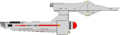 USS Noshiro (NCC-1885)
 -
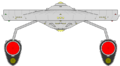
-
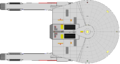
.png)
.png)
.png)
.png)
.png)
.png)
.png)
.png)
.png)
.png)
.png)
.png)
.png)
.png)
.png)
.png)
Notes
- Like with the Constitution class as a pathway to overhaul for the Horizon class, the Detroyats, with the Resolution as the test subject, were targeted to be updated as the Suryas, though this would be discredited by the associated costs.
- I've pushed back the Flight III Miranda by one year to 2266 to mesh well with the transporter upgrade received that year.
Not sure why NCC-1859 stands out mass-wise. If research doesn't support, I intend to delete this sidebar factoid.Clearly, Timo had a concept of an idea intended for NCC-1859. I've decided it was built, but somewhere secretive and never commissioned nor registered; the funding was represented by NCC-1859. Whatever the backstory turns out to be, the ship probably never received a hull name/registry or had a rotating suite of such markings that mimicked established commissioned ships.
- USS Resolution was registered three times: NCC-1101 (it's Detroyat designation), then NCC-1850, as a pre-Surya configuration, then finally NCC-1877, when it surrendered that designation to USS Surya, as the subclass lead.
- USS Athena (NCC-1841) existed only in the sidebar, where there was more evidence that USS Aloia (also NCC-1841) was more concrete and was (clandestinely) converted into the Soyuz class USS Bozeman. Therefore, Athena was replaced by Aloia.
- The striking of USS Polaris (NCC-1839) and USS Aloia (NCC-1841)—though, in reality, converted to Soyuz subclass USS Collins and USS Bozeman—took place in either 2259 or 2260. I've decided on 2260, since the Miranda conversion to Soyuz took place that year.
- The total number was raised to 50, from 49, because there is enough information to support it.
- It should be noted that Timo introduced the hull numbers in the 1800 block, rather than the on-screen 1900 block, and the SFC game canon supports Timo on this.
Alt Sources
- Star Fleet Reference Manual v1, pp. 118-121