Guide:Anton
.png)
| |
| Anton | |
|---|---|
| Class Overview | |
| Category | light cruiser |
| Operational | 2239-2252 |
| Constructed | 5 |
| Dimensions | |
| Length | 248.0 m |
| Beam | 127.1 m |
| Height | 59.8 m |
| Mass | 659,500 tons |
| Performance | |
| Cruise Speed | w 6 |
| Max Speed | w 8 |
| Endurance | 2 years |
| Complement | |
| Officers | 31 |
| Enlisted | 259
|
| Tactical Systems | |
| Beam Weapons |
|
| Missile Weapons |
|
| Shields |
|
| Laboratories | Initial prototypes
Final versions
|
| Transporters | Initial prototypes
Final versions
|
| Auxiliary Craft |
|
| Historical | |
| Ships of Note |
|
| Canonicity | |
| Design | FASA |
| Name | FASA |
| History | own, FASA
|
Among the numerous ship designs related to Project Starship, the Anton class light cruisers deserve
perhaps little more than a footnote. Yet however unsound their engineering solutions, however
unwieldy their design, they ultimately defined the shape of the future for a major element of
Star Fleet’s strength. Often derisively considered the ‘second-rate starship’, this configuration
represented a compromise between the high warp performance of Constitution-like vessels and the
economy of a ship with inboard engines and a single hull. It would later become the shape of the
Surya and Miranda lines of heavy frigates and light cruisers, the Hokule’a medium cruisers, the
Springfield class of frigates, the Nebula explorers, and will no doubt be how Star Fleet’s counterpart
to the modern Sovereign class will turn out in the late 2370s.
In the 2230s, however, the shape of USS Anton was mainly a point of ridicule. As the Chiokis Corporation met with failure after failure in integrating the sleek hulls of Horizon heavy cruisers and modern Saladin destroyers into the first Project Starship spaceframe, it was finally forced to consider alternatives. A hull of some kind had to be fielded to test the PB-31 engines, operationally connected to duotronic control computers and a full-scale powerplant, or funding would evaporate. The structure of choice for Chiokis was the Baton Rouge angular secondary hull. A hectic integration effort resulted in a mongrel of design philosophies whose aesthetics could only be commented on in the rudest of terms. Still, what was significant was that this ship could fly. By 2235, USS Anton (NX-1225) had established beyond doubt the correct performance figures and operational procedures of the PB-31 engine, and thus removed the final obstacles on the way of the launch of USS Constitution and USS Enterprise.
Essentially, the aft half of the Anton was constructed of two Baton Rouge secondary hulls mated side by side. These hulls were nearly complete system integration test articles that featured almost all the gear of a fully completed cruiser. Each hull still housed its navigational deflector machinery; the beam projector was simply moved underneath the hull, to fire past the lower sensor dome of the saucer-type primary hull from port or starboard. Also, each hull contained a shuttle hangar with all its accessories, mainly for the reason that removal of these facilities would have resulted in unnecessary expenses. Antimatter tankage was also retained almost unchanged.

The crucial pieces of equipment aboard were brand new, however. The RMR-124 antimatter reactor featured a short multilinear core assembly and long plasma conduits extending athwartships and then down canted pylons, in a configuration that was as close a mirror image of the upcoming Constitution assembly as possible. The impulse engines were of the type being installed on the NCC-1701 as well, with a modified nozzle arrangement but with 87% component commonality. The pylons were only slightly shorter than the ones that would be used on the heavy cruiser starships. And the sole difference between the PB-31 Mod 0 engines of the Anton and those being welded onto the Constitutions was the presence of extra monitoring instrumentation in the former.
Between 2236 and 2238, the Anton was joined by four sister ships, each with a different agenda in testing the components of the Project. However, on the background hovered the company’s ambitions of eventually selling these vessels to Star Fleet for operational use. The dockyards had already been machined for producing the aft hulls out of all-new components, for greater structural strength, simplicity and efficacy. Mass production could proceed if the word were given.
The Antons remained unarmed, sparsely equipped Chiokis testbeds until 2238. At that point, Chiokis was fighting the final battle for the custodianship of Project Starship, and the one thing it still lacked was weapons integration expertise. The very modestly armed Amchitka class vessels Chiokis had been producing as a stopgap measure did not represent the required state of the art in photon torpedo and phased laser and particle gun systems, nor in fire control hard- or software. Now was the time to arm the Antons and provide proof of the company’s skills.
The heaviest weaponry for the Antons was of Constitution standard, featuring the same primary and secondary phase cannon types but in fewer mounts. Only forward-facing weapons were installed, both out of necessity of hull geometry, and to spare the existing cannon for installation on the heavy cruisers. Laser armament was very potent, yet of slightly smaller caliber than the Constitution counterpart, with 3.2 GW emitters only. Fire control sensors and computers represented full heavy cruiser standard.
In 2239, Star Fleet finally agreed to purchase the Antons. Under a light cruiser designation, and carrying a crew of 290, they were dispatched on two-year missions of exploration towards uncharted and unchallenged space. The only ship to renew such a mission was USS Silversides (NCC-1226); Star Fleet found to its disappointment that the piecemeal construction of the testbed ships had resulted in labor-intensive vessels of limited utility. Ownership of the other four vessels was returned to Chiokis, but with indications given that Star Fleet would be interested in an improved version in the near future.
When refined versions of the design emerged from 2242 onwards, they achieved major fame under the Surya, Miranda and Coventry class names. Chiokis took special pride in the ugly ducklings it had used as the basis of its success, somewhat misleadingly declaring the successor designs "subvariants of the Anton class". The swan song of the Antons themselves was already sung, though. The light cruisers languished in reserves until stricken from Fleet strength altogether in the 2260s.
Gallery
.png)
.png)
.png)
Additional Images
-
 Anton class (2245)
 -
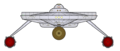
-
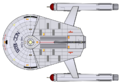
-
 Anton (2265)
 -

-
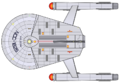
(side).png)
(bow).png)
(dorsal).png)
_(side).png)
_(bow).png)
_(dorsal).png)
Notes
- At some point a few years after 2239, Star Fleet returns four of the ships (all but Silversides) to the Chiokis Corporation. At some point after that, the ships were transferred to Star Fleet's reserves (maybe when Silversides is transferred there?).
- Custom image ideas:
- Ventral view of final version
- three particle cannon ports (to respective perspectives)
- four torpedo tubes for NCC-1228 (ventral saucer)
Alt Sources