Guide:Hopi
.png)
| |
| Hopi | |
|---|---|
| Class Overview | |
| Category | large survey cruiser |
| Operational | 2258-2282 |
| Constructed | 10 (built 2256-2263) |
| Dimensions | |
| Length | 203.8 m |
| Beam | 138.3 m |
| Height | 92.1 m |
| Mass |
|
| Performance | |
| Cruise Speed | w 6.0 |
| Max Speed | w 8.0 |
| Endurance | 5 years |
| Complement | |
| Officers | 42 |
| Enlisted | 283
|
| Tactical Systems | |
| Beam Weapons |
|
| Shields |
|
| Laboratories |
|
| Transporters |
|
| Auxiliary Craft |
|
| Historical | |
| Ships of Note |
|
| Canonicity | |
| Design | TAS/Mark Wilson |
| Name | Mark Wilson |
| History | Mark Wilson, own
|
The first suggestions that the technological revolution of the Great Awakening might be old news
came in 2255 when the UFP Commission for Star Fleet decreed that ‘proven’ technologies be used in the
construction of the next long range survey type. By the definition of the day, these technologies
included the PB-47 warp engine and the KR13 dilithium-regulated antimatter reactor, both frontline
systems from the preceding decade.
Far from outdated, the engine and its matching powerplant were nevertheless surprisingly affordable because of ongoing production for numerous military applications. For the first time, Star Fleet now calculated that it could afford to field them for the less aggressive duty of long range survey. The counter-intuitive rationale was the continuing military threat, and the desire to withhold armed long range units from survey duty if at all possible. The resulting engineering solution was a bare bones spaceframe for the potent propulsion system, emphasizing modularity and low construction costs.
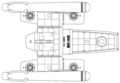
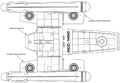
The swift completion of USS Hopi (NCC-1450) for an early 2258 launch and subsequent commissioning satisfied all parties involved, and resulted in confirmation of orders for a total production run of twenty, ten going to Star Fleet Exploration Command and the rest to well-funded and trusted civilian organizations. Although both the naming scheme and certain external features suggested familial relationship between the preceding Cahuya survey cruisers and the Hopi design, the new vessel was conceptually quite dissimilar. Thorough modularity extended both to construction techniques and interior arrangement. The oblong primary hull, some 170 m long, was divided into four distinct compartments. The tapered bow housed crew accommodation as well as command and control spaces, such as a dorsal Class Two bridge module and a corresponding ventral tactical suite of paired Type V phaser emitters and their fire control facilities. A constant cross section mid-hull could be flexibly furnished with research gear, including a deployable telescope. A somewhat beamier aft hull in turn held propulsive and power generation functions and support systems, as well as holds for cargo and consumables. Podded above was an impulse assembly, also housing two more phaser V emitters. The fourth major compartment, a stubby stern hangar with broad sliding doors, could hold two large Class G reconnaissance shuttles and a number of smaller auxiliaries.
The engineers could have bolted a pair of PB-35 or -38 engines to this potent survey vessel and declared her an exploratory cruiser. Instead, they attached two lateral hull sections, essentially similar to the mid-hull systems area of the primary hull, and reserved these completely for mission-specific survey gear. Laboratory modules or bulky individual pieces of machinery could be secured in place within the girderwork, their placement constrained only by the exterior shells and by the athwartship primary plasma conduits within. Connecting corridors, turbolifts, dataways and power lines could then be constructed out of standardized elements.
Pylons for the PB-47 units were mounted outboard and immense sensor mounts forward and aft of each lateral hull. No less than eight annular subspace field generators for FTL sensing were provided, two in both the forward mounts, two in both the aft ones. Up to 96 standard sensor pallets could be plugged into the generator assemblies, turning the survey cruiser into the most powerful flying telescope so far fielded.
Despite the stunning standards of equip, the Hopi came in at 55% the cost of a Constitution series deep space cruiser. Operating costs were somewhat less advantageous, as some 325 crew were required in full survey configuration. Nevertheless, a three-year Hopi survey sortie would perfectly supplant a similar heavy cruiser effort; the heavy survey cruiser was a complete success both technologically and economically.
Operational testing established practical performance values at warp 6 cruising and warp 8 maximum speed, much as expected. Rimward missions were promptly launched, their schedule hindered more by the problems of training deep space –rated crew than by the pace of Hopi construction. All ten vessels were operational by 2263, thanks to shameless appropriation of heavy frigate dockyard facilities for the program.
After the initial round of highly successful charting missions, the vessels received a series of preplanned equipment upgrades. Older G1 recce shuttles were replaced by G3 craft, auxiliary computers were added to the systems hulls, and much of the stellar charting gear was swapped for star system and planetary survey equipment. The second wave of surveys would largely concentrate on finding exploitables at the distant reaches of the galaxy, far ahead of the commercial prospectors and local government surveys.
In the depths of rimward space, disaster struck. Three missions were lost within five years, plunging Exploration Command to doubt and self-crimination. USS Kanesatake was in 2265 pockmarked by Talarian lasers during a prospecting dispute and, unbeknownst to her crew, developed a warp imbalance that would tear the ship to pieces ten days later. USS Guyasuta was found adrift in the Kadena system in mid-2267; duly logged records showed the entire crew beaming down to the system’s neutron star, for reasons that still remain obscure. Finally, USS Aliquippa disappeared into the Delta Triangle in 2269, only one of her outriding scoutcraft surviving to tell the story.
None of the losses could be attributed to shortcomings in vessel design or operating procedures. Nor was there any certainty that a full heavy cruiser, operating under the same overall doctrine, would have fared any better in similar incidents. Nevertheless, the losses gave an opening to the critics of ‘exploratory adventurism’, a lobby that in actuality supported active exploratory policy but disdained the construction and use of lightly armed vessels in that role. The Hopi program was but the first to fall, as the early 2270s saw the execution of President McLaren’s drastic exploratory scaleback policy. Concurrently deactivated were the Cahuya and Byrd classes; pulling the T’Pari units in for a refit brought the number of active survey cruisers down from sixty to mere fifteen, discounting auxiliary and nearspace units. Other deactivation and refitting decisions followed, and within five years, Star Fleet’s exploratory commitment had fallen by some 75% in all UESPA indices.
The surviving Hopi class vessels witnessed this development from the penalty box. The first two had been disarmed in 2272 already and sold forward to assorted domestic users. As construction of modern combat cruisers picked up pace, two more would be liquidated in this manner, and two placed in reserves; by 2282, the remaining three had been liberated of their engines to provide spares for the frigate fleet, the last barely having had time to receive modern pennant paint. A bright Star Fleet future for a promising ship class had been cut short by the policy reversal.
However, many were ultimately of the opinion that this was for the best. The deep survey effort would soon again pick up pace, now with fully armed exploratory cruisers of Tikopai class. The imposing fleet of some three dozen would far outperform the combined pre-seventies survey cruiser force, at least until it in turn was called to arms against the Klingons and withdrawn from the deep frontier. The civilian Hopis would receive sensory, navigational and even propulsive upgrades and continue their careers well past the 2280s. And some good would come out of the Hopis in reserve, too: they would be utilized as floating Faraday observatories well into the 2330s.
Gallery
-
 Hopi class
 -

-
-
.png)
.png)
.png)
Notes