Guide:Constitution (refit)
.png)
| |
| Constitution (refit) | |
|---|---|
| Class Overview | |
| Category | heavy cruiser / cruiser |
| Operational | 2272 - 2337 |
| Constructed | 71 total: |
| Dimensions | |
| Length |
|
| Beam |
|
| Height |
|
| Mass |
|
| Performance | |
| Cruise Speed | w 7 |
| Max Speed |
|
| Endurance | 5 years |
| Complement | |
| Officers |
|
| Enlisted | 380
|
| Tactical Systems | |
| Beam Weapons | Enterprise
Constitution Flt IV
Endeavor
Tikopai
Enterprise Flt II
|
| Missile Weapons | Enterprise
Constitution Flt IV
Endeavor
Tikopai
Enterprise Flt II NCC-1701 (training duty)
NCC-1847
NCC-1710, 1713
|
| Shields | Enterprise
Constitution Flt IV
Endeavor
Tikopai
Enterprise Flt II
|
| Laboratories |
|
| Transporters | Enterprise, Flt IV, Endeavor, Tikopai
Enterprise, Endeavor, Tikopai (2282 upgrade)
Enterprise Flt II
|
| Auxiliary Craft | Enterprise, Tikopai, Enterprise Flt II
Flt IV
Endeavor, NCC-1710
|
| Historical | |
| Ships of Note |
|
| Canonicity | |
| Design | ST:TMP; SotSF |
| Name | SotSF |
| History | own, SotSF
|
Background: Hobbyist's Guide

In 2270, the last of the Constitution starships pulled in from their exploration missions after three decades of operation. The ships had expanded Federation space threefold, found the limits of near-Human worlds, and encountered races both humanoid and completely alien. Five ships had been lost, some to ancient war machines, some to natural phenomena or space entities either malevolent or so superior as to be completely indifferent of the fate of mere starships. In addition, six more vessels had been so badly damaged that they required extensive multi-year overhauls. Deep space was a challenge far greater than had been anticipated.
Star Fleet was still wary of Klingon aggressions; but after Organia, the UFP Councils were not. The last dissolutionary stronghold in Altair had rejoined the Federation in 2268, and it was felt that any enemy would now be met by a united front. Indeed, the Federation was now stronger than ever, with the First Federation and Coridan memberships and resources secured.
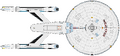
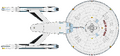
So the Federation was to expand further, to explore the unknown while guarding the known. This meant that powerful and complex craft with the ability to conduct long, self-sustained, and wildly varying missions were favored in fleet construction plans, while ships optimized for specific single missions received little funding. The technology to construct multi-purpose starships already existed; the resources to build new hulls were hard to come by. Furthermore, the Organian treaty imposed severe limits on fleet expansion. The obvious solution to both problems was to convert older hulls. After some doubts about the financial soundness of the plan, the Constitution class was given a lifetime extension refit along with several weapons and propulsion technology upgrades, beginning with refitting the prestigious USS Enterprise (NCC-1701).
While several extensive upgrades had been made to Constitutions during their earlier service, nothing this drastic had been attempted before. In practice, Star Fleet intended to turn the almost 30-year-old ships into a larger version of the hypermodern Belknap cruisers. The primary hull was both refurbished internally and expanded structurally. Torpedo launch machinery was removed; the phasers, while still of the type VII standard, were doubled in number, upgraded, and rewired to tap directly from the warp core for increased maximum output. To spare the emitters, this peak power throughput normally took the form of half-second pulses instead of the two-second beams that had been standard for the original model. However, the dependence of phasers on the availability of warp power proved a serious operational shortcoming, and Star Fleet was soon forced to install a cascade of EPS relays that allowed auxiliary- and battery-powered firings in emergencies.
Several key systems were completely automated and a new central computer installed. A high degree of automation allowed the operation of skeleton-crewed vessels through a common coded network interface or, alternatively, a high level of coordination between fully manned ships. A hullwide grid for the new shield system was spread over the saucer. Even the overall hull form was altered by addition of a layer of cabins on the circumference, increasing saucer radius by over three meters—a configuration similar to the production-standard Belknaps. Finally, an upgraded impulse drive of RSM type was installed. Additional RCS thrusters were mounted on the nacelle aft ends for greater close-in maneuverability. Other thruster groups speckled the primary hull rim and the secondary hull as before.
Other parts of the ship underwent even more extensive modifications. The connecting neck was completely reconfigured using Belknap structural elements. A vertical shaft was opened in the secondary hull to house a new type of warp core, the Kiratovani KR13-N, whose two perpendicular containment tubes replaced the earlier General Atomics multilinear configuration. Incidentally, this meant that the bulk of antimatter was now handled inside the ship hull, rather than confined to the nacelle assemblies. Thus the nacelle separation system was replaced by a powered-ejection system for the entire vertical intermix bottle, firing through the bottom of the ship. The top of the bottle connected to the main deuterium tankage within the connecting neck, the bottom to antimatter tankage on Deck 20.
The chord of the dorsal was increased to facilitate new equipment, although not quite to Belknap dimensions. At the bottom of the dorsal, twin Skar-Rat Mk 6 torpedo launchers were located side by side, next to the ventral intermix shaft and main deuterium tanks, in another example of "citadel" thinking that put all the eggs in one maximally protected basket at the very center of the ship. Two docking ports of standard model but without the traditional external cover plates were installed here; five more ports were provided overall, two on the engineering hull and three on the saucer. Torpedo arming / loading machinery was on the deck above. Most of the decks in the dorsal were dedicated to various support functions. Power conduitry ran along the trailing edge, from the EPS converters at the top end of the vertical intermix bottle on Deck 13 aft end all the way to the impulse engine systems on Decks 6 and 7. A Jeffries tube also accompanied these conduits.
The secondary hull was the part of the ship modified the most extensively to house new machinery. It was stripped of external plating and given an increase in size by adding an outer layer of power conduits, gangways, lifeboat berths, RCS clusters, docking ports, and shield machinery. Along with the removal of laboratories and crew facilities, this freed space for the shaft of the new vertical antimatter tube as well as for a somewhat enlarged cargo bay for consumables, equipment, or miscellaneous freight. Shuttle hangar space was retained but modified to serve a wider variety of craft, by adding two large rectangular elevators forward of the landing area, in place of cargo preprocessing facilities. These replaced the former turntable-elevator, which did retain its turntable role. The central turboshaft serving the hangar bay was removed to provide full-width access between the landing area and the elevators; also removed was the partitioning between the cargo preprocessing bay and the main hold, leaving gaping holes sealed only by flimsy rolling doors (or, when these were open, by containment fields).
Two phaser VIs provided fire cover for the aft portion of the ship, filling a dangerous proximity gap in phaser coverage. The amidships phaser array and tractor beam emitter at the bottom of the secondary hull were retained in the refit, although the equipment itself was upgraded—the phasers to the VII standard with four emitters, the tractor beam to steerable-emitter configuration.
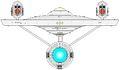
The most noticeable external change was the installation of triangular supporting pylons for the new and still somewhat experimental LN-64 series nacelles for the FWG-1 linear warp coils. These pylons could withstand triple the stresses of sublight accelerations compared to the earlier rectangular ones. Technical specifications for the new engines were basically identical with the Belknap ones, yet differing field configurations meant that significant simulation time was needed to clear the engines for the full flight regime of the Constitutions.
The Enterprise was launched prematurely in response to the V’Ger crisis, in September 2272. Following the spectacular success of the mission, seven other Constitutions—mainly venerable high-fatigue ships—were upgraded to this standard between 2273 and 2279. No new keels were laid, however. The old naval superstition against assigning new names to old ships was ignored for once: the unlucky USS Exeter, towed in from Omega IV and dormant ever since, was renamed USS Indomitable to scare away ghosts from the past.
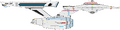
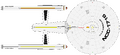
Long before its completion, the extensive refit proved even more expensive than feared. To keep the costs manageable, Star Fleet ended up running two slightly differing refit programs of narrower scope parallel with the main effort. The first included the installation of somewhat lower-performance series LN-60 warp and Namada NK impulse engines and the KR12-N reactor system, plus the selection of a simpler torpedo system, lower-performance phasers, and fewer docking ports. Upgrades to the sensor cluster and bridge structures on the saucer were not performed in this refit. The original shuttlebay configuration with heavy physical partitionings was also retained, resulting in simplicity and structural reliability but also in slightly decreased shuttle maintenance capacity in comparison with the more extensive refit. Thus, only two utility shuttles and two work pods were normally carried. Cargo holds were in turn more spacious, due to a differently positioned vertical intermix shaft that allowed for three full rows of container pockets in the forward bulkhead as well.
Seven ships were refitted to this standard, including the original USS Constitution. They were pressed to survey and support duty under cruiser instead of heavy cruiser designation; due to their almost frigate-like weaponry, they seldom operated independently in defense missions. This refit was left somewhat incomplete since, even discounting USS Essex which was retained for training use with a minimal deflector upgrade and the survivors of the Victory batch that had been taken away from Operations Command to somewhat ambiguous "detached duty", there still were eight rather worn-out but quite operational Constitutions remaining in the earlier configurations. In addition, the buyback program of exported Achernars had left Star Fleet with a moderate number of these low-standard vessels, which were deemed to be in even greater need of an upgrade.
Star Fleet did not feel it needed any more support cruisers. The ships should be brought to a standard enabling independent defense missions, preferably one that would have commonalities with the rest of the cruiser fleet but without the exorbitant costs associated with those designs. Two alternatives existed for achieving this cost-saving commonality: either mix and match the best components of either group into a roughly homogeneous whole, or create a completely new refit standard for both the Flight III ships and the Achernars. The third option, of converting the ships into refit Enterprise subclass units, was immediately abandoned as economically nonviable.
Seven of the ships standing in line for the refit had standard Flight III hulls, while USS Wasp had required a massive patch-together effort after the damage received during the Babel conference of 2267 and sported several highly nonstandard components. Four full-fledged buyback Achernars (NCCs 1734, 1736, 1738, and 1740—still carrying the names of their former operators: Isshasshte, Ortisei, Harolna, and Hemalat) were also earmarked for urgent upgrading. Internally, there were large differences even within the groups, since not all of the ships had undergone the same number of minor equipment upgrades. After a lengthy cost analysis, it was found that all the ships could be given commonalized duotronics of Fasfax III series, bringing them to the standard of the Flight IV ships and giving commonality with the modern frigate and destroyer arsenal. Phasers would be upgraded as far as funds allowed, while torpedo and impulse systems would be refurbished yet not altered. However, the greatest shortcoming was in the field of warp propulsion; neither PB-32 nor PB-47 would suffice as a common standard, but no funds existed for a full installation of LN-60 engines and their complex internal power systems.
The unique and still somewhat half-completed USS Wasp was a natural choice for a technology guinea pig. Drydocked in 2271, the ship was now subjected to a refit that would mate special self-contained LN-52 warp engines with the existing power grid and add a full complement of type VII main phasers on the saucer, type VI phasers on the engineering hull, and a defense-optimized computer system. The LN-52 was based on the premise of warp plasma generation inside the nacelle assembly, and thus promised an effortless refit requiring no major reworking of internal structures.
The LN-52 had first been tested aboard the scoutship Monoceros (NCC-601). The linear engine was mounted dorsally, and initially supplemented the ventral PB-31. By 2270, the ventral nacelle could be discarded, and the LN-52 proved its mettle in a series of demanding test sprints and cruises. Yet Star Fleet gave priority to fielding the engine aboard Keppler class tugships, to compensate for disappointments in the LN-23 program and shortages in fleet tug availability. Application of the drive system to heavy cruisers had to wait until 2273, but did significantly improve the performance of the Wasp and her sisters-to-be over the PB-47 specs. The main shortcoming now was that heavy internal reinforcing was needed on all the vessels to accommodate the propulsion units—and practically each vessel needed tailored support struts to compensate for different hull arrangements and stages of fatigue.
In the end, costs of the Wasp modernization were still significantly lower than for the full Enterprise subclass, while combat prowess was now almost on level with that refit standard. The seven remaining Bonhomme Richard vessels were refitted similarly by the end of 2274, beginning with the low-fatigue USS Endeavor. Due to a combination of minor equipment differences, budgetary reshuffling and a clandestine military intervention mission that took the Wasp off the dockyards before official re-commissioning, the refit batch was ultimately named after the Endeavor instead. The four buyback Achernars were refitted, but four new keels were also built out of existing components to this standard when it was realized that, perhaps counter-intuitively, this approach made more economical use of the remaining LN-52 nacelle pairs than further refitting of Achernars. Significant sums had been spent in any case, and the Endeavor subclass was considered a disappointment despite the satisfactory technical performance. LN-52 production was quietly discontinued.
The four Endeavor newbuilds became entangled in naming confusion, when the commissioned vessels were collectively involved in another secretive operation that was best swept under the rug. The "veteran" names (Truxton, Confiance, Bunker Hill, and La Vengeance) were quickly painted over and replaced by more generic ones (Nibiru, Asterion, Radiant, Almagast) following the undisclosed event.
In the mid-2270s, funding no longer presented a problem for cruiser acquisition programs. Instead of pressing on with the original refit program, or with the lower-cost alternatives, Star Fleet made a conscious decision to use the funds to field a large number of technically slightly inferior but completely modern newbuild cruisers. The mandate had existed since the earliest days of the Constitution project, with a range of registries kept reserved for this exploratory force from the 2240s on. No design had been attached to the mandate during the three decades of waiting, however, as the project had been too far beyond Star Fleet’s financial means to reach even a speculative engineering stage. This was for the better, as the designers now could go shopping off the shelf labeled "Constitution upgrade" for completely satisfactory cruiser components. These included the high performance engines but not the modernized primary sensors, featured a different bridge design more resembling the original form, and introduced two extra saucer docking ports, plus a small secondary shuttlebay on the saucer aft of the bridge. An impressive 33 newbuild ships were finally completed to form the exploration strongback of Star Fleet, and performed independent surveys in extreme deep space with only slightly lower efficiency than the five highly complex flagships of the modernized Constitution fleet. The major investment in this subclass gave Star Fleet significant survey capacity until the end of the century, a fact widely utilized by the militant factions of Star Fleet and UFP leadership in defending the later large-scale military building programs. While still sometimes considered a "refit", the program owed much of its success to the fact that it avoided the compromises imposed by a true refitting process.
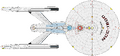
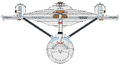
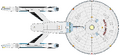
All these classes were collectively called the Constitution class, but sometimes referred to as Refit Phases I-IV, or unofficially as Enterprise, Constitution Flight IV, Endeavor, and Tikopai subclasses.
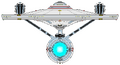
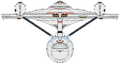
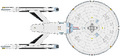
In 2284, at the height of defense spending, a new upgrade standard was introduced for USS Yorktown, which already represented Phase II but now received most of the features of the extensive Enterprise subclass refit, plus some new improvements. Notable differences from Phase I included new flat-panel computer interfaces for an upgraded M-9C1-compatible computer core, omission of half the cargo area in favor of laboratory space, and installation of handling equipment for more powerful photon torpedoes. Also, the Yorktown still sported the original Constitution shuttlebay which had been retained in Flight IV (i.e., Phase II), giving her the benefit of additional space for shuttle workshops, and for miscellany like new and improved brig systems.
The main goal of the upgrade was to effect a significant efficiency increase in both impulse and warp drives. A new, bypass-cooled GA-2300 warp core fit nicely in place of the original throughflow system, requiring only minimal changes in ship structures and allowing for easier access to the dilithium chamber without need for teleoperated machinery. Increased safety and damage resistance were widely hailed, and the ships thus converted did indeed have exceptional engine safety records. Many later classes have adopted this system as well, although through-flow intermix bottle reactors still persist, especially on smaller ships like scouts and corvettes. Type LN-64B nacelles were installed to give a maximum speed of warp 13, the highest for cruisers at that point.
The upgrade was unofficially called the Enterprise Flight II subclass, officially being Constitution Refit Phase V. Most Enterprise Flight I ships were upgraded to this standard and seven new keels were also laid. The standard was internally more diverse than the others, Endeavor subclass excepted: USS Yorktown was the only one to feature the older shuttlebay, and USS America had an aft-facing torpedo tube in addition to the twin forward launchers. The America also introduced a new impulse deck that was planned for use in a wide variety of new military ship types, most of which failed to materialize.
This proved to be the final incarnation of the venerable cruiser design*. USS Yorktown had been incapacitated by the Probe in 2286, and left the dockyards as (a near-perfect replica of) the Enterprise, a tribute to captain James Kirk for his historic rescue mission during the Probe crisis. USS El Dorado and USS Krieger of Phase I standard were ultimately retired in that condition to fleet surplus depots, although Phase V had been planned for these ships as well.
Nine of the 13 Achernar subclass cruisers in Star Fleet use never received linear-coil warp engines. They continued to serve in their original configuration, save for a minor navigational deflector upgrade also effected on the reactivated USS Republic (NCC-1371) that took over cadet training from the destroyed older Enterprise (NCC-1701). The Achernars were used mainly for defensive duties and played a major role in the Xindi conflict of 2272, but the final ships of this class were retired with Khitomer cutbacks. Still, for most of the 2280s, Star Fleet concurrently operated no less than six highly successful major heavy cruiser subclasses based on the Constitution design.
In 2293, USS Alliance inherited Federation flagship status from USS Enterprise, and became the last in the long line of Constitution class ships to hold that title; the ceremonial mission thereafter went to various Excelsior, Ambassador, and later Galaxy class ships.
*Not counting a number of engineering testbeds created out of spare components, among the more famous the long-serving SS Heinemann (NAR-30229) that came to mount no fewer than eleven different and oddly positioned pairs of engines. The expansive Constitution refitting and construction program resulted in relatively more “spares” than any previous starship program.
Registry
Enterprise subclass
| Hull # | Name | Builder | Laid Down | Commissioned | Status |
|---|---|---|---|---|---|
| NCC-1701 | Enterprise (Flt III) |
drydocked 2270 | September 2272 | destroyed (2285) | |
| NCC-1702 | Farragut (Flt III) |
{2271-2277} | {2273-2279} | converted to Enterprise Flight II subclass {2286-2288} | |
| NCC-1703 | Lexington (Flt III) |
{2271-2277} | {2273-2279} | converted to Enterprise Flight II subclass {2286-2288} | |
| NCC-1706 | Indomitable (Flt III) |
{2271-2277} | {2273-2279} | converted to Enterprise Flight II subclass {2286-2288} | |
| NCC-1707 | Hood (Flt III) |
{2271-2277} | {2273-2279} | destroyed (2288)[1] | |
| NCC-1712 | Bonhomme Richard (Flt III) |
{2271-2277} | {2273-2279} | converted to Enterprise Flight II subclass {2286-2288} | |
| NCC-1722 | El Dorado (Flt III) |
{2271-2277} | {2273-2279} | mothballed (2288) | |
| NCC-1726 | Krieger (Flt III) |
{2271-2277} | {2273-2279} | mothballed (2288) |
Constitution Flight IV
| Hull # | Name | Builder | Laid Down | Commissioned | Status |
|---|---|---|---|---|---|
| NCC-1700 | Constitution (Flt III) |
{2271-2275} | {2273-2277} | decommissioned (NLT 2292) | |
| NCC-1704 | Yorktown (Flt III) |
{2271-2275} | {2273-2277} | converted to Enterprise Flight II subclass (2284) | |
| NCC-1713 | Monitor (Flt III) |
{2271-2275} | {2273-2277} | decommissioned (2293) | |
| NCC-1714 | Marat (Flt III) |
{2271-2275} | {2273-2277} | decommissioned (2293) | |
| NCC-1715 | Merrimac (Flt III) |
{2271-2275} | {2273-2277} | decommissioned (2293) | |
| NCC-1717 | Defiance (Flt III) |
{2271-2275} | {2273-2277} | decommissioned (2293) | |
| NCC-1718 | Excelsior (Flt III) |
{2271-2275} | {2273-2277} | lost (2279) |
Endeavor subclass
| Hull # | Name | Builder | Laid Down | Commissioned | Status |
|---|---|---|---|---|---|
| NCC-1711 | Potemkin (Flt III) |
{2272-2273} | {2273-2274} | decommissioned {2293-2295} | |
| NCC-1716 | Endeavor (Flt III) |
2272 | 2273 | decommissioned {2293-2295} | |
| NCC-1719 | Eagle (Flt III) |
{2272-2273} | {2273-2274} | decommissioned {2293-2295} | |
| NCC-1720 | Lafayette (Flt III) |
{2272-2273} | {2273-2274} | decommissioned {2293-2295} | |
| NCC-1721 | Wasp (Flt III) |
2271 | 2273 | decommissioned {2293-2295} | |
| NCC-1723 | Ari (Flt III) |
{2272-2273} | {2273-2274} | decommissioned {2293-2295} | |
| NCC-1724 | Saratoga (Flt III) |
{2272-2273} | {2273-2274} | destroyed (2282) | |
| NCC-1725 | Tori (Flt III) |
{2272-2273} | {2273-2274} | decommissioned {2293-2295} | |
| NCC-1728 | Truxton / Nibiru | {2273-2274} | {2274-2275} | renamed Nibiru (2282); decommissioned {2293-2295} | |
| NCC-1729 | Confiance / Asterion | {2273-2274} | {2274-2275} | renamed Asterion (2282); decommissioned {2293-2295} | |
| NCC-1730 | Bunker Hill / Radiant | {2273-2274} | {2274-2275} | renamed Radiant (2282); decommissioned {2293-2295} | |
| NCC-1731 | La Vengeance / Almagast | {2273-2274} | {2274-2275} | renamed Almagast (2282); decommissioned {2293-2295} | |
| NCC-1734 | Isshasshte (Achernar class, 2264) |
{2272-2275} | {2274-2276} | decommissioned {2293-2295} | |
| NCC-1736 | Ortisei (Achernar class, 2264) |
{2272-2275} | {2274-2276} | decommissioned {2293-2295} | |
| NCC-1738 | Harolna (Achernar class, 2264) |
{2272-2275} | {2274-2276} | decommissioned {2293-2295} | |
| NCC-1740 | Hemalat (Achernar class, 2264) |
{2272-2275} | {2274-2276} | decommissioned {2293-2295} |
Tikopai subclass
| Hull # | Name | Builder | Laid Down | Commissioned | Status |
|---|---|---|---|---|---|
| NCC-1800 | Tikopai | 2277 | decommissioned {2307-2319} | ||
| NCC-1801 | K'ushui | {2277-2287} | decommissioned {2307-2319} | ||
| NCC-1802 | K'hotan | {2277-2287} | decommissioned {2307-2319} | ||
| NCC-1803 | Altair | {2277-2287} | decommissioned {2307-2319} | ||
| NCC-1804 | Fomalhaut | {2277-2287} | decommissioned {2307-2319} | ||
| NCC-1805 | Nakarat | {2277-2287} | decommissioned {2307-2319} | ||
| NCC-1806 | Vega | {2277-2287} | decommissioned {2307-2319} | ||
| NCC-1807 | Arcturus | {2277-2287} | decommissioned {2307-2319} | ||
| NCC-1808 | Pollux | {2277-2287} | decommissioned {2307-2319} | ||
| NCC-1809 | Capella | {2277-2287} | decommissioned {2307-2319} | ||
| NCC-1810 | Darion | {2277-2287} | decommissioned {2307-2319} | ||
| NCC-1811 | Sardar | {2277-2287} | decommissioned {2307-2319} | ||
| NCC-1812 | Aldebaran | {2277-2287} | decommissioned {2307-2319} | ||
| NCC-1813 | Hor | {2277-2287} | decommissioned {2307-2319} | ||
| NCC-1814 | Canopus | {2277-2287} | decommissioned {2307-2319} | ||
| NCC-1815 | Spica | {2277-2287} | decommissioned {2307-2319} | ||
| NCC-1816 | Agena | {2277-2287} | decommissioned {2307-2319} | ||
| NCC-1817 | Vena | {2277-2287} | decommissioned {2307-2319} | ||
| NCC-1818 | Acrux | {2277-2287} | decommissioned {2307-2319} | ||
| NCC-1819 | Binar | {2277-2287} | decommissioned {2307-2319} | ||
| NCC-1820 | Antares | {2277-2287} | decommissioned {2307-2319} | ||
| NCC-1821 | Anak | {2277-2287} | decommissioned {2307-2319} | ||
| NCC-1822 | Betelgeuse | {2277-2287} | decommissioned {2307-2319} | ||
| NCC-1823 | Lux | {2277-2287} | decommissioned {2307-2319} | ||
| NCC-1824 | Rigel | {2277-2287} | decommissioned {2307-2319} | ||
| NCC-1825 | Helios | {2277-2287} | decommissioned {2307-2319} | ||
| NCC-1826 | Deneb | {2277-2287} | decommissioned {2307-2319} | ||
| NCC-1827 | Adhara | {2277-2287} | decommissioned {2307-2319} | ||
| NCC-1828 | Alioth | {2277-2287} | decommissioned {2307-2319} | ||
| NCC-1829 | Alkaid | {2277-2287} | decommissioned {2307-2319} | ||
| NCC-1830 | Alnilam | {2277-2287} | decommissioned {2307-2319} | ||
| NCC-1831 | Arided | {2277-2287} | decommissioned {2307-2319} | ||
| NCC-1832 | Bellatrix | 2287 | decommissioned {2307-2319} |
Enterprise Flight II subclass
| Hull # | Name | Builder | Laid Down | Commissioned | Status |
|---|---|---|---|---|---|
| NCC-1702 | Farragut (Enterprise Flt I) |
{2286-2287} | {2287-2288} | decommissioned {2295-2307} | |
| NCC-1703 | Lexington (Enterprise Flt I) |
{2286-2287} | {2287-2288} | decommissioned (2308); target for deflector-based ORDEX | |
| NCC-1704 / NCC-1701-A |
Yorktown / Enterprise (Flt IV) |
2284 | 2286 | renamed & registered as USS Enterprise, NCC-1701-A (2286); heavily damaged & decommissioned (2293) | |
| NCC-1706 | Indomitable (Enterprise Flt I) |
{2286-2287} | {2287-2288} | decommissioned {2295-2307} | |
| NCC-1712 | Bonhomme Richard (Enterprise Flt I) |
{2286-2287} | {2287-2288} | decommissioned {2295-2307} | |
| NCC-1843 | Levant | 2287 | 2290 | decommissioned {2320-2336} | |
| NCC-1844 | Ticonderoga | 2287 | 2290 | decommissioned {2320-2336} | |
| NCC-1845 | Raritan | 2287 | 2289 | decommissioned {2320-2336} | |
| NCC-1846 | Temeraire | 2287 | 2289 | decommissioned {2320-2336} | |
| NCC-1847 | America | 2287 | 2290 | decommissioned {2320-2336} | |
| NCC-1848 | Scipion | 2287 | 2290 | decommissioned {2320-2336} | |
| NCC-1849 | Alliance | 2287 | 2289 | assigned as Federation flagship (2293); passed flagship duty on (2312); decommissioned 2337 |
Gallery
-
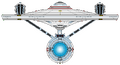
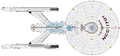
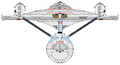
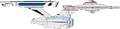 Enterprise subclass
 -
-
-
-
.png)
.png)
.png)
.png)
-
 Constitution Flight IV
 -
-

-
-
.png)
.png)
.png)
.png)
.png)
-
 Endeavor subclass cruiser
 -
-
-
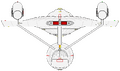
-
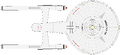
.png)
.png)
.png)
.png)
.png)
-
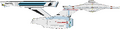 Tikopai subclass cruiser
 -
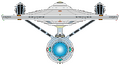
-
-
-
.png)
.png)
.png)
.png)
.png)
-
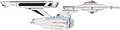 Enterprise Flight II subclass
 -
-

-
-
-
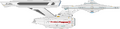 USS America (NCC-1847) (with aft-firing torpedo launcher)
.png)
.png)
.png)
.png)
.png)
.png)
Alternate Images
-
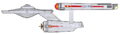 Bonhomme Richard (2265)
 -
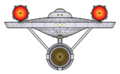
-

-
 Bonhomme Richard (2265 heavier)
 -

-

-
 Constitution refit
 -

-

-

-

-
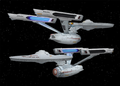 Tikopai 2-view
_(side).png)
_(bow).png)
_(dorsal).png)
_(side).png)
_(bow).png)
_(dorsal).png)
.png)
.png)
.png)
.png)
.png)
.png)
Alt Sources
- Star Fleet Reference Manual v1, pp. 98-101
- Starfleet Design (archived):
- Starfleet Protoype 2291-2292, Gagarin, pp 11-14
Supporting Documents
- Constitution Registry: tracking each ship's conversion history
Notes
- The original Constitution article says USS Kongo suffered a crippling onboard explosion in 2277, suggesting it was still of the Constitution Flight III configuration, and not yet refitted into the TMP era. (The explosion might indicate she didn't get refitted to this standard either, which is now game-canon.)
- Neither Timo nor Memory Alpha indicate what year USS Enterprise (NCC-1701-A) was commissioned, though the former clearly calls out the incapacitated USS Yorktown as the ship to be recommissioned with that name. StarTrek.com explicitly dictates the year as 2286.
- Corrected Timo's mis-spelling of Skar-Rat.
- All mentions of USS Atlirith are being changed to USS Wasp. The Atlirith was not mentioned at all in the original Constitution article and Timo makes it clear it is not a new-build of the LN series.
- For the Wasp's refit, I clarified the placement of the different phaser types.
- I clarified which Endeavor ships were renamed and to what. The new names were chosen by me.
- Changed USS Hood to USS Lexington for longest-serving Connie.
- Timeline notes:
- The operational end years for the Enterprise Flight I, Constitution Flight IV, and the Tikopai subclass were all set by me.