Guide:Cahuya
.png)
| |
| Cahuya | |
|---|---|
| Class Overview | |
| Category | survey cruiser |
| Operational | 2231-2281 |
| Constructed | 10 (converted from Venture class) |
| Dimensions | |
| Length | 234.0 m |
| Beam | 132.7 m |
| Height | 55.1 m |
| Mass | 492,000 tons |
| Performance | |
| Cruise Speed | w 6 |
| Max Speed | w 8 |
| Endurance | 5 years |
| Complement | |
| Officers | 25 |
| Enlisted | 360
|
| Tactical Systems | |
| Beam Weapons |
|
| Shields |
|
| Laboratories |
|
| Transporters |
|
| Auxiliary Craft |
|
| Historical | |
| Ships of Note |
|
| Canonicity | |
| Design | SSA/Todd Guenther |
| Name | SSA/Todd Guenther, LUG |
| History | LUG, own
|
- See Also: Venture class light cruiser

An engine refit for the Ventures was at long last effected in 2231 for ten of the vessels, introducing the advanced PB-29 type to the survey cruiser community. The forward main reactor was swapped for a total conversion one, the aft one deleted; the massive new nacelles received swept pylons of increased strength. Propulsive performance increased at one leap to warp six cruising and warp eight dash speed, vitalizing the class for three more decades of celebrated operations. Yet as only ten of the cruisers would be reworked, Exploration Command made the most of what it was allowed to have. Various modern sensors were rigged on an arching wing that rested on the pylons and vaulted over the reactor superstructure. Three vast subspace antennas were mounted around the hangar area, one on a dorsal pylon, two directly on the hull flanks. The ventral cargo barge was superseded by additional cargo transporters and her berth faired over with a hull extension that accommodated antimatter bunkerage.
Incremental improvements on laboratory facilities, accommodation standards, computing capability and accuracy and firing rate of armament were of lesser scope than the propulsive upgrade. The analysis facilities of the class never quite rose to 2230s-60s standards, and the omission of the bow launch tube in favor of navigation gear vital at higher speeds was something of a blow to the sensing capabilities of the vessels. On the other hand, missions previously conducted by firing a swarm of probes could now be handled with an actual overflight or even a longer stay; the increase in speed was not eaten up by an expansion of operational range. For the last chapter of their lives, these Cahuyas (as per the first of the refits, NCC-740) were very much ‘shallow space’ surveyors, not out of distrust towards their research capabilities, but due to the military environment of the time. The loss of USS Inuit (NCC-747) at Azha in June 2258 was considered proof positive of a need for even greater separation from the Klingon battlefront. Later analysis suggests the vessel did not succumb to a raiding flotilla, though, but was consumed by a spaceborne lifeform of a type common in the region.
The remaining Cahuyas were withdrawn and deactivated in an orderly manner starting in the late 2270s, leaving something of a survey cruiser gap due to the unexpected Hopi class retirement. Starfleet would next dare field lightly armed deep space surveyors in the 2290s, placing its bets on fully combat-capable survey types in the meantime.
Gallery
-
 Bow
Bow -
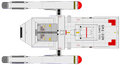 Dorsal
.png)
.png)
Notes
- Several text dates and ranges had to be adjusted to reflect the final decommissioning period for the Cahuyas and to reflect the same for the Ventures.
- The Cahuya does not have its own entry in Timo's Guide, as it was broken out for the purpose of the game.