Guide:Castor
.png)
| |
| Castor | |
|---|---|
| Class Overview | |
| Category | survey cruiser |
| Operational | 2174-2208 |
| Constructed | 10 |
| Dimensions | |
| Length | 242.0 m |
| Beam | 108.4 m |
| Height | 114.8 m |
| Mass | 67,300 tons |
| Performance | |
| Cruise Speed | w 3 |
| Max Speed | w 3.35 |
| Endurance | 3 years |
| Complement | |
| Officers |
|
| Enlisted |
|
| Tactical Systems | |
| Beam Weapons |
|
| Shields |
|
| Laboratories |
|
| Transporters |
|
| Auxiliary Craft |
|
| Historical | |
| Ships of Note |
|
| Canonicity | |
| Design | SFC |
| Name | SFC |
| History | SFC
|
The postwar UFP Star Fleet was really no better off regarding exploration starships than its prewar
UE forebear had been. Even though superb new cruisers had been fielded, the increased military
duties tied them up rather completely. And although survey vessels had also increased in number
and reach with the Placido program, the volume of space to be explored had become so vast that
most survey indices used by UESPA indicated a clear downtrend throughout the 2160s and 70s.
The brunt of medium range exploration duty was carried by the venerable Daedalus class survey ships, which could be considered auxiliary cruisers at best. They were few in number and small in size, and Star Fleet desperately wanted to field an auxiliary cruiser equipped with more powerful impulse systems, modern survey and communication gear, much greater internal volume, and better structural integrity. After a brief competition between various design bureaus, Star Fleet settled on a Gemini Industries proposal that combined a barebones Placido hull with affordable, twin-nacelle warp machinery and a keel extension with fuel bunkerage and sensor mounts. The ship hauled along a gigantic yet lightweight secondary hull pod, via the help of an adapter piece that clamped the keel; the adapter also housed the extra impulse engines needed for maneuvering the combination at sublight.

Some twenty Placido hulls were ordered from their original production facilities, and two new spacedocks built to accommodate the construction program. The hulls were internally configured to rough Placido standard; the new 58 m nacelles were mounted on lateral pylons at the wingtips, wreaking havoc on transatmospheric performance but not precluding landings and takeoffs outright. The ventral sensor dome was replaced by a long boom mount for a significantly larger and more versatile dish array. Defensive lasers were fitted in abundance, with four 400 MW hyper-accelerated emitters dotting the main hull. Shields were also close to the original standard, based on a multi-layered system similar to the Daedalus one, and comparable to combat vessel shielding in ideal circumstances.
Mechanical locking points on both sides of the the keel gave a firm grip for the middle component of the spacecraft – the interface structure housing the main impulse wings, interstellar navigation gear and ventral cargo clamps. While a variety of loads could in theory be carried, the component completing the whole was a single trititanium-durasteel pod 217 meters long and 62 meters across. This huge structure was principally a light support frame and protective envelope for a staggering number of different sensors. Yet inside were also accommodations for survey crews, which could number in the hundreds for short duration missions. The regular contingent of the ship already included almost thirty officers, only three of whom were directly involved in ship operations, the rest handling various science functions. Four very capable atmospheric auxiliary craft were available for the survey teams. In comparison, the option of separating the lifting body hull from the rest of the ship was rarely used for planetary forays – but sometimes utilized for a wider survey of the neighborhood, so that the sensor section could be left in orbit of a planet of interest.
The ten survey cruisers completed were christened the Castor class (with the second ship off the dockyards inevitably named Pollux, and the others following various unrelated naming practices). Registries from NCC-280 to NCC-289 were allocated. Survey operations began in late 2174, when USS Shrike, escorted by the heritage light cruiser Yellowjacket (Christopher class), retraced the historic route of survey ship Defiant, albeit without finding evidence on the fate of the original explorers. Similar ‘refresh cruises’ were performed by other Castor units as well, sometimes without escort, as political conditions near Earth had stabilized significantly.
Mission profiles were soon refined to take into account the widening starbase network. With the help of these bases, the auxiliary cruisers could survey and secure most of the region of space formerly cursorily charted by Enterprise ships. Star Fleet was aware that this was just a temporary solution, and that a truly new cruiser type would have to be fielded in the near future. For the time being, the internal organization of the Federation took too many resources for any to be left for radically new capital ship programs.
Famous Castor survey ships include USS Greyhound, which in 2176 observed the first confirmed extragalactic visitor to human-explored space, a probe entering the UFP at warp 30. It is believed the device, a seemingly inert metal cylinder, came from the Smaller Magellanic Clouds. Federation probes sent towards the area are yet to arrive, and messages from them are not expected until after several centuries, by which time faster ships will undoubtedly have usurped from them their mission significance. USS Clara Barton in turn helped fight the Rigelian fever at its outbreak in 2199 by providing both laboratory facilities, database services and quarantine enforcement that initially limited the plague to Rigel V. In 2190, USS Alert lived up to her name by revealing to the Federation the outbreak of internal unrest in the Romulan space. No historical explanation has been found for the brief battle near b Cersus, but the incident was enough to convince the UFP Council to allocate more funds for the completion of the Caracal class multi-mission cruisers and other ambitious Star Fleet programs of the time.
Silence soon descended on Romulan space again, but few regretted the brief loosening of budgetary strings. In any case, and despite the absence of external threats to the Federation, Star Fleet held regular wargames near Arcturus and Procyon, operating the spacious and well equipped Castors as command ships in offensive formations. Despite exercises of this kind, the wartime unity of the Fleet already showed signs of eroding. Vulcan was quite on schedule in the process of decommissioning its old warfleet, and expected Andoria to follow suit. Yet as long as Star Fleet had nothing but auxiliary cruisers to offer in return, it was difficult to see how Fleet unification could proceed as planned.
For the duration of the 2180s-2200s, Star Fleet thus significantly downscaled its operations again, hoping to provide time and resources for reorganization. It soon found out that the Klingon Empire considered this a sign of weakness, and possibly a backhanded challenge as well. It also learned a healthy respect of Orion guile and venom as the various pirate operatives continually disturbed Star Fleet maneuvers, UFP civilian traffic and local mining establishments, colonies and settlements. The reputation of Star Fleet did not yet quite strike fear in the hearts of wrongdoers.
Gallery
-
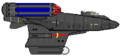 Independent primary hull
 -
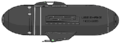 Disconnected secondary hull

