Guide:Defiant and Valiant

| |
| Defiant & Valiant | |
|---|---|
| Class Overview | |
| Category | Survey cruisers |
| Operational | |
| Constructed | 2 |
| Dimensions | |
| Length | 92.4 m |
| Beam | 41.1 m |
| Height | 17.0 m |
| Mass |
|
| Performance | |
| Max Speed | w 2.5 |
| Endurance | 20 years (w/ hydrogen scoops and possible planetside replenishment of air/water/organic consumables) |
| Complement | |
| Officers | 4 |
| Enlisted | 26
|
| Tactical Systems | |
| Beam Weapons | 2 laser emitters (190 nm / 12 MW) on habitat hull |
| Missile Weapons | 1 missile rack w/ 6 fusion missiles (10 kT) and 18 probes beneath habitat hull |
| Shields |
|
| Laboratories | 1 astrophysics |
| Auxiliary Craft | 4 maintenance pods |
| Canonicity | |
| Design | Spaceflight Chronology, Greg Jein / Michael Okuda |
| Name | TOS |
| History | TOS |
| Class Report | Defiant / Valiant class |
| Worksheet | Defiant / Valiant class report |
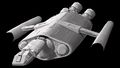
In 2064, barely a year after the pioneering flight of Zephram Cochrane, two ships equipped with warp drive zoomed out from Earth orbit towards the upper and lower edges of the galactic disk. Survey cruisers Defiant and Valiant were sent to find out the limits of Human reach with the new drive. Sending back reports on radio waves only, the ships quickly disappeared into the galactic void.
Few on Earth could have predicted the creation of the bold surveyors even a year in advance. Admittedly, Western American and ECON industrial communities had begun their separate efforts to rebuild Humanity’s presence in space, erecting new space stations in place of the ones blown to dust in the war and building spaceports for heavy duty surface-to-orbit craft in place of the craters that once were cosmodromes. However, very little of this new space network was in place when the T’Plana-Hath decelerated to orbit and lowered her sensor screens. Reactions from across the globe ranged from impotent panic to stunned silence: none of the nations had observed the vessel approaching, and none could as much as send a spacebus to meet the mighty visitor, let alone challenge her presence. Three weeks later, when Cochrane made public his warp technology, fear and desperation drove together the East and the West. There was no alternative to cooperation now: Earth had to gain warp capability for the sakes of all her nations and alliances.
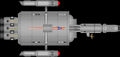
The East was to provide the spaceframes. Five of the Akademik Mstislav Keldysh class cruisers had been ordered back in 2049 to serve the interplanetary interests of the Econ, and four of them completed before the war. The ships were roughly the equivalent of the Western Companion class, capable of Earth-Mars or Earth-Jupiter runs and optimized for hunting down enemy shipping and anti-shipping vessels, but were mostly used for sabotaging satellite networks just prior to the war. Four giant nozzles of the fusion reaction engines heated ammonia propellant from a huge centerline tank by fusing deuterium from lateral saddle tanks, all enclosed in an outer armor shell of rounded diamond cross section. Missile racks and laser projectors dotted the exterior in the original configuration.

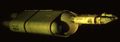
The West became the major system contractor. Two of the cruisers were in 2064 modified for interstellar operations by cutting off the bow structures, adding a separate fusion powerplant within the ammonia tank, and bolting on two warp coil nacelles, simple scale-ups of the upgraded Phoenix engines and capable of englobing the craft in a 3-cochrane field. Total fueled mass was increased from 4,500 to 16,300 tons, most of that in the warp coils. Interstellar hydrogen (mainly from icy bodies to be encountered) was to boost the craft when ammonia ran out, and to serve as fusion fuel. Standard mode of operation required the ships to drop out of warp at the edge of the next star system, replenish fuel, and conduct observations including mapping the next leg of their journey.
As in the original Keldyshes and many of their contemporaries, the crew of the warpships was housed in a pod in front of the fuel/propellant tank, well separated from the reaction chambers. The zero-gravity conditions aboard necessitated comprehensive medical support for the crew, and cryosleep was used to ease the strain on the life support systems. Although already obsolete in interplanetary applications, the technique of slowing down metabolism to near standstill was nevertheless quite practical in conserving the resources required for interstellar flight. The nominal survey radius of the ships was intended to be 150 lightyears, or ten years in both directions, provided that only three of the thirty crew were awake most of the time. The theoretical figure, worthy of envy from later starship captains, owed much to cryosleep techniques, but the truth was that such an impressive radius could only be reached if fuel and various consumables could be replenished underway as efficiently as the Vulcan-backed calculations predicted. In other words, the missions took huge risks and braved a true point of no return after just one or two years.
In addition to life support equipment, the two-deck armored pod contained several telescopes of various types, as well as a powerful laser projector extending to starboard, intended both as a scientific instrument and communication device and as a defensive weapon. No FTL instruments were available, though. In front of the pod was an angular utility compartment featuring a bridge superstructure and a large airlock. Defensive systems mounted here included glass bead cloud emitters to fool lasers, and a rack-type launcher for nuclear missiles as well as probes—weaponry gathered from the military space programs of various nations from all sides of the recent nuclear conflict. Four small maintenance pods were also berthed in the structure connecting the habitat pod to the ammonia tank. The ships were not supposed to conduct exhaustive planetary surveys; their mission was one of interstellar mapping and technology demonstration, and the survey equipment carried aboard was of limited use in studying (or reaching!) planetary surfaces. There was no real intention of contacting alien species. Vulcans had provided the explorers with rudimentary translation programs for the alien languages they admitted to being familiar with, but the ships were not going to visit space inhabited by the speakers of those languages.

Both of the vulnerable little vessels failed to return from their missions. SS Valiant sped to galactic south at maximum speed, but ended up getting caught in a spatial fold within an ion storm, encountering the galactic barrier in early 2073 and falling prey to its effects. According to investigations by USS Enterprise in 2265, Captain Tarasco initiated self-destruct as the dire consequences of the encounter with the barrier were realized. SS Defiant was destroyed a year after her departure in a region of space later found to be claimed by the Barrier Alliance. Few on Earth cared; the war and its chaotic aftermath had ravaged the deep space listening networks, and most of the knowledge gained and sent back was never received. Some data was later recovered by colonist spacecraft speeding past the radio waves, utilizing the only form of "time travel" allowed in the Cochrane version of theory of relativity.
But the main message was not lost. It would take some twenty years before Earth could again launch craft across such vast expanses of space. Yet when the dust of the war settled for good, Humans possessed the knowledge that long range warp travel was possible, and proceeded to build a mighty fleet of FTL ships with the assistance of Zephram Cochrane and the benevolent aliens he had encountered. These ships were used for colonization of nearby planets and for contacting neighbor cultures, launching the first real wave of Human expansion.
Ships
- Ship names attributed to the class are:
- SS Defiant
- SS Valiant
Gallery
-
 SS Valiant mission patch
 -
 Ventral view
 -
 Bow view
 -
 SS Valiant under construction
 -
 SS Defiant in orbit
 -
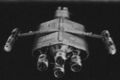 Last view of SS Defiant
 -
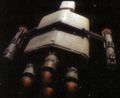 Last view of SS Valiant
 -
 Stern view of SS Valiant as she approaches the galactic barrier
 -
 Destruction of the SS Valiant
 -
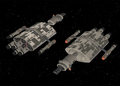 2-view


.jpg)


.jpg)

.png)
External Sources
- Youtube: "The Valiant - Earth's First Starship"
- Youtube: "Death of the Valiant - The Fate of Earth's First Starship"
Notes
- I really like the pattern on the 2-view above. It seems extremely appropriate for the immediate post-First Contact period.