Guide:Oberth
_(stbd).png)
| |
| Oberth | |
|---|---|
| Class Overview | |
| Category | surveyor / supply ship / tender / medical ship / various others |
| Operational | 2266 -
|
| Constructed | 226 total:
|
| Dimensions | |
| Length | 120.0 m |
| Beam | 60.1 m |
| Height | 31.9 m |
| Mass |
|
| Performance | |
| Cruise Speed |
|
| Max Speed |
|
| Endurance | 2-4 years |
| Complement | |
| Officers |
|
| Enlisted |
|
| Tactical Systems | |
| Beam Weapons | |
| Missile Weapons |
|
| Shields |
|
| Laboratories | Oberth planetary surveyor configuration:
Oberth stellar surveyor configuration:
Angueira, Gunum:
Pakokku, Oahu: none |
| Transporters | original standard:
Pakokku:
Eyre:
after 2275: all systems Mk IV |
| Auxiliary Craft | 1x work pod (in equipment/cargo pod) |
| Historical | |
| Ships of Note |
|
| Canonicity | |
| Design | ST III |
| Name | TNG, Ships of the Star Fleet, FASA, LUG |
| History | Timo, Ships of the Star Fleet, FASA
|
Background: Hobbyist's Guide
The ingenious Oberth small starship was an effort to create a common affordable platform for missions including light supply, mapping, various scientific observations, and communications relay laying. Remarkably for such an ambitious project, the Oberth actually was an unqualified success.
The simple basic philosophy of the design, often suggested but seldom made practical, was to build a minimum starcraft and attach to her a pod configurable for all the missions. While the concept was ages-old, the history of this particular design began with a study from 2257, performed largely by Centaurian starship designers instead of the usual Star Fleet R&D bureau. Thus, the results were not chained by Star Fleet’s plans for future starship families, and many rather individualistic components were developed for the class. Predictably, Star Fleet initially wasn’t too happy with the design, supporting its own program of converting Saladin destroyers to Nelson scoutships and promoting a successor design similiar to the smaller Hale and Bode scouts. But after the industrialists of New Athens had pitched the design with endless virtual and subscale models for the better part of a decade, "leftover" NCCs in the 600 range were finally appointed for an initial prototype batch of four vessels.
Diverting of resources to the high-volume destroyer projects and to the Nelson follow-on science scouts still delayed production of the tiny surveyors until late 2264. Built to various engine and equipment configurations, USS Oberth (NCC-616), USS Lagrange (NCC-617), USS Lake (NCC-618), and USS Copernicus (NCC-623) began yet another line of science vessels named after space exploration personalities of Earth history. The Lagrange had an austere supply configuration, the Copernicus was built as a relay layer, and the Lake initially demonstrated an angular passenger/cargo module before being converted to the generic surveyor configuration and renamed Hawking. The Oberth, in turn, was fitted as a general purpose science vessel by the end of her test runs and the decision was made to proceed with this configuration for the first production batch in 2266, beginning with USS Gagarin (NCC-630).
The core common to all variants was easily recognizable as the modern counterpart of the Hale design. A 38-meter, two-deck saucer, with an inset bridge module in the middle, unsurprisingly accommodated primary command, control, and habitability functions. The half-sunken bridge was surrounded by a ring of escape pods covered with sliding panels, and farther out by bunking for up to 25 crew, plus officers’ quarters and galley. The lower saucer deck (designated Deck 3 in deference to the traditional status of the bridge module as Deck 1) could be flexibly configured for up to 60 assorted research personnel or supercargo, full scientific facilities of no less than five general purpose laboratories, sixteen berths for modular-assembly scanning instruments, or hangar arrangements for research and liaison craft and drones.
Deck 4 was a wide, engineering-dedicated level that housed main and auxiliary power systems, power distributors, life support, and other vital ship’s systems. Several options existed for the horizontal warp core at centerline, including a SEMP "Robuste" fusion reactor (never used), a RMR-400 or -500 series dilithium system, and the ultimately virtually standard KR05-P. Two midget WD-3 warp nacelles (versions A through G in the various subclasses and upgrades, massing mere 40,000 tons apiece) were attached to the port and starboard flanks of the third deck. Their intercoolers were on the dorsal surface of the deck just inboard of the nacelles. An IP-5 impulse deck hung below the deck aft centerline, next to its twin fusion generator/cooler assembly.
Useable hull volume was maximized by locating the fuel tanks outside, within the oblong ventral equipment pod that could freely be scaled according to mission needs. Fuel was transferred via lines within two curved triangular structural supports holding the pod underneath the saucer. For 2265, the configuration appears needlessly complicated. Yet in 2257, when dilithium power was still a novelty in the small-ship community, the locating of antimatter bunkerage in a jettisonable pod was an understandable engineering solution—especially in a vessel that did not need the compact profile of a warship and had greater protection priorities for crew and mission hardware than for propulsive systems. Still, these volatile components were the only part of the propulsive system housed outside the main hull, thus leaving most of the pod free for cargo, relay buoys, or mission modules. The forward section, covered by instrumentation-transparent material, catered for a wide variety of sensors and scanners in addition to housing the main navigational deflector. Sliding doors protected the three aft compartments and made them accessible from outside by work pods or cranes; usually one workbee was also carried in the aftmost compartment for various cargo handling and repair duties, unless alternate berthing for it was provided in the saucer.
In emergencies, a complex jettison procedure would rid the saucer hull of the ventral pod, its support pylons, and the warp nacelles. Impulse power would then be available for planetary landings, even though the impulse reactor units could also be ejected if needed. Only one Oberth is reported to have used the jettison option, however: USS Giotto (NCC-19847, Fermi subclass) performed a planetary landing after suffering extensive damage in the Cellari Ambush of the Cardassian conflict in 2355, and sat marooned on Cellari III for two months. Incredibly, the ship is credited with the kills of two Malaki patrol boats and one Gondori tanker and disabling of one heavily damaged and nearly derelict Galor Type II cruiser in three separate combat engagements during her four-month flight from behind Cardassian lines. The luring of a Velgan class frigate into a minefield near Maynard’s Meadow led to yet another, although uncredited combat victory for the ship—some of the alleged exploits of the ship still remain contested by historians. Thirteen of the original 84 crew survived, and Lt. Sannah C. Delacroix, the acting captain, was decorated with the Star Fleet Citation for Conspicuous Gallantry and the Karagite Order for Heroism.
The potential for military victories certainly wasn’t built into the vessels. A minimal if ultramodern defensive armament of one phaser V emitter on the primary hull and a one-layer forcefield was originally chosen. Defensive measures beyond this were dependent on improvisation. Although never officially stressed, the relay-laying configuration could quite as well be used for laying gravitic mines. In addition, tractor beam machinery was usually mounted inside the forward pod compartment and/or the instrument berth between the impulse nozzles. The original designers had never even dreamed of including a torpedo launcher in the arsenal, yet the Mk 16 introduced in 2275 was compact enough for installation even aboard the small science ships. Three Oberths from across the original production run (USS Gagarin, USS Banting, and USS Cooper) were fitted with a single bow tube and a magazine for 10-15 shots, and dual-mode software was added to short range sensors. The measure failed to save the Gagarin from Klingon boarding in 2279, though. The resulting prisoner-of-war conflict was finally resolved during the 2287 détente, yet the vulnerability of science vessels to hostile boarding was not; raiding of such vessels remained a prime intelligence source for Klingon forces.
The following Komarov subclass received the launcher as a permanent feature and also carried proper targeting sensors. The experimental Darwin conversion, USS Thagard, embraced these tactical improvements and added more, mostly as a demonstration of systems integration and miniaturization. She became something of a flagship for the survey fleet, equipped with a large auditorium, shipping an honorary Marine guard and even featuring a botanical garden in the ventral pod.
In lieu of a proper hangar, the ships could be fitted with up to three large rolling-door airlocks on the saucer rim. These featured docking fixtures, and also gave the crew space access in the supply and tender roles, but were mainly used for housing instrumentation in survey vessels. Normal ingress/egress was in all ships—except the four prototypes—augmented by a six-pad transporter that could be directly connected to dataways on starbases or large starships, facilitating effortless intership transport. This capability was especially useful in the tender and supply roles. No bulk cargo transporters were normally installed in the surveyor models, or even the tenders. However, the Pakokku series of supply ships utilized a medium cargo unit for outpost and surface transrep missions, where hardwired transports could not be performed; the improved Eyre class featured two units. As the class matured, the transporter systems were dutifully upgraded, ultimately to Mk VII level.

In 2273-76, the ships already completed received new WD-3B nacelles and modern powerplants, and computer systems were thoroughly upgraded. A new paint scheme was also applied. Some missions of the retiring Monoceros and Nelson scouts were directly given over to Oberth vessels, and the need to maintain old destroyers for scout duty was diminished. Most of the Oberths were designated science scouts (SS), although the mission class identifier was later also expanded as "superscout". The Komarovs and torpedo-toting original Oberth units in turn were considered tactical scouts (ST) for the duration of the Klingon crisis.
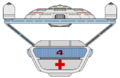
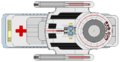
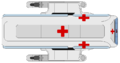
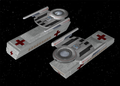
Furthermore, a completely new role was given to the design, also related to the Klingon conflict: a medical support variant of the basic supply model was created with the addition of quick-conversion medical facilities to the new batch of some thirty supply ships (of Glenn subclass). Based on experiences from these "combi" ships, a subclass of 18 ships was built with a dedicated hospital module in place of the ventral pod, augmented by permanent biomedical laboratory and surgery facilities in the primary hull (Angueira subclass). The antimatter bunker in the pod was less of an obstruction than originally feared; its delta and gamma flux was even harnessed to medical purposes in some ships.
In 2311, after the fourth and supposedly last major lot of surveyors (NCC-19000 onwards, and formally Fermi subclass, although seldom thus designated) had been delivered to Star Fleet and the number of produced hulls brought to 140, older hulls were released for private operations, sometimes gaining a new class name (including Vigilant surveyors and Sierra small craft tenders operated by the FCS). Some were pulled back to Fleet use during the Cardassian war when all Federation supply ship types suffered heavy losses due to the favored Cardassian tactic of cutting all enemy support lines before decisive battles. New tenders (Oahu subclass, NCC-31595 onwards) and surveyors (Sakharov subclass, NCC-53834 onwards), with the option for slightly heavier modular armament, were also introduced at a time when border wars were already reshaping Star Fleet’s conceptual views of surveyors and survey operations.
The Sagan subclass of science scouts broke new ground by taking onboard a Varanasi warp core twice the size of earlier units and housing it vertically inside the ventral pod. The installation required some reworking of the support pylons, exchanging fuel lines for plasma conduits, but proved a great success and a promising solution to the surveyors’ deep space performance limitations. A wide range of special variants quickly followed, and ships were converted from one variant to another at a speed that made Star Fleet accounting departments give up subclass designations in despair and disgust. The subclass breakdown in the datasheet of this entry should thus be taken as a rough indicator of original status only.
Externally, differences between late-model Oberths are minor, although equipment and powerplant standards vary within broad limits. Some ships have been used as testbeds for modern starship equipment, such as the infamous illegal phase-cloak tests performed by USS Pegasus (NCC-53847, Sakharov subclass) in 2358. The tests that ultimately led to the destruction of the vessel through mutiny were finally exposed in 2370 and led to the prosecution of Rear Admiral E. Pressman and several Star Fleet Intelligence, Security and R&D officials on charges of violating the Treaty of Algeron.
At the moment, Star Fleet is slowly replacing the numerous Oberths with Nova class surveyors and also relegating some of their science duties to larger starships. Still, it is likely that by 2380, more than fifty Oberths (mainly Eyre supply ships, Sakharov surveyors, and Oahu tenders of NCC-31000 or higher) will still be in frontline service.
Gallery
Other Images
-
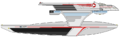 Oberth, with the sensor pod configuration
 -
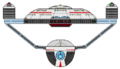
-

-
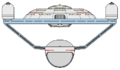
-
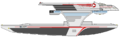 Lagrange, a prototype, with the supply pod configuration
 -
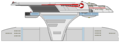 Lake, a prototype, with a passenger/cargo module
 -
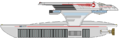 Copernicus, a prototype, with a communication relay module
 -
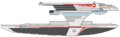 Glenn, with the supply pod configuration
 -
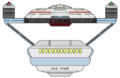
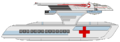 Angueira, with the medical configuration
 -
-
-
-
-
-
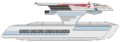 Pakokku, with the supply configuration
 -
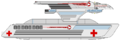 Gunum, with the new medical configuration
 -
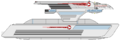 Eyre, with new supply configuration
 -
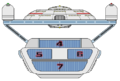
-
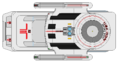
-
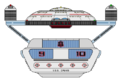
-
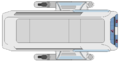
-
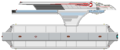 Oahu, with advanced tender module
 -
 Oberth class with Loknar frigate
_(bow).png)
_(dorsal).png)
_(stern).png)
_(stbd).png)
_(stbd).png)
_(stbd).png)
_(stbd).png)
_(stbd).png)
_(bow).png)
_(dorsal).png)
_(ventral).png)
(stern).png)
.png)
_(stbd).png)
_(stbd).png)
_(stbd).png)
_(bow).png)
_(dorsal).png)
_(stern).png)
_(ventral).png)
_(stbd).png)

Notes
- At least 3 (maybe 4) of the Oberth class would be assigned to the SCE's Starship Contingent Teams post-2279, following the retirement of the Daedalus class ships in that role. However, it's possible the Oberth class vessels did not directly succeed the Daedaluses, but rather followed one or more interim classes, as the Oberths were apparently in service with the SCE until at least 2370, when ships from the Saber class were selected to also serve.
- This is what I've uncovered/decided from my reading of the Oberth and Garneau entries:
- The primary Oberth class went into production with the success of the USS Oberth prototype, and the first production vessel was USS Gagarin. Later, USS Gagarin was converted to a tactical scout role, and three additional ships were also converted to that standard, creating the Gagarin sub-class. The Gagarin, two other Oberths and the Garneau class USS Darwin were upgraded with a torpedo tube in 2276. The conversion year for the Gagarin tactical scout subclass did not start until 2276—in my opinion—because the Mk 16 was only introduced the year before (2275). It could have occurred as late as 2279, but I think that's a bit delayed for the seizure of USS Gagarin that same year. Note, the conversion of USS Darwin to the Gagarin type occurred much later (in 2293).
- The Lagrange subclass is not in the datasheet portion of the article. Instead, it lists the Glenn as one of the first supply subclasses. Therefore, I've decided, the Lagrange was a prototype model, from which the Glenn was developed. The Glenn image, therefore, is modified from the former, and the Lagrange later converted to full Glenn.
- The Lake prototype was not put into production as a subclass; instead, the ship would eventually be converted into the primary Oberth surveyor configuration (and re-named).
- The Copernicus relay tender is not indicated as a subclass, though about 55 years (2321) later the Oahu is introduced in that role.
- The Angueira and Pakokku subclasses appear to have been produced simultaneously in the 2270s.
- The Komarov subclass is identical to the original Oberth, swapping out some other space for the torpedo launcher. Its build occurred sometime between the primary three Gagarin conversions (2276) and that of the (later) USS Darwin (to Thagard) conversion (in 2293). Guide: Garneau indicates "several new batches" of surveyors "were built" by the original Garneau's 2279 swansong, so I've set the initial production date of the Komarov to 2277.
- The Glenn subclass had the capacity to quickly convert spaces in the pod to medical facilities. This directly led to the development of the medically-devoted Angueira sub-class.
- Other than a new module, the Gunum medical configuration appears to have served alongside the older Angueiras.
- Like the Komarov subclass, the Sagan is externally similar to the original Oberth, but now has the vertical warp core in the pod. The Korolev entry indicates the Sagan marks the start of the "modern" Oberth variants.
- The Eyre subclass appears to have been developed on the same design as the Gunum medical configuration, but after the development of the vertical warp corp of the Sagan subclass.
- The Sakharov subclass was the final one to be produced, with the latest technology for surveys.
- A major change in year is applied to Fermi: Timo states it was completed in 2351; however, the subclass' hull number range start (NCC-19000) suggests it entered production (or service) in 2309. Forty-six Fermis were constructed, so a rough range of three years suggests the run was completed (around) 2311, the year to which I'm adopting (and adapting for the body's statement). This also necessitated a movement of the (previously) preceding Sagan paragraph to immediately follow the "Fermi in 2311" one, for chronological clarity. Lastly, the statement "...and the number of hulls brought to 195" has been changed to "...and the number of produced hulls brought to 140", to reflect all ships built (or converted) to the Oberth type by this point in time.
- The comment where the Oahu and Sakharov subclasses were first mentioned had to be edited to remove 2348 as the year of introduction, as well as (attempt) to downplay the influence on Cardassian tensions on their development.
- Timo says Star Fleet wanted to upgrade the Hale and Bode designs, rather than go with this unsolicited Centaurian ship, but both of those classes were decommissioned prior to the release of the 2257 study. Instead, the language was changed to suggest a modernization of those two designs is what Star Fleet was pushing.
- The comment regarding prototype production starting in late 2265 has been changed to 2264, as the prototypes could not be completed, tested, and the new class produced and operational all in 2266.
- USS Oberth's naval construction code has been changed from NCC-602 to -616. The former is already assigned to USS Aries (Hermes scout). NCC-616 is the first in the 600 range open and -617 happens to be what Timo assigned to the second prototype, USS Lagrange.
- I've changed the date of the Pegasus mutiny to 2358 (from Timo's 2359), as that is the year established by Memory Alpha.
- The NCC for USS Banting has been changed from Timo's -838 to video game Starfleet Academy's -639, to better match with the established range for the original Oberth class.
NCCs
- This is not stated anywhere in Timo, but the time frame for certain Oberth types means that these ships would have been originally commissioned with service ship letters in their registrations. Starting in 2271, they would be re-registered with standard NCCs. The following subclasses are so affected: Oberth & Glenn.
- For the purposes of context, the following decisions regarding NCCs for the Oberth type are provided here:
- Oberth: These ships were originally categorized as "corvette/scout" in the NCC registry, with the range of "L828-L841". In 2271, the range of "616-618" and "623" was assigned to the original four prototype vessels. All were named (and USS Lake became USS Hawking after converting from its prototypical passenger/cargo transport to general science configuration). "630-639" were provided to the remaining ten production vessels, starting with USS Gagarin and all are named.
Alt Sources
- Star Fleet Reference Manual v2:
- Oberth: pp. 104-107
- Angueira: pp. 120-123
- Starfleet Protoype 2291-2292, Gagarin, p 81
- Starship Handbook (Combined)104-107