Guide:Hale
.png)
| |
| Hale | |
|---|---|
| Class Overview | |
| Category | scout |
| Operational | 2229-2250 |
| Constructed | 80 |
| Dimensions | |
| Length | 120.0 m |
| Beam |
|
| Height | 44.5 m |
| Mass |
|
| Performance | |
| Cruise Speed | w 4 |
| Max Speed | w 5 |
| Endurance | 1 year |
| Complement | |
| Officers | 13 |
| Enlisted | 52
|
| Tactical Systems | |
| Beam Weapons |
|
| Shields |
|
| Laboratories |
|
| Transporters | none |
| Auxiliary Craft |
or
|
| Historical | |
| Ships of Note |
|
| Canonicity | |
| Design | SFC, FASA |
| Name | SFC |
| History | SFC, SFC
|
Background: Hobbyist's Guide
The "scout gap" of the turn of the century was not quite filled by the introduction of the mere forty Podish and Tuverlind scoutships. Their poor reliability had made further production of the type unlikely. There were downsides of other kind to the massive Hermes, a military machine theoretically capable of secondary missions of scientific study. Maneuvering such ungainly hulls in missions of clandestine military or scientific intelligence gathering presented high risks; hauling such bulk around was unwise from the economical point of view as well. Restricting the Hermes class to a standoff observation and fleet coordination role was a rational decision that brought out the strengths of the design, yet it dealt a further blow to the scientific scouting force. The small Lowell, in turn, was only eligible for nearspace operations of limited scope.
The 2218 Klingon offensive had left scant leverage for the parties promoting scientific scouting, however. Some half-hearted studies at converting the light Kovaris destroyers aside, little progress was made in the 2220s. Finally, after much budgetary wrangling, a new request for proposals was put forth in 2227 to give Star Fleet a dedicated scout type adaptable for both scientific and military missions. Requirements included full shuttlecraft operations support capacity, stealth and agility, endurance, warp probe launching ability, high speed, and adequate defensive strength, all naturally at a low acquisition cost. Instead of the bulky standard saucers, smaller type-specific hull designs were to be used as the basis of the spaceframe.
It only took two months for all parties involved to agree that no single class could meet the requirements. An optimized procurement plan was formulated for two distinct types. One would aim at stealth, agility, and low cost, all of which agreed with a small spaceframe; supercruise and a dash speed comparable to light destroyers were still required of the design. Another would tackle the issues requiring bulk and brawn: the shuttlecraft capability, the high speed engines, the probe launcher. The plan did not deal with the engineering aspects of the two classes, but did assign construction contract numbers and class names for both.
The Hale class of Short Range / Proximity Survey scouts was by far the easier of the two to build, of that Cosmadyne Corporation was convinced when it accepted the contract for 50 vessels. A slightly ovoid saucer hull was swiftly designed, 96 meters on the long and 74 on the short axis, and 18 meters and five decks thick. The volume could easily accommodate long duration survey crews in addition to the regular contingent of 65, which already was set to include five mission officers alongside the eight operating the ship. The bridge was almost completely inset into the forward part of the top deck, with just sensors and a small observation tower protruding. An extendable sensor boom rested atop the aft part of the hull, and could deploy a trailing array for passive gravitic, subspace, and EM field measurements.
The Fairey FTL-6 main reactor of the vessel occupied some 6000 m3 in an armored box below the sensor boom, while propulsive systems were housed outside the saucer hull. The modern PB-23 warp engines, of the dedicated S variant to properly compromise between the high reactor output and the proximity and signature limitations of the warp field, were usually shrouded by protective petals for further improved stealth and safety; a low-signature lateral ramscoop could also be fitted in place of the usual domes. At full power, warp 5 could be sustained, although this meant significantly degraded low observability characteristics. The centrally-mounted SP-1B impulse engine was hidden behind protective vanes as well, yet would offer great agility and acceleration with the shutters fully opened. A tiny hangarette for one light shuttle had ventral space doors and featured little in the way of service gear.

Primary armament consisted of a single relatively heavy laser emitter below the bow. The main weapon was not particularly well positioned for discouraging pursuit and might have been best suited for engaging lightly defended opponents such as transport vessels. The SR/PS mission profile hardly called for offensive operations, though. Moreover, secondary power distributors were somewhat under-engineered and charging the main gun meant reduced power for other tactical systems. Some ships were thus equipped with supplementary plasma cannon in up to six individual berths; extremely few ever carried a full complement. The presence of the weapons was mostly a gesture of concession to the ongoing major military confrontation. Defense Command reassured UESPA and FSA representatives that the vessels would be relinquished for scientific survey duty "as soon as the war was over".
Undeclared and seemingly unresolvable, the conflict dragged on to the 2230s, with no end in sight. Other projects superseded the scout program and, in 2233, Cosmadyne was told to halt construction at 80 units. Fifty more were to be built, but to more affordable general standards emphasizing the support and supply aspects of the survey mission. The new power system assembled from off-the-shelf components chosen for their lower cost actually had a 125% higher secondary loop output than the original system. The resulting improved tactical response did not secure any further construction contracts, however.
The Hales were never to be freed from their military obligations. A withdrawal from frontline operations after Axanar came too late in the life of the class to allow for a second career. In the 2240s, dilithium-regulated annihilation finally emerged as a viable power source and spelled the end to many open-intermix types. While smallish vessels lacking the room required for an engine upgrade were the first to be retired, the Hales also suffered from another type of inherent drawback: namely, their warp engine geometry. Star Fleet engineers were at loss to find a way to increase engine output without immersing the entire hull in deadly field gradients. A combined complete engine remounting and weapons upgrade might have saved the scouts, but no funds were forthcoming for such a major effort, as the creation of the Capella class to those specifications was the far more cost-effective solution. Some two decades later, the problems associated with the tucked-in nacelle configuration would finally be solved and the Garneau class would closely approximate the Hale design, albeit at smaller size and higher performance.
Starting in 2246, the Hales were retired en masse. As no compromising photon torpedo or dilithium technology was included in the vessels, most units could be sold to civilian and foreign users, but a handful were kept as liaison and supply vessels for Star Fleet use. USS Cassegrain (NCC-I429) was in 2249 hijacked by renegade Andorians who set the crew adrift and disappeared to parts unknown with cargo holds full of various weapons components. Within a year, Star Fleet had decommissioned the last specimen of Hale class from their supply and liaison role. A select few units still performed useful service as training facilities for firefighting and sealing crews until the mid-2270s.
Gallery
-
 Hale (bow)
 -
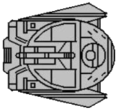 dorsal
.png)
.png)
External Sources
- Vintage Starships: "2233 – Hale": includes 3D views
Notes
- The concept of flights to differentiate between the shroud petals and ramscoops is added; these were not separate runs, just three variants intermingled throughout the production runs.
- The sidebar quantity has been reduced to 80, per the text.
- I have no idea why the Hale class scouts were registered (by me?) in the 1000 range, nominally reserved for heavy cruisers. Even USS Cassegrain was registered as NCC-I429 by Timo, yet I had it registered as NCC-1039. I'm "moving" them to the NCC-I400 through -I500 range.