Guide:Bode
.png)
| |
| Bode | |
|---|---|
| Class Overview | |
| Category | heavy scout |
| Operational | 2232-2256 |
| Constructed | 51 |
| Dimensions | |
| Length | 191.2 m |
| Beam |
|
| Height |
|
| Mass | 287,000 tons |
| Performance | |
| Cruise Speed | w 5 |
| Max Speed | w 7.3 |
| Endurance | 1 year |
| Complement | |
| Officers | 15 |
| Enlisted | 58
|
| Tactical Systems | |
| Beam Weapons | 2x laser emitters (700 MW) (dorsal primary hull) |
| Missile Weapons | 1x fwd torpedo tube, with
|
| Shields |
|
| Laboratories |
|
| Transporters |
|
| Auxiliary Craft |
|
| Historical | |
| Ships of Note |
|
| Canonicity | |
| Design | SFC/FASA |
| Name | SFC |
| History | SFC, FASA Four Years War sourcebook
|
The upper tier of the 2227 scout program was dubbed the Bode class early on. Being far more complex to develop and build than the lower tier Hale class, the High Speed / Long Range scout first began trials in 2230. An arrowhead hull 98 m long, 29 m high and 44 m wide was designed from scratch to house two lasers on upper bows, a probe launcher on ventral bow, and a host of laboratories within. The all-important shuttle landing bay was located astern, with an upward-rolling space door. Forward of the bay was sufficient hangar and repair space for up to four shuttles, or alternatively room for installation of up to six modular laboratories. The versatile vessel in effect carried enough research gear to qualify as a research cruiser rather than a mere scoutship. As the engines quite dwarfed the hull, though, it was immediately obvious even to the casual viewer that high warp performance was the raison d’etré of this ship class.
With the first performance trials came great disappointment: the engines ran into severe Ishakawa- Dell power drain effects and had trouble breaking past warp five. There was no fault as such in the PB-27-2 engine, similar in basic design to the Mann upgrade units. The two 120,000 ton nacelles installed on the Bode were self-contained units, each carrying fuel on a saddle tank running along the topside, featuring an intermix cone and two heat exchanger ‘eggs’ astern and tubular final stage intercoolers below, and even serving as mounting platforms for scientific and reconnaissance instrumentation. Their output certainly should have been sufficient for greater performance, but there was a conflict inherent in the extra boost needed to break past the Ishakawa-Dell threshold: the unexpectedly high breakthrough field strength would endanger the instrumentation, and possibly the crew as well.
Yet settling for warp five top speed would have voided all the advantages and aims of the scoutship program. Extensive, indeed destructive testing on USS Mayer led to the development of a protective visor system between the hull and the front ends of the warp engines. Several variants were flown; the final choice was almost 40 meters across. Satisfactory field strength values within crew spaces were reached, while instrument relocation settled some of the equipment compatibility issues.

By 2232, the fifteen Bode scouts in service (the Mayer having been written off as unsalvageable) were operating at a top speed of warp 7.3, more than twice the maximum speed of the destroyer fleet and as such quite sufficient for the intended scouting duty. Impulse maneuverability with the single NSP-5B engine beneath the shuttlebay was rather limited. So was weapons coverage, especially with the field visors blocking the aft sectors. This mattered little, however, as standoff scouting was the primary mode of operations for the class. In military operations, the ability to send ahead fast probes, instead of forcing the ship herself to enter the area of interest and then deploy sublight probes, was understandably crucial. The probes of the bow launcher had a range of several lightdays, and the FTL scanners and passive sensors could theoretically detect an idled starship at up to six lightyears. Stealth at supercruise was sufficient for getting much closer to the enemy, though, and ‘peek and run’ operations were also practiced.
Despite the initial design problems and their makeshift solutions, the high performance scoutships finally entered series production (a term somewhat at odds with the scope of the production run). By 2236, all fifty units originally projected had been completed, not including a replacement for the sacrificed Mayer. Yet the original procurement plans had become quite unrealistic, if they hadn’t been that from the start. With a fleet of barely a hundred viable scouts of various types, and with the cruisers tied up in defense duties, Starfleet could not keep up its exploration and military programs simultaneously. The Bodes were dedicated to the latter, never sailing out with more than one shuttlecraft and typically sacrificing twenty of their probes for an equal number of fusion torpedoes.
The state of disarray in the exploration program was widely criticized in the Federation Council, and the discussion about resources dedicated to Starfleet heated up. In 2237-38, Councilman Saldran of Rigel IV led a campaign of Starfleet black-painting and doomsday predictions. This was met with embarrassed silence on behalf of the worlds protected from the Klingon threat by the same Starfleet, and with forced smiles from Starfleet representatives who assured the Fleet would be up and running again in a few years, but could not yet publicly reveal the progress being made in antimatter power system development.
Meanwhile, partial remedies were attempted. Exploratory missions were subcontracted to organizations like UESPA, ACI, NUMA and NAR, and some Class Four and Five civilian vessels with second- and third-generation stardrives leased for exploration support operations. Whenever possible, Bode scouts were sent to scientific errands, usually in regions that also held military interest. Yet it was not on these somewhat foolhardy extended solo operations that the first casualties were suffered. USS Hilbert (NCC-I552) was apparently boarded by Klingons while surveying a variable-speed pulsar well within Federation borders, and found adrift, her crew, coding devices and navigational charts missing. USS Levy (NCC-I568) ran into a trio of Klingon destroyers near planet M-83-II, but escaped with minimal casualties, apparently at least partially thanks to the Klingon hesitancy in attacking massively inferior targets – one destroyer might have blown her up before she managed to engage warp drive, but for three an argument over who was to execute such an action resulted in a crucial delay! The ruins of an ancient culture on the planet were later found to have been completely destroyed, presumably by the Klingons. To date, no rationale has been found for this mysterious act of vandalism, but reports of similar harassing of Federation archeological teams by Klingons at that time are plentiful.
No losses were suffered during the battles of 2241-2245, mainly due to the cautious tactics used. By the forties, though, the Bodes were hopelessly outdated in every respect. In the new, dilithium-engined Fleet, their top speed was in no proportion to the bulk and complexity of their drive systems. Tweaking of the warp reactors for higher output in 2247 helped little, except in emphasizing the problem. A redesign involving solid-state engines, dilithium power and a lightweight hull – and thus in practice representing a completely unrelated, all-new class – was proposed in 2254 for warp 6/11 performance, and abandoned half a year later. Medium scouts or scouting cruisers were a relic of the past: scouting duties were being handled by offshoots of the versatile Procyon corvette design, insofar as the improved sensors of regular starships were insufficient for the job. Early 2256 saw the quiet retiring of the last Bode, USS Guernsey (NCC-I596).
Gallery
Other Images
-
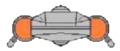 Bode bow perspective
 -
 With visors extended
 -
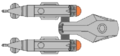 Dorsal perspective
 -
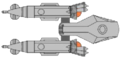 With visors extended
 -
 Starboard perspective, with visors extended
 -
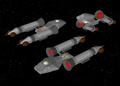
-
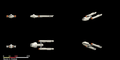 Bode refit
.png)
.png)
.png)
.png)
.png)
.png)
.png)
External Sources
- Vintage Starships: "2236 – Bode": includes 3D views
- Vintage Starships: "2253 – Bode Refit": includes 3D views
Notes
- The "the battles of 2246-2250" were changed to 2241 and 2245, to reflect the Four Year's War in game-canon.
- The textual year for the decommissioning of the USS Guernsey was changed from 2254 to 2256, to reflect the sidebar.