Guide:Hunter
.png)
| |
| Hunter | |
|---|---|
| Class Overview | |
| Category | corvette (later patrol boat, then back) |
| Operational | 2219-2243 |
| Constructed | 125 total:
|
| Dimensions | |
| Length |
|
| Beam | 35.4 m |
| Height | 36.2 m |
| Mass |
|
| Performance | |
| Max Speed | w 3.7 |
| Endurance |
|
| Complement | |
| Officers | 4 |
| Enlisted | 26 |
| Troops | 16 (Marine mission)
|
| Tactical Systems | |
| Beam Weapons |
|
| Missile Weapons | 2x ventral cassettes (w/ 600 rockets) |
| Shields |
|
| Laboratories |
|
| Transporters |
|
| Auxiliary Craft |
|
| Historical | |
| Ships of Note |
|
| Canonicity | |
| Design | SFC |
| Name | SFC |
| History | SFC, own
|
Between 2208 and 2219, no common Star Fleet corvette type was in operation. This was mostly due
to the fact that the areas patrollable by such small vessels were largely stabilized by the beginning
of the 23rd century, while the technology to extend the range of corvettes beyond this ‘tamed’ space
did not yet exist. The next common corvette design was thus intended to succeed the Pointer class
in domestic law enforcement missions only, with a nominal hull mass of less than 4,500 tons.
No deep space assignments were projected for the new lightweight corvette – the escalation of the Klingon threat had effectively ended the deployment of light combat vessels to the borderlands, since nobody wanted to ‘lightly combat’ the menacing adversaries. To stress the non-military nature of the new Hunter class ships, Star Fleet for a time used the designation ‘patrol boat’ for them. The designation reverted back to ‘corvette’ in the 2230s when it became apparent that even these rather modestly armed ships might have to be assigned to the Klingon front after all.
With their four single 1.6 GW laser emitters and two sublight rocket cassettes, the Hunters were still quite capable of inflicting damage on adversaries larger than themselves. The corvettes also carried a selection of modern sensors, adequate for acquiring, tracking and identifying suspect vessels and directing laser fire at short ranges. No effort was made to heavily shield the ships against enemy fire, however, nor to install torpedo armament or frigate-quality computer systems. Economy of design was the main criterion in the shaping of the class.
A further shape constraint came from the requirement for following suspect vessels into planetary atmospheres and surfaces. Sub-impulse propulsion and material technology advances made it possible to give the type full landing capacity on Class M worlds. Yet to facilitate repeated maneuvering in the atmospheres of these planets, the single PB-22 warp engine had to be mounted inside the primary hull, with a huge plasma diffuser endcap at the stern and an annular ramscoop at the bow, aft of a deflector dish. The power systems surrounded the aft part of the engine in a conical hull section, while the rest of the ship was built above and below the forward part of the engine. This layout naturally placed safety limitations on the field output of the unit. Since heavy shielding of the engine was out of the question, only modest power levels could be used, and warp performance of these ships was limited.
The hull design introduced the extensive use of trititanium (nowadays known by the shorter name tritanium, and usually replaced by duranium in small spacecraft). The aft cone began at 28 m diameter astern, reached a maximum diameter of some 35 meters amidships, and then quickly tapered back to 28 m before blending into an aerodynamically shaped bow section. On the flanks were field windows for the warp engine, and below these the impulse nozzles. Very little of the conical space was arranged into personnel-accessible decks, instead being filled to capacity with the main fusion reactor, twin deuterium tanks, a single tritium tank, and two shield generators.
In the forward half of the ship, two decks sat atop the engine, including a windowed flight deck, main C3I facilities and a pair of two-person officer cabins. Below these was a staging deck for boarding parties, with huge docking adapters port and starboard for latching onto a wide variety of targets. The deck formed the widest point of the forward hull, and necessarily so, because ship centerline there was taken by the warp coil shaft.
On the deck below, aft of the navigational deflector and the bow laser systems, the starboard side featured a power distribution room, then an austere crew compartment with bunks, a lavatory and a small galley plus lockers for personal items. Port of the engine shaft, in a corresponding location, were a sickbay and a stasis unit for consumables, plus a second, smaller crew compartment.
Below this, the hull tapered down to accommodate two more lasers with a ventral field of fire, a long landing strut below the bow, and two rocket cassettes for ground strafing. Within, there were holding cells, a workshop and a small internal cargo hold, squeezed wherever there was room and semi-practical access from the staging deck. The roughly 200 m3 cargo space was in frequent use in colony support and maintenance missions, which were part of the postwar corvette mission profile. It later provided enough space for the retrofitting of a two-pad transporter system to some vessels.
A ventral planetfall ramp catered for ground egress, although with the single bow and twin aft landing struts deployed, the ramp had to reach down some 10 meters for level ground! Each of the aft landing legs was accompanied by a vertically mounted reaction engine beneath the center of gravity. Since the corvette easily outweighed most 20th century oceangoing warships, the helmsman had to carefully consider whether the landing surface was solid enough for turning off the gravitics; typically, the vessel would have to stay powered up throughout a surface visit.
No auxiliary craft were carried, since none were needed. In police or customs operations, the ship intercepted suspect vessels and demanded direct docking access. Refusing was not wise – during and after docking, both the side laser cannon were constantly pointed at the suspect at point-blank range. Indeed, if no hull opening was offered for use, the lasers could be used to swiftly create one. EV boarding assault was naturally also a possibility. Hand lasers were the norm in boarding operations, although projectile weapons were also carried for surface use.

The atmospheric capabilities of the corvette made her an excellent tool for special military duties. Twenty Hunter ships were deployed on Marine missions, serving as heavy auxiliaries and ‘assault craft leaders’ in support of lesser-capacity landing craft. In a ground assault mission, a team of six Marines in powered armor, or sixteen in standard combat gear, could be rapidly deployed from the cargo hold via the bottom ramp, or an underslung ground combat vehicle could be carried. Also, strafing runs could be performed using rockets. As the introduction of next-generation transporters and high-precision phaser armament to light starships made these mission types obsolete, however, Star Fleet in 2239 withdrew the Marine ships and placed them on regular in-system patrol duty.
Ten other corvettes were employed by Star Fleet Intelligence, presumably for operative insertion missions. Their exact configuration remains classified. Reputedly at least two were equipped with some kind of auxiliary craft, probably unmanned drones but possibly also manned reconnaissance or ‘special tasks’ craft. Rumors also abound of the existence and use of onboard warp transporters well prior to the official date of man-rating the teleporting technology. Boarding of ships at warp (or through other types of low-intensity duonetic fields) would certainly have been of interest for the intelligence community, and presented a nasty surprise for most adversaries. Also, the theoretical independent interstellar capability of the design was undoubtedly turned into operational practice in SFI service, since the Marine practice of deploying their assault craft and assault craft leaders from aboard large transports less than 100 AU from their target would not have provided the necessary degree of stealth for special operations.
Thirty vessels of a stretched configuration, featuring a four-meter hull plug forward of the airlocks and a three-meter plug for the powerplant section, were created for extended military patrol. These ships enjoyed greater endurance due to larger propellant and fuel tanks, improved life support and more comfortable crew facilities. Carrying the subclass name Bloodhound, they served in border starbases, patrolling nearby space up to the 500 AU defense perimeter and providing defensive as well as light offensive firepower. On such a patrol mission out of the Beta Rigel II Fleet outpost, USS Nestor happened to witness a rendezvous between an Orion transport convoy and a Klingon destroyer in 2221, revealing the trade relations between the governments.
Most ships of the class received an update in 2234, in which 2.8 GW lasers replaced the ventrally-firing 1.6 GW units. Engines were also uprated and shielding improved. Rocket cassettes were eliminated as obsolete in all but Marine vessels. Some extended vessels also accommodated four-person transporters by sacrificing cargo space, while most original Hunters made do with a twin-pad unit. This made the ships highly effective patrol vessels: they obtained a reputation of reliability, durability and flexibility in Defense Command. Thirty-five Hunters were delivered to civilian operators, including Federation Customs Service and Tellar Police Forces.
The last ships of the Hunter class were retired in 2243, and modern patrol vessels with higher warp performance replaced them in law enforcement missions. Many of the low-fatigue units served later as civilian luxury yachts or light cargo vessels, usually having their warp engines and all weaponry removed.
Gallery
-
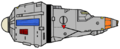 Bloodhound subclass, with extended midsection
 -
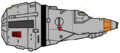 Goose subclass commercial medium sublight transport


Notes
- It is unknown when the corvette designation changed to patrol boat, so it was randomly determined to be 2232. Klingon aggression picked up in 2236, so it was decided that is the year the corvette designation was re-applied.
- At some point, some Bloodhounds were modified to become Goose subclass medium sublight transports, though not in Star Fleet service.
- The outpost is now re-identified as on Beta Rigel II, rather than just Rigel II. "Rigelians" is also replaced by "Orions", which is more in keeping with the apparent cultural attributes of both.