Guide:Pointer
.png)
| |
| Pointer | |
|---|---|
| Class Overview | |
| Category | corvette |
| Operational | 2182-2208 |
| Constructed | 162 |
| Dimensions | |
| Length | 79.0 m |
| Beam | 72.8 m |
| Height | 14.4 m |
| Mass |
|
| Performance | |
| Max Speed | w 3.5 |
| Endurance | 6 months |
| Complement | |
| Officers | 3 |
| Enlisted | 22
|
| Tactical Systems | |
| Beam Weapons |
|
| Missile Weapons |
|
| Other Weapons |
|
| Shields |
|
| Auxiliary Craft |
|
| Historical | |
| Ships of Note | USS McKenna (NCC-L53) |
| Canonicity | |
| Design | SFC/Rick Sternbach, Irishman |
| Name | SFC/Rick Sternbach |
| History | SFC
|
After the unconventional Ariadne class had solved Star Fleet’s deep space patrol combatant problem,
funds and resources could be allocated for a more ‘traditional’ – that is, more Terran – nearspace
patroller. The Pointer class was introduced in 2182 to provide assistance to Federation local defense
forces as well as customs and police units. In this role, the class replaced the bewildering collection
of small craft and civilian conversions in service in the UFP member worlds, retiring for example
the Zoenamy class of UESF corvettes, Kuhulkka class of Tellarite gunboats and Husav class of
Andorian patrol craft. Larger than her forebears, the Pointer would be capable of operating
efficiently outside the Sol system, even if she could not practically deploy across interstellar
distances. Her role would be to guard the systems of UFP member worlds, as well as to protect
shipments and maintain order within contested, only partially UFP-held systems like Beta Rigel or
Altair.
In the Pointer class, some key Tellarite engineering concepts were applied, for the first time in a foreign vessel. Andorian shielding technology was also an integral part of the design, as were Vulcan computers and tractor beam machinery. Yet the most prominent influences on the design were the traditional Earth cargo tug and the modern UESF scout. While not directly derived from an existing hull design, the Pointer in many ways resembled the forward compartment of an ECS freighter. Such tugs had proven quite maneuverable and durable against both pirates and Romulan forces when discarding their cargo sections. Star Fleet was eager to make use of one of the proven strengths of Earth technology – not to mention the skills of ECS veterans who now formed the core of Star Fleet local defense forces.

The close-mounted configuration of warp nacelles often found on tugs offered structural durability and well understood flight dynamics, and the two sets of 13,000 ton GP-13 warp coils were readily adaptable for such a mounting. The compression fusion powerplant was located in a flattened cylinder engineering module that also directly mounted the flat-nozzled impulse engine, the only part of the propulsion system that subscribed purely to military standard.
The primary pressurized part of the hull was only lightly armored and exceptionally lightweight so that the total hull mass of the vessel (reactors, fuel, crew and equipment included) was mere 3,000 tons. In comparison with the prewar tugs, it was of much flatter shape, compacting the classic command sail into a single-deck spine. This narrow structure held a small flight control center forward and a swiveling, telescoping airlock and boarding tube system aft. The crew of twenty-five inhabited the upper deck of the wide pressurized structure beneath, sharing the spaces with fire control and communications rooms, navigation computers and life support systems. The lower deck featured ventral doors for twin auxiliary craft bays amidship and a forward array for short range survey sensors.
Aft of the pressurized area, non-shirtsleeves structures surrounded the reactor module. The two winglike extensions had no aerodynamic role to play, even in case of as such plausible emergency landings. Instead, they held magazines for hundreds of heavy KE rockets, to be fired from wingtip launchers. On the dorsal surfaces were hardpoints for modular auxiliary weapons systems, including additional rocket pods, mine racks, or even self-contained phase cannon. The principal energy armament of the type consisted of twin bow-mounted lasers, though, adapted from the podded units used on the Ariadnes but carried and fired in pairs. This was backed up by mundane plasma weaponry: two plus two guns, on dorsal and ventral shafts in the pressure hull.
Intended mostly for debris clearing and police operations, these weapons were woefully underpowered against the shields of most known starship adversaries. Then again, the corvettes were never intended to be used for frontline combat. In second-line operations, and equipped with suitable combinations of MAWS modules, the small ships could partake in the defense of starbases and outposts. Offensive operations weren’t limited merely by lack of punch and protection, but also by the modest propulsive endurance.
For long range deployments, the corvettes could be carried in place of cargo containers on many large freighter types. A versatile tender design called Alexandria class was also derived from the Class W freighter, capable of carrying two Pointers in place of aft cargo containers. The next pair of containers featured refueling and rearming systems with booms that could serve a total of four corvettes at a time. The containers forward of these held deuterium and tritium fuel, while the foremost containers were furbished for crew accommodation and medical care, and also held an operations control center with briefing and communications rooms. Six such vessels were completed to support Pointer operations.
.png)
With minor modifications, such as a 2198-99 fitting of new impulse nozzles for improved maneuverability, fuel efficiency and stealth, the Pointer corvette was used as the primary in-system patrol ship of the UFP for some 26 years, until again giving way to an increasing number of local designs. No common UFP patrol vessel was introduced for the turn-of-the-century decades, as Star Fleet kept hoping for breakthroughs in lightweight warp propulsion systems as a means to extend corvette reach. USS McKenna of Pointer class briefly became a celebrity in the 2199 rescue of the civilian transport Bleg-Ra, distressed in a free asteroid cloud near Delta IV. Other ships of this humble class have not been immortalized on the pages of history.
Gallery
-
 Bow
Bow -
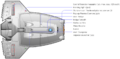 Dorsal
 -
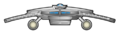 Stern
Stern -
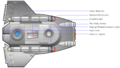 Ventral
 -
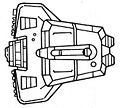 Dorsal schematic
.png)
.png)
.png)
.png)
