Guide:Venture: Difference between revisions
No edit summary |
|||
| Line 18: | Line 18: | ||
|patients= | |patients= | ||
|crew= | |crew= | ||
|cargo= | |cargo= | ||
|beamweapons=<br> | |beamweapons=<br> | ||
* 2x laser emitters (750 MW) (twin bank) (dorsal bow) | * 2x laser emitters (750 MW) (twin bank) (dorsal bow) | ||
Revision as of 12:28, 20 May 2015
.png)
| |
| Venture | |
|---|---|
| Class Overview | |
| Category | light cruiser |
| Operational | 2186-2233 |
| Constructed | 30 |
| Dimensions | |
| Length | 197.4 m |
| Beam | 119.4 m |
| Height | 42.4 m |
| Mass | 410,000 tons |
| Performance | |
| Cruise Speed | w 3 |
| Max Speed | w 4.8 |
| Endurance | 5 years |
| Complement | |
| Officers | 31 |
| Enlisted | 260
|
| Tactical Systems | |
| Beam Weapons |
|
| Missile Weapons |
|
| Shields |
|
| Laboratories |
|
| Transporters |
|
| Auxiliary Craft |
|
| Historical | |
| Ships of Note |
|
| Canonicity | |
| Design | SSA/Todd Guenther |
| Name | SSA/Todd Guenther, LUG |
| History | LUG, own
|
With the cancellation of the Baikonur (NX-700) deep space survey cruiser and her VX-10 engines,
the vessel destined to inaugurate the range of mission-descriptive registries reserved for survey
purposes was the Venture (NX-720). Prime motivation for the design was the impending retirement
of the last Daedalus units and the growing obsolescence of the Castors, the most potent of the auxiliary
cruisers available. However, mere generation change would not suffice; as it was already known
that military programs would be a black hole of funding in the immediate future, the next surveyor
would be built in limited numbers, with at most 30 and more probably just a dozen keels approved.
Speed and range would have to compensate for lack of numerical strength, and for once the cost/benefit
analyses favored the adoption of a modern military engine.
Essentially, Exploration Command was once again sent searching for a survey cruiser design it could both afford and dare send to the outer reaches of its theater of operations. It was the latter need that necessitated that the cruiser be a co-recipient of PB-14 military warp propulsion technology. As a side effect, the resulting vessels would sooner or later face drafting by Defense Command – a mixed curse, considering it made the construction of the high performance surveyors financially possible in the first place.
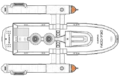
Few other technologies in the Venture were shared with the ongoing, purely military light cruiser programs. Construction of the boat-like primary hull would be based on conventional metalloceramics rather than TiMo nanoalloys, and main power would, for frontier reliability and redundancy, be provided by two rather bulky 10:1 fusion reactors. The powerplant domes protruded from a dorsal centerline spine that extended forward to the command superstructure. A sail three decks high featured the navigation bridge and operations control rooms as well as extensive cartography facilities; at its base, a broader deck held officer accommodation, with a mess hall forward.
The top two decks of the main hull were divided between crew accommodation at bow, laboratories beneath the command sail, main engineering facilities farther aft, and twin hangars astern for supporting a standard flight of four shuttlecraft. Lower down, the hull tapered sharply at bow, and on the other hand flared to two side bulges amidships. The forward ends of the bulges held navigational deflector subspace field generators that also catered for the FTL scanners of the vessel, providing excellent long range sensing capabilities. The aft ends held three nozzles each for the M-2130 impulse engines. The fuel vital for long exploration sorties was bunkered between the cowlings, along with spacious holds for what Exploration Command hoped would be consumables and survey gear, and Defense Command assumed would feature surface combat and support vehicles and materiel. These could be offloaded via a ventrally berthed atmospheric barge, or two new-model cargo transporters that were accompanied by two triple-pad personnel units.
The construction program for the survey cruisers extended from 2184 to 2199, churning out spaceframes at a more leisurely pace than the Caracal program. Indeed, such were the delays in getting USS Venture spaceborne that her first operational mission in 2186, intended to scout out the Sagittarius direction, had already been usurped and completed by the much slower civilian surveyor Palomar. For Starfleet to again gain the initiative in deep space exploration, more assets than just the thirty high performance survey cruisers would have to be fielded to augment the combat fleet.
For the Ventures, this simply meant full-time employment. After first launched on their voyages of discovery, the vessels clocked in an average 8% downtime, five of these due to repairs and three to inter-mission restocking and refueling. This incredibly demanding schedule consisted mainly of two-year sorties during which crew rotation was more or less impossible. While original plans called for swapping of the entire complement at mission end for one trained ashore as a unit, in reality a breed of deep space veterans would be born, serving on mission after mission and ultimately gaining command positions aboard Fleet heavyweights such as the Horizon class.

This was a generation much different from the one raised on the Daedalus, Libra or Castor decks, on brief missions where the recent military reputation of the UFP gave protection and confidence, where mysteries lurked beyond every corner, and where graceful retreat was often the advised option yet seldom a practicable one. The Venture veterans worked within a confined if vast area of space, connected to home by improved subspace communications, responsible for the execution of a defined policy of noninterference. They had strict orders to avoid trouble with known enemies, or to add to their number. To their frustration, they would often find their assigned survey regions already trampled by other Federation agencies, enterprises and citizens. Virgin space was assigned to the armed envoys of Horizon, Caracal or Mann descent, then to Baton Rouges, then to those Proximas and Icaruses that could be saved from the battlefronts.
Yet the Ventures soldiered on. An engine refit was at long last effected in 2231 for ten of the vessels, introducing the advanced PB-29 type to the survey cruiser community. The forward main reactor was swapped for a total conversion one, the aft one deleted; the massive new nacelles received swept pylons of increased strength. Propulsive performance increased at one leap to warp six cruising and warp eight dash speed, vitalizing the class for three more decades of celebrated operations. Yet as only ten of the cruisers would be reworked, Exploration Command made the most of what it was allowed to have. Various modern sensors were rigged on an arching wing that rested on the pylons and vaulted over the reactor superstructure. Three vast subspace antennas were mounted around the hangar area, one on a dorsal pylon, two directly on the hull flanks. The ventral cargo barge was superseded by additional cargo transporters and her berth faired over with a hull extension that accommodated antimatter bunkerage.
Incremental improvements on laboratory facilities, accommodation standards, computing capability and accuracy and firing rate of armament were of lesser scope than the propulsive upgrade. The analysis facilities of the class never quite rose to 2230s-60s standards, and the omission of the bow launch tube in favor of navigation gear vital at higher speeds was something of a blow to the sensing capabilities of the vessels. On the other hand, missions previously conducted by firing a swarm of probes could now be handled with an actual overflight or even a longer stay; the increase in speed was not eaten up by an expansion of operational range. For the last chapter of their lives, the Ventures (or Cahuyas, as per the first of the refits, NCC-740) were very much ‘shallow space’ surveyors, not out of distrust towards their research capabilities, but due to the military environment of the time. The loss of USS Inuit (NCC-747) at Azha in June 2258 was considered proof positive of a need for even greater separation from the Klingon battlefront. Later analysis suggests the vessel did not succumb to a raiding flotilla, though, but was consumed by a spaceborne lifeform of a type common in the region.
The remaining Cahuyas were withdrawn and deactivated in an orderly manner starting in the late 2270s, leaving something of a survey cruiser gap due to the unexpected Hopi class retirement. Starfleet would next dare field lightly armed deep space surveyors in the 2290s, placing its bets on fully combat-capable survey types in the meantime.
Gallery
-
 Bow
Bow -
 Dorsal
.png)
.png)
Notes
- Several text dates and ranges had to be adjusted to reflect the final decommissioning period for the Cahuyas and to reflect the same for the Ventures.