Guide:Icarus/Ashanti/Apache
.png)
| |
| Icarus / Ashanti / Apache | |
|---|---|
| Class Overview | |
| Category | battle cruiser / heavy destroyer |
| Operational | |
| Constructed | 70 total: |
| Dimensions | |
| Length | 274.1 m |
| Beam | 155.0 m |
| Height | |
| Mass | |
| Performance | |
| Cruise Speed |
|
| Max Speed |
|
| Endurance | 4 years |
| Complement | |
| Officers |
|
| Enlisted |
|
| Tactical Systems | |
| Beam Weapons | Icarus original
Icarus refit 2234, Ashanti original
Apache
Refit 2273
|
| Missile Weapons | Icarus original
Icarus refit 2234, Ashanti original
Apache
Refit 2273
|
| Shields |
|
| Laboratories |
|
| Transporters | |
| Auxiliary Craft | Original standard
some Icarus
|
| Historical | |
| Ships of Note |
|
| Canonicity | |
| Design | FSCC/Todd Guenther |
| Name | Icarus, Kevin Ryan ‘Errand of Vengeance’; Ashanti, SotSF & LUG; Apache, FSCC, FASA |
| History | own, Kevin Ryan ‘Errand of Vengeance/Fury’, David Dvorkin ‘Timetrap’, SotSF, FASA, LUG
|
The first clashes between Klingon forces and Star Fleet’s newest capital ships were unfortunate events, as they pitted the Proximas and Baton Rouges against the very best enemy counterparts—modern D-6 warbirds whose firepower was exceptional for the Klingon fleet. The loss of USS Aquitania (Proxima class) was a tragedy that disquieted the public and the government alike. More significantly, it caused Star Fleet analysts to adjust a few parameters in their cost-benefit analysis models, turning them slightly more in favor of quantity as opposed to quality.

Thus, the second battle cruiser to enter Star Fleet’s new anti-Klingon arsenal abandoned many Proxima concepts and instead became a direct outgrowth of Detroyat heavy destroyer philosophy, indeed a growth version in the physical sense. Even the engine of choice was the PB-27 familiar from the super-destroyer, vastly more affordable than the goliath nacelles of the Proxima class. Rigging was again by horizontal pylons on the single engineering hull, yet with decreased separation and with field guide vanes that had plasma expanders on the outboard surfaces and vents on the trailing edges. The powerplant was a modified Baton Rouge unit, calling for a horizontally rather than vertically stretching engineering hull; the cruiser was thus markedly longer yet less beamy or tall than her heavy destroyer forebear.
Similar changes in dimensional relationships improved the affordability and durability of the primary hull. A straight-contoured disk similar to the Baton Rouge one in diameter, yet slimmer at just four decks, was installed with a 90 degree sector cut out from astern. An impulse power and propulsion assembly of the standard SAB-A type filled the cutout. The mounting provided less maneuverability than the corresponding Proxima installation, as the proximity of the secondary hull reduced thrust vectoring. To compensate, twin IMRF units were installed, ultimately giving the new design superior agility. Internal volume was roughly comparable to the bulkier Baton Rouges, and similar armament was installed as well. By now the virtual standard for Fleet lasers, the Lockheed 130/1 was mounted in two twin banks on the dorsal surface and in two single banks on ventral flanks, providing near-perfect spherical coverage. Smaller 200-series units took care of a stern blind cone. Main hitting power came from Type L phased particle guns, in an off-the-shelf dorsal double mount. A torpedo launcher was originally considered as an alternate fit but, much as with the Detroyats, a single type of main weapon per class proved enough of an integration and maintenance challenge.
Sensor fit was of the austere Proxima standard, not even featuring short range arrays on the primary hull. The single laboratory normally installed provided just 80 m2 of general purpose analysis, synthesis and simulation space; separate computers were carried for the purpose, as the main computer buses were directly wired to tactical systems and lacking in branches. On the other hand, much of the interior was very generic in layout, accommodating systems and facilities from any number of manufacturers, and hopefully allowing both mass production and effortless upgrades. There were advantages to combat and post-combat repair in this approach as well, even though survivability as such suffered from lack of optimized bracings and isolation arrangements.
While construction of USS Icarus (NCC-1130) was the responsibility of Geering affiliate Ethertech’s Sol V yards, no less than four design bureaus and 23 constructors were enlisted in the project, refining the design further by paring it down to the lowest common denominator. Production picked up pace in a manner that made the battle cruisers the numerically dominant combat force and the preferred attrition unit – ten vessels were completed by 2232, and proved superior to both the lesser Detroyats and the larger Proximas in combat economy. A second battle cruiser batch was immediately ordered, and the ten units were completed to satisfaction by 2235.
Technology was speeding past the dependable design, however. By the late 2230s, light cruiser designs with superior weaponry and agility were emerging, and Project Starship was close to becoming reality as well. It was with decided reluctance that the Council agreed to fund the final eight units of the original standard – aptly named, the crews argued, for their tendency to get their wings burned. The Naming Commission could hardly be blamed for the choice, though, as HMS Icarus herself had been a splendid example of British shipbuilding and a worthy inclusion in the thematic group that perpetuated the names of Royal Navy warship of historical note.
Yet there was still potential in the sturdily built hulls, and brute force could substitute for finesse, especially when the primary opponent remained the Klingon Empire. The obvious approach was taken, and PB-29B units bolted onto the sides of the final surge of twenty Icarus units, known as the Ashanti subclass. Armament upgrades were implemented across the battle cruiser fleet, chief among them the installation of a four-tube torpedo launcher, yet engine refits of similar scope remained unaffordable. In practice, the Ashantis completely replaced the original Icarus force on the front lines, yielding a slight decrease in numbers but an increase in battlefield availability nevertheless; the new engine gave a solid cruise performance of warp five.
The 2240s were a grim chapter in Icarus history. At Nozseca, five vessels were rendered unspaceworthy, three beyond repair, all with massive loss of life. At Donatu, three would perish from the Icarus group; at Second Arquin, two Ashantis would be ambushed with lethal results. By the time of Final Axanar, Star Fleet dared not field its battle cruisers unescorted by a more heavily shielded ‘proper’ cruiser, even if the latter had inferior propulsion. Yet both the Icaruses and the Detroyats made for excellent frontline destroyers when operated under proper doctrine. Indeed, the 22 Icarus units built as attrition replacements were specifically outfitted for the destroyer mission (enabling quicker completion for frontline use) and dubbed the Apache class, by far the most powerful of Star Fleet destroyers at the time. Unlike the Detroyats, they also came to feature proper flotilla command facilities for leading packs of lighter destroyer types.
It was the introduction of these advanced single-engined destroyer classes in the 2240s and 2250s that sent the two-nacellers to mothballs and deprived them of a solid-state coil refit. Yet times of crisis would see reactivation of select examples of the valuable assets, with contemporary phaser modules nonchalantly plugged into laser and phase cannon sockets before deployment. Many an Icarus still operated in the 2260s, often at their own peril. While combat still claimed victims, the most devastating and public loss was that of USS Golden Hind (NCC-1142), which in 2268 misjudged a warp approach and slammed into Devon, blasting a huge crater in the landscape and killing thousands by direct and secondary shockwave and radiation effects. The sluggish downgradient behavior of the PB-27 was officially established as a factor in the incident and Star Fleet had little option but to permanently idle all vessels of this engine standard. Recall orders were issued across the operating theater of the battle cruisers.
Yet when the Icaruses began returning from the frontier, they met a world much changed. The intervention of the Organian entities had created the circumstances under which peace could be waged between the UFP and the Klingon Empire, but the combatants had been the ones to forge the actual terms of the peace. Shipbuilding under the Organian Peace Treaty was riddled with limitations, especially concerning the numbers of capital ships constructed. This particular limitation had been expected to work to Star Fleet’s advantage, offsetting the high output of Klingon dockyards and finally allowing the higher quality of Star Fleet vessels to have an impact. However, the ‘use it or lose it’ nature of the treaty terms also meant that Star Fleet needed to cling to every cruiser hull in active service. Funds saved from the recalling of war fleets helped maintain the Icaruses in nominal exploration and patrol duty. In practice, this mainly consisted of lowest-level quayside readiness, now under the expedient heavy cruiser designation.
Cruiser numbers in general plummeted in the 2270s. The Icarus retirements contributed to the temporary reduction in heavy cruiser figures, along with the decommissionings of Constitution derivatives for their engine upgrades. The nineteen remaining Ashantis were also considered plausible candidates for re-engining, possibly with PB-47, perhaps even with PB-32 units liberated by Constitution refits and retirements. However, the mid-70s saw the return of bountiful budgets and a gradual withdrawing from the Organian commitments. Re-engining of the Ashantis for deep space never got beyond theoretical studies.
There was plenty for heavy cruisers to do close to home, though. Compared with re-engining, upgunning was almost trivially simple, and a token rearming of Ashantis and Icaruses was approved in 2273 already. Surplus RIM-13 and 10A phaser banks replaced the older models, mostly of RIN-6 and 9 standards, and modern ordnance was brought aboard for the torpedo launchers. The forces saw very real Subquadrant Zero patrol duty, bringing their deterrent to bear with almost sedate grace; a number also served on the Klingon border, and contributed to defensive deployments near key starbases.
There was no denying the poor maintainability and slow response times of the aging vessels, though. Retirements continued throughout the following decade, and some of the hulls were put to use as engineering testbeds for the troubled modern battle cruisers in the 2280s. After Khitomer, the last Ashanti could finally be broken up in good conscience in 2297.
Gallery
-
 Ashanti (stbd)
 -
 Icarus 2259 refit (stbd)
 -
 bow
bow -
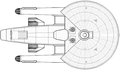 dorsal
.png)
.png)
.png)
.png)
External Sources
- Vintage Starships: "2243 - Apache": includes 3D viewer
Notes
- Stated in the sidebar, but not the text, the Apaches received a 2254 conversion to the intelligence scout mission.