Guide:Ranger (light cruiser): Difference between revisions
| (11 intermediate revisions by the same user not shown) | |||
| Line 132: | Line 132: | ||
[[Image:No Photo Available.jpg|left|300px|thumb|Even if the ''Rangers'' sported virtually no exploration gear, random discoveries could befall any vessel, including one providentially named ''USS Coronado'' (NCC-788). The arid surface of the distant [[Cestus III]] was an ideal location for an observation outpost and local stronghold, right at the rimward flank of Klingon expansion, yet seemingly in uncontested space. Had the ''Coronado'' been better equipped for survey duty, signs of Gorn mining activity would have been obvious to her, and heated future conflict might have been avoided.]] | [[Image:No Photo Available.jpg|left|300px|thumb|Even if the ''Rangers'' sported virtually no exploration gear, random discoveries could befall any vessel, including one providentially named ''USS Coronado'' (NCC-788). The arid surface of the distant [[Cestus III]] was an ideal location for an observation outpost and local stronghold, right at the rimward flank of Klingon expansion, yet seemingly in uncontested space. Had the ''Coronado'' been better equipped for survey duty, signs of Gorn mining activity would have been obvious to her, and heated future conflict might have been avoided.]] | ||
The destruction of ''USS Sentry'' in [[2209]] came as a rude surprise to [[ | The destruction of ''USS Sentry'' in [[2209]] came as a rude surprise to [[Star Fleet]], in more ways than one. | ||
Clearly, some basic assumptions of the Klingon psyche now had to be abandoned; also puzzling | Clearly, some basic assumptions of the Klingon psyche now had to be abandoned; also puzzling | ||
was the lack of a wider Imperial reaction to the altercation. On a more concrete note, the weak | was the lack of a wider Imperial reaction to the altercation. On a more concrete note, the weak | ||
showing of the modern ''[[Guide: Advance|Advance]]'' class battle cruiser had not been anticipated. Nor had | showing of the modern ''[[Guide: Advance|Advance]]'' class battle cruiser had not been anticipated. Nor had Star Fleet had | ||
any idea that Klingon territorial claims extended this far spinward, enforced with such irrational vehemence that SF Intelligence could but conclude that crucial industrial resources were hidden on | any idea that Klingon territorial claims extended this far spinward, enforced with such irrational vehemence that SF Intelligence could but conclude that crucial industrial resources were hidden on | ||
the stormy surface of [[Gamma Demetrius]] – or Boreth, as the refugees had called the planet before the | the stormy surface of [[Gamma Demetrius]] – or Boreth, as the refugees had called the planet before the | ||
fateful exchange of fire. | fateful exchange of fire. | ||
Star Fleet’s only effective countermeasure to unrest in this distant part of space would be its | |||
supercruising fleet. Unnervingly, this force at the time consisted of just twelve ''[[Guide:Mann|Mann]]'' light cruisers; | supercruising fleet. Unnervingly, this force at the time consisted of just twelve ''[[Guide:Mann|Mann]]'' light cruisers; | ||
in light of the continuing inactivity of the Imperial fleet, funds were released neither for further | in light of the continuing inactivity of the Imperial fleet, funds were released neither for further | ||
| Line 150: | Line 150: | ||
The Federation Council could not dismiss the signs of bellicose intent indefinitely. Grudgingly, six | The Federation Council could not dismiss the signs of bellicose intent indefinitely. Grudgingly, six | ||
further ''Manns'' were promised, then just four procured after a bitter inter-partisan battle. Frustrated | further ''Manns'' were promised, then just four procured after a bitter inter-partisan battle. Frustrated | ||
with the complete inadequacy of the measure, | with the complete inadequacy of the measure, Star Fleet in late [[2212]] shunted almost 40% of its | ||
maintenance budget into the development of a mass-produceable supercruising light cruiser. Self-evidently, | maintenance budget into the development of a mass-produceable supercruising light cruiser. Self-evidently, | ||
the contract went to [[ | the contract went to [[Chiokis Corporation]], keeper of the secrets of supercruise propulsion | ||
and affordable manufacturing of trititanium hulls. Actual construction was mainly performed by | and affordable manufacturing of trititanium hulls. Actual construction was mainly performed by | ||
Star Fleet Division at [[Sol IV]]. Against expectations, the crash program was a complete success. In | Star Fleet Division at [[Sol IV]]. Against expectations, the crash program was a complete success. In | ||
| Line 176: | Line 176: | ||
The service career of the ''USS Ranger'' proved short, culminating ignominiously in Klingon capture, as | The service career of the ''USS Ranger'' proved short, culminating ignominiously in Klingon capture, as | ||
the Empire in [[2218]] boarded the vessel during a multi-ship engagement. | the Empire in [[2218]] boarded the vessel during a multi-ship engagement. Star Fleet had been able to get its escalation | ||
program started, however, and response was swift. Twenty-eight sisters to the ''Ranger'' as well as | program started, however, and response was swift. Twenty-eight sisters to the ''Ranger'' as well as | ||
twenty-five stepsisters of the marginally more modern '''''Triumphant''''' (NCC-1200) class were | twenty-five stepsisters of the marginally more modern '''''Triumphant''''' (NCC-1200) class were | ||
| Line 192: | Line 192: | ||
outclassed in a warp laser fight. Clearly, the might of the Klingon war machine was a relative | outclassed in a warp laser fight. Clearly, the might of the Klingon war machine was a relative | ||
concept, based more on great aggression than on great skill or strength. The multi-front assault was | concept, based more on great aggression than on great skill or strength. The multi-front assault was | ||
held at bay, and enough time was bought to field a modern range of | held at bay, and enough time was bought to field a modern range of Star Fleet combatants. | ||
[[Image:No Photo Available.jpg|left|300px|thumb|The sole survivor of the [[Sol]] defense force at the Battle of [[Ganymede]], ''USS Yamato'' (NCC-1305) juts out of the side of the | [[Image:No Photo Available.jpg|left|300px|thumb|The sole survivor of the [[Sol]] defense force at the Battle of [[Ganymede]], ''USS Yamato'' (NCC-1305) juts out of the side of the | ||
Klingon flagship. The audacious ramming and boarding counterattack saved [[Earth]] from the equally cheeky deep | Klingon flagship. The audacious ramming and boarding counterattack saved [[Earth]] from the equally cheeky deep | ||
penetration raid of Admiral Kesslok’s force, and ensured immortality to the name ''Yamato'' in [[ | penetration raid of Admiral Kesslok’s force, and ensured immortality to the name ''Yamato'' in [[Star Fleet]] history.]] | ||
In the [[2220s]], ''[[Guide:Baton Rouge|Baton Rouge]]'' heavy cruisers and ''[[Guide:Detroyat|Detroyat]]'' and ''[[Guide:Saladin|Saladin]]'' destroyers sailed out against a | In the [[2220s]], ''[[Guide:Baton Rouge|Baton Rouge]]'' heavy cruisers and ''[[Guide:Detroyat|Detroyat]]'' and ''[[Guide:Saladin|Saladin]]'' destroyers sailed out against a | ||
| Line 207: | Line 207: | ||
Rather than get sucked into yet another primary hull replacement quagmire, Chiokis relinquished | Rather than get sucked into yet another primary hull replacement quagmire, Chiokis relinquished | ||
the ''Ranger'' modernization work to [[ | the ''Ranger'' modernization work to [[Harbin]]. Funding for the ships, now comparable to destroyers in | ||
size, was less of a hurdle than a decade prior. Fifty contracts in total were secured, chiefly by | size, was less of a hurdle than a decade prior. Fifty contracts in total were secured, chiefly by | ||
[[ | [[Empress]] and [[Nunin]] yards, resulting in the '''''Jidai''''' (NCC-1300) and '''''Pytheas''''' (NCC-1400) classes of | ||
reconnaissance and exploratory light cruisers. Yet in [[2227]], production was halted at just ten and | reconnaissance and exploratory light cruisers. Yet in [[2227]], production was halted at just ten and | ||
eleven units, respectively. According to | eleven units, respectively. According to Star Fleet, the classes were now meeting their respective | ||
support commitments, allowing the rest of the cruiser force to carry on the fight. | support commitments, allowing the rest of the cruiser force to carry on the fight. | ||
| Line 238: | Line 238: | ||
[[2228]] was ''USS Spann'' (NCC-790), followed by twelve out of the surviving sixteen by [[2233]]. Fitting | [[2228]] was ''USS Spann'' (NCC-790), followed by twelve out of the surviving sixteen by [[2233]]. Fitting | ||
the Harbin saucer into a preexisting spaceframe was more demanding than new-building, and the | the Harbin saucer into a preexisting spaceframe was more demanding than new-building, and the | ||
experienced [[ | experienced [[Vickers]] took over from its [[Empress Ship Design & Building|Selenite]] and [[Nunin Starflight Interstellar|O’Ryanite]] competitors. Externally, a | ||
modernized ''Ranger'' looked very much like a ''Pytheas'', save for the secondary hull: the stern hangar | modernized ''Ranger'' looked very much like a ''Pytheas'', save for the secondary hull: the stern hangar | ||
was retained, as were both torpedo embankments, even though modern systems were naturally | was retained, as were both torpedo embankments, even though modern systems were naturally | ||
| Line 258: | Line 258: | ||
was spared the disgrace by virtue of having died a warrior’s death: by [[2259]], every last of the | was spared the disgrace by virtue of having died a warrior’s death: by [[2259]], every last of the | ||
spyships had been eliminated by the enemy, the heroic struggle of ''USS Yamato'' (NCC-1305) | spyships had been eliminated by the enemy, the heroic struggle of ''USS Yamato'' (NCC-1305) | ||
guaranteeing longevity to her name in [[ | guaranteeing longevity to her name in [[Star Fleet]] history. The ''Pytheas'' fleet in turn bowed to | ||
''[[Guide: Constitution|Constitution]]'' heavy cruisers as | ''[[Guide: Constitution|Constitution]]'' heavy cruisers as Star Fleet’s primary instrument of independent deep space exploration. | ||
The last ''Ranger'', ''USS Duncan'' (NCC-793), was retired from spacelane patrol in late [[2269]], her | The last ''Ranger'', ''USS Duncan'' (NCC-793), was retired from spacelane patrol in late [[2269]], her | ||
| Line 265: | Line 265: | ||
attrition due to maintenance problems. ''USS Ibn Rustah'' (NCC-1409) remained in active service until | attrition due to maintenance problems. ''USS Ibn Rustah'' (NCC-1409) remained in active service until | ||
the [[2293|Khitomer peace]], scoring planetary survey successes till the very last. | the [[2293|Khitomer peace]], scoring planetary survey successes till the very last. | ||
==Gallery== | ==Gallery== | ||
| Line 291: | Line 282: | ||
File:Where No Man Has Gone Before.png|"Where No Man Has Gone Before"<br>(''see Note'') | File:Where No Man Has Gone Before.png|"Where No Man Has Gone Before"<br>(''see Note'') | ||
File:Ranger (2-view).png | |||
</gallery> | </gallery> | ||
==External Sources== | |||
* [https://vintagestarships.wordpress.com/2017/01/04/2217-ranger/ Vintage Starships: "2217 - Ranger"]: includes 3D Viewer | |||
* [https://vintagestarships.wordpress.com/2017/01/04/2240-ranger-ii/ Vintage Starships: "2240 - Ranger"]: includes 3D Viewer | |||
==Notes== | |||
* The reference to the Klingon Empire invading and capturing [[Archanis]] has been removed, as it is ''Timo''- and game-canon for the ''USS Ranger'' to be lost in 2218, while the planet was not until [[2236]]. | |||
* The Naval Construction Contract (NCC) for the ''Ranger'' subclass extends past the 700 series. Ships after NCC-799 will have to be accounted for elsewhere. | |||
* During the game, the loss of each of the ''Jidai'' class to enemy action must accounted for, with the last to take place in [[2259]]. | |||
* Despite the use of saucers in some of the images here, the original ''Ranger'' and the ''Triumphant'' should have the bubble hull; the ''Jidai'', ''Pytheas'' and refit ''Ranger'' will have the "swelled" saucer. | |||
<br><br> | |||
---- | ---- | ||
* [[Guide: Timo's Guide to | * [[Guide: Timo's Guide to Star Fleet |Back to the Table of Contents]] | ||
* [[Guide: 2200-2240 - Way of the Warrior|Back to "Way of the Warrior"]] | * [[Guide: 2200-2240 - Way of the Warrior|Back to "Way of the Warrior"]] | ||
* [[Guide: Of Ship Statistics|Appendix A: Of Ship Statistics]] | * [[Guide: Of Ship Statistics|Appendix A: Of Ship Statistics]] | ||
* [[Guide: Glossary|Appendix B: Glossary]] | * [[Guide: Glossary|Appendix B: Glossary]] | ||
* [[Guide: | * [[Guide: Star Fleet Organization - General Outline|Appendix C: Star Fleet Organization - General Outline]] | ||
* [[Guide: Abbreviations From Outside|Appendix D: Abbreviations From Outside]] | * [[Guide: Abbreviations From Outside|Appendix D: Abbreviations From Outside]] | ||
[[Category:Guide|{{PAGENAME}}]] | [[Category:Guide|{{PAGENAME}}]] | ||
Latest revision as of 02:45, 5 August 2023
_stbd_plan.png)
| |
| Ranger | |
|---|---|
| Class Overview | |
| Category | light cruiser |
| Operational | |
| Constructed | 75 total: |
| Dimensions | |
| Length |
|
| Beam |
|
| Height |
|
| Mass |
|
| Performance | |
| Cruise Speed | w 4 |
| Max Speed |
|
| Endurance | 6 years |
| Complement | |
| Officers |
|
| Enlisted |
|
| Tactical Systems | |
| Beam Weapons | Ranger:
Triumphant:
Jidai:
Pytheas:
Ranger 2228 refit:
Ranger 2253 refit:
Pytheas 2259 refit:
|
| Missile Weapons | Ranger:
Triumphant:
Jidai:
Ranger 2228 refit:
Ranger 2253 refit:
|
| Shields |
|
| Laboratories | Ranger:
Pytheas:
|
| Transporters | All original sub-classes:
All sub-classes 2241-46 refit:
All Pytheas, some Ranger 2262 refit:
|
| Auxiliary Craft | Ranger, Triumphant:
Jidai, Pytheas:
|
| Historical | |
| Ships of Note |
|
| Canonicity | |
| Design | Ranger: LUG/Randy Asplund; Pytheas: FSRC/aridas sofia |
| Name | FSRC, LUG, Decipher, FASA, et al |
| History | LUG, own
|

The destruction of USS Sentry in 2209 came as a rude surprise to Star Fleet, in more ways than one. Clearly, some basic assumptions of the Klingon psyche now had to be abandoned; also puzzling was the lack of a wider Imperial reaction to the altercation. On a more concrete note, the weak showing of the modern Advance class battle cruiser had not been anticipated. Nor had Star Fleet had any idea that Klingon territorial claims extended this far spinward, enforced with such irrational vehemence that SF Intelligence could but conclude that crucial industrial resources were hidden on the stormy surface of Gamma Demetrius – or Boreth, as the refugees had called the planet before the fateful exchange of fire.
Star Fleet’s only effective countermeasure to unrest in this distant part of space would be its supercruising fleet. Unnervingly, this force at the time consisted of just twelve Mann light cruisers; in light of the continuing inactivity of the Imperial fleet, funds were released neither for further construction, nor for the desired propulsive uprating of the Horizon and Advance force. Yet by 2212, it had become clear that something was amiss in the Empire. The incidence of Klingon-on-Klingon combat engagements, even if never zero, appeared to be increasing drastically. A pattern of defections and secessions, followed by punitive expeditions, swept through observable border space. Clearly, the seat of the Emperor no longer was in complete control of the Klingon fighting urge.
The Federation Council could not dismiss the signs of bellicose intent indefinitely. Grudgingly, six further Manns were promised, then just four procured after a bitter inter-partisan battle. Frustrated with the complete inadequacy of the measure, Star Fleet in late 2212 shunted almost 40% of its maintenance budget into the development of a mass-produceable supercruising light cruiser. Self-evidently, the contract went to Chiokis Corporation, keeper of the secrets of supercruise propulsion and affordable manufacturing of trititanium hulls. Actual construction was mainly performed by Star Fleet Division at Sol IV. Against expectations, the crash program was a complete success. In June 2215, dockyard mooring clamps first released USS Ranger (NCC-781) to Martian orbit, and to two months of greatly expedited testing.
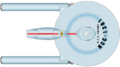
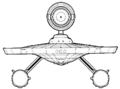
Although retaining the 101.7 m diameter of the Mann hull, the Ranger primary structural frame was trimmed down on the ventral side to just 20 m thickness (or 27.1 m when including the dorsal superstructures and ventral sensor dome). The 140,000 ton, 113 m PA-100 engines were mounted on short pylons beneath the stern, where they enjoyed greater freedom of field shapes and duonetic emission levels. Total conversion power and propulsive systems still took a lion’s share of the primary hull, yet major mission systems were now moved to a wholly new secondary structure, dangling above the stern. The advantageous combining of Mann and Horizon features solved the problems of internal volume allocation, and further held promise of modular and efficient mission gear upgrades. Initially housed in the six-deck secondary hull – a tapering cylinder of smoothly curving shapes – were a medium-power navigational deflector at bow; an adjoining deep space tactical sensor suite; two Maximpact medium torpedo launchers flanking the deflector/sensor dish; a dorsally accessible cargo hold; and a stern hangar mainly reserved for maintenance auxiliaries. Within the eight-deck primary hull lay berthing and all manner of long duration physiological and psychological support for the 287 crew. Again, minimal laboratory facilities were included in the mission suite: the Ranger was built with a specific mission in mind, yielding not a cubic meter to idle scientific curiosity.
The service career of the USS Ranger proved short, culminating ignominiously in Klingon capture, as the Empire in 2218 boarded the vessel during a multi-ship engagement. Star Fleet had been able to get its escalation program started, however, and response was swift. Twenty-eight sisters to the Ranger as well as twenty-five stepsisters of the marginally more modern Triumphant (NCC-1200) class were completed by 2220, by expanding the production base of tritanium-hulled ships from Sol to Procyon and Alpha Centauri. Armed to the teeth with the latest-standard lasers, the light cruisers ventured out to meet the tidal wave of Klingons, achieving by careful coordination and superior tactics what they could not manage by strength of numbers or armament alone. In terms of technology, the Rangers were by the 2220s already obsolescent and stressed well beyond their limits.
Thankfully, the same was true of the Klingon fleet, which had been logistically utterly unprepared for war in 2209 and had made little progress since. In an acclaimed engagement in 2228, scout cruiser USS Bastion (NCC-811, Sentinel class) was able to reduce to scrap in a single engagement five of her Klingon counterparts before succumbing; the targeting systems of some of the adversaries could not attain lock no matter what, while others were armed with short-ranged disruptors only and were outclassed in a warp laser fight. Clearly, the might of the Klingon war machine was a relative concept, based more on great aggression than on great skill or strength. The multi-front assault was held at bay, and enough time was bought to field a modern range of Star Fleet combatants.
In the 2220s, Baton Rouge heavy cruisers and Detroyat and Saladin destroyers sailed out against a flow of homebound Manns and Rangers. There was little to be done for the veterans, which no longer were combat-worthy even in the broadest sense of the word. Converting the ships for homefront duties was patently impossible due to the cramped and inflexible internal arrangements. Yet the basic Ranger design was sound enough, the two-hull arrangement preferable for many mission profiles. A simple replacement of the primary hull with a proper saucer would yield warp-dynamic advantages, offsetting the performance loss from necessary total conversion reactor down-scaling.
Rather than get sucked into yet another primary hull replacement quagmire, Chiokis relinquished the Ranger modernization work to Harbin. Funding for the ships, now comparable to destroyers in size, was less of a hurdle than a decade prior. Fifty contracts in total were secured, chiefly by Empress and Nunin yards, resulting in the Jidai (NCC-1300) and Pytheas (NCC-1400) classes of reconnaissance and exploratory light cruisers. Yet in 2227, production was halted at just ten and eleven units, respectively. According to Star Fleet, the classes were now meeting their respective support commitments, allowing the rest of the cruiser force to carry on the fight.
The new primary hull was 95 meters in diameter, and featured seven decks in all. Little was retained of the original besides the ventral sensor array, now compatible with improved planetary survey instrumentation. As only 202 crew would be needed for the exploratory or military reconnaissance missions, accommodation standards actually went up despite the reduction in volume. Further berthing was provided in the secondary hull, which in the Pytheases omitted the torpedo launchers. In the Jidais, the launchers were converted to fire pulse wave rather than photonic torpedoes, and both classes replaced the aft hangar with a sensor dome. The forward sensor array was also down-scaled and modernized, and the dorsal cargo doors were adopted for launching and recovering the larger exploratory shuttles or scoutcraft the ships now carried.
Even the torpedo-less Pytheas was not completely without teeth, of course. Four laser banks were provided in the primary hull, and shielding met the requirements of the modern battlefield. Still, no frontline missions were envisioned. The light cruisers could not maintain fleet speed with Saladin, Detroyat or Baton Rouge forces, and freely gave the Hermes class monopoly to fleet coordination systems and facilities. Independent exploration and judicious old-fashioned spying at a more leisurely pace would serve Federation strategic interests just as well.
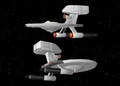
While the Pytheases went to interstellar fame with discovery after discovery, paving way for future generations of deep space cruisers, financial realities back home changed to the better, and the original Ranger fleet gradually received a corresponding upgrade. The first ship to be converted in 2228 was USS Spann (NCC-790), followed by twelve out of the surviving sixteen by 2233. Fitting the Harbin saucer into a preexisting spaceframe was more demanding than new-building, and the experienced Vickers took over from its Selenite and O’Ryanite competitors. Externally, a modernized Ranger looked very much like a Pytheas, save for the secondary hull: the stern hangar was retained, as were both torpedo embankments, even though modern systems were naturally substituted in these positions. The SAB impulse engines were a definite improvement over either the original M-2196 units or the Pytheas SAA standard, and heavier lasers were also substituted for the antiquated Tesla units. Overall, the new Rangers were competent combatants, even if lacking in flexibility and joint operations capability.
The surviving Triumphants received no refits and were swiftly scrapped at the introduction of modern heavy destroyers, vessels that made utter ridicule of the tactical abilities of the light cruisers. In turn, propulsive performance proved to be the stumbling block of Jidai, Pytheas and Ranger alike. A fine engine for its day, the PA-100 had little patience for engineers who attempted gradual uprating, and began to leak from all seams when pressed beyond its inherent limits. Anything larger, such as the PB-29 of the modern destroyer fleet, would have broken the back of the light cruisers; anything smaller would fail to yield the desired improvements. When even the compact PB-35 proved too heavy for successful installation, the Rangers were deemed unfit for modern combat tasks, and underwent a humiliating withdrawal from frontline service in favor of the reborn Texas light cruisers. Many were cut into components for Liberty transports. The Jidai fleet was spared the disgrace by virtue of having died a warrior’s death: by 2259, every last of the spyships had been eliminated by the enemy, the heroic struggle of USS Yamato (NCC-1305) guaranteeing longevity to her name in Star Fleet history. The Pytheas fleet in turn bowed to Constitution heavy cruisers as Star Fleet’s primary instrument of independent deep space exploration.
The last Ranger, USS Duncan (NCC-793), was retired from spacelane patrol in late 2269, her torpedo launchers long since removed. The Pytheas class kept going longer, even in face of major attrition due to maintenance problems. USS Ibn Rustah (NCC-1409) remained in active service until the Khitomer peace, scoring planetary survey successes till the very last.
Gallery
-
 Ranger / Triumphant sub-classes (original), bow plan
 -
 Dorsal plan
 -
 Stern plan
 -
 "Where No Man Has Gone Before"
 -
 Pytheas sub-class
bow view -
 Pytheas sub-class
dorsal view -
 Pytheas sub-class
port view -
 Ranger refit
starboard aspect -
 Ranger refit
dorsal aspect -
 Ranger refit
bow aspect -
 "Where No Man Has Gone Before"
(see Note) -
_bow_plan.png)
_dorsal_plan.png)
_stern_plan.png)
.jpg)
.png)
.png)
.png)
.png)
.png)
.png)

.png)
External Sources
- Vintage Starships: "2217 - Ranger": includes 3D Viewer
- Vintage Starships: "2240 - Ranger": includes 3D Viewer
Notes
- The reference to the Klingon Empire invading and capturing Archanis has been removed, as it is Timo- and game-canon for the USS Ranger to be lost in 2218, while the planet was not until 2236.
- The Naval Construction Contract (NCC) for the Ranger subclass extends past the 700 series. Ships after NCC-799 will have to be accounted for elsewhere.
- During the game, the loss of each of the Jidai class to enemy action must accounted for, with the last to take place in 2259.
- Despite the use of saucers in some of the images here, the original Ranger and the Triumphant should have the bubble hull; the Jidai, Pytheas and refit Ranger will have the "swelled" saucer.