Guide:Sherman
_stbd.png)
| |
| Sherman | |
|---|---|
| Class Overview | |
| Category | light transport / cargo drone |
| Operational | 2224-2290 |
| Constructed | 201 total |
| Dimensions | |
| Length |
|
| Beam | 58.7 m |
| Height | 53.9 m |
| Mass |
|
| Performance | |
| Cruise Speed | w 3 |
| Tow Speed | w 2.25 (for longer loads) |
| Max Speed |
|
| Endurance |
|
| Complement | |
| Officers |
|
| Enlisted |
|
| Tactical Systems | |
| Beam Weapons |
|
| Shields |
|
| Transporters | Sherman, Wanda:
Alexis, Pershing:
|
| Auxiliary Craft | Sherman, Wanda, Alexis:
Pershing:
|
| Historical | |
| Ships of Note |
|
| Canonicity | |
| Design | TOS-Remastered, TAS (Robert Gilbertson, SSA/Todd Guenther, Thomas Monson, & Evan Malverne) |
| Name | FASA, SSA, Jackill |
| History | FASA, own
|
The warp engine advances of the Saladin and Baton Rouge designs soon led to breakthroughs in
nonmilitary use as well. As warp engines became faster and more compact, huge cargo carriers were
no longer the only economical solution to interstellar cargo transport. Small, fast cargo ships could
now compete with the lumbering giants in the carriage of valuables and passengers – or even in the
timely delivery of high value bulk such as pergium- or dilithium-rich ore. To take full advantage of
the fact, Star Fleet decided in 2221 to field a large number of medium transports based on modern
warp technology. Even after the introduction of medium warp transports, the sublight ore carriers
retained their position in the UFP fleet, but the large fleet cargo vessels of Vanguard lineage gave
way to the smaller, newer designs. Also, civilian designs were superseded by Star Fleet vessels along
many shipping routes in face of the serious military threat of Klingon privateers.
_stbd.png)
The design Star Fleet chose for the first modern transport ships was an ambitious one. Not only was the design to feature top-class warp propulsion, it was also highly automated to allow for efficient loading and unloading of cargo. In later models, piloting operations were also automated, and the ships required only periodical maintenance. These ships were thus designated cargo drones, although they retained full life support in the hull to accommodate the occasional maintenance crews. Despite superficial similarities, little was common with the far more primitive Boyden warp-capable drones of the previous century.
The boxlike central hull featured small priority cargo vaults and inspection crew and passenger facilities, while warp engineering was housed atop it along with tanks for fusion fuel. Three types of modular tank could be clipped on, aft of the dorsal structure, although in practice only the largest model ever saw regular service. Main cargo holds were below the central hull; the center-most structure was fixed and featured elevators, dataways, power and ventilation trunks and multiple cargo airlocks, while storage modules for bulk cargo and liquids, as well as smaller holds for general cargo, could be attached forward and aft of the central structure. The tanks and holds could be maneuvered in place by a cargo crane system, the rails of which extended back from the central hull to allow for unobstructed access to port facilities. Cargo could also be brought onboard via port and starboard airlocks and fluid umbilicals. Finally, if needed, a standard cargo pod could be attached to the crane for towing at low warp.
The commercially obtained warp nacelles, dubbed PB-15 in Star Fleet use, were mounted on short, sturdy pylons attached to the cargo elevator support structure. They featured large ramscoops for extended interstellar operations, and were somewhat stubbier than the PB-23 nacelles under development for modern Star Fleet transports specifically. Drive plasma was fed through twin conduits running along the cargo crane rails. Power was generated by a large fusion reactor in the warp engineering compartment, and an auxiliary fission reactor was available for shipboard power needs. Impulse power was limited to low performance units at the aft support structure, but reaction control systems were of high quality to help with docking operations.

All around the hull were sensor strips for maximal situational awareness. Advanced optronics enabled both in-system and interstellar navigation with relative ease, although the ships did rely on external guidance cues when maneuvering near orbital installations or loading or offloading cargo. It was also reasonably rarely that the ships would venture outside communications range of traffic control systems that monitored shipping along standard lanes. A foray into the unknown, for example to assist Star Fleet survey operations, would almost always be supervised by a live crew.
For crewed operations of extended duration, a further dedicated module would form the bow of the vessel to provide proper berthing. A traditional bridge atop this blocky extension took over from the control room within the core vessel, and in some models was flanked by twin laser cannon for self-defense. The automated flight control system was not authorized to fire the weapons – they were to be used only in conjunction with high-security cargo transfers, under the supervision of the onboard operating crew and security team. A navigational deflector dish at the bow of the core unit would in turn have to be removed when the crew module was attached, and replaced by a different, crew-rated unit attaching to the lower forward cargo hold.
The initial design was christened Sherman class in the crewed transport incarnation; the first full drone version, produced in parallel, was given the Mk II specifier. The crewed vessels were built in quantity, and quickly became the mainstay of Star Fleet light cargo operations. In contrast, the drone class initially only comprised fifteen vessels that were placed under intense scrutiny before fully unpiloted operations could begin. However, a refined drone design eventually went to series production as the Wanda subclass, with 50 alliteratively named hulls completed for Star Fleet Merchant Marine use by 2237, twenty of them through converting those crewed Shermans that were in the greatest need of an overhaul to begin with. A prime application was hauling of fissionables, heavy metals or other non-time-critical bulk and goods.

The Mastercom design bureau subsequently fiddled with follow-up variants with minor performance improvements or cargo space arrangement alterations. There was sufficient flexibility in the standard design to reproduce the results of the so-called Mk IIa and Mk IIb modifications, though, and no actual refitting of earlier units took place. A more distinct Alexis subclass with high performance was completed in 2251-56, with uprated PB-16 engines for a maximum speed of full warp 5. The final batch of drones would still largely follow Wanda guidelines, and comprise 70 units swiftly built by Star Fleet Division in 2261-63 under the subclass name Pershing. At the same time, most of the Shermans were converted to fully automated operations.

In addition to SF Merchant Marine use, Star Fleet operated several Sherman derivatives as Class Two auxiliaries for fleet supply needs. Regardless of crew complement, these ships were all registered as drones, using the late 22nd and early 23rd century convention of NCC-#G format, where # was a number in the 128-160 (Sherman), 300-349 (Wanda), 480-499 (Alexis) or 1400-1469 (Pershing) range. This separated them from manned transports such as the original crewed Sherman vessels (500-549, with F following the number), as well as from manned supply ships, fuel carriers and general support types (S) or simple cargo pods (C). Non-transports like training ships (T) and local defense and law enforcement vessels (L) as well as repair and maintenance ships (R), warp couriers (D), light intelligence vessels (I), standoff observation ships of more substantial size (O), runabouts and similar small craft (B), and eventually also perimeter ships (P), were also given a special letter designation in this Star Fleet scheme, which soon swapped format and applied the code letter before the number. In a further complication, NCC-Q# format was originally used on the Mk I, even though Q later came to denote target drones only. The elaborate system was mostly abandoned in the 2270s, and the various transports were thereafter given simple NCC registries. (See Registry Codes, for additional information.)
Some Shermans were drafted to scientific survey duty in addition to their transport role. In the simplest case, this meant that automated Star Fleet or UESPA survey gear was bolted onto the hulls to monitor randomly encountered phenomena. In more involving missions, there were science specialists aboard, and the ships were asked to follow predetermined routes for extensive stellar cartography, or sometimes to visit points of interest not directly on their path. USS Antares (NCC-F501) met a grisly fate in 2265 on such a mission, as she located and picked up a survivor from a crash while cursorily surveying planet Thasus; the young survivor soon misused supernatural abilities gained from the inhabitants of the planet and ultimately destroyed the Antares, killing twenty-five people.
Uncrewed operations generally presented risk to material goods only. USS Penelope (NCC-G1415) fell into Orion hands in 2256 with a full load of dilithium, but a special forces operation to retrieve it was successful. No charges were pressed against the Orion government at that time – it was believed that support to the government would help curtail independent pirate operations. The policy was indeed successful in uniting most Orion pirates under a single (or, at times, double or triple) government that could later be discouraged from continuing state-sponsored piracy. Klingon raids claimed half a dozen further Shermans, and a bizarre friendly fire incident ended the ore-hauling career of USS Woden (NCC-G325) in 2268, but losses thereafter were limited to retirements due to structural fatigue. A small number of Pershings received LN-61 engines in an economically nonviable experiment that did not prolong the lifetime of the class to an appreciable degree. The last Sherman-derived drones were withdrawn from service in 2290, and replaced by drone conversions of more modern vessels.
Notes
- The Sherman classes are considered medium-sized transports, and though they had six different types of tank modules developed for them, they were capable of carrying other standard container types too:
- Type S Forward Main Hold module: two types, bulk cargo (such as ore, 750 mt) and climate-controlled compartmentalized holds (600 mt).
- Type S Aft Main Hold module: also two types, bulk cargo (such as ore) and liquids (with baffle separation) (750 mt).
- Type S tank modules: Up to 4 carried above the crane (behind the dorsal structure); primarily used for liquids/gases, though three specialized tanks were manufactured for deuterium, 'other fuels', and antimatter (300 mt).
- Type S Bulk Dry module: the Sherman, when not carrying any modules above the crane, nor the Aft Main Hold module, could carry 4 of these 30,679 mt modules without impeding warp capability.
- Type S Antimatter module: As with the Bulk Dry module, the ship could carry one of these 36,268 mt modules without impeding warp capability.
- Type S Volatile Liquid module: Could carry 2 of these 58,435 mt modules without impeding warp capability.
- Standard-sized Type VII containers could be individually attached below the crane, for the lower tow speed.
- The first drone variant was originally referred to as the Mk I; the Sherman drones have been changed to be Mk IIa and Mk IIb, to better match with other comments regarding the development of more drones and the conversion of crewed models to drones.
- The date for Star Fleet's decision to "field a large number of medium transports based on modern warp technology" is pushed back to 2221, as 2224 is the year the Sherman class became active.
- The date of production for the Pershing subclass has been changed in the sidebar to match the text.
See Also
Gallery
-
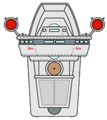 Sherman (crewed), bow view
 -
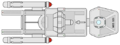 dorsal view
 -
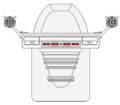 stern view
 -
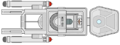 ventral view
 -
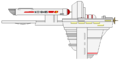 Mk II (drone), stbd view
 -
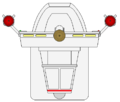 bow view
 -
 dorsal view
 -
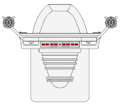 stern view
 -
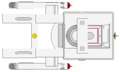 ventral view
_(bow).png)
_(dorsal).png)
_(stern).png)
_(ventral).png)
.png)
.png)
.png)
.png)
.png)
-

-
 "Check Up"
 -
 A distress call best unanswered
 -
 "Follow the leader"
 -
 Transfer point


