Guide:Alexandria
.png)
| |
| Alexandria | |
|---|---|
| Class Overview | |
| Category | corvette tender (later freighter) |
| Operational | 2186-2236 |
| Constructed | 6 |
| Dimensions | |
| Length | 638.1 m |
| Beam | 167.4 m |
| Height | 237.0 m |
| Mass | 511,000 tons |
| Performance | |
| Cruise Speed | w 3 |
| Max Speed | w 5.5 |
| Endurance | 2 years |
| Complement | |
| Officers | 3 |
| Enlisted | 14
|
| Passengers | 100 |
| Cargo | corvette tender mission
freighter mission
|
| Tactical Systems | |
| Beam Weapons |
|
| Shields |
|
| Transporters |
|
| Auxiliary Craft |
|
| Canonicity | |
| Design | jbobroony(DeviantArt)/modified by me |
| Name | Timo's Guide: Pointer class corvette |
| History | Timo's Guide: Pointer class corvette/myself
|
Even as the Pointer class corvettes were just entering service around UFP homeworlds, their capacity to complete their primary mission - to provide assistance to Federation local defense forces as well as customs and police units - was promising to be quite expandable. If they could be delivered to remote but highly important areas, they could protect shipments and maintain order within contested space, as well as provide immediate protection for civilian operations deemed critical, but yet not worth demanding the constant on-site vigilance of a capital ship (frigate or larger).
The problem lay with the Pointers speed and range. Warp 3.5 was deemed more than acceptable for most in-system response times, and it made even 'local' interstellar neighborhood patrols reasonable for these short-endurance vessels. However, when you need firepower on-station at a remote industrial site for 2-3 years at a time, it didn't make sense to have a corvette hopscotch between major worlds on a trek that itself could take several months (or even years, at warp 3). The Pointers were coming online at a fantastic speed and a solution was deemed to be needed as soon as possible, so the Committee for Starfleet went looking to the commercial fleets for answers.

They found it with the W Class or Senator class freighter. First unveiled in 2165, the vessel was perfect for Starfleet's needs. It utilized an open-space framework to haul around containers of almost any size, but was one of the first to be built to accommodate the newer 75,000 and 100,000 ton versions. With extremely little modifications, the ships could be bought 'off-the-shelf' and tasked with not only transporting the smaller-ranged corvettes to their destinations of assignments at a sustained speed creating than the corvettes' warp 3.5, but they could ferry the crews along, too, in conditions much more hospitable than living within those tight quarters. Additionally, with the right resources and equipment loaded alongside the piggy-backing ships, once the destination was reached, the corvettes could see their dwell time expanded from 6 months to up to 18 months (without external re-supply) by having the Alexandria mothership remain on station alongside them.
The first modification came to the aft-most section of the cargo area. Tie down points and access ways were installed to take the place of 4 of the 75k containers allocated for the dorsal spine area and reversed for the same space intended for 4 100k containers on the ventral side. Two types of semi-automated service containers were developed for the '3 Zone' just forward of the ship bays. The first carried both additional KE rockets and fusion mines, as well as storage space for spare MAWS modules, but also equipment that, when properly loaded with the munitions, would auto-feed the receptacle bays on the Pointers, even if the ship was hovering within the bay unsecured. The loading of the automated booms had to be accomplished by crew members in spacesuits, but this was no issue for the personnel of the sister ships still embarked aboard the Alexandria. Or, if no ships were currently embarked, the SMM crew was trained to provide the re-armament service. A similar setup was conceived for the 2 refueling service containers, that were feed directly by the 8 deuterium and tritium fuel containers loaded into the '2 Zone'. The over-allocation of fuel was rationalized with the concept the freighter would be able to top off other starships and facilities it may encounter.
Forward of all of these, in the '1 Zone', were four habitable containers designed to accommodate the embarked Pointer crews. The three personnel community containers (or 'barges' as they were colloquially known) could house, feed, entertain and sustain many more than the 100 'Fleeters' expected for long-hauls, plus they also had the free rein of the freighter's generous spaces (though the aft engineering section was considered off-limits, unless an invitation was extended). A fourth container provided an operations center, communication facilities and training classrooms for the Pointer crews.
Additional modifications included self-defense weapons. It had been argued the Pointers could themselves provide all necessary defense, but the response was that a well-informed aggressor could target an empty Alexandria on a return trip, stranding not only those just-delivered, but all corvettes the mothership may have serviced. Plus, if the ship remained on-station, having additional weaponry would only benefit the operation being protected. Six plasma cannons were installed on the bow and aft ring; due to the configuration of the cargo zones, the mid-section was left completely undefended. It was also realized that one tender could easily support up to 4 corvettes, either with all four ships carefully secured for the extent of the trip or allowing 2 to warp alongside a slightly speed-reduced tender, swapping out with the secured vessels every few weeks at relatively brief stops. More than four corvettes (up to eight) could be supported when on-station (though there was very little demand for so many co-located corvettes).
A total of six Alexandrias were procured for corvette tending by the end of 2188. As the modifications made did not subtract from the ship's cargo capacity in more than the slightest, when the Pointers were fully decommissioned by 2208, the tenders quickly shed their specialized containers and joined the SMM in much more mundane and typical freight transport, working alongside and in support of Starfleet for another twenty-eight years.
Notes
- The Alexandria class is not represented in Timo's Guide, as I created it from a reference to it in the Guide.
Gallery
-
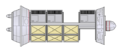 Senator (or W Class) freighter

See Also