Guide:Cavalry

| |
| Cavalry | |
|---|---|
| Class Overview | |
| Category | light destroyer |
| Operational | 2151-2193 |
| Constructed | 33 total |
| Dimensions | |
| Length | 190.0 m |
| Beam | 37.8 m |
| Height | 50.0 m (sensor dish retracted) 55.1 m (sensor dish extended) |
| Mass |
|
| Performance | |
| Cruise Speed | w 2 |
| Max Speed | w 3.1 |
| Endurance | 2 years |
| Complement | |
| Officers | 9 |
| Enlisted |
|
| Tactical Systems | |
| Beam Weapons | Cavalry
Strachan
Mars
Turing
|
| Missile Weapons | Strachan
Mars
|
| Shields |
|
| Transporters | Cavalry, Strachan (original)
Cavalry (refit), Strachan (refit), Mars, Turing
|
| Auxiliary Craft | 2 atmospheric shuttlepods |
| Historical | |
| Ships of Note |
|
| Canonicity | |
| Design | FASA |
| Name | FASA, SFC, own |
| History | FASA, SFC, own
|
The UESF military doctrines of the 2140s were still based on the experiences of the rather lopsided
battles against unorganized feline Xindi forces in what were actually just peacetime police
operations. The blind faith in ‘heavily’ armed and armored cruisers was badly misplaced in the
actual conflicts of the era, as was the idea of operating without major front line supply and repair
bases. Yet the UESF was still very much limited to operating in or near the Sol system and the major
human settlements elsewhere, in terms of technology, politics and tradition alike.
Even when these triple barriers began to crumble, a fatal conservatism prevailed in strategic
thinking. When Earth in 2151 fielded a series of new destroyers, they were not propelled by the
revolutionary deep space engine of the Enterprise class, but by the much humbler fusion-powered
S66-D, capable only of warp 3.1 at very best. In face of the recent experiences of the exploratory
cruiser Enterprise (NX-01) with deep space threats, the UESF should have immediately discontinued the light destroyer program and diverted the funds to longer-ranging combatants. Instead, the
Admiralty deemed the design ideal for system defense and proceeded with full production.
Tactical scenarios were based on unrealistic extrapolations of a limited dataset: it was predicted that invaders would utilize large starships conceptually similar to the Vulcan voidships, and such an adversary would best be fought with short-ranged strike vessels possessing great offensive firepower. The anti-fighter defense role, factually more important against the continuing pirate threat, would be left to the already existing, heavily armored cruisers bristling with defensive plasma cannon. Thus, the Cavalry (DD-600) class of destroyers featured only four 6 GW plasma turrets and dedicated significant room to twin missile tubes or a single hypermodern phased particle cannon. Also, heavy armor was concentrated on the bow of the hull, and frontal profile was minimized by reducing beam, for once overriding the doctrinal call for aerodynamic performance.
The narrow hull gave unwelcome commonality with the preceding Djartanna destroyers: internal volume was at a premium. The utilitarian hull featured just four decks, of which the lowermost was essentially divided in two by the ventral radiator assemblies of the heavily armored compression fusion reactor amidships. The forward part of the bifurcated deck housed ventral plasma cannon banks, while the aft one held power transfer systems. The two middle decks housed the missile launchers or the alternately carried Type A phase cannon forward, engineering spaces abaft, and crew berthing amidships. Deepest within, just forward of the reactor core, were the sickbay on upper and the mainframes of the Yoshimitsu combat management system on lower middeck. The top deck was actually numbered Deck 2, as atop its fire control spaces and bow plasma cannon banks lay a series of crew-accessible superstructures, including the navigation bridge, a retractable sensor dish, the top of the reactor core and a lifepod station. The upper level of a stern shuttlebay also extended above Deck 2, giving enough internal volume for carrying of two Monarch or Skeet atmospheric shuttlepods. Two airlocks/docking ports on Deck 3 rim facilitated intership access, and a single GP transporter was added in a series of refits between 2156 and 2159.
The multiple means of disembarkation were quite necessary as, despite the hull itself having rudimentary atmospheric maneuverability, the Cavalry as a whole possessed no operational landing and takeoff capability. The single, 120,000 ton set of fourteen-spool warp coils was packed into an open frame, standoff nacelle well below the stern, on a sturdy twin pylon mounting. Since the coils were somewhat less modern than the powerplant, much of the reactor output was left unused by the warp drive system. This benefited the high performance impulse engines, whose twin nozzles in the aft corners of the hull could fire past the nacelle for violent maneuvering. Linear acceleration was also commendable, surpassing that of both the lighter Gangess and the heavier cruisers. An emergency nacelle separation maneuver would provide even greater agility, yet leave the ship hopelessly crippled afterwards.
Operating a single-engined combat vessel was a novel experience for the UESF, and many civilian specialists more familiar with the configuration were employed in training the crews. Two Dnestr class commercial transports were purchased for training duty, and modified internally to provide a more destroyer-like service environment. In return, it was customary for a while to paint the destroyers with false viewports and cargo pod seams to reinforce the illusion of a freighter-like silhouette, although few adversaries could be fooled by this. It was not the intended job of the destroyers to protect convoys or lure in pirates in any case. The standard mode of system defense operations was reactive rather than proactive: to pounce at approaching enemy fleets from several directions with slashing attacks, then retreat as a single formation towards an ambush set up by a heavy contingent of cruisers. The fatefully misguided Xindi bombardment of the Caribbean in 2153 and its follow-up actions involving Klingon and further Xindi penetrations seemed to justify the doctrine, in which intrusions by a low number of heavily shielded point targets would be deterred by decisive counteroffensives of similarly few UESF units.

Other operational experiences showed that the concept required some fine-tuning, however. UESS Carronade (NDD-601) was lucky to survive a Romulan raid on Defense Outpost 4 on January 1st, 2152 – the first attack truly verifiable as the doings of the Rihannsu, although the evidence was initially mistranslated just as badly as in the earlier Intrepid and Enterprise encounters, thanks to extreme Romulan prowess in information warfare. The plasma cannon armament was found to be singularly ineffective against the Romulan shields, and later destroyers received an updated secondary armament – but not of the phase cannon type, which had also performed poorly in the engagement. Instead, advanced warp-accelerated lasers, developed and tested using the Cavalry testbed UESS Mars, were soon substituted for the obsolete plasma cannon mounts. Torpedo tubes were installed on the last two units of the original production run (twin tubes replacing the main phase cannon), as well as on seventeen second-batch vessels (single tube supplementing the particle beam armament). The armor grid was reconfigured no less than seven times to produce optimal shielding to match the latest Romulan firing patterns. Throughout the Romulan conflict, the Cavalries still remained much more vulnerable to enemy retaliation than the Messier, Triton or Enterprise cruiser modernizations, Achilles or Christopher newbuilds, or the almost equally massive modern Marshall heavy destroyers, all of which now mounted Andorian shield generators.
Still, the Cavalries proved to be formidable warcraft and matched in the elegant balance of martial skills what they could not achieve through simple strength in shielding, weaponry or numbers. The last of the original 29 ships were completed in 2156. The Marshall class had recently been introduced to meet the new tactical requirements, combining deep space range and endurance with heavy armament – the latter concentrated in a fighting section derived from the Cavalry hull. The early first loss of this new class made it possible for the older destroyer type to extend continuity in another fashion as well: the penultimate Cavalry, DD-627, would perpetuate the name Patton in the upcoming years of conflict. UESS Cavalier (DD-628) in turn was the last Cavalry loss in the Romulan War, shot to pieces well after the official declaration of ceasefire and limping to a crash landing onto an unexplored, barely M-class world on May 24th, 2161. Seven months later, on January 21st, 2162, rescuers found all the survivors of the crash, led by LT Lawrence D. Baker, alive and in good health. Their recovery was a long-awaited positive media event in the middle of the postwar atmosphere of disillusionment, ambiguity and anxiety.
Four unfinished late-standard Cavalry (aka Mars subclass) hulls were completed in 2160 with shield generators and two single 80 MW warp lasers, and equipped with advanced sensors for long range armed reconnaissance, to serve the UFP Star Fleet as the Turing subclass. Their sorties in the Tarn conflict of 2162-64 were success stories that overshadowed the early UFP defeats and helped secure the Star Fleet reputation, even when yet another military conflict ended in an apparent draw. These vessels proved useful in later exploration duty as well, whereas most of the 21 surviving original Cavalries and Marses were sold forward to other UFP navies (chiefly the UESF) in 2161- 68 pending the formation of an operational common fleet.
Gallery
-
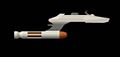 Starboard
 -
UESS Patton engaging Romulans


Notes
- Though not identified as a subclass within the text (yet), the last 2 vessels of the Cavalry class were modified for torpedo weapons. As part of the Delta Dynamics' commissioning award program, TheRochellaProject suggested "Lt Harcus Strachan, a Canadian cavalry officer who served in WW1 and was awarded the Victoria Cross for his actions in the Battle of Cambrai". The first of the two ships (the other being the Procope) will be named after the cavalry officer, with the subclass also taking the name.
- The USS prefix is replaced here with UESS.
- The registry for the Phalanx was changed from DD-612 to ND-613, and Patton from DD-627 to ND-627.
- The reference of Poisson as a testbed for advanced weaponry was changed to Mars, which came early enough for that role.