Guide:Triton
.png)
| |
| Triton | |
|---|---|
| Class Overview | |
| Category | Heavy Cruiser |
| Operational | 2146 - 2172 |
| Constructed | 17 |
| Dimensions | |
| Length | 176.8 m |
| Beam | 136.0 m |
| Height | 34.9 m |
| Mass |
|
| Performance | |
| Cruise Speed |
|
| Max Speed |
|
| Endurance | 4 years |
| Complement | |
| Officers | 15 |
| Enlisted | 99
|
| Tactical Systems | |
| Beam Weapons | Tritons (original)
Intrepids, Tritons (refit 2151-53)
|
| Missile Weapons | Tritons (original & refit)
Intrepids
|
| Shields |
|
| Laboratories |
|
| Transporters | |
| Auxiliary Craft |
|
| Historical | |
| Ships of Note |
|
| Canonicity | |
| Design | ENT |
| Name | ENT: 'Minefield' (Intrepid Michael A. Martin, Christopher L. Bennett) |
| History | Timo, Christopher L. Bennett ("A Choice of Futures", "Tower of Babel")
|
Background: The Hobbyist's Guide
As work on Henry Archer’s antimatter drive proceeded at a snail’s pace, UESF command became exceedingly worried about defending Earth’s extrasolar assets. Visiting or resident Vulcan voidships were more than sufficient deterrent against an invasion by the known adversaries, that much even the Starfleet admirals had to grudgingly admit. Yet Vulcans had no interest in sending their ships out to support the mad Human dash to deep space. A Messier cruiser would take years to arrive at a distant battlefield, only to bring largely outdated, FTL-incapable and self-defense oriented weaponry to bear. The cruiser would also be virtually unmaneuverable in impulse combat, a martial art in which Earth’s known opponents were disturbingly good.
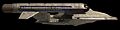
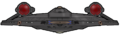
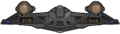
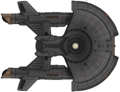
By the 2140s, the whole Messier design philosophy was recognized as a dead end. There was lots of excess bulk in ships originally designed as huge flying fuel tanks and the placing of their reaction engines at the very stern was far from ideal for maneuvering. After studying a number of adversary designs, Earth experts decided to aim for a hull with low frontal and side profile but wide horizontal decks. Comments were muttered about an irrational need to design something completely unlike the spindly, all-aspect-minimized Vulcan ships. Yet the almost aerodynamic shape of flat, ray-like hulls was a logical extension of Earth’s vast engineering experience with lifting body spacecraft and of the research done on wide-area cylindrar gravity fields.
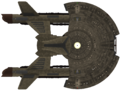
While the researchers at the Warp Five Complex were busy trying out their propulsive and power generation innovations, work began in early 2142 on the hulls that would mount the new warp three-plus engines. A semicircular hull 136 meters across would form the bow of the new heavy cruiser. Compared to this section, the boxy aft extension housing fuel and main powerplant was truly minuscule. Attached astern would be a warp field stabilizer, manipulating the main propulsive subspace field for reduction of inertial mass. Several options were open for nacelle placement, depending on the size and shape of the final engine choice.
The two sublight propulsion systems were mounted at the outer corners of the hull. Each unit was capable of producing auxiliary power for ship’s systems via MHD exhaust tapping, in addition to providing vectorable thrust. Placed well ahead of the center of mass no matter what kind of warp engines would be attached, but dead center in case of a nacelle jettison, the engines would be ideal both for spatial and atmospheric propulsion. Furthermore, nearly every piece of instrumentation was carefully faired over to aerodynamic smoothness. Thus, the hull would be perfectly controllable in atmospheric entry, even though the UESF insistence on such capacity no longer corresponded to tactical reality. As an emergency procedure, atmospheric ditching, of course, remained practical. Indeed, Earth vessels would be uniquely protected by this ability in many scenarios that would lead to massive casualties aboard other designs.
Main berthing was arranged on the outer rim of the hull, just inboard of the RCS systems. Further inward on the widest deck were sensor control rooms and two laboratory complexes, then the main computer area and a fire control room. On the deck above was further berthing. Closer to centerline were supply and cargo holds, accessible also via two aft-facing entry locks that doubled as hangars for the ship’s work pods; there were no other auxiliaries aboard on standard missions. The deck above this had high bays for these facilities, as well as berths for heavy lasers port and starboard. Corresponding weapon berths on the deck below the widest one were accompanied by a centrally-mounted short range scientific sensor cluster in the middle, assorted partial-gravity utility spaces to the sides, and two single-tube missile launchers forward. Long range sensors were grouped next to a navigational deflector system at the bow. Topmost ran a rectangular superstructure that covered tactical sensors, a defensive suite of either four plasma cannon or an experimental gravitic shielding system, and conventional EM shield generators. On this structure also lay the main bridge.

Construction on the first four hulls was completed in late 2145. Work on engine systems had proceeded on schedule as well, and two pairs of 125-meter, 100,000 ton PB-3 warp nacelles were ready for installation. These big brothers to the Daedalus PB-2 were at the upper end of the size range suited for the hulls and protruded slightly ahead of forward hull trailing edge. The engine support pylons inboard and downcanted fins outboard of the nacelles held thermal exchangers and plasma vents, along with field guides. Primary drive plasma exhausts were shuttered with hemispherical diffuser electrodes for greater stealth in deep space operations, as well as for additional energy recovery.
What was lacking was the antimatter powerplant initially projected for the class. Yet such projections had never been considered completely realistic by the UESF and a more conventional fusion backup was readily available. The inaugural pair of vessels, UESS Triton and UESS Redoubtable, sailed out of their box docks in February 2146 and the other two unnamed hulls were also floated away so that construction on the next set of four could begin. Centuries of naval history weighed upon the UESF when it decided to dub the new combat vessels "heavy cruisers", separating them from the preceding generations of less combat-ready survey spacecraft in the most inoffensive way possible.
A shakedown period of two years saw the ships try out their weapons and sensors against a number of simulated threats near Earth, stretch their legs at warp three cruises to Alpha Centauri, Sirius, and Draylax and reach a dash speed of warp 3.6. The Trafalgar and Lepanto received their engines in 2147 and the next four vessels were completed in 2149-50. Orders were placed for a third batch of four as well, bringing total financial expenditure to about 50% that spent on the Messier cruisers. This did not go down well in the UE Senate, which after the 2150 gradualist party victory began to question the investment in warships that seldom left Sol and did virtually nothing to curtail piracy.
Yet the twelve Tritons proved elemental in Earth’s upcoming military challenges. They were more than mere technology demonstrators or propaganda pieces: when rearmed with phase cannon (and, in case of the Intrepid-led batch of five very welcome newbuilds, with a warp torpedo launcher) in 2151-54 and cleared for a tooth-rattling flank speed of warp 4.0, they became combat platforms capable of challenging local adversaries on basically even footing. Twelve ships mostly lacking long range FTL weapons couldn’t hope to intercept warp-speed invaders until at the very doorstep of Human systems and couldn’t be spared to hunt down elusive pirates—but they could strike hard when needed.
When the Triton dockyards were freed again in 2153, the political atmosphere might have been ripe for the construction of another dozen. Instead, the UESF concentrated on acquiring the more advanced and significantly faster Enterprise class vessels, which brought the credibility of Earth’s cry of challenge up one more level. A Triton could never rival the humblest Vulcan combat vessels one on one, but an Enterprise just might. At the most that could be justified was an order for an additional five in 2158. The older heavy cruisers were deployed in theaters of greatest threat, while the Enterprises took the battle to enemy territory, first in the Xindi conflict, then in the Romulan one.

Early triumphs and disasters in the Romulan War almost invariably involved the presence of a Triton cruiser. Yet once the action moved outside of Earth territory, the Tritons disappeared from headlines. This was partially due to the inability of the vessels to accompany the slashing strikes of fast Enterprise, Achilles, or Christopher formations. A more concrete reason for the diminishing role came from the heavy combat losses suffered by the class. By the time of the battle of Cheron, only four Tritons of the original twelve remained space-worthy. The UFP Star Fleet proceeded to drive the Intrepid (now NCC-08) and the Fearless (NCC-09) past their limits in the Tarn confrontation, retiring the vessels in non-serviceable condition in 2167 and expending them as targets. The Dauntless (NCC-01) and the Gallant (NCC-04) were likewise rendered un-battleworthy in the conflict, but were not stricken until 2172. Out of the five final units, only USS Pioneer (NCC-63) attained fame in warp drive experiments and a groundbreaking diplomatic mission to Beta Rigel.
Ships
Guide canon
Triton primary subclass I
- NCH-200 Triton
- NCH-201 Redoubtable
- NCH-202 Trafalgar
- NCH-203 Lepanto
Triton primary subclass II
- NCH-204
- NCH-205
- NCH-206
- NCH-207
Intrepid subclass I
- NCH-208/NCC-08 Intrepid (first hull number conjecture)
- NCH-209/NCC-09 Fearless (first hull number conjecture)
- NCH-210/NCC-01 Dauntless (first hull number conjecture)
- NCH-211/NCC-04 Gallant (first hull number conjecture)
Intrepid (Prospect?) subclass II
- NCH-212/NCC-xx Prospect
- NCH-213/NCC-xx
- NCH-214/NCC-xx Resolute
- NCH-215/NCC-63 Pioneer
- NCH-216/NCC-xx Concord
Gallery
-
-
-

-
-
-
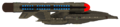 2153 refit
 -
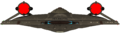
-
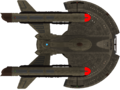
-
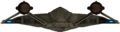
-

.png)
.png)
.png)
.png)
.png)
.png)
.png)
.png)
.png)
Star Fleet Registry
Intrepid subclass
- USS Dauntless (NCC-01)
- USS Gallant (NCC-04)
- USS Intrepid (NCC-08)
- USS Fearless (NCC-09)
- USS Pioneer (NCC-63)
- USS (NCC-142)
- USS Concord (NCC-229)
- USS Prospect (NCC-238)
- USS Resolute (NCC-312)
Alt Sources
- Starship Handbook (Combined) (as NV class)
Notes
- Timo updated the entry by adding 5 additional Intrepid sub-class ships built in 2158, but did not include that in the text. Therefore, it was decided to add in the appropriate text to indicate the additional 5 were a compromise from the requested 12. Additional tweaks to the sidebar were made to reflect this. The sidebar's length of service was extended to match the text.
- Memory Alpha refers to this class as the Intrepid type, not to be confused with the much later Federation Star Fleet class light cruiser. Others refer to this as the Neptune class.
- The NCC-04 was identified by Timo as Valiant; however, due to a beta-canon Columbia with that name, it has been designated here as Gallant. The last four ships have also been named for game-canon.
- The concluding statements regarding the Triton class here differ significantly from that of Timo's January 2017 draft. There is zero intention of updating this article to match that one.
- The prefix "USS" has been changed to "UESS" for ships operating during the United Earth Starfleet era.
- The last nine ships constructed (all Intrepid subclass) were transferred to the UFP Star Fleet.