Guide:Poseidon: Difference between revisions
No edit summary |
|||
| Line 83: | Line 83: | ||
* The three war-time ''Poseidons'' are all transferred to the [[UFP Star Fleet]], while the remaining 14 vessels' production is appropriated by the [[Federation]]. | * The three war-time ''Poseidons'' are all transferred to the [[UFP Star Fleet]], while the remaining 14 vessels' production is appropriated by the [[Federation]]. | ||
* It's interesting that ''Olympia'' and ''Coto'' were the 2nd and 3rd vessels completed, but did not receive Federation registries sequential with that of ''Poseidon'', despite a block of numbers reserved for the entire class. | |||
<br><br> | <br><br> | ||
Revision as of 09:57, 17 July 2023
.png)
| |
| Poseidon | |
|---|---|
| Class Overview | |
| Category | heavy cruiser |
| Operational | 2159 - 2173 |
| Constructed | 17 (built 2157 - 2167) |
| Dimensions | |
| Length | 223.7 m |
| Beam | 132.6 m |
| Height | 37.5 m |
| Mass | 258,500 mt |
| Performance | |
| Cruise Speed | w 3 |
| Max Speed | w 5 |
| Endurance | 4 years |
| Complement | |
| Officers | 23 |
| Enlisted | 158
|
| Tactical Systems | |
| Beam Weapons |
|
| Missile Weapons |
|
| Shields |
|
| Laboratories | 2x GP |
| Transporters | 1x GP (3-pad); Mk I |
| Auxiliary Craft |
|
| Historical | |
| Ships of Note |
|
| Canonicity | |
| Design | ST:Legacy computer game |
| Name | ST:Legacy computer game |
| History | ST:Legacy computer game
|
Background: Hobbyist's Guide
By the time the Achilles and Helena cruisers were chosen as the affordable way to continue the war, the UESF had already pledged itself to at least four keels of an earlier, costlier approach. The Poseidon class had been United Earth Starfleet’s original successor to the Triton cruisers and was built using the expensive and time-consuming prewar methods. On the other hand, it also carried prewar technology of superior performance, making the Poseidons an eventual fleet spearhead type. Neither technological edge nor production economy won the war in the end; the chance conclusion to the conflict left undecided the question of whether the Achilles or the Poseidon approach would have been the correct way to proceed. What cannot be denied is that the Poseidon was Earth’s best warship at the time of the Cheron victory.

Built out of Enterprise hulls, the ships had been originally intended as further explorers. Their simplified structure, wherein aft engine booms were replaced by a single aft-protruding hull block, still contained the essentials of an Enterprise-type vessel, including plasma rechargers for high warp performance and a shuttle hangar for exploration auxiliaries. No external IMRF dome was included, as a more stable field configuration could be obtained by placing the nacelles farther forward and, incidentally, also below the horizontal centerplane. Unfavorable AG nodes could also be avoided in the new design and the saucer impulse engines were now capable of handling sublight propulsion all by themselves, at locations optimal for thrust vectoring.
However, combat specifications were quickly issued when fighting against the Romulans broke out, displacing several pieces of exploration gear. The shuttlepod complement was halved and the space used for an antimatter distribution system that fed a dorsally-mounted photonic torpedo launcher. Two forward and two aft tubes were provided. The system had a superior rate of fire compared with Enterprise arrangements. Although it lacked magazine space, twenty torpedo casings could still be loaded, primed, and fed into any of the four tubes by the central loader. A more conventional set of four tubes was available in the primary hull, compatible with the older range of weapons. Also, twelve phase cannon ports were provided in the primary hull. The nominal warload was four Type A and eight Type B weapons.
Due to the hesitation on procurement policy after the disastrous first year of the war, only the prototype vessel was completed in time to take part in major combat. For the final battles of 2159, the Poseidon carried a single Type A cannon plus seven heavy lasers, mainly participating with devastating volleys of antimatter torpedoes. The Olympia and the Coto were launched in time for the victory parades, then returned for fitting of mission gear. The remaining three ships of wartime construction left their box docks in 2161-63, freeing the facilities for the completion of two postwar batches of the vessels. At the completion of the production run, the Poseidons sported the registries NCC-200 through NCC-216, already hinting at Earth’s ambition towards a multi-hundred-strong combat force. It would take decades for such ambition to be realized, however.

The Poseidons continued Earth’s power projection program where the Enterprises had left it. Relying on dilithium-regulated power generation, they nevertheless fell victim to the same reliability and availability problems. Also, being slower than the Christophers by a full warp factor, they never quite got to do the most interesting assignments, to sail to the farthest shores, to respond to the most acute crises. Yet their influence on future shipbuilding was significantly greater than that of the Christophers. It is regrettable that despite their technological near-perfection, they are often left in the shadow of the Enterprise class as well, being seen merely as the little sisters of that prominent cruiser type.
Gallery
-
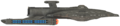 Poseidon
 -
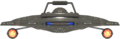
-

-
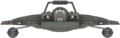
-
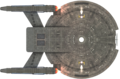
-

-
 "Tough sister"
 -

.png)
.png)
.png)
.png)
.png)


Notes
- The prefix "USS" has been changed to "UESS" for ships of the United Earth Starfleet.The NCC prefix was changed to NCH, for heavy cruisers.
- As with the Marshalls, the Poseidon class is granted a pre-planned block of NCC registry range in the new Star Fleet.
- The three war-time Poseidons are all transferred to the UFP Star Fleet, while the remaining 14 vessels' production is appropriated by the Federation.
- It's interesting that Olympia and Coto were the 2nd and 3rd vessels completed, but did not receive Federation registries sequential with that of Poseidon, despite a block of numbers reserved for the entire class.