Guide:Achernar: Difference between revisions
No edit summary |
No edit summary |
||
| Line 65: | Line 65: | ||
|history= own | |history= own | ||
}} | }} | ||
[[Image:No Photo Available.jpg|left|200px|thumb|''USS Sol'' watching over traffic at the Luna Defense Perimeter in the aftermath of the Probe visit. En route from [[Vega]] when the Probe arrived, the ''Sol'' was saved from neutralizing and reached [[Earth]] in time to re-establish order amidst the swarming refugee and aid vessels. For the first two days of the restoration operation, Star Fleet was unable to deploy any other space assets apart from small craft, and the capabilities of the Sol were stretched to their limits. The versatile cruiser proved her mettle many times over, wiping out any doubts Star Fleet might have had about a limited-application vessel of heavy cruiser size.]] | [[Image:No Photo Available.jpg|left|200px|thumb|''USS Sol'' watching over traffic at the Luna Defense Perimeter in the aftermath of the Probe visit. En route from [[Vega]] when the Probe arrived, the ''Sol'' was saved from neutralizing and reached [[Earth]] in time to re-establish order amidst the swarming refugee and aid vessels. For the first two days of the restoration operation, [[Star Fleet]] was unable to deploy any other space assets apart from small craft, and the capabilities of the ''Sol'' were stretched to their limits. The versatile cruiser proved her mettle many times over, wiping out any doubts Star Fleet might have had about a limited-application vessel of heavy cruiser size.]] | ||
In the 2260s, as tensions with the Klingon Empire were reaching a breaking point, Star Fleet once again | In the [[2260s]], as tensions with the Klingon Empire were reaching a breaking point, [[Star Fleet]] once again | ||
considered equipping its allies with relatively modern ships and weaponry. To ease the strain on the | considered equipping its allies with relatively modern ships and weaponry. To ease the strain on the | ||
primary frontiers of the cold war, capital ships of decisive strength would have to begin patrols on the | primary frontiers of the cold war, capital ships of decisive strength would have to begin patrols on the | ||
| Line 77: | Line 77: | ||
Several destroyers and some frigates could easily be lend-leased to the allies, but no large cruisers in | Several destroyers and some frigates could easily be lend-leased to the allies, but no large cruisers in | ||
the proper performance niche were available: the old Baton Rouge variants were too decrepit for this | the proper performance niche were available: the old ''[[Guide: Baton Rouge|Baton Rouge]]'' variants were too decrepit for this | ||
use, the Constitution variants too advanced and too employed, and the remaining Horizon-era vessels | use, the ''[[Guide: Constitution |Constitution]]'' variants too advanced and too employed, and the remaining ''[[Guide: Horizon|Horizon]]''-era vessels | ||
of course little more than gutted hulls. A customized design was clearly needed, and Star Fleet teetered | of course little more than gutted hulls. A customized design was clearly needed, and Star Fleet teetered | ||
between three principal choices: reopening the Amchitka production lines (and presumably also | between three principal choices: reopening the ''[[Guide: Amchitka|Amchitka]]'' production lines (and presumably also | ||
somehow upgunning the obsolete design), devising a downgraded Surya variant (even though the | somehow upgunning the obsolete design), devising a downgraded ''[[Guide:Surya|Surya]]'' variant (even though the | ||
suitable dockyards were still tied up with Star Fleet’s own acquisition and maintenance programs), or | suitable dockyards were still tied up with Star Fleet’s own acquisition and maintenance programs), or | ||
using the Constitution structure as the starting point for a significantly simplified and exportable | using the ''Constitution'' structure as the starting point for a significantly simplified and exportable | ||
starship. The latter came to be the preferred export model, when Star Fleet realized that it already | starship. The latter came to be the preferred export model, when Star Fleet realized that it already | ||
possessed the know-how and detailed plans of building a low performance, Constitution-configuration | possessed the know-how and detailed plans of building a low performance, ''Constitution''-configuration | ||
starship out of existing hull components – not to mention several leftover Horizon secondary hulls and | starship out of existing hull components – not to mention several leftover ''Horizon'' secondary hulls and | ||
an idled production line for destroyer saucers. Ships resembling the initial Constitution prototypes | an idled production line for destroyer saucers. Ships resembling the initial ''Constitution'' prototypes | ||
could now be easily manufactured: the old problems of warp performance fine-tuning could be ignored | could now be easily manufactured: the old problems of warp performance fine-tuning could be ignored | ||
and a brute force approach taken instead. | and a brute force approach taken instead. | ||
| Line 94: | Line 94: | ||
engine. Although originally intended for frigates, the modern engine had a malleable field and an | engine. Although originally intended for frigates, the modern engine had a malleable field and an | ||
inherent robustness for greater power levels, and thus gave adequate performance on the export | inherent robustness for greater power levels, and thus gave adequate performance on the export | ||
cruisers as well. The PB-47 mod 3 units, in concert with the slightly underpowered Saladin-type SBE | cruisers as well. The PB-47 mod 3 units, in concert with the slightly underpowered ''[[Guide: Saladin|Saladin]]''-type SBE | ||
impulse engines and a battery of six RIN-6 phaser VII emitters and two Racal ‘Awalt’ Mk 3 torpedo | impulse engines and a battery of six RIN-6 phaser VII emitters and two Racal ‘Awalt’ Mk 3 torpedo | ||
tubes, allowed the ships to fight effectively from warp as well as from sublight speeds. Increased | tubes, allowed the ships to fight effectively from warp as well as from sublight speeds. Increased | ||
magazine capacity and modern loaders brought the torpedo firepower of these vessels to a respectable | magazine capacity and modern loaders brought the torpedo firepower of these vessels to a respectable | ||
cruiser level, despite the low number of tubes. Amidship phasers were also eventually applied on all | cruiser level, despite the low number of tubes. Amidship phasers were also eventually applied on all | ||
Star Fleet Achernars. In turn, laboratories were virtually omitted from the design, and the space was | Star Fleet '''''Achernars'''''. In turn, laboratories were virtually omitted from the design, and the space was | ||
used for enlarged ship’s stores, versatile auxiliary command facilities and a secondary sickbay. | used for enlarged ship’s stores, versatile auxiliary command facilities and a secondary sickbay. | ||
Auxiliary craft capacity was also significantly greater than in other Constitution derivatives, as the | Auxiliary craft capacity was also significantly greater than in other ''Constitution'' derivatives, as the | ||
engineering arrangements left additional | engineering arrangements left additional usable volume in the secondary hull. In essence, the ships | ||
could double as auxiliary carriers for local defense or assault needs. | could double as auxiliary carriers for local defense or assault needs. | ||
In peacetime, the specialized facilities of the ships were put to different use. The Achernars were | In peacetime, the specialized facilities of the ships were put to different use. The ''Achernars'' were | ||
efficient machines for colonial support duties, thanks to their enlarged cargo holds. They could also | efficient machines for colonial support duties, thanks to their enlarged cargo holds. They could also | ||
carry and deploy large numbers of standard and special-environment craft for planetary exploration | carry and deploy large numbers of standard and special-environment craft for planetary exploration | ||
| Line 116: | Line 116: | ||
Original plans were scaled for a remarkable maximum of 68 vessels, but such a great number of | Original plans were scaled for a remarkable maximum of 68 vessels, but such a great number of | ||
buyers never materialized. Noncommittal astronomical names were initially selected for the 13 ships | buyers never materialized. Noncommittal astronomical names were initially selected for the 13 ships | ||
completed out of remaining Horizon and Archon spaceframes, even though the buyers usually | completed out of remaining ''Horizon'' and ''[[Guide: Archon|Archon]]'' spaceframes, even though the buyers usually | ||
renamed the vessels at delivery. USS Achernar spearheaded the early production batch intended for | renamed the vessels at delivery. ''USS Achernar'' spearheaded the early production batch intended for | ||
export customers, ranging from the trusted Andesian Guardianship of the ‘southeast passage’ (2 units) | export customers, ranging from the trusted Andesian Guardianship of the ‘southeast passage’ (2 units) | ||
to the distant Xindi Control in deep Alpha (4 units). As a deal for selling three ships to the Ktarians | to the distant Xindi Control in deep Alpha (4 units). As a deal for selling three ships to the Ktarians | ||
fell through, causing feelings of embitterment on both sides, USS Astrad, USS Alfr and USS Xanthii | fell through, causing feelings of embitterment on both sides, ''USS Astrad'', ''USS Alfr'' and ''USS Xanthii'' | ||
were adopted for use in Star Fleet proper and given improved transporter and computer systems. | were adopted for use in Star Fleet proper and given improved transporter and computer systems. | ||
Serving in the TacFleet special military response force alongside the advanced Victory subclass, the | Serving in the TacFleet special military response force alongside the advanced ''[[Guide: Victory|Victory]]'' subclass, the | ||
three ships proved elemental in defending against the Xindi incursion from a long-neglected section of | three ships proved elemental in defending against the Xindi incursion from a long-neglected section of | ||
the lower coreward Federation border in the early 2270s. | the lower coreward [[Federation]] border in the [[2270s|early 2270s]]. | ||
Several other export ships were also gradually reabsorbed into the fleet, in some cases receiving new | Several other export ships were also gradually reabsorbed into the fleet, in some cases receiving new | ||
and more nationalistic names in the process. This practice was begun in 2269, when the formerly | and more nationalistic names in the process. This practice was begun in [[2269]], when the formerly | ||
Xindi-operated XXS Naxu Thain, XXS Tezanha and XXS Sathiyaxa were reacquired and renamed | Xindi-operated ''XXS Naxu Thain'', ''XXS Tezanha'' and ''XXS Sathiyaxa'' were reacquired and renamed | ||
USS John F. Kennedy, USS Tao Feng and USS Surak, respectively. USS Achernar herself became USS | ''USS John F. Kennedy'', ''USS Tao Feng'' and ''USS Surak'', respectively. ''USS Achernar'' herself became ''USS John Muir'' | ||
John Muir after her return from the Rigel front. Somewhat ironically, USS Sol never wavered, despite | after her return from the Rigel front. Somewhat ironically, ''USS Sol'' never wavered, despite | ||
being reassigned from | being reassigned from Gamma Hydra to Lya to eventual (and fitting) Quadrant Zero defense in the colors of | ||
the 3rd Fleet. | the 3rd Fleet. | ||
While the export customers were largely satisfied with the type, UFP Council soon realized that | While the export customers were largely satisfied with the type, the UFP Council soon realized that | ||
proliferation of such technology to nations not abiding to the Prime Directive could have disastrous | proliferation of such technology to nations not abiding to the Prime Directive could have disastrous | ||
effects. Under the leadership of the newly elected President of the UFP Kenneth Wescott, the Council | effects. Under the leadership of the newly elected President of the UFP Kenneth Wescott, the Council | ||
took on a highly cautious approach towards all military aid. As the Klingon threat receded somewhat | took on a highly cautious approach towards all military aid. As the Klingon threat receded somewhat | ||
after Organia, a gradual campaign of buying back the ships was begun. By 2271, Star Fleet once again | after [[Organia]], a gradual campaign of buying back the ships was begun. By [[2271]], Star Fleet once again | ||
was in possession of eleven of the thirteen ships, and plans were made for upgrading them into | was in possession of eleven of the thirteen ships, and plans were made for upgrading them into | ||
something more useful. While this project, described later under the Constitution refit entry, proved | something more useful. While this project, described later under the ''[[Guide: Constitution refit|Constitution refit]] entry, proved | ||
something of a failure and was aborted after only four converted hulls, the Achernars did perform | something of a failure and was aborted after only four converted hulls, the ''Achernars'' did perform | ||
sterling service in a purely defensive role until the Khitomer cutbacks. None were lost in battle, and | sterling service in a purely defensive role until the Khitomer cutbacks. None were lost in battle, and | ||
the remaining two export ships were recovered intact as well. All ships were removed from service in | the remaining two export ships were recovered intact as well. All ships were removed from service in | ||
an orderly manned at the very end of their projected lifetimes; by 2295, the secondary hull of USS | an orderly manned at the very end of their projected lifetimes; by [[2295]], the secondary hull of ''USS Coromandel'' | ||
(NCC-1744, ex-''Ekkhaia'', ex-''Sirius''), formerly of the ''Southern Cross'' (NCC-1376), had | |||
enjoyed some ninety years of colorful service. | enjoyed some ninety years of colorful service. | ||
Revision as of 19:53, 13 February 2020

_(side).png)
| |
| Achernar | |
|---|---|
| Class Overview | |
| Category | heavy cruiser |
| Operational | 2260-2295 |
| Constructed | 13
|
| Dimensions | |
| Length | 289.0 m |
| Beam | 127.1 m |
| Height | 72.6 m |
| Mass | 690,000 tons |
| Performance | |
| Cruise Speed | w 6 |
| Max Speed |
|
| Endurance | 5 years |
| Complement | |
| Officers |
|
| Enlisted |
|
| Cargo | 12,000 mt |
| Tactical Systems | |
| Beam Weapons | Standard Star Fleet weapons fit
Standard export weapons fit
|
| Missile Weapons | Standard Star Fleet weapons fit
Standard export weapons fit
|
| Shields |
|
| Laboratories | Standard Star Fleet
Standard export
|
| Transporters | Standard Star Fleet 4 GP (6-pad), 3 emergency evacuation (22-pad), 1 cargo; Mk III Standard export 4 GP (6-pad), 3 emergency evacuation (22-pad), 1 cargo; Mk II Standard Star Fleet post-2274 4 GP (6-pad), 3 emergency evacuation (22-pad), 1 cargo; Mk IV |
| Auxiliary Craft |
|
| Historical | |
| Ships of Note |
|
| Canonicity | |
| Design | TMP, ST3, Franz Joseph |
| Name | , ST6 |
| History | own
|

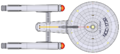
In the 2260s, as tensions with the Klingon Empire were reaching a breaking point, Star Fleet once again considered equipping its allies with relatively modern ships and weaponry. To ease the strain on the primary frontiers of the cold war, capital ships of decisive strength would have to begin patrols on the flanks of disputed space, in areas where Star Fleet bases were few and where local players like the Andesians or the Elasi had a strong foothold. While several such allies had proven unreliable during the last round of weapons exports, a brief round of negotiations and inspection tours by Federation Council Special Committees was enough to guarantee the delivery of warships to six non-member political entities.
Several destroyers and some frigates could easily be lend-leased to the allies, but no large cruisers in the proper performance niche were available: the old Baton Rouge variants were too decrepit for this use, the Constitution variants too advanced and too employed, and the remaining Horizon-era vessels of course little more than gutted hulls. A customized design was clearly needed, and Star Fleet teetered between three principal choices: reopening the Amchitka production lines (and presumably also somehow upgunning the obsolete design), devising a downgraded Surya variant (even though the suitable dockyards were still tied up with Star Fleet’s own acquisition and maintenance programs), or using the Constitution structure as the starting point for a significantly simplified and exportable starship. The latter came to be the preferred export model, when Star Fleet realized that it already possessed the know-how and detailed plans of building a low performance, Constitution-configuration starship out of existing hull components – not to mention several leftover Horizon secondary hulls and an idled production line for destroyer saucers. Ships resembling the initial Constitution prototypes could now be easily manufactured: the old problems of warp performance fine-tuning could be ignored and a brute force approach taken instead.
What transformed these cut-and-paste starships into practical fighting machines was the PB-47 warp engine. Although originally intended for frigates, the modern engine had a malleable field and an inherent robustness for greater power levels, and thus gave adequate performance on the export cruisers as well. The PB-47 mod 3 units, in concert with the slightly underpowered Saladin-type SBE impulse engines and a battery of six RIN-6 phaser VII emitters and two Racal ‘Awalt’ Mk 3 torpedo tubes, allowed the ships to fight effectively from warp as well as from sublight speeds. Increased magazine capacity and modern loaders brought the torpedo firepower of these vessels to a respectable cruiser level, despite the low number of tubes. Amidship phasers were also eventually applied on all Star Fleet Achernars. In turn, laboratories were virtually omitted from the design, and the space was used for enlarged ship’s stores, versatile auxiliary command facilities and a secondary sickbay. Auxiliary craft capacity was also significantly greater than in other Constitution derivatives, as the engineering arrangements left additional usable volume in the secondary hull. In essence, the ships could double as auxiliary carriers for local defense or assault needs.
In peacetime, the specialized facilities of the ships were put to different use. The Achernars were efficient machines for colonial support duties, thanks to their enlarged cargo holds. They could also carry and deploy large numbers of standard and special-environment craft for planetary exploration purposes, compensating for their shortcomings in other exploration modes like independent sensory analysis. The modern PB-47 warp engines proved an economical choice for colonial supply runs or local patrol circuits. Optimized for intense maneuvering, their acceleration curves were commendable, even though they offered endurance and top speed somewhat inferior to the PB-32 system when mounted on heavy cruisers.
Original plans were scaled for a remarkable maximum of 68 vessels, but such a great number of buyers never materialized. Noncommittal astronomical names were initially selected for the 13 ships completed out of remaining Horizon and Archon spaceframes, even though the buyers usually renamed the vessels at delivery. USS Achernar spearheaded the early production batch intended for export customers, ranging from the trusted Andesian Guardianship of the ‘southeast passage’ (2 units) to the distant Xindi Control in deep Alpha (4 units). As a deal for selling three ships to the Ktarians fell through, causing feelings of embitterment on both sides, USS Astrad, USS Alfr and USS Xanthii were adopted for use in Star Fleet proper and given improved transporter and computer systems. Serving in the TacFleet special military response force alongside the advanced Victory subclass, the three ships proved elemental in defending against the Xindi incursion from a long-neglected section of the lower coreward Federation border in the early 2270s.
Several other export ships were also gradually reabsorbed into the fleet, in some cases receiving new and more nationalistic names in the process. This practice was begun in 2269, when the formerly Xindi-operated XXS Naxu Thain, XXS Tezanha and XXS Sathiyaxa were reacquired and renamed USS John F. Kennedy, USS Tao Feng and USS Surak, respectively. USS Achernar herself became USS John Muir after her return from the Rigel front. Somewhat ironically, USS Sol never wavered, despite being reassigned from Gamma Hydra to Lya to eventual (and fitting) Quadrant Zero defense in the colors of the 3rd Fleet.
While the export customers were largely satisfied with the type, the UFP Council soon realized that proliferation of such technology to nations not abiding to the Prime Directive could have disastrous effects. Under the leadership of the newly elected President of the UFP Kenneth Wescott, the Council took on a highly cautious approach towards all military aid. As the Klingon threat receded somewhat after Organia, a gradual campaign of buying back the ships was begun. By 2271, Star Fleet once again was in possession of eleven of the thirteen ships, and plans were made for upgrading them into something more useful. While this project, described later under the Constitution refit entry, proved something of a failure and was aborted after only four converted hulls, the Achernars did perform sterling service in a purely defensive role until the Khitomer cutbacks. None were lost in battle, and the remaining two export ships were recovered intact as well. All ships were removed from service in an orderly manned at the very end of their projected lifetimes; by 2295, the secondary hull of USS Coromandel (NCC-1744, ex-Ekkhaia, ex-Sirius), formerly of the Southern Cross (NCC-1376), had enjoyed some ninety years of colorful service.
Gallery
-
 Achernar (2265)
 -

-
_(bow).png)
_(dorsal).png)
Notes
- USS Sol (NCC-1744) was the last Achernar and scrapped shortly after the last Coventry.