Guide:Amchitka/Kearsarge

| |
| Amchitka / Kearsarge | |
|---|---|
| Class Overview | |
| Category | light cruiser |
| Operational | |
| Constructed | 51 total:
|
| Dimensions | |
| Length |
|
| Beam | 122.0 m |
| Height |
|
| Mass |
|
| Performance | |
| Cruise Speed |
|
| Max Speed |
|
| Endurance | 3 years |
| Complement | |
| Officers |
|
| Enlisted |
|
| Tactical Systems | |
| Beam Weapons | Amchitka standard weapons fit 2230-51:
Amchitka standard weapons fit 2251-69:
Wotan:
Kearsarge standard weapons fit 2231-52:
Kearsarge standard weapons fit 2252-87
|
| Missile Weapons | Amchitka standard weapons fit 2230-51:
Amchitka standard weapons fit 2251-69:
Wotan:
Kearsarge standard weapons fit 2231-52:
Kearsarge standard weapons fit 2252-87
|
| Other Weapons | Amchitka standard weapons fit 2230-51:
|
| Shields |
|
| Laboratories |
|
| Transporters | Amchitka
Kearsarge, NCC-1312, -1314
Amchitka refit 2251, Wotan
Kearsarge refit 2252
|
| Auxiliary Craft | Amchitka
Kearsarge
Wotan
|
| Historical | |
| Ships of Note |
|
| Canonicity | |
| Design | SFB |
| Name | Amchitka SFProt/SotSF, Kearsarge SFB, Wotan GEC and own |
| History | SFB, own
|
In February 2229, a crisis meeting was held at Star Fleet R&D’s Tokyo headquarters. Participating
were admirals from SF Operations, top-clearance researchers from various departments, and
representatives of the Chiokis Corporation. The latter had unpleasant news to deliver: due to
problems encountered in structural integration of modern engines to Horizon class spaceframes,
work on Project Starship would be delayed by at least five more years, moving the projected
delivery date to 2239 or later. The frustrated Star Fleet could do nothing to hasten the process. It was
entirely dependent on the ability of Chiokis to deliver the spaceframe for the first Starship, since no
other corporation possessed the technological expertise, nor could outside elements be brought into
the highly classified project at this late date. While Chiokis could promise to deliver the first
manned full-scale testbed for the starship drive system by 2230, this machine would be no closer to
actual operational fighting vessel status than the heretofore built unmanned and subscale prototypes
had been.
Yet Star Fleet desperately needed new rapid-response cruisers. It had counted on getting the first Starships by 2225 at the very latest, and thus gaining a platform capable of simultaneous heavy laser, phased particle cannon and warp torpedo operations. What it really had in the beginning of the thirties were torpedo- and laser-equipped Saladin and Detroyat destroyers plus the first few Icarus cruisers; laser- and particle cannon -toting Baton Rouge heavy cruisers; and a host of older designs severely lacking in speed and firepower. While mixed fleets of these vessels could successfully combat Klingon forces, no single ship yet possessed the trident of weapons vital to success. Thus, when calculating the number of vessels available for defending UFP planets, the admirals had to divide the true numbers by two or three. Since Star Fleet already possessed far fewer ships than the Klingon Empire, this state of affairs was simply unacceptable.
Two short term solutions existed: refit the Baton Rouges with multi-tube, forced-intermix warp torpedo armament, or field a new cruiser class. Naturally, Star Fleet would have preferred not having to choose at all. But relentless Klingon pressure on the borders was threatening Federation integrity and throttling down its industrial expansion. The unity of the Romulan War era was eroding fast, and some in Star Fleet even expressed irrational anger at Andor for the failure of Chiokis to deliver on all its promises. Adding to the troubles, a superior type of total conversion powerplant utilizing dilithium focusing finally emerged in the 2230s – but instead of being the salvation of Star Fleet, it rather perversely slowed down the efforts to upgrade the Baton Rouge or complete Project Starship, as the new powerplant absolutely had to be included in the design of these future combatants. A stopgap for a stopgap would have to be fielded to buy time for the inclusion, without the dilithium reactor but with a maximal number of other Project Starship innovations. Thus was born the final in a series of light cruisers that nobody really wanted but everybody desperately needed, an ugly outgrowth of the Ranger modernization family tree.
Chiokis’ providing of six initial cruisers at greatly reduced cost and licensing out the production of a further six to Salazaar Fleet Builders was considered a sufficient penance by Star Fleet. Perhaps better classified as heavy destroyers than light cruisers, these vessels still filled the cruiser boots better than the Texas refits did. They featured a variant of the Ranger refit or Jidai saucers, built to increased thickness (12 m, 4 full diameter decks) and diameter (122 m) by mounting the upper and lower main structural frames farther apart on redesigned outer stringers. The ventral bulge still had the telltale conical shape, setting the design well apart from the flat Geering hulls of the old heavy cruiser and frigate series. Mated to the aft rim was a slightly protruding engineering facility, and on canted pylons above it, two 90,000 ton nacelles of PB-35 type. These engines, whilst successful in transport applications and in the recent modernization of the Texas class, could at best be considered scale models of true cruiser engines. If not for continuing production bottlenecks, Chiokis would have preferred to install a single PB-30 series nacelle instead, and never mind the reduced throughput for lack of dilithium power. Still, the company’s experience in coercing extra performance out of the smaller engine type for high speed special transports proved invaluable in making the light cruiser perform as desired with minimal R&D expenses and effort.
While the vessels seemingly shared many features with the delayed Project Starship, they were in fact much simpler machines. The total conversion powerplant was sufficient for giving the ships a maximum warp speed superior to that of the most modern destroyers, but the fire control sensors were directly lifted from the Saladins, and the navigational deflector and sensor array was little modified from the Baton Rouge one (although outriggered on a slimmer Saladin-style ventral mast). Nothing fancy was attempted regarding cruise performance or maneuverability. What sufficed was getting either one ‘Adasak’ 1.2 TW phase cannon or mine rack, one ‘Vas-Alan’ twin-tube torpedo launcher, plus a full battery of heavy warp-accelerated lasers to the battlefield at speeds comparable to those of the destroyer fleet. Mounting the torpedo launcher on Deck 3 of the saucer, and the particle beam weapon on Deck 9, left enough space for 80 torpedo reloads, a crew of 203, and one ultramodern Mk II warp-to-warp transporter platform. The Salazaar variant omitted the phase cannon and instead mounted the ‘Kshat’ minelaying system.

The NCCs of the ships built to the Amchitka specs fell after the light cruisers of Jidai class, beginning with NCC-1310. After delivery of the fourth Salazaar Amchitka (USS Shumagin, NCC-1319), Star Fleet reneged on further procurement, ostensibly to give Chiokis time to finish the first Starships. Andorian displeasure was made public – yet was nothing compared to the outrage when in 2230 it was revealed that Star Fleet would order no less that forty ships of Amchitka type from Terran and Martian yards.
It was to great interstellar relief that Star Fleet Division in early 2231 responded that it lacked the capacity to produce all the light cruisers contracted for. In a largely symbolic gesture, Salazaar obtained two keels of an eventual 40, and cooler sentiments prevailed. Economically far more significant to the company was the largely indigenous Loknar frigate program, utilizing Project Starship technologies and essentially outdating the controversial light cruisers before a single one had been launched – albeit with the same risks of possibly being stillborn as Project Starship carried. It was now Star Fleet Division’s turn to act out of spite, proceeding with its Amchitka-based program against better strategic-logistic judgement. In any case, USS Kearsarge (NCC-1500, one of the last registry ‘centuries’ to be initiated) was able to sail off SFD’s Titan yards in April 2231 unhindered by mass protests of the kind that Andorian workers had previously staged.
The distinguishing features of the Kearsarge class were a conformal navigational deflector system, a quadruple array of torpedo tubes and a pair of PB-45 nacelles. While the former two represented only minor improvements over Amchitka standard, the engine swap gave the Kearsarges a cruise speed of warp 5 and a practical redline at warp 8.5, worlds above Amchitka performance. More importantly, the figures tallied with those projected for the Loknar class, giving SFD reason for smugness: a ship of roughly equal hull mass (some 140,000 tons vs. the 110,000 – 145,000 tons of Loknars) was moving just as swiftly with far more compact engines (150,000 tons per nacelle vs. the 250,000 tons of full PB-31 units). This of course ignored things such as fuel economy or range, but SFD had a point in saying that those were actually superfluous in the defensive mission profile chosen by the Andorians. The missions of the Kearsarges in turn consisted of classic ‘secondary fleet action’, raiding and convoy escort all across the Star Fleet theater of operations. In comparison, the ten Amchitkas suffered from propulsive limitations, and were relegated to destroyer leader roles, providing cruiser-type sensor and computing capabilities to flotillas of low-performing destroyer types.
Yet after 2246, it seemed that the Andorians would get the last laugh. In the post-Axanar fleet, a very narrow niche existed for the light cruisers. Star Fleet had decided to designate the Surya and Miranda classes of starships ‘heavy frigates’ instead of light cruisers, and was utilizing them in deep space operations neither the Amchitkas nor the Kearsarges were capable of – not with their small auxiliary craft contingents and humble research facilities. All that was left were second-line scouting and commerce protection tasks in relatively secure regions of space, training duty, and assistance to destroyer operations. In all these roles, greater affordability was being offered by the modernized Texas units, of which there seemed to be an endless supply. Understandably, Star Fleet did not want to waste effort in upgrading the Kearsarges; as for Amchitka, Chiokis mostly wanted to forget that it had ever been forced to design such a ship class.
To retain at least some modicum of operational worth, the light cruisers still had to receive weapon system upgrades. The most important of them had been the fitting of retractable modern Agusta twin phaser VII turrets in place of the multi-megawatt lasers beginning in 2251. The older phase cannon mounts in turn were fitted with single light Type V phasers for CIWS work; these compact new weapons made good use of the infrastructure available at the former heavy mounts, and could essentially be dropped in place and left to run on automatic. Crew requirements dropped from 303 to 290 due to computer upgrades introducing duotronic technology. Transporters were brought to Mk III standard; a few ships ultimately received an advanced system with two platforms sharing a single pattern buffer. A decision was still made to retain the minimal shuttlebays, to compensate for some of the shortcomings of the transporters. All the new gear was rapidly using up the space reserved for upgrades, and further refits were deemed highly unlikely.
The late sixties brought about a new threat scenario: large interstellar ‘berserker machines’ had been witnessed in action for the first time. In addition, exploration vessels had reported on encounters with malevolent and extremely resilient spaceborne lifeforms against which standard cruiser armament was impotent. Star Fleet briefly toyed with introducing superheavy antimatter warheads to defeat these potential new opponents, and plans were made to turn the eight Amchitkas into special ‘defensive monitors’ by installing this superweapon aboard. A half-finished spaceframe from Salazaar’s abortive production run was converted into a proof-of-concept testbed, USS Wotan (NX-1390). After proving quite the opposite, the testbed was relegated to destructive structural testing. However, the brief resurrection of the program had given Salazaar hope of new orders.
Such hopes were in obvious conflict with the recent Organian peace treaty. The Fleet did not need new warships, so said the Committee for Star Fleet. Could the Amchitkas be given exploration prowess? As Salazaar was discovering that the answer was negative, a new factor emerged. Within three months, sixteen pirate attacks were connected to Orion activity all along the crucial Beta Rigel shipping lane, and several dozen more were suspected of having been committed by Orions. This was a major ramp-up in pirate activity, and certainly cause for concern. Considering the past history of Orion-Klingon relations, it was not inconceivable that this was a continuation of Klingon aggressions by proxy. Star Fleet’s frigate forces were deployed on the shipping protection mission in full, and so were the heavy frigates and light cruisers. By the next three months, the logistics problems had become intolerable, yet pirate raids still continued.
.png)
Here, finally, was an opening for Salazaar. Design work on correcting the biggest shortcoming of the Amchitka class, the propulsion system, had already been finished: the modern PB-47 engine and the RMR-510 dilithium powerplant were adaptable to the light cruiser. Salazaar gambled, and declared its readiness to field three upgraded light cruisers by the end of the following year, with full series production to follow. Yet the Committee for Star Fleet was hesitant to commit. A competing PB-47 light cruiser design had recently been submitted, and would offer significantly greater performance than any refit of the preexisting vessels. The only thing standing on the way of this new class were the old light cruiser hulls, and the Organian Peace Treaty clause limiting the total number of hulls in this category. The orders Salazaar eventually received were not for conversion work, but for dismantling.
Vocal protests erupted overnight, and not just on Andoria. Why was SFB once again sold short? Why had there been no open bidding process for the new light cruiser program? Internal reports by Star Fleet, revealing the revolutionary PB-51 linear engine as the true propulsion system for the new design and justifying the secrecy, could not be made public. Other kinds of ‘spin control’ had to be utilized to save the Kearsarges and the Andorian faces. A bookkeeping sleight-of-hand allowed half of the ships to be placed in ‘reserves’ in late 2268, thereby circumventing Organian limitations; in practice, the ships were merely idled in a manner similar to the dreadnoughts and HQ ships, and still formed a very real deterrent against their similarly ‘camouflaged’ Klingon counterparts. Salazaar in turn was promised a role in a number of refit programs that would bend, stretch and mangle the Organian treaty in other ways to Star Fleet advantage.
The ‘active’ Kearsarges saw sterling service in the Xindi Incursion, but were defeated by more subtle and sinister forces immediately thereafter: the waves of modern heavy frigates that emerged in the late seventies so outperformed the Kearsarge class that its retirement became a political necessity. By the 2280s, all the old light cruisers, from Amchitka to Kearsarge to the Texas refits, had disappeared – either being disarmed and donated forward, sold for scrap, or converted to support vessels of various sorts. The light cruiser force had shrunk by more than 60 % in a matter of a decade.
The fight for the future of the Kearsarge class had meant a decreased commitment to the original Amchitkas. Eight of the ships had near-miraculously survived the great pirate hunt and were being kept on ‘active standby’ – another bureaucratic limbo that in practice meant idling on core world piers with minimal supervision crews. In 2285, when the Genesis crisis brought Federation-Klingon relations to a breaking point, the decision was made to refit the vessels for escort duty. This refit, far greater in scope than the projected Kearsarge modification, was aimed at producing a vessel capable of fighting against modern Klingon warships, and perhaps enabling Star Fleet to convert the mothballed Kearsarges to this standard as well. The limited success met with the project is described later in an entry of its own.
Notes
- For purposes of clarity, the following timeline of the Amchitkas & Kearsarges is provided:
- 2229: The decision is made to field a new light cruiser as a stopgap for Project Starship. Chiokis Corporation and Salazaar Fleet Builders (SFB) are each directed to provide six Amchitkas.
- 2230: After SFB completes the USS Shumagin, NCC-1319, Star Fleet orders the yard to cease further completion of the pre-Wotan and one other. Wotan is mothballed. The Kearsarge sub-class is revealed, with 40 orders being given to Star Fleet Division (SFD) yards at Earth and Mars.
- 2231: After protests on Andor, SFD announces it cannot complete the full 40 Kearsarges at Earth & Mars; some contracts are provided to the SFD yards at Titan, two to SFB.
- 2251: The Amchitkas receive a weapons upgrade.
- 2252: The Kearsarges receive a weapons upgrade.
- 2265: Wotan is converted into a technology test bed vessel.
- 2267: When the Amchitkas are ordered to be dismantled, protests on Andor and elsewhere break out.
- 2268: Star Fleet reverses it's order: half of the Kearsarges are to be put into modified reserve status, as are all the Amchitkas.
- 2269: The selected vessels begin their reserve status.
- 2285: The Amchitkas are selected for escort duties.
- 2287: The Kearsarges are (apparently) all placed into mothball or similar reserve state (per refit article).
Gallery
-
 Kearsarge sub-class
 -

-

-
 Amchitka (line drawing)
 -
 Kearsarge (dorsal bow)
 -
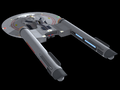 Kearsarge (dorsal stern)
 -
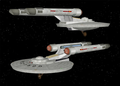 2-view
.png)
.png)
.png)


.png)
.png)