Guide:Texas refit: Difference between revisions
re-created |
|||
| Line 1: | Line 1: | ||
{{Sidebar Guide ship | |||
|image=[[File:Texas (orig).png|250px|''Texas'' class light cruiser]] | |||
|classname= ''Texas'' | |||
|category= light cruiser | |||
|years= [[2175]]-[[2259]] | |||
|constructed= 50 | |||
|length= 189.9 m | |||
|beam= 85.3 m | |||
|height= 50.1 m | |||
|mass= 212,000 tons | |||
|cruisespeed= w 3 | |||
|maxspeed= w 4.1 | |||
|endurance= 3 years | |||
|officers= 21 | |||
|enlisted= <br> | |||
* 85 (standard exploration configuration) | |||
* 140 (combat configuration) | |||
|troops= | |||
|passengers= | |||
|patients= | |||
|crew= | |||
|cargo= | |||
|beamweapons= <br> | |||
* 2x laser emitters (1.0 GW) (port/stbd primary hull) | |||
* 2x laser emitters (800 MW) (fwd primary hull) | |||
* 2x laser emitters (800 MW) (aft secondary hull) | |||
|missileweapons= <br> | |||
* 2x fwd torpedo tubes (w/ 70 fusion or photonic torpedoes) (ventral primary hull) | |||
|otherweapons= | |||
|shields=<br> | |||
* 4-layer graviton/subspace globular shield | |||
* Navigational deflectors (port/stbd primary hull) | |||
* Polarizable armor (primary and secondary hulls) | |||
|labs= <br> | |||
* 2x GP | |||
|transporters= <br> | |||
* 1x GP (6-pad); Mk I | |||
* 1x emergency evacuation (22-pad); Mk I | |||
* 2x cargo units; Mk I | |||
|auxcraft=<br> | |||
* 4 light shuttles | |||
|historicalships= <br> | |||
* ''USS Altay'' (NCC-911)<ref name=HorizonAdvance>[[Guide:Horizon/Advance]]</ref> | |||
* ''USS Gobi'' (NCC-909) | |||
* ''USS Harar'' (NCC-941) | |||
* ''USS Labrador'' (NCC-916) | |||
* ''USS Oklahoma'' (NCC-945) | |||
* ''USS Sinai'' (NCC-912) | |||
* ''USS Sonora'' (NCC-907) | |||
* ''USS Takla Makan'' (NCC-904) | |||
* ''USS Taimyr'' (NCC-920) | |||
|design= SFB/Steve Cole & Richard Kerr (dimensions altered) | |||
|name= SFB | |||
|history= SFB | |||
}} | |||
Block obsolescence hit the young UFP [[Starfleet]] hard in the [[2170s]]. Losing the military scoutships | |||
was bad enough for Exploration Command, but at least the drafting of numerous auxiliary cruisers | |||
provided an affordable partial remedy. Defense Command was far worse off when the ''[[Guide: Marshall|Marshall]]'' | |||
heavy destroyers and ''[[Guide: Christopher|Christopher]]'' light cruisers were retired from defending the borders and | |||
heartlands of the [[Federation]]. The intended successor, the ''[[Guide: Active|Active]]'' heavy destroyer, was cancelled at | |||
the last minute, ostensibly because her performance specifications did not meet Starfleet | |||
expectations. In face of continuing Romulan silence and seemingly unshakeable peace, it was | |||
difficult to gain support for the design, let alone the construction, of a new heavy combatant. When | |||
permission for a successor class was finally given in January [[2172]], frantic engineering efforts were | |||
needed to create the required designs and construction methods, lest the gap between generations | |||
grow intolerably wide. | |||
[[Image:No Photo Available.jpg|left|200px|thumb|The ''Gobi'' (NCC-909) sails out with auxiliary survey cruisers ''Minotaur'' (NAR-24) and ''Alesia'' (NAR-23), support cruiser | |||
''Cryghton'' (NCC-122) and the elderly scout ''T’Khian'' (NCC-75). Explorer flotillas of this sort proved an impractical tool in expanding the Federation horizons, yet at least facilitated a better understanding and control of what lay inside UFP territory. Modern Starfleet pennants have been applied on all vessels for this [[2179]] sortie towards the Taurus nebula.]] | |||
By late [[2173]], though, all the elements were ready. The design chosen for the prosaically named | |||
New Light Cruiser was not so ambitious as to call for extensive prototyping, and a go-ahead was | |||
given for four precursor hulls. Production of at least ten further vessels was also all but guaranteed | |||
from the outset. Starfleet’s ultimate aim was to procure fifty cruisers, enough to replace both the | |||
''Marshalls'' and ''Christophers'' at one stroke. | |||
The first light cruiser to reach completion was in May [[2175]] launched as ''USS Texas'' (NCC-900). Her | |||
lines clearly revealed her lineage. The two-part structure of the vessel featured a detachable, | |||
aerodynamic command hull and a slightly larger engineering section, the latter mounting two PB-7 | |||
warp engines of 70,000 ton mass each. The lifting body structure of the command hull was closer to | |||
''Christopher'' than ''Marshall'' in design, but served the same threefold role of primary weapon and | |||
sensor mount, command center and crew evacuation module. The smooth exterior was armored | |||
overall, with a dorsal sensor dome jutting out above the main bridge, and a dish array placed on a | |||
corresponding ventral location. The bow corners held 800 MW laser emitters; 1 GW units were | |||
mounted laterally, outboard of the twin navigational deflector assemblies, giving full spherical | |||
coverage. Two forward-firing torpedo tubes were located ventrally. Both the primary and secondary | |||
hulls also featured ventral tractor beam emitters. | |||
Internally, there was enough room for two autonomous laboratory units on Deck 3, both of which | |||
enjoyed direct physical access to the centrally located main computer core. Forward of the lab area | |||
were the ship’s secondary batteries; aft of it, the separation engines. Forward of the starboard lab | |||
were sensor and probe control rooms, also part of the ship’s rather extensive scientific suite. | |||
Forward of the port lab was the transporter complex. Life support systems and officer | |||
accommodation were the primary functions on Deck 2; a high ratio of officers to crew was now | |||
standard for ships engaged in exploration duty, and twenty-one personnel of Ensign grade or above | |||
were required aboard a ''Texas''. Some thirteen of these still engaged in traditional officer work of | |||
managing ship’s operations and tactical operations, and had their workstations clustered in the upper | |||
part of the ship. Main fire control was located just forward of the main computer shaft, main | |||
navigation room aft of it. The main bridge and its sensor dome formed Deck 1 atop the shaft. | |||
In classic manner, lower decks were tended by the ratings, although extensive automation and | |||
peacetime doctrinal and budgetary choices reduced crew size to a fraction of the ''Christopher'' | |||
figures. The wide Deck 4 was the main crew accommodation deck, with spacious standard berthing | |||
for 85, combat berthing for up to 170, plus storage for consumables. Sickbay, galley and gymnasium | |||
were naturally also to be found here. The bow was completely dedicated to forward laser emitters | |||
and their support systems, however. Decks five and six were again of limited beam and housed the | |||
torpedo launchers and their magazines, as well as shield generators and hull polarizer rotors. | |||
The secondary hull housed an auxiliary control room in addition to being home to main and | |||
auxiliary power systems, fuel tanks, and cargo transporters and holds. At the center of the hull was a | |||
docking bay and service hangar for four light shuttlecraft, again indicating the exceptional | |||
exploration prowess of the design. Access was via ventral hatches, and docking was still facilitated | |||
by mechanical arms; it would be quite a while until precision tractor beams would take over the | |||
approach control role. | |||
[[Image:No Photo Available.jpg|left|200px|thumb|Showing how low a cruiser can get, ''USS Harar'' (NCC-941) settles down on the surface of Locus Point, [[Paraagan II]]. Next | |||
to the ore transports of the old mining station, the cruiser is a minuscule thing, but soft-landing her safely still takes some | |||
skill and effort. The system defense missions of the ''Texas'' class at the turn of the century often involved landings and | |||
seldom demanded warp drive, explaining why the nacelles of the ''Harar'' have been removed. Re-installation was a simple | |||
enough matter, however, and the simplicity greatly facilitated the later refits that would restore the pride and prestige of | |||
the class.]] | |||
The traditional placement of the hangar allowed the impulse engines to be placed directly astern. | |||
Two reactor clusters were used, but their exhaust nozzles formed a single linear array. Between the | |||
impulse reactors sat the main Fairey powerplant, feeding the PB-7s. The conservative compression | |||
fusion powerplant of 10:1 m/am spicing did not quite give the design an ''[[Guide: Enterprise|Enterprise]]''-like | |||
performance. Warp 3 cruising was easily attained, yet top speed was in practice limited to little over | |||
warp 4.1, a significant step down from ''Christopher'' standards. Yet the opponents of the day were the | |||
sheer distances to be covered in exploration and patrol work, rather than hostile fleets to be flanked, | |||
so cruise mattered more than dash. | |||
Test cruises by the four initial vessels were successes both technically and operationally. They were | |||
welcome from the public relations point of view as well: the first true postwar capital ship project | |||
helped solidify support for Starfleet among the member navies. Getting funding for all the fifty units | |||
was an uphill battle, but funds freed from the cessation of all ''Christopher'' and most ''Marshall'' | |||
operations helped Starfleet attain the procurement goal by [[2182]]. In [[2175]], sequential registries from NCC-900 to NCC-949 were allocated, in anticipation of a full production run. This actually represented quite a discontinuity in the numbering | |||
scheme, as even the latest destroyer models were not supposed to go past NCC-400. However, | |||
Starfleet hoped to adopt a new numbering scheme wherein mission classes would be discernible | |||
from registries, and thus the '''''Texas''''' ships got ‘light cruiser numbers’ in the 900-999 range while the | |||
heavy cruisers began with NCC-1000. Registries between 700 and 799 were to be left for projected | |||
survey and research units, 800-899 for military scouting and intelligence gathering, 400-699 for | |||
additional destroyer programs, and all higher four-digit numbers for future growth. This attempt at | |||
making the registries more informative was doomed to fail due to unpredictably changing | |||
procurement policies, such as the sudden surge of light cruisers at the turn of the century, or the | |||
abandoning of battleship ambitions. But there was no real reason to maintain the practice of | |||
allocating running numbers, either, since exceptions and cancellations were inevitably mixing up | |||
this type of ordering as well. | |||
Military engagements in the last quarter of the [[22nd century]] were rare. The ''Texas'' cruisers were | |||
allowed to embark on exploratory cruises, typically as part of a task force consisting of two | |||
auxiliary cruisers, a logistics support vessel and sometimes a scoutship in addition to the light | |||
cruiser. No ''Texas'' losses were suffered on these relatively short-legged if sometimes years-long | |||
missions, although ''USS Gobi'' (NCC-914) had to fight bitterly in protection of her chattel in a [[2191]] | |||
engagement against trans-dimensional Tobaki raiders. | |||
Even by the turn of the century, the light cruisers were showing few signs of fatigue. Poor relative | |||
propulsive performance was the main factor in ending exploration deployments by [[2205]]. Most | |||
''Texases'' became in-system ‘guard dogs’, as Starfleet gradually prepared for the fleet-wide adoption of | |||
saucer-type hulls for its long range forces. | |||
The Klingon offensive threw all such planning into chaos. The important defensive role of the ''Texas'' | |||
vessels was acknowledged and retained, yet plans were put to motion to refurbish the ships for | |||
greater offensive performance. The [[2230s]] ''Texas'' refit and following advanced subclass construction programs are described in a separate entry later on. Meanwhile, ships that did not participate in the | |||
full refit were either withheld from action or modified for lesser rather than higher combat | |||
performance. In [[2236]]-[[2237|37]], ''USS Takla Makan'', ''USS Sonora'' and ''USS Taimyr'' had their shuttlebays | |||
replaced with large deuterium tanks and extensible fuel transfer interfaces, and were equipped for | |||
use as frontline replenishment tankers. ''USS Labrador'' received a ventrally carried subspace antenna | |||
for long range tactical scans. All these ships lost their torpedo launchers and heavy lasers in the | |||
conversion process, even though bow lasers were retained. | |||
[[File:Texas in action.png|left|200px|thumb|The ''Oklahoma'' fires a broadside in a [[2219]] skirmish with marauders intent on pillaging the settlements on [[Agnihotra]]. | |||
Postwar-standard forcefield shielding easily deflects particle beam fire against the stern quarter of the venerable light | |||
cruiser, symbolizing the stubborn perseverance of these second-rate vessels.]] | |||
The last unmodified ''Texas'' cruisers were retired ''en masse'' in [[2259]]. Upgraded and successor designs | |||
were kept in service much longer, however. The combat record of the antiquated design remained | |||
respectable in the [[23rd century]] as well, even if in second-line combat engagements and preemptive | |||
deployments. The reluctant [[2172]] investment on the light cruisers proved its worth for Federation | |||
security many times over. | |||
==Notes== | |||
* The active years of the ''Texas'' class has been extended from the 'sidebar' information (2241) in ''Timo's Guide'' to 2259, per the history indicated in the ''Guide'''s body. | |||
==Gallery== | ==Gallery== | ||
<gallery> | <gallery> | ||
| Line 17: | Line 200: | ||
File:Texas II (starboard ventral).jpg|Starboard ventral view | File:Texas II (starboard ventral).jpg|Starboard ventral view | ||
</gallery> | </gallery> | ||
---- | |||
* [[Guide: Timo's Guide to Starfleet|Back to the Table of Contents]] | |||
* [[Guide: 2200-2240 - Way of the Warrior|Back to "Way of the Warrior"]] | |||
* [[Guide: Of Ship Statistics|Appendix A: Of Ship Statistics]] | |||
* [[Guide: Glossary|Appendix B: Glossary]] | |||
* [[Guide: Starfleet Organization - General Outline|Appendix C: Starfleet Organization - General Outline]] | |||
* [[Guide: Abbreviations From Outside|Appendix D: Abbreviations From Outside]] | |||
[[Category:Guide|{{PAGENAME}}]] | |||
Revision as of 09:57, 9 April 2017
.png)
| |
| Texas | |
|---|---|
| Class Overview | |
| Category | light cruiser |
| Operational | 2175-2259 |
| Constructed | 50 |
| Dimensions | |
| Length | 189.9 m |
| Beam | 85.3 m |
| Height | 50.1 m |
| Mass | 212,000 tons |
| Performance | |
| Cruise Speed | w 3 |
| Max Speed | w 4.1 |
| Endurance | 3 years |
| Complement | |
| Officers | 21 |
| Enlisted |
|
| Tactical Systems | |
| Beam Weapons |
|
| Missile Weapons |
|
| Shields |
|
| Laboratories |
|
| Transporters |
|
| Auxiliary Craft |
|
| Historical | |
| Ships of Note |
|
| Canonicity | |
| Design | SFB/Steve Cole & Richard Kerr (dimensions altered) |
| Name | SFB |
| History | SFB
|
Block obsolescence hit the young UFP Starfleet hard in the 2170s. Losing the military scoutships
was bad enough for Exploration Command, but at least the drafting of numerous auxiliary cruisers
provided an affordable partial remedy. Defense Command was far worse off when the Marshall
heavy destroyers and Christopher light cruisers were retired from defending the borders and
heartlands of the Federation. The intended successor, the Active heavy destroyer, was cancelled at
the last minute, ostensibly because her performance specifications did not meet Starfleet
expectations. In face of continuing Romulan silence and seemingly unshakeable peace, it was
difficult to gain support for the design, let alone the construction, of a new heavy combatant. When
permission for a successor class was finally given in January 2172, frantic engineering efforts were
needed to create the required designs and construction methods, lest the gap between generations
grow intolerably wide.

By late 2173, though, all the elements were ready. The design chosen for the prosaically named New Light Cruiser was not so ambitious as to call for extensive prototyping, and a go-ahead was given for four precursor hulls. Production of at least ten further vessels was also all but guaranteed from the outset. Starfleet’s ultimate aim was to procure fifty cruisers, enough to replace both the Marshalls and Christophers at one stroke.
The first light cruiser to reach completion was in May 2175 launched as USS Texas (NCC-900). Her lines clearly revealed her lineage. The two-part structure of the vessel featured a detachable, aerodynamic command hull and a slightly larger engineering section, the latter mounting two PB-7 warp engines of 70,000 ton mass each. The lifting body structure of the command hull was closer to Christopher than Marshall in design, but served the same threefold role of primary weapon and sensor mount, command center and crew evacuation module. The smooth exterior was armored overall, with a dorsal sensor dome jutting out above the main bridge, and a dish array placed on a corresponding ventral location. The bow corners held 800 MW laser emitters; 1 GW units were mounted laterally, outboard of the twin navigational deflector assemblies, giving full spherical coverage. Two forward-firing torpedo tubes were located ventrally. Both the primary and secondary hulls also featured ventral tractor beam emitters.
Internally, there was enough room for two autonomous laboratory units on Deck 3, both of which enjoyed direct physical access to the centrally located main computer core. Forward of the lab area were the ship’s secondary batteries; aft of it, the separation engines. Forward of the starboard lab were sensor and probe control rooms, also part of the ship’s rather extensive scientific suite. Forward of the port lab was the transporter complex. Life support systems and officer accommodation were the primary functions on Deck 2; a high ratio of officers to crew was now standard for ships engaged in exploration duty, and twenty-one personnel of Ensign grade or above were required aboard a Texas. Some thirteen of these still engaged in traditional officer work of managing ship’s operations and tactical operations, and had their workstations clustered in the upper part of the ship. Main fire control was located just forward of the main computer shaft, main navigation room aft of it. The main bridge and its sensor dome formed Deck 1 atop the shaft.
In classic manner, lower decks were tended by the ratings, although extensive automation and peacetime doctrinal and budgetary choices reduced crew size to a fraction of the Christopher figures. The wide Deck 4 was the main crew accommodation deck, with spacious standard berthing for 85, combat berthing for up to 170, plus storage for consumables. Sickbay, galley and gymnasium were naturally also to be found here. The bow was completely dedicated to forward laser emitters and their support systems, however. Decks five and six were again of limited beam and housed the torpedo launchers and their magazines, as well as shield generators and hull polarizer rotors.
The secondary hull housed an auxiliary control room in addition to being home to main and auxiliary power systems, fuel tanks, and cargo transporters and holds. At the center of the hull was a docking bay and service hangar for four light shuttlecraft, again indicating the exceptional exploration prowess of the design. Access was via ventral hatches, and docking was still facilitated by mechanical arms; it would be quite a while until precision tractor beams would take over the approach control role.
The traditional placement of the hangar allowed the impulse engines to be placed directly astern. Two reactor clusters were used, but their exhaust nozzles formed a single linear array. Between the impulse reactors sat the main Fairey powerplant, feeding the PB-7s. The conservative compression fusion powerplant of 10:1 m/am spicing did not quite give the design an Enterprise-like performance. Warp 3 cruising was easily attained, yet top speed was in practice limited to little over warp 4.1, a significant step down from Christopher standards. Yet the opponents of the day were the sheer distances to be covered in exploration and patrol work, rather than hostile fleets to be flanked, so cruise mattered more than dash.
Test cruises by the four initial vessels were successes both technically and operationally. They were welcome from the public relations point of view as well: the first true postwar capital ship project helped solidify support for Starfleet among the member navies. Getting funding for all the fifty units was an uphill battle, but funds freed from the cessation of all Christopher and most Marshall operations helped Starfleet attain the procurement goal by 2182. In 2175, sequential registries from NCC-900 to NCC-949 were allocated, in anticipation of a full production run. This actually represented quite a discontinuity in the numbering scheme, as even the latest destroyer models were not supposed to go past NCC-400. However, Starfleet hoped to adopt a new numbering scheme wherein mission classes would be discernible from registries, and thus the Texas ships got ‘light cruiser numbers’ in the 900-999 range while the heavy cruisers began with NCC-1000. Registries between 700 and 799 were to be left for projected survey and research units, 800-899 for military scouting and intelligence gathering, 400-699 for additional destroyer programs, and all higher four-digit numbers for future growth. This attempt at making the registries more informative was doomed to fail due to unpredictably changing procurement policies, such as the sudden surge of light cruisers at the turn of the century, or the abandoning of battleship ambitions. But there was no real reason to maintain the practice of allocating running numbers, either, since exceptions and cancellations were inevitably mixing up this type of ordering as well.
Military engagements in the last quarter of the 22nd century were rare. The Texas cruisers were allowed to embark on exploratory cruises, typically as part of a task force consisting of two auxiliary cruisers, a logistics support vessel and sometimes a scoutship in addition to the light cruiser. No Texas losses were suffered on these relatively short-legged if sometimes years-long missions, although USS Gobi (NCC-914) had to fight bitterly in protection of her chattel in a 2191 engagement against trans-dimensional Tobaki raiders.
Even by the turn of the century, the light cruisers were showing few signs of fatigue. Poor relative propulsive performance was the main factor in ending exploration deployments by 2205. Most Texases became in-system ‘guard dogs’, as Starfleet gradually prepared for the fleet-wide adoption of saucer-type hulls for its long range forces.
The Klingon offensive threw all such planning into chaos. The important defensive role of the Texas vessels was acknowledged and retained, yet plans were put to motion to refurbish the ships for greater offensive performance. The 2230s Texas refit and following advanced subclass construction programs are described in a separate entry later on. Meanwhile, ships that did not participate in the full refit were either withheld from action or modified for lesser rather than higher combat performance. In 2236-37, USS Takla Makan, USS Sonora and USS Taimyr had their shuttlebays replaced with large deuterium tanks and extensible fuel transfer interfaces, and were equipped for use as frontline replenishment tankers. USS Labrador received a ventrally carried subspace antenna for long range tactical scans. All these ships lost their torpedo launchers and heavy lasers in the conversion process, even though bow lasers were retained.

The last unmodified Texas cruisers were retired en masse in 2259. Upgraded and successor designs were kept in service much longer, however. The combat record of the antiquated design remained respectable in the 23rd century as well, even if in second-line combat engagements and preemptive deployments. The reluctant 2172 investment on the light cruisers proved its worth for Federation security many times over.
Notes
- The active years of the Texas class has been extended from the 'sidebar' information (2241) in Timo's Guide to 2259, per the history indicated in the Guide's body.
Gallery
-

-
 Bow
Bow -
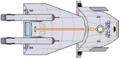 Dorsal
 -
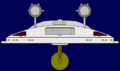 Stern
Stern
.png)
.png)
.png)
.png)
-
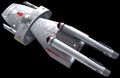 Dorsal view
 -
 Dorsal bow view
 -
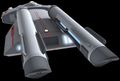 Dorsal stern view
 -
 Port view
 -
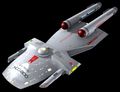 Port dorsal view
 -
 Port ventral view
 -
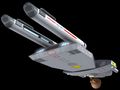 Starboard ventral view
.jpg)
.jpg)
.jpg)
.jpg)
.jpg)
.jpg)
.jpg)