Guide:Durance: Difference between revisions
| Line 265: | Line 265: | ||
==Gallery== | ==Gallery== | ||
===''Rio Verde'' subclass survey vessel=== | ===''Rio Verde'' subclass survey vessel=== | ||
<gallery> | <gallery> | ||
Revision as of 05:45, 8 November 2022
_(stbd).png)
| |
| Durance | |
|---|---|
| Class Overview | |
| Category | Transport |
| Operational | 2130 - 2163 |
| Constructed | 92 total: |
| Dimensions | |
| Length |
|
| Beam |
|
| Height |
|
| Mass |
|
| Performance | |
| Cruise Speed |
|
| Max Speed |
|
| Endurance |
|
| Complement | |
| Officers |
|
| Enlisted |
|
| Troops |
|
| Passengers |
|
| Cargo |
|
| Tactical Systems | |
| Beam Weapons | Durance, Rio Verde
Aberdeen
Durance (wartime fit), Redstone, Chryse
Manheim
|
| Missile Weapons | Manheim
|
| Shields |
|
| Auxiliary Craft | Durance, Durance (wartime fit)
Aberdeen, Rio Verde, Manheim: none Redstone, Chryse
|
| Historical | |
| Ships of Note |
|
| Canonicity | |
| Design | DCP |
| Name | DCP |
| History | DCP
|
Background
Timo
The Durance class of military and later civilian transports was the final major UESN-backed program intended to boost interstellar commerce and cultural exchange, and a tour de force for the world that had risen from the ruins of WW III with the help of these very interstellar connections. The best warp engines Terran science and engineering could provide were installed on the ships, enabling operations in extreme deep space, in the direction of the Rigel colonies, but also towards the distant Canopus. And that way lay the seeds for a bloody conflict, one that would intensify from an overacted self-preservation reaction to rampant privateering, and finally to a prolonged interstellar war.
The Durance class ships sported an angular forward hull of seemingly simple construction, with cargo sections strapped on to the aft structural strongback, and with the two 15,000 ton warp nacelles outriggered in a sturdy and conservative manner. However, recent adventures in propulsive technology research had not been completely without practical benefits: standard fusion power now sufficed to speed the freighters to warp 2 and beyond. The command and navigation spaces plus medical facilities, officer accommodation and staterooms were on the three upper decks of the forward hull, protected by flat armor plates; there were no protrusions and almost no viewports in this part of the hull. The name and registry of the ship were displayed proudly on the uncluttered, angled bow surface, while blow-away panels hid rows of lifepods on the hull flanks.
Twin navigational deflectors and main airlock systems were located on the next two decks, which also provided primary accommodation for the ratings. This was originally of relatively spacious stateroom type, following Boomer tradition for cargo runs of extremely long duration. A later compacting of the arrangements allowed up to four platoons of troops to be shipped in tolerable conditions. Amidships, these decks housed support facilities such as the galley, gymnasium and fabrication center; at extreme stern was the engineering control room. In the fantail abaft, impulse engines provided sublight thrust, while repeater coils for the warp drive allowed the towing of container trains and outsize loads – an option rarely used, and requiring a strap-on cargo section specially configured for the task.
Small manned pods were available for maneuvering both the strap-on and trailing containers in place. Alternately, a capacious cargo shuttle could be shipped for delivering light cargo to planets not equipped with orbital spaceports. A hangar for the former or a docking berth for the latter would be installed aft of the habitat hull. The mid-hull, also straddled by an observation deck, mounted the warp engines on strong down-canted pylons. For defense needs, 2 GW plasma cannon were provided on the engine forward shrouds, while a single cannon also sat atop the forward hull. Field of fire was limited in the proximity of the vessel, though – a fact made bitterly obvious in the upcoming war.
The dorsal support structure aft of the mid-hull contained the main propellant tanks, the grapples for strap-on cargo sections, and a series of RCS engines. As the main reaction engines were located in the lower part of the aft support structure, the thrust line lay near the center of mass of an unloaded vessel. Variance in mass distribution due to the attaching of cargo containers was compensated for by a balancing system that moved propellant and ballast between tanks in the spine of the support structure, and within the large grapple cone above it. Service tunnels snaked through the structures, giving access also to the cargo sections if necessary. Mobile anti-gravs facilitated cargo movement through the various accessways.

USS Durance (FR-250) set new standards to transport operations. Initially, she and her sister ships operated mainly in the wide swath of space between Lorillia and Bolarus, antispinward from Earth and its neighbors, and provided lifelines to Earth colonies in that direction. But that hastily and incompletely explored area of space held several cultures not contacted by Earth ships – until the pirate raids began. USS Chandeleur (FR-263) was the first to fall to an attack by the forces of the Rihannsu people (in 2137), expanding to meet the people who had intruded their space. After her, ships and outposts near the stars of Triangulum Australe went down in a steady succession without anybody on Earth noticing; subspace communications at that point were so slow that it would have taken decades for messages to return from these reaches of space. Furthermore, the shipborne transmitters of the time could not hope to transmit across distances much greater than five lightyears. After that point, the messages either had to be boosted forward by a network of relay buoys, or degenerated into EM radiation that faded into space at lightspeed.
Durance class freighters played another role in the war that soon escalated: two ships were modified as prototype ‘escort cruisers’ to protect commerce in the area, when it became obvious that the expected lifetime of unescorted vessels near Triangulum Australe was lower than the reaction time of nearby UESF forces. Featuring added plasma weapons and omitting the cargo pods, the ships had no true offensive capabilities. They proved to be insufficient in protecting convoys against vicious Rihannsu attacks after the beginning of open war.
Other conversions were tested: USS Manheim (FR-260) was converted to a destroyer by the addition of a missile tube and phased particle beam cannon into her cargo grapples, and USS Heron Bay (FR- 251) soon followed suit. USS Rio Verde (FR-258) became a scientific survey vessel through the addition of a wide selection of sensors to the same position, plus instrumentation in spaces vacated by the omission of cargo handling equipment and some crew. These conversions serve as an example of the multitude of ship configurations and equipment standards used before and during the Romulan War – a logistics nightmare that only ended with the introduction of major ship lineages well after the founding of the Federation Star Fleet.
Durance class transports never reached the numbers required to handle all Earth commerce. Nor had they been intended to. Their projected niche was that of extreme deep space logistics, in support of an effort to gradually establish an Earth presence hundreds of lightyears from the homeworld. Only 15 were built before the war, far too few to create functional outposts in the war theater in anything shorter than three years. No such outposts could even be planned in the Rigel or Sheliak directions, not until the war was over.
Wartime production was funded by nominally letting the ECS procure the vessels as civilian transports, under the R class designation. The some 80 units built to the much lower standards of the Redstone and Chryse classes did little to alleviate the problems, since their cruise endurance was greatly limited. Further hampering UESF logistics efforts, the final Silversides class of 40 additional ships was cancelled due to lack of materials for the warp coils.
All the Durances and related designs were retired by 2163, some after 33 years of sterling service, to give way to the new classes of ships emerging for the use of UFP Star Fleet. Civilian users eagerly adopted the now completely outdated transports, attaching longer container trains to them and thus reducing speed and all but removing maneuverability. In military service, the Durances were at first followed by the more capable Vanguard class, which finally offered the speed, range and numbers to allow for the establishing of functional outposts and starbases in the Rigel direction. Yet much of the burden of logistical operations still fell on the various cruisers that performed exploration and reconnaissance missions and patrol runs in deep space. It would still be nearly a century before Star Fleet could obtain a true operational logistics arm, separate from its exploration and defense forces.
Delta Dynamics
Durance class transport
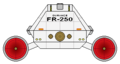
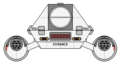
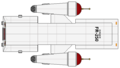
The Durance class first entered service with the United Earth Stellar Navy in 2130, transitioned to the UE Starfleet in 2133, and fully decommissioned in 2163, the second year of the Federation. Within the overall series, 92 hulls were procured, with 15 specifically of the Durance variation, the others within two later subclasses. These primary Durances were 98.7 meters in length, 57.5 meters on the beam, 27.9 meters high (24.7 meters without the removable DSS), and massed 42,100 metric tons. Three officers led the 37 enlisted crew, for a total of 40. The ships cruised at warp 2 and had a maximum speed of warp 2.2, with a deployment endurance of 4.5 years.
The Durance was armed with three 2-gigawatt plasma cannons, one on the forward dorsal hull, and one on the outboard sides of each nacelle. The ships were protected by an electromagnetic shield, polarizable armor (on the forward hull and sections of the aft), and twin navigational deflectors on the ventral forward hull. They had no laboratories, but could carry one heavy atmospheric shuttle or two cargo handling pods, when outfitted with the optional hanger bay (in lieu of the forward cargo container). Two grappling arms were installed on the forward side of the triangular dorsal support structure (located between the two cargo containers), assisting the work pods in maneuvering the containers or transferring fuel to receiving ships. Within the dorsal support structure were additional fuel tanks.
Prior to the Romulan War (2156-2160), the Durances were the primary means of support for colonies antispinward from Earth, operating between Lorillia and Bolarus. However, as the Rihannsu became more aggressive to the interlopers, UESS Chandeleur (FR-263) was the first of the class to fall. The ships never made too much of an impact on Earth herself, as they had been built in such relatively meager numbers. However, during the war, their perceived potential led to the production of plenty more, in two subclasses: Redstone and Chryse.
-
 Without a load
 -

-

-

-

-
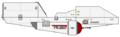 With 1 cargo container and optional observation deck/shuttlebay
 -
-

-
-
-
 With 2 cargo containers
 -

-

-

-

-
 With 2 loaded and 2 trailing cargo containers
 -

-

-

-

_(bow).png)
_(dorsal).png)
_(stern).png)
_(ventral).png)
_(stbd).png)
_(bow).png)
_(dorsal).png)
_(stern).png)
_(ventral).png)
_(stbd).png)
_(bow).png)
_(dorsal).png)
_(stern).png)
_(ventral).png)
_(stdb).png)
_(bow).png)
_(dorsal).png)
_(stern).png)
_(ventral).png)
Durance-style cargo container
The cargo container designed exclusively for the United Earth Starfleet's Durance class transport in 2130 carried up to 12,400 metric tons apiece. Variance in mass distribution due to the attaching of multiple containers aboard the transport was handled by a balancing system that moved propellant and ballast between tanks in the spine of the optional dorsal support structure (the triangular object just forward of a lone container placed on the stern section of the ship). When a ship visited an orbital port without cargo handling equipment, the versatile grappling arms would un-stowed from the forward side of the structure and maneuver the pods away from the ship; if the Durance carried the optional shuttlebay, then the two cargo handling pods helped reduce the transition time, as well as improved the safety of the evolution. When energized, magnetic clamps on the ship would close position and lock on to the metallic portions of the container's hull.
These cargo containers had enormous hatches on their rear side, reminiscent in style and function to personnel and shuttlepod ports found on starships. However, rarely were these pods pressurized and the massive hatches were intended to allow for the ingress and egress of cargo pods and workbees retrieving or stowing the various items in the container's inventory. Temperature management systems, power, and required fluids were husbanded directly from the transport itself, but restricted to only one pod. When a single pod was carried, these services came through a direct connection of the ports from the dorsal support structure. In order to carry two pods, the Durance would be required to shed the structure, and the services came directly to the forward container from the rear side of the forward hull section. Trailing containers, attached by the magnetics contained within the rear-side seals, could never receive such services. As was standard, supply runs would often shuttle containers to their destination, unload them, and then depart with pre-loaded containers.
.png)
.png)
.png)
.png)
.png)
Gallery
Rio Verde subclass survey vessel
.png)
.png)
.png)
.png)
.png)
Manheim subclass destroyer
.png)
.png)
.png)
.png)
.png)
Durance wartime fit
_(stdb).png)
_(bow).png)
_(dorsal).png)
_(stern).png)
_(ventral).png)
Redstone subclass transport
.png)
.png)
.png)
.png)
.png)
Chryse subclass transport
.png)
.png)
.png)
.png)
.png)
Supporting Documents
Notes
- The cargo mass for "reduced-speed operations" was changed from 14,800 mt to 24,800 (which is the correct multiple for two cargo containers) and increased to represent a full load of 8 containers.
- The year of the loss of UESS Chandeleur comes from a private discussion with Timo.