Guide:Loknar: Difference between revisions
No edit summary |
|||
| (4 intermediate revisions by the same user not shown) | |||
| Line 72: | Line 72: | ||
|history= own FASA | |history= own FASA | ||
}} | }} | ||
A design contemporary and in some ways parallel to the ''[[Guide:Larson|Larson]]'' class, the '''''Loknar''''' class of frigates | A design contemporary and in some ways parallel to the ''[[Guide:Larson|Larson]]'' class, the '''''Loknar''''' class of frigates was mainly produced by [[Chiokis]] for [[Andorian]] defense needs. The original goal was to field a relatively light, laser-armed ship with modern warp engines for system defense and shipping lane patrol of [[Federation]] core regions. The opponents there would be lone intruders or Federation lawbreakers, or possibly [[Orion]] pirates; a heavily torpedo-armed ship was not needed, but rapid reaction capability was essential. | ||
was mainly produced by [[Chiokis]] for Andorian defense needs. The original goal was to field a | |||
relatively light, laser-armed ship with modern warp engines for system defense and shipping lane | |||
patrol of [[Federation]] core regions. The opponents there would be lone intruders or Federation | |||
lawbreakers, or possibly Orion pirates; a heavily torpedo-armed ship was not needed, but rapid | |||
reaction capability was essential. | |||
In the long shadow of the Klingon offensive, however, questions were raised about the dedication of | In the long shadow of the [[Klingon]] offensive, however, questions were raised about the dedication of resources for such a "civilian" program. The answer amounted to the inauguration of the concept of "active reserves", a central [[Star Fleet]] tenet in the following century. The ''Loknars'' would double as wartime border defense combatants in addition to enforcing core region law in peacetime. The speed and range of modern warp drives would facilitate the double role; a single medium torpedo launcher would in turn provide the punch needed for anti-shipping operations and border combat. | ||
resources for such a | |||
wartime border defense combatants in addition to enforcing core region law in peacetime. The | |||
speed and range of modern warp drives would facilitate the double role; a single medium torpedo | |||
launcher would in turn provide the punch needed for anti-shipping operations and border combat. | |||
The double role meant a considerable increase in mass and size over initial plans that had merely | The double role meant a considerable increase in mass and size over initial plans that had merely aimed at replacing the earlier ''[[Guide:Burke|Burke]]'' patrol frigates. The ships featured a two-nacelle warp propulsion system, with the cruiser-caliber [[PB-31D]] instead of the originally planned light [[PB-35]] nacelles mounted high above and behind a thin saucer hull, on angled pylons with control and cooling systems and engineering access. Externally, the design bore a resemblance to the pathfinding ''[[Guide:Enterprise|Enterprise]]'' cruisers of the [[2150s]], as well as to the more recent ''[[Guide:Proxima|Proxima]]'' battle cruisers. | ||
aimed at replacing the earlier ''[[Guide:Burke|Burke]]'' patrol frigates. The ships featured a two-nacelle warp | |||
propulsion system, with the cruiser-caliber PB-31D instead of the originally planned light PB-35 | |||
nacelles mounted high above and behind a thin saucer hull, on angled pylons with control and | |||
cooling systems and engineering access. Externally, the design bore a resemblance to the | |||
pathfinding ''[[Guide:Enterprise|Enterprise]]'' cruisers of the [[2150s]], as well as to the more recent | |||
''[[Guide:Proxima|Proxima]]'' battle cruisers. | |||
The pylons were each attached to a block-like engineering section, and these engineering | The pylons were each attached to a block-like engineering section, and these engineering compartments themselves to the trailing edge below the saucer, with two twin impulse engine nozzles between them. Yet there were significant differences in systems placement. The whole engine and power system was duplicated, each set of coils having its own intermix chamber, and each impulse engine having its own fusion reactor. Plasma feeds were interconnected, however, so that power could be cross-shared; also, antimatter was stored in a joint centerline compartment, facilitating maximum protection and centralized refueling and ejection arrangements. | ||
compartments themselves to the trailing edge below the saucer, with two twin impulse engine | |||
nozzles between them. Yet there were significant differences in systems placement. The whole | |||
engine and power system was duplicated, each set of coils having its own intermix chamber, and | |||
each impulse engine having its own fusion reactor. Plasma feeds were interconnected, however, so | |||
that power could be cross-shared; also, antimatter was stored in a joint centerline compartment, | |||
facilitating maximum protection and centralized refueling and ejection arrangements. | |||
In cruise mode, only one powerplant at a time was in use, while the other acted as a backup. In | In cruise mode, only one powerplant at a time was in use, while the other acted as a backup. In combat or pursuit, both powerplants would be brought online. The extra power would be essential in operating the potent [[Prentice-Schafer]] Type H shield generator and the heavy directed energy armament simultaneously. The ''Loknars'' originally carried four [[Lockheed]] 130/1.2 accelerated lasers, replaced in the [[2250s]] Flight II model (or ''Lactra'' subclass, as it never was called) by four twin phaser Vs, and could thus mount an effective defense against small and medium ships. Further punch was provided by the single [[Selenia]] ‘[[Wolf]]’ Mk 1 medium torpedo launcher firing enhanced-penetration fusion warheads. The final, nearly cruiser-standard torpedo armament consisted of three such tubes forward plus a light tube aft, using up all the space originally reserved for exploration gear and depriving the ships of a multi-mission future. | ||
combat or pursuit, both powerplants would be brought online. The extra power would be essential | |||
in operating the potent [[Prentice-Schafer]] Type H shield generator and the heavy directed energy | |||
armament simultaneously. The ''Loknars'' originally carried four [[Lockheed]] 130/1.2 accelerated lasers, | |||
replaced in the [[2250s]] Flight II model (or ''Lactra'' subclass, as it never was called) by four twin phaser | |||
Vs, and could thus mount an effective defense against small and medium ships. Further punch was | |||
provided by the single [[Selenia]] | |||
fusion warheads. The final, nearly cruiser-standard torpedo armament consisted of three such tubes | |||
forward plus a light tube aft, using up all the space originally reserved for exploration gear and | |||
depriving the ships of a multi-mission future. | |||
Internally, the frigates were usually configured to Andorian standard, and their crew quarters | Internally, the frigates were usually configured to Andorian standard, and their crew quarters optimized for Andorian physique and culture. Besides accommodation and life support, the saucer offered little room for anything beyond the most essential command and communication facilities. In the four-tube configuration, the hull already held far more systems and ordnance than corresponding destroyer or even cruiser hulls. A simple docking bay at starboard engineering hull stern served as the primary cargo transfer point, yet actual cargo holds were almost nonexistent, and the onboard auxiliary craft contingent limited to two work pods. However, three transporter pads provided ship-to-ship or ship-to-surface transportation, allowing the [[Andorian Imperial Guard]] to fight their preferred kind of battle. The single 22-pad evacuation unit was also adopted as a | ||
optimized for Andorian physique and culture. Besides accommodation and life support, the saucer | boarding/assault unit by some adventurous Andorian captains, even though it provided no means to retrieve the boarding crew if the assault failed. In any case, the ''Loknars'' could not accommodate a [[SFMC|Marine]] contingent, so any boarding action would mean bloodletting (figurative or literal) from the regular crew, a price only Andorian operators would be ready to pay. | ||
offered little room for anything beyond the most essential command and communication facilities. | |||
In the four-tube configuration, the hull already held far more systems and ordnance than | |||
corresponding destroyer or even cruiser hulls. A simple docking bay at starboard engineering hull | |||
stern served as the primary cargo transfer point, yet actual cargo holds were almost nonexistent, and | |||
the onboard auxiliary craft contingent limited to two work pods. However, three transporter pads | |||
provided ship-to-ship or ship-to-surface transportation, allowing the [[Andorian Imperial Guard]] | |||
to fight their preferred kind of battle. The single 22-pad evacuation unit was also adopted as a | |||
boarding/assault unit by some adventurous Andorian captains, even though it provided no means to | |||
retrieve the boarding crew if the assault failed. In any case, the ''Loknars'' could not accommodate a | |||
Marine contingent, so any boarding action would mean bloodletting (figurative or literal) from the | |||
regular crew, a price only Andorian operators would be ready to pay. | |||
The steady if somewhat protracted production differed from the Starship and Star Frigate programs | The steady if somewhat protracted production differed from the Starship and Star Frigate programs in only involving a low number of dockyards at [[Salazaar]] and [[Saturn]], yielding a low annual output of hulls. As many as 35 ships went directly to [[AIG]] and were primarily utilized for core world defense. A further 30 were deployed on starbases near the [[Romulan]] neutral zone, for rapid deployment in case the Romulans attempted a surprise break-out, and for deep space law enforcement missions in peacetime. Five were sold to the [[Andesian Guardianship]] for protecting Federation interests in the Orion-contested sectors of the [[Dilithium Belt]]. A final 30 [[Human]]-manned craft with slightly different interior layout were attached to defense fleets operating on the Klingon front, providing base defense and sometimes escorting larger Star Fleet and civilian vessels. | ||
in only involving a low number of dockyards at [[Salazaar]] and [[Saturn]], yielding a low annual output of | |||
hulls. As many as 35 ships went directly to [[AIG]] | |||
defense. A further 30 were deployed on starbases near the Romulan neutral zone, for rapid | |||
deployment in case the Romulans attempted a surprise break-out, and for deep space law | |||
enforcement missions in peacetime. Five were sold to the Andesian | |||
Federation interests in the Orion-contested sectors of the [[Dilithium Belt]]. A final 30 | |||
craft with slightly different interior layout were attached to defense fleets operating on the Klingon | |||
front, providing base defense and sometimes escorting larger Star Fleet and civilian vessels. | |||
Despite the piecemeal ordering and procurement, a common naming and registry scheme was used, | Despite the piecemeal ordering and procurement, a common naming and registry scheme was used, featuring Federation colonies and other member world locations. Naming was sometimes downright predatory, with thematically fitting names adopted as soon as a previous holder of the name was declared lost or otherwise stricken from strength; competition for stellar names with the ''[[Guide:Procyon|Procyon]]'' corvettes was especially fierce. Registries for this exceptionally numerous class were slotted to the 2700-2799 range in anticipation of several such major ship procurement programs. Most of these programs failed to materialize, though, leaving the ''Loknars'' the highest-registry combat ships in Star Fleet service until the [[2270s]]. | ||
featuring Federation colonies and other member world locations. Naming was sometimes downright | |||
predatory, with thematically fitting names adopted as soon as a previous holder of the name was | |||
declared lost or otherwise stricken from strength; competition for stellar names with the ''[[Guide:Procyon|Procyon]]'' | |||
corvettes was especially fierce. Registries for this exceptionally numerous class were slotted to the | |||
2700-2799 range in anticipation of several such major ship procurement programs. Most of these programs failed to | |||
materialize, though, leaving the ''Loknars'' the highest-registry combat ships in Star Fleet service until the [[2270s]]. | |||
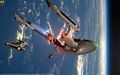
[[Image:No Photo Available.jpg|left|200px|thumb|Two ''Loknars'' in Andorian colors kindly escort ''IKV Soq'' back towards the border following an | [[Image:No Photo Available.jpg|left|200px|thumb|Two ''Loknars'' in [[Andorian]] colors kindly escort ''IKV Soq'' back towards the border following an "unfortunate navigational error" that took the cruiser to within five lightyears of [[Procyon]]. Sorting out meek [[Klingon|Imperial]] reconnoitering missions from reckless privateer raids or the frequent yet futile invasion attempts by weak Klingon factions was a constant pain for Star Fleet border defense forces throughout the late [[2240s]]. Klingon behavior returned to more predictable tracks after the end of the Empire’s Wars of Internal Dissension, and the odds of enemy cruisers penetrating into traditional ''Loknar'' hunting grounds decreased significantly.]] | ||
Despite being | Despite being "peacetime" ships, the ''Loknars'' saw combat duty in many undeclared wars. The receding of the Klingon threat made several minor players like the [[Lesser Orion]]s, [[Elasi]], and [[Landorian]]s bolder in their efforts to disrupt Federation traffic. ''USS Bodiri'' (NCC-2717) of the Andorian Imperial Guard saw action against Lesser Orion pirates in [[2249]], thwarting an invasion of a prime directive-protected [[Planetary Classifications|class L]] world in the [[Secundi Bahia]] system. In the [[2250s|fifties]], Andorian forces often clashed with the Landorians in the Xaridian region until decisive political measures were taken to pacify the latter. Persistent negotiations finally led to the re-absorption of this fringe group into the Andorian society in the [[2340s]], at which time several other groups on [[Andor]] already vocally expressed their secessionist demands. On the whole, though, the [[2250s]] action against Landorians led to a surprising and unprecedented solidification of the multifaceted Andorian society. | ||
receding of the Klingon threat made several minor players like the Lesser | |||
Imperial Guard saw action against Lesser Orion pirates in [[2249]], thwarting an invasion of a prime | |||
directive-protected [[Planetary Classifications|class L]] world in the [[Secundi Bahia]] system. In the [[2250s|fifties]], Andorian forces often | |||
clashed with the Landorians in the Xaridian region until decisive political measures were taken to | |||
pacify the latter. Persistent negotiations finally led to the re-absorption of this fringe group into the | |||
Andorian society in the [[2340s]], at which time several other groups on [[Andor]] already vocally | |||
expressed their secessionist demands. On the whole, though, the [[2250s]] action against Landorians | |||
led to a surprising and unprecedented solidification of the multifaceted Andorian society. | |||
Between [[2246]] and [[2265]], there was very little direct, coordinated military action against Klingon | Between [[2246]] and [[2265]], there was very little direct, coordinated military action against Klingon forces; even though their piracy raids never truly ceased, they lost much of their intensity and coherence. Yet, the uncertainty of Klingon intentions and lack of intelligence about the inner functionings of the Empire forced Star Fleet to position its forces in anticipation of the worst. The destroyers and cruisers had to constantly stand prepared for major offensive or defensive deployments at the borders, so ''Loknars'' and other frigate types took charge of anti-piracy patrols. Star Fleet often succeeded in turning back the intruders by swift deployment of large numbers of these fast combatants, without having to resort to actual use of deadly force. | ||
forces; even though their piracy raids never truly ceased, they lost much of their intensity and | |||
coherence. Yet, the uncertainty of Klingon intentions and lack of intelligence about the inner | |||
functionings of the Empire forced Star Fleet to position its forces in anticipation of the worst. The | |||
destroyers and cruisers had to constantly stand prepared for major offensive or defensive | |||
deployments at the borders, so ''Loknars'' and other frigate types took charge of anti-piracy patrols. | |||
Star Fleet often succeeded in turning back the intruders by swift deployment of large numbers of | |||
these fast combatants, without having to resort to actual use of deadly force. | |||
Lone ''Loknars'' on border patrol were quite vulnerable, though. Their modest long range sensing | Lone ''Loknars'' on border patrol were quite vulnerable, though. Their modest long range sensing capabilities made it possible for a fast and determined enemy to take them by surprise. ''USS Morgan City'' | ||
capabilities made it possible for a fast and determined enemy to take them by surprise. ''USS Morgan City'' | (NCC-2704) fell prey to a Klingon strike in [[2246]], was captured and repaired, and adopted as part of the Klingon forces. The fake frigate lured many [[UFP]] freighters to their doom until drastic measures were taken: the entire ''Loknar'' fleet was recalled for the duration of a three-month hunt for the pirate vessel and the ''Morgan City'' had to withdraw to Klingon space.* | ||
(NCC-2704) fell prey to a Klingon strike in [[2246]], was captured and repaired, and adopted as | |||
part of the Klingon forces. The fake frigate lured many UFP freighters to their doom until drastic | |||
measures were taken: the entire ''Loknar'' fleet was recalled for the duration of a three-month hunt for | |||
the pirate vessel | |||
The fate of the ''Morgan City'' was unique in more than one respect: usually, the ''Loknar'' frigates did | The fate of the ''Morgan City'' was unique in more than one respect: usually, the ''Loknar'' frigates did not loiter beyond Federation boundaries. Also, civilian heroics were more usual for the ''Loknars'' than military accomplishments. In a major media event of [[2258]], ''USS New America'' (NCC-2706) tractored to safety a Federation starliner that had suffered an impulse drive malfunction on approach of [[Procyon]] and was in danger of plunging into the cromosphere of the star with 400 people aboard. ''USS Gaikos'' (NCC-2740) in turn proved that a ''Loknar'', too, could carry 400 people in a cinch, when she evacuated a failed terraforming outpost from under severe tectonic trouble. | ||
not loiter beyond Federation boundaries. Also, civilian heroics were more usual for the ''Loknars'' | |||
than military accomplishments. In a major media event of [[2258]], ''USS New America'' (NCC-2706) tractored to safety a Federation starliner that had suffered an impulse drive malfunction on approach | |||
of [[Procyon]] and was in danger of plunging into the cromosphere of the star with 400 people aboard. | |||
''USS Gaikos'' (NCC-2740) in turn proved that a ''Loknar'', too, could carry 400 people in a cinch, when | |||
she evacuated a failed terraforming outpost from under severe tectonic trouble. | |||
The type was well liked among the Andorian crews, tolerated by the | The type was well liked among the Andorian crews, tolerated by the Human operators, and initially fought well in the budgetary rat race. But in the [[2270s]], frigate funds were directed to the ''[[Guide:Daran|Daran]]'' and | ||
fought well in the budgetary rat race. But in the [[2270s]], frigate funds were directed to the ''[[Guide:Daran|Daran]]'' and | ''Knox'' designs; these were used to replace the ''Loknars'' with smaller numbers of faster, more advanced, and more affordable ships. All Human crews were reassigned to the newer types by [[2286]], leaving the ten surviving vessels active in bookkeeping terms only. In the meantime, a new player was introduced to the field: a heavily armed family of corvettes took over most of the law enforcement and local defense mission. The evolutionary niche of the frigates thus moved up a notch, prompting Star Fleet to concentrate resources on the ''[[Guide:Miranda| Miranda]]'' family of heavy frigates and their derivatives. | ||
''Knox'' designs; these were used to replace the ''Loknars'' with smaller numbers of faster, more | |||
advanced and more affordable ships. All | |||
leaving the ten surviving vessels active in bookkeeping terms only. In the meantime, a new player | |||
was introduced to the field: a heavily armed family of corvettes took over most of the law | |||
enforcement and local defense mission. The evolutionary niche of the frigates thus moved up a | |||
notch, prompting Star Fleet to concentrate resources on the ''[[Guide:Miranda|Miranda]]'' family of heavy frigates and | |||
their derivatives. | |||
The ''Loknars'' were no match for these versatile and complex vessels. Star Fleet had long since opted | The ''Loknars'' were no match for these versatile and complex vessels. Star Fleet had long since opted out of any upgrades to its ''Loknar'' force, but three refits had been performed on the Andorian-operated units. Yet when the heavily armed ''Knox'' and superfast ''[[Guide:Ianar|Ianar]]'' classes were introduced to augment the ''Darans'', [[Andoria]] saw no need to modernize its aging frigates further. As the last of the three lifetime extension programs expired, the final representatives of the ''Loknar'' class were retired from the [[AIG|Blue Fleet]] in [[2299]]. | ||
out of any upgrades to its ''Loknar'' force, but three refits had been performed on the Andorian-operated | |||
units. Yet when the heavily armed ''Knox'' and superfast ''[[Guide:Ianar|Ianar]]'' classes were introduced to | |||
augment the ''Darans'', | |||
three lifetime extension programs expired, the final representatives of the ''Loknar'' class were retired | |||
from the [[AIG|Blue Fleet]] in [[2299]]. | |||
<nowiki>*</nowiki><sub> The Klingons have long maintained that the capturing of the ''Morgan City'' was not the work of Klingon forces, but | <nowiki>*</nowiki><sub> The Klingons have long maintained that the capturing of the ''Morgan City'' was not the work of Klingon forces, but "a treacherous plot worthy of Romulans only". The theory has generally been dismissed, yet the thawing of relations with the [[Star Empire]] has yielded new data on Romulan covert operations in the [[23rd century]] that suggests that there may indeed have been some [[Tal'Shiar]] involvement in the incident. Several so far unverified sources also indicate connections between the renegade Klingon Admiral [[Kamato]] and a faction of the Romulan Praetorate.</sub> | ||
plot worthy of Romulans | |||
yielded new data on Romulan covert operations in the [[23rd century]] that suggests that there may indeed have been some | |||
involvement in the incident. Several so far unverified sources also indicate connections between the renegade Klingon Admiral | |||
Kamato and a faction of the Romulan Praetorate.</sub> | |||
==Gallery== | ==Gallery== | ||
| Line 229: | Line 132: | ||
* The rescue effort of ''USS Gaikos'' was deemed to have occurred in [[2259]], closely following that of ''USS New America''. | * The rescue effort of ''USS Gaikos'' was deemed to have occurred in [[2259]], closely following that of ''USS New America''. | ||
* While it has not been re-written to indicate so, the game-canon is that the non-AIG ''Loknars'' are crewed by typically-mixed Federation crew, not only | * While it has not been re-written to indicate so, the game-canon is that the non-AIG ''Loknars'' are crewed by typically-mixed Federation crew, not only Humans. The first 35 went to the AIG; in [[2249]], the first of the Flight Is for the AIG are completed and delivered and new ones are now slated for [[Star Fleet]]. | ||
* The sidebar operational end year has been changed from [[2296]] to [[2299]], to match the text. | * The sidebar operational end year has been changed from [[2296]] to [[2299]], to match the text. | ||
==Alt Sources== | |||
* [https://www.ststcsolda.space/federation/loknar/loknar.html STSTCSOLDA] | |||
---- | ---- | ||
*[[Guide: Timo's Guide to Star Fleet|Back to the Table of Contents]] | * [[Guide: Timo's Guide to Star Fleet|Back to the Table of Contents]] | ||
*[[Guide: 2240-2270 - The Final Frontier|Back to "The Final Frontier"]] | * [[Guide: 2240-2270 - The Final Frontier|Back to "The Final Frontier"]] | ||
*[[Guide: Of Ship Statistics|Appendix A: Of Ship Statistics]] | * [[Guide: Of Ship Statistics|Appendix A: Of Ship Statistics]] | ||
*[[Guide: Glossary|Appendix B: Glossary]] | * [[Guide: Glossary|Appendix B: Glossary]] | ||
*[[Guide: Star Fleet Organization - General Outline|Appendix C: Star Fleet Organization - General Outline]] | * [[Guide: Star Fleet Organization - General Outline|Appendix C: Star Fleet Organization - General Outline]] | ||
*[[Guide: Abbreviations From Outside|Appendix D: Abbreviations From Outside]] | * [[Guide: Abbreviations From Outside|Appendix D: Abbreviations From Outside]] | ||
[[Category:Guide|{{PAGENAME}}]] | [[Category:Guide|{{PAGENAME}}]] | ||
Latest revision as of 14:25, 13 October 2025
.png)
| |
| Loknar | |
|---|---|
| Class Overview | |
| Category | frigate |
| Operational | 2242-2299 |
| Constructed | 100 total: |
| Dimensions | |
| Length | 290.2 m |
| Beam | 127.1 m |
| Height | 56.0 m |
| Mass |
|
| Performance | |
| Cruise Speed | w 5 |
| Max Speed |
|
| Endurance | 1 year |
| Complement | |
| Officers |
|
| Enlisted |
|
| Tactical Systems | |
| Beam Weapons | Flt I
Flt IA, Flt II, Flt IIA
|
| Missile Weapons | Flt I, Flt IA
Flt II, Flt IIA
|
| Shields |
|
| Transporters | Flt I, Flt II
Flt IA, Flt IIA
2270 refit
|
| Auxiliary Craft |
|
| Historical | |
| Ships of Note |
|
| Canonicity | |
| Design | FASA |
| Name | FASA |
| History | own FASA
|
A design contemporary and in some ways parallel to the Larson class, the Loknar class of frigates was mainly produced by Chiokis for Andorian defense needs. The original goal was to field a relatively light, laser-armed ship with modern warp engines for system defense and shipping lane patrol of Federation core regions. The opponents there would be lone intruders or Federation lawbreakers, or possibly Orion pirates; a heavily torpedo-armed ship was not needed, but rapid reaction capability was essential.
In the long shadow of the Klingon offensive, however, questions were raised about the dedication of resources for such a "civilian" program. The answer amounted to the inauguration of the concept of "active reserves", a central Star Fleet tenet in the following century. The Loknars would double as wartime border defense combatants in addition to enforcing core region law in peacetime. The speed and range of modern warp drives would facilitate the double role; a single medium torpedo launcher would in turn provide the punch needed for anti-shipping operations and border combat.
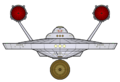
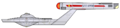
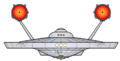
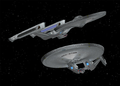
The double role meant a considerable increase in mass and size over initial plans that had merely aimed at replacing the earlier Burke patrol frigates. The ships featured a two-nacelle warp propulsion system, with the cruiser-caliber PB-31D instead of the originally planned light PB-35 nacelles mounted high above and behind a thin saucer hull, on angled pylons with control and cooling systems and engineering access. Externally, the design bore a resemblance to the pathfinding Enterprise cruisers of the 2150s, as well as to the more recent Proxima battle cruisers.
The pylons were each attached to a block-like engineering section, and these engineering compartments themselves to the trailing edge below the saucer, with two twin impulse engine nozzles between them. Yet there were significant differences in systems placement. The whole engine and power system was duplicated, each set of coils having its own intermix chamber, and each impulse engine having its own fusion reactor. Plasma feeds were interconnected, however, so that power could be cross-shared; also, antimatter was stored in a joint centerline compartment, facilitating maximum protection and centralized refueling and ejection arrangements.
In cruise mode, only one powerplant at a time was in use, while the other acted as a backup. In combat or pursuit, both powerplants would be brought online. The extra power would be essential in operating the potent Prentice-Schafer Type H shield generator and the heavy directed energy armament simultaneously. The Loknars originally carried four Lockheed 130/1.2 accelerated lasers, replaced in the 2250s Flight II model (or Lactra subclass, as it never was called) by four twin phaser Vs, and could thus mount an effective defense against small and medium ships. Further punch was provided by the single Selenia ‘Wolf’ Mk 1 medium torpedo launcher firing enhanced-penetration fusion warheads. The final, nearly cruiser-standard torpedo armament consisted of three such tubes forward plus a light tube aft, using up all the space originally reserved for exploration gear and depriving the ships of a multi-mission future.
Internally, the frigates were usually configured to Andorian standard, and their crew quarters optimized for Andorian physique and culture. Besides accommodation and life support, the saucer offered little room for anything beyond the most essential command and communication facilities. In the four-tube configuration, the hull already held far more systems and ordnance than corresponding destroyer or even cruiser hulls. A simple docking bay at starboard engineering hull stern served as the primary cargo transfer point, yet actual cargo holds were almost nonexistent, and the onboard auxiliary craft contingent limited to two work pods. However, three transporter pads provided ship-to-ship or ship-to-surface transportation, allowing the Andorian Imperial Guard to fight their preferred kind of battle. The single 22-pad evacuation unit was also adopted as a boarding/assault unit by some adventurous Andorian captains, even though it provided no means to retrieve the boarding crew if the assault failed. In any case, the Loknars could not accommodate a Marine contingent, so any boarding action would mean bloodletting (figurative or literal) from the regular crew, a price only Andorian operators would be ready to pay.
The steady if somewhat protracted production differed from the Starship and Star Frigate programs in only involving a low number of dockyards at Salazaar and Saturn, yielding a low annual output of hulls. As many as 35 ships went directly to AIG and were primarily utilized for core world defense. A further 30 were deployed on starbases near the Romulan neutral zone, for rapid deployment in case the Romulans attempted a surprise break-out, and for deep space law enforcement missions in peacetime. Five were sold to the Andesian Guardianship for protecting Federation interests in the Orion-contested sectors of the Dilithium Belt. A final 30 Human-manned craft with slightly different interior layout were attached to defense fleets operating on the Klingon front, providing base defense and sometimes escorting larger Star Fleet and civilian vessels.
Despite the piecemeal ordering and procurement, a common naming and registry scheme was used, featuring Federation colonies and other member world locations. Naming was sometimes downright predatory, with thematically fitting names adopted as soon as a previous holder of the name was declared lost or otherwise stricken from strength; competition for stellar names with the Procyon corvettes was especially fierce. Registries for this exceptionally numerous class were slotted to the 2700-2799 range in anticipation of several such major ship procurement programs. Most of these programs failed to materialize, though, leaving the Loknars the highest-registry combat ships in Star Fleet service until the 2270s.

Despite being "peacetime" ships, the Loknars saw combat duty in many undeclared wars. The receding of the Klingon threat made several minor players like the Lesser Orions, Elasi, and Landorians bolder in their efforts to disrupt Federation traffic. USS Bodiri (NCC-2717) of the Andorian Imperial Guard saw action against Lesser Orion pirates in 2249, thwarting an invasion of a prime directive-protected class L world in the Secundi Bahia system. In the fifties, Andorian forces often clashed with the Landorians in the Xaridian region until decisive political measures were taken to pacify the latter. Persistent negotiations finally led to the re-absorption of this fringe group into the Andorian society in the 2340s, at which time several other groups on Andor already vocally expressed their secessionist demands. On the whole, though, the 2250s action against Landorians led to a surprising and unprecedented solidification of the multifaceted Andorian society.
Between 2246 and 2265, there was very little direct, coordinated military action against Klingon forces; even though their piracy raids never truly ceased, they lost much of their intensity and coherence. Yet, the uncertainty of Klingon intentions and lack of intelligence about the inner functionings of the Empire forced Star Fleet to position its forces in anticipation of the worst. The destroyers and cruisers had to constantly stand prepared for major offensive or defensive deployments at the borders, so Loknars and other frigate types took charge of anti-piracy patrols. Star Fleet often succeeded in turning back the intruders by swift deployment of large numbers of these fast combatants, without having to resort to actual use of deadly force.
Lone Loknars on border patrol were quite vulnerable, though. Their modest long range sensing capabilities made it possible for a fast and determined enemy to take them by surprise. USS Morgan City (NCC-2704) fell prey to a Klingon strike in 2246, was captured and repaired, and adopted as part of the Klingon forces. The fake frigate lured many UFP freighters to their doom until drastic measures were taken: the entire Loknar fleet was recalled for the duration of a three-month hunt for the pirate vessel and the Morgan City had to withdraw to Klingon space.*
The fate of the Morgan City was unique in more than one respect: usually, the Loknar frigates did not loiter beyond Federation boundaries. Also, civilian heroics were more usual for the Loknars than military accomplishments. In a major media event of 2258, USS New America (NCC-2706) tractored to safety a Federation starliner that had suffered an impulse drive malfunction on approach of Procyon and was in danger of plunging into the cromosphere of the star with 400 people aboard. USS Gaikos (NCC-2740) in turn proved that a Loknar, too, could carry 400 people in a cinch, when she evacuated a failed terraforming outpost from under severe tectonic trouble.
The type was well liked among the Andorian crews, tolerated by the Human operators, and initially fought well in the budgetary rat race. But in the 2270s, frigate funds were directed to the Daran and Knox designs; these were used to replace the Loknars with smaller numbers of faster, more advanced, and more affordable ships. All Human crews were reassigned to the newer types by 2286, leaving the ten surviving vessels active in bookkeeping terms only. In the meantime, a new player was introduced to the field: a heavily armed family of corvettes took over most of the law enforcement and local defense mission. The evolutionary niche of the frigates thus moved up a notch, prompting Star Fleet to concentrate resources on the Miranda family of heavy frigates and their derivatives.
The Loknars were no match for these versatile and complex vessels. Star Fleet had long since opted out of any upgrades to its Loknar force, but three refits had been performed on the Andorian-operated units. Yet when the heavily armed Knox and superfast Ianar classes were introduced to augment the Darans, Andoria saw no need to modernize its aging frigates further. As the last of the three lifetime extension programs expired, the final representatives of the Loknar class were retired from the Blue Fleet in 2299.
* The Klingons have long maintained that the capturing of the Morgan City was not the work of Klingon forces, but "a treacherous plot worthy of Romulans only". The theory has generally been dismissed, yet the thawing of relations with the Star Empire has yielded new data on Romulan covert operations in the 23rd century that suggests that there may indeed have been some Tal'Shiar involvement in the incident. Several so far unverified sources also indicate connections between the renegade Klingon Admiral Kamato and a faction of the Romulan Praetorate.
Gallery
-
 Locknar (2245)
 -
-

-
 Locknar (2265)
 -
-

-
 Loknar frigate
 -
_(side).png)
_(bow).png)
_(dorsal).png)
_(side).png)
_(bow).png)
_(dorsal).png)

_(2-view).png)
Notes
- As previously stated, all references to the ASDF were changed to the AIG.
- I've been aggressive in changing sidebar references from "Lactra" to "Flight II", because the text strongly claims the "subclass" was never referred to as the first new-build ship's name. The sidebar also references "early" versions of each of the two named "subclasses", which I've deemed to mean the use of the lighter PB-35s, rather than later PB-31Ds.
- All Flight IIs (52 total) were built between 2250 and 2267, though starting in 2256 they were built directly to the Flight IIA standard, with the Flight IIs upgraded to the IIA standard. Flight IAs were upgraded to Flight IIA standard, once the process had been completed for the IIs.
- The phrase "slotted to the 2700-2799 range in anticipation of several such major ship procurement programs" appears to mean that the NCCs for the class jumped to that range in anticipation of larger (and more important) ship-of-the-line programs that did not develop.
- The rescue effort of USS Gaikos was deemed to have occurred in 2259, closely following that of USS New America.
- While it has not been re-written to indicate so, the game-canon is that the non-AIG Loknars are crewed by typically-mixed Federation crew, not only Humans. The first 35 went to the AIG; in 2249, the first of the Flight Is for the AIG are completed and delivered and new ones are now slated for Star Fleet.