Guide:Garneau: Difference between revisions
No edit summary |
No edit summary |
||
| (33 intermediate revisions by the same user not shown) | |||
| Line 6: | Line 6: | ||
* ''Garneau'' light science scouts/light surveyors: [[2267]] - [[2279]] | * ''Garneau'' light science scouts/light surveyors: [[2267]] - [[2279]] | ||
* ''Lena'' light supply ships: [[2267]] - [[2302]] | * ''Lena'' light supply ships: [[2267]] - [[2302]] | ||
* ''Darwin'' light science scouts/light surveyors: [[2277]] - [[ | * ''Darwin'' light science scouts/light surveyors: [[2277]] - [[2298]] | ||
* ''Fisher'' light tugs: [[2281]] - [[2335]] | * ''Fisher'' light tugs: [[2281]] - [[2335]] | ||
* ''Clarke'' light supply ships: [[ | * ''Fjon'' light supply ships: [[2293]] - [[2329]] | ||
* ''Todega'' deep space salvage tugs: [[ | * ''Greer'' special operations corsair: [[2296]] - [[xxxx]] | ||
* ''Schmidt'' deep space salvage tugs: [[ | * ''Clarke'' light supply ships/couriers: [[2304]] - [[xxxx]] | ||
* ''Todega'' deep space salvage tugs: [[2309]] - [[xxxx]] | |||
* ''Schmidt'' deep space salvage tugs: [[2324]] - [[xxxx]] | |||
|constructed= xxx total: | |constructed= xxx total: | ||
* ''Garneau'': 12 ([[2267]] - [[2269]]) | * ''Garneau'': 12 ([[2267]] - [[2269]]) | ||
| Line 17: | Line 18: | ||
* ''Darwin'': 23 ([[2277]] - [[2286]]) | * ''Darwin'': 23 ([[2277]] - [[2286]]) | ||
* ''Fisher'': 93 ([[2281]] - [[2293]]) | * ''Fisher'': 93 ([[2281]] - [[2293]]) | ||
* ''Fjon'': 21 ([[ | * ''Fjon'': 21 (converted from ''Darwin'': [[2293]] - [[2298]]) | ||
* ''Clarke'': 23 ([[ | * ''Greer'': 8<br> | ||
* ''Todega'': 50 ([[ | ** 1 (converted from ''Darwin'': [[2296]]) | ||
* ''Schmidt'': 40 ([[ | ** 7 (converted from ''Lena'': [[2297]] - [[2298]]) | ||
* ''Clarke'': 23 ([[2304]] - [[2306]]) | |||
* ''Todega'': 50 ([[2309]] - [[2315]]) | |||
* ''Schmidt'': 40 ([[2324]] - [[2328]]) | |||
|length= <br> | |length= <br> | ||
* ''Garneau'', ''Lena'', ''Darwin'', ''Fisher'', ''Clarke'': 80.0 m | * ''Garneau'', ''Lena'', ''Darwin'', ''Fisher'', ''Clarke'': 80.0 m | ||
| Line 87: | Line 91: | ||
|auxcraft= none | |auxcraft= none | ||
|historicalships= <br> | |historicalships= <br> | ||
* ''USS Anholt'' | |||
* ''USS Darwin'' (NCC-652) | * ''USS Darwin'' (NCC-652) | ||
* ''USS Fisher'' (NCC-xxx) | |||
* ''USS Fjon'' | |||
* ''USS Garneau'' (NCC-641) | * ''USS Garneau'' (NCC-641) | ||
* ''USS Greer'' | |||
* ''USS Lena'' (NCC-5028) | |||
|design= SFP, Federation Starship Recognition Chart (Aridas Sofia, Todd Guenther) | |design= SFP, Federation Starship Recognition Chart (Aridas Sofia, Todd Guenther) | ||
|name= FASA, SFP, Federation Starship Recognition Chart, Timo | |name= FASA, SFP, Federation Starship Recognition Chart, Timo | ||
| Line 99: | Line 108: | ||
By [[2267]], this study had turned into a family of low-cost Class Two vessels, the first of which was a light surveyor dubbed '''''Garneau''''' class. The moving of the antimatter pods and deuterium tankage into the main hull took up some 56% of the primary hull internal volume formerly available for accommodation and research facilities. Yet, space was left for somewhat uncomfortably housing a crew of 15-40, as well as for four standard laboratory modules and sixteen sensor berths—contrasting with the eight modules and 32 berths of a typical podded ''Oberth''. Weaponry and associated systems were omitted and the impulse system slightly down-scaled. Otherwise, changes were minimal: essentially, all it took to change an ''Oberth'' into a ''Garneau'' was to remove the ventral pod and its attachment points and cut a 120 m3 opening into the saucer to install the fuel tanks and to replace the bow airlock/hangar with a navigational deflector array. | By [[2267]], this study had turned into a family of low-cost Class Two vessels, the first of which was a light surveyor dubbed '''''Garneau''''' class. The moving of the antimatter pods and deuterium tankage into the main hull took up some 56% of the primary hull internal volume formerly available for accommodation and research facilities. Yet, space was left for somewhat uncomfortably housing a crew of 15-40, as well as for four standard laboratory modules and sixteen sensor berths—contrasting with the eight modules and 32 berths of a typical podded ''Oberth''. Weaponry and associated systems were omitted and the impulse system slightly down-scaled. Otherwise, changes were minimal: essentially, all it took to change an ''Oberth'' into a ''Garneau'' was to remove the ventral pod and its attachment points and cut a 120 m3 opening into the saucer to install the fuel tanks and to replace the bow airlock/hangar with a navigational deflector array. | ||
Translating the simple design into an operational success was equally effortless. Some 34 ''Garneaus'' were rapidly constructed, mainly at [[Centaurian]] shipyards, and sent to dilithium-hunting and mapping missions within [[Federation]]-controlled but poorly explored space. Many ships sailed out with only one or two laboratories installed, carrying minimal crews, although the full complement would have been two general planetary sciences labs, two geology and mineralogy labs, and some 25 crew and scientists. Most were operated by civilian research and industrial organizations, even if in pursuit of Star Fleet goals, and carried NAR registries. Towards the end of the [[2279|2270s]], the dozen originally under Star Fleet registry (NCC- | Translating the simple design into an operational success was equally effortless. Some 34 ''Garneaus'' were rapidly constructed, mainly at [[Centaurian]] shipyards, and sent to dilithium-hunting and mapping missions within [[Federation]]-controlled but poorly explored space. Many ships sailed out with only one or two laboratories installed, carrying minimal crews, although the full complement would have been two general planetary sciences labs, two geology and mineralogy labs, and some 25 crew and scientists. Most were operated by civilian research and industrial organizations, even if in pursuit of Star Fleet goals, and carried NAR registries. Towards the end of the [[2279|2270s]], the dozen originally under Star Fleet registry (NCC-640-651) were also sold to commercial concerns; the eye of storm between decreasing piracy and increasing [[Klingon]] tensions lured resource hunters back into the business and the ''Garneau'' was the ideal platform for serious prospecting. | ||
The Star Fleet surveyor replacement program was economical and efficient, rather than fast and ambitious. '''''Darwin''''' (NCC-652) light surveyors were improved ''Garneaus'' with light weaponry and more advanced computer systems and warp engines. Some two dozen were built between [[2277]] and [[2286]], but it was soon found out that survey missions in nearby space were no longer of crucial interest. Longer-range surveys in turn required full-sized ''Oberth'' ships, of which several new batches were built. The by-then rather decrepit ''Garneaus'' were retired and replaced by the ''Darwins'', which were then sent to map the resources of [[UFP]] core regions to high resolution. The mapping program was so efficient that to this day, no further mineral survey in the area has been needed. | The Star Fleet surveyor replacement program was economical and efficient, rather than fast and ambitious. '''''Darwin''''' (NCC-652) light surveyors were improved ''Garneaus'' with light weaponry and more advanced computer systems and warp engines. Some two dozen were built between [[2277]] and [[2286]], but it was soon found out that survey missions in nearby space were no longer of crucial interest. Longer-range surveys in turn required full-sized ''Oberth'' ships, of which several new batches were built. The by-then rather decrepit ''Garneaus'' were retired and replaced by the ''Darwins'', which were then sent to map the resources of [[UFP]] core regions to high resolution. The mapping program was so efficient that to this day, no further mineral survey in the area has been needed. | ||
| Line 105: | Line 114: | ||
In addition to the surveyors, 18 ships were originally completed without the wiring needed for the laboratories and many of the sensors. Instead, they were configured for simple supply duties and maintenance of subspace communication relays. A medium cargo transporter was installed for ease of supply operations. The '''''Lena''''' (NCC-5028) subclass of [[2267]] was an economic success as well, although the extreme fatigue placed on the small ships forced almost all of them to be scrapped in the [[2297|2290s]]. None were operated by civilians and the hopes of selling the supply variant to civilian enterprises were squashed by the introduction of a highly economical Klingon-originated design commercially known as the ''Tong'Duj'' class. While somewhat larger than the ''Lena'', its acquisition cost was one-fifth of that of the Federation design, and operating costs only 1.2 times those of the ''Lena'' subclass. Several variants were quickly fielded, saturating the market despite UFP attempts at placing import restrictions. Between the ''Antares'' and ''Tong'Duj'' variants, little in the way of civilian market was found for Star Fleet-designed light or medium transports in the late [[23rd century]]—and sales have been sluggish in the [[24th century]] as well. Star Fleet’s tendency to over-engineer its ships for every possible contingency seems to generally overprice them out of civilian markets altogether. | In addition to the surveyors, 18 ships were originally completed without the wiring needed for the laboratories and many of the sensors. Instead, they were configured for simple supply duties and maintenance of subspace communication relays. A medium cargo transporter was installed for ease of supply operations. The '''''Lena''''' (NCC-5028) subclass of [[2267]] was an economic success as well, although the extreme fatigue placed on the small ships forced almost all of them to be scrapped in the [[2297|2290s]]. None were operated by civilians and the hopes of selling the supply variant to civilian enterprises were squashed by the introduction of a highly economical Klingon-originated design commercially known as the ''Tong'Duj'' class. While somewhat larger than the ''Lena'', its acquisition cost was one-fifth of that of the Federation design, and operating costs only 1.2 times those of the ''Lena'' subclass. Several variants were quickly fielded, saturating the market despite UFP attempts at placing import restrictions. Between the ''Antares'' and ''Tong'Duj'' variants, little in the way of civilian market was found for Star Fleet-designed light or medium transports in the late [[23rd century]]—and sales have been sluggish in the [[24th century]] as well. Star Fleet’s tendency to over-engineer its ships for every possible contingency seems to generally overprice them out of civilian markets altogether. | ||
A more involving modification reintroduced the support pylons of the ''Oberths'', this time lacking the plasma conduitry and instead reinforced to carry high structural loads. Extra fuel tanks were installed semi-internally and the resulting '''''Fisher''''' (NCC- | A more involving modification reintroduced the support pylons of the ''Oberths'', this time lacking the plasma conduitry and instead reinforced to carry high structural loads. Extra fuel tanks were installed semi-internally and the resulting '''''Fisher''''' (NCC-xxx) light tugs were sent to replace the aging ''[[Guide: Ohio|Ohio]]'' light tugs in Star Fleet service. The ships would haul single cargo pods or, sometimes, trains of empty or near-empty pods. The subclass of 93 was the most successful of all the ''Oberth'' spinoffs, and eased the workload on heavier tug designs significantly. The vessels were not decommissioned until the [[2335|2330s]], by which time the standard cylindrar cargo pod had more or less been retired from all but Star Fleet use anyway. No direct successor design was thus needed for the ''Fishers''. | ||
The next step was a demonstration of the so-far theoretical procedure of conversion between podded and unpodded hull configurations. The ''Darwin'' was in [[2293]] equipped with a standard survey pod, her antimatter bunker relocated, and her interiors reworked to what amounted to showpiece standard. The resulting vessel was renamed to thematically match the ''Oberth'' subclass, becoming ''USS Thagard''. The conversion process, performed largely on manufacturer expense, was a technological success and resulted in a celebrated starship, but saw no further operational applications. | The next step was a demonstration of the so-far theoretical procedure of conversion between podded and unpodded hull configurations. The ''Darwin'' was in [[2293]] equipped with a standard survey pod, her antimatter bunker relocated, and her interiors reworked to what amounted to showpiece standard. The resulting vessel was renamed to thematically match the ''Oberth'' subclass, becoming ''USS Thagard''. The conversion process, performed largely on manufacturer expense, was a technological success and resulted in a celebrated starship, but saw no further operational applications. | ||
| Line 113: | Line 122: | ||
In [[2293]]-[[2298]], another 21 ships of ''Darwin'' descent were pressed to light supply duty. The '''''Fjon''''' (NCC-5063) subclass was to replace the fatigued ''Lena'' vessels, joining the heavier ''[[Guide: Pakokku|Pakokku]]'' (NCC-5046) and ''[[Guide: Krasnoyarsk|Krasnoyarsk]]'' (NCC-2350) supply ships in the effort of supporting Star Fleet across its suddenly increased regions of responsibility. To keep up with the growth, the ''Fjons'' were given a stretch: their cargo holds were enlarged significantly by extending Deck 4 aft by almost 40 meters, then up so that it faired smoothly with the saucer hull. The resulting two and a half decks of cargo space were given a large, single-piece dorsal loading door. The new spaces to both sides of engineering systems on Decks 2 and 3 were fitted as workshops and the rim of Deck 3 on the saucer was modified as well, eliminating the side docking ports and introducing a bow phaser bank. With the ability to carry almost four times the original cargo load, significant supercargo for crew rotation, and tooling for basic ''in situ'' repairs, the ''Fjons'' gained practical frontline tender capabilities. | In [[2293]]-[[2298]], another 21 ships of ''Darwin'' descent were pressed to light supply duty. The '''''Fjon''''' (NCC-5063) subclass was to replace the fatigued ''Lena'' vessels, joining the heavier ''[[Guide: Pakokku|Pakokku]]'' (NCC-5046) and ''[[Guide: Krasnoyarsk|Krasnoyarsk]]'' (NCC-2350) supply ships in the effort of supporting Star Fleet across its suddenly increased regions of responsibility. To keep up with the growth, the ''Fjons'' were given a stretch: their cargo holds were enlarged significantly by extending Deck 4 aft by almost 40 meters, then up so that it faired smoothly with the saucer hull. The resulting two and a half decks of cargo space were given a large, single-piece dorsal loading door. The new spaces to both sides of engineering systems on Decks 2 and 3 were fitted as workshops and the rim of Deck 3 on the saucer was modified as well, eliminating the side docking ports and introducing a bow phaser bank. With the ability to carry almost four times the original cargo load, significant supercargo for crew rotation, and tooling for basic ''in situ'' repairs, the ''Fjons'' gained practical frontline tender capabilities. | ||
[[File:USS Anholt of Fjon subclass.png|left|300px|thumb|USS Anholt of Fjon | [[File:USS Anholt of Fjon subclass.png|left|300px|thumb|''USS Anholt'' of ''Fjon'' subclass shows off her expanded lines, corresponding to an empty mass increase of some 20,000 tons.]] | ||
The official maximum speed of warp 7 was regularly exceeded to meet the demanding schedules and the manufacturer limit was reset at the significantly faster warp 7.1 on the new scale in [[2319]], after the | The official maximum speed of warp 7 was regularly exceeded to meet the demanding schedules and the manufacturer limit was reset at the significantly faster warp 7.1 on the new scale in [[2319]], after the | ||
| Line 146: | Line 155: | ||
File:Greer (science) (ventral).png | File:Greer (science) (ventral).png | ||
File:Fjon (stbd).png|''Fjon'' | File:Fisher (tug) (stbd).png|''Fisher'' light tug | ||
File:Fisher (tug) (bow).png | |||
File:Fisher (tug) (dorsal).png | |||
File:Fisher (tug) (stern).png | |||
File:Fisher (tug) (ventral).png | |||
File:Fjon (stbd).png|''Fjon'' light supply ship | |||
File:Fjon (bow).png | File:Fjon (bow).png | ||
File:Fjon (dorsal).png | File:Fjon (dorsal).png | ||
| Line 152: | Line 167: | ||
File:Fjon (ventral).png | File:Fjon (ventral).png | ||
File: | File:Greer (stbd).png|''Greer'' special operations corsair | ||
File: | File:Greer (bow).png | ||
File: | File:Greer (dorsal).png | ||
File: | File:Greer (stern).png | ||
File: | File:Greer (ventral).png | ||
File:Clarke (supply) (stbd).png|''Clarke'' | File:Clarke (supply) (stbd).png|''Clarke'' light supply ship | ||
File:Clarke (supply) (bow).png | File:Clarke (supply) (bow).png | ||
File:Clarke (supply) (dorsal).png | File:Clarke (supply) (dorsal).png | ||
| Line 164: | Line 179: | ||
File:Clarke (supply) (ventral).png | File:Clarke (supply) (ventral).png | ||
File:Todega (deep space tug) (stdb).png|''Todega'' | File:Todega (deep space tug) (stdb).png|''Todega'' deep space salvage tug | ||
File:Todega (deep space tug) (bow).png | File:Todega (deep space tug) (bow).png | ||
File:Todega (deep space tug) (dorsal).png | File:Todega (deep space tug) (dorsal).png | ||
| Line 170: | Line 185: | ||
File:Todega (deep space tug) (ventral).png | File:Todega (deep space tug) (ventral).png | ||
File:Schmidt (deep space tug) (stdb).png|''Schmidt'' | File:Schmidt (deep space tug) (stdb).png|''Schmidt'' deep space salvage tug | ||
File:Schmidt (deep space tug) (bow).png | File:Schmidt (deep space tug) (bow).png | ||
File:Schmidt (deep space tug) (dorsal).png | File:Schmidt (deep space tug) (dorsal).png | ||
| Line 180: | Line 195: | ||
* Pre-creation of the article, this is what I've uncovered/decided, based on my reading of the ''Oberth'' and ''Garneau'' entries: | * Pre-creation of the article, this is what I've uncovered/decided, based on my reading of the ''Oberth'' and ''Garneau'' entries: | ||
** The '''''Garneau''''', '''''Lena''''', & '''''Darwin''''' subclasses all share the same external features (and dimensions). | ** The '''''Garneau''''', '''''Lena''''', & '''''Darwin''''' subclasses all share the same external features (and dimensions). | ||
** Only one dozen '''''Garneaus''''' were constructed for [[Star Fleet]]; the other 22 were acquired by civilian concerns (presumably scientific organizations). The final operational year is [[2279]], as defined by the term "[t]owards the end of the 2270s]]". | ** Only one dozen '''''Garneaus''''' were constructed for [[Star Fleet]]; the other 22 were acquired by civilian concerns (presumably scientific organizations). The final operational year is [[2279]], as defined by the term "[t]owards the end of the [[2270s]]". | ||
* ''Darwin'' light surveyors complete a thorough core space resource mapping in the [[2290s]], ending [[Star Fleet]]’s need for light prospecting vehicles.<ref name=Aden>[[Guide: Aden]]</ref> | * ''Darwin'' light surveyors complete a thorough core space resource mapping in the [[2290s]], ending [[Star Fleet]]’s need for light prospecting vehicles.<ref name=Aden>[[Guide: Aden]]</ref> | ||
| Line 186: | Line 201: | ||
* I decided the '''''Lenas''''' were fully decommissioned by [[2302]], with the arbitrary year of [[2297]] marking the start of the process. | * I decided the '''''Lenas''''' were fully decommissioned by [[2302]], with the arbitrary year of [[2297]] marking the start of the process. | ||
* I've decided the '''''Fisher''''' started entering service in [[ | * I've decided the '''''Fisher''''' started entering service in [[2281]], in preparation for the ''[[Guide: Ohio|Ohio]]'' light fleet tugs' [[2287]] retirement (large quantities of both ships). The year [[2335]] was chosen (arbitrarily) for their own decommissioning in the "[[2330s]]". Also, while the ''Fisher'' ''could'' have been introduced pre-[[2271]] (when the registry letter codes system was discontinued), that would mean they were operational at least 16 years before the ''Ohios'' were decommissioned, which is just far too early for a ship that is so small, its operational lifespan has been less than two decades (see the original ''Garneaus''). Because of that, no ''Garneau''-types will have registry letters. | ||
* Unless [[Guide: Asmodeus]] indicates a new-build, the working presumption is that ''USS Asmodeus'' was the first ''Fisher'' subclass selected to undergo the tactical modification to the light corvette configuration. | |||
* In [[2286]], the 23rd '''''Darwin''''' was completed. In [[2293]], ''USS Darwin'' was converted to the ''Oberth''-type ''Gagarin'' subclass, leaving 22 ''Darwins''. Between [[2293]] and [[2298]], 21 ''Darwins'' were converted to ''Fjon'' sublass. That leaves exactly one ''Darwin'' subclass vessel. Instead of having a single light surveyor continuing the original mission until...some time...I think it prudent to consider this unnamed ship as a casualty of some event, occurring no later than [[2298]], establishing [[2298]] as the end of the operational period of the ''Darwins''. | |||
* The '''''Greer''''' corsair subclass is not an urban myth. What I'm thinking is that the unnamed and leftover ''Darwin'' was originally the ''USS Greer'', which served as a prototype for this special operator. Once that was approved, the seven most-capable ''Lenas'' were "decommissioned" and converted to ''Greer'' standards. I don't have a end operational date as-of-yet. | |||
* The '''''Clarke''''' entered service in the [[2300s|first decade]] of the [[24th century]] by my best understanding, so I arbitrarily chose [[2304]]. I don't have a end operational date as-of-yet. | |||
* The '''''Todega''''' served as "most popular light salvage vessel" for five decades. Since Timo takes the ''Hobbyist'' up until [[2375]], the range of decades is not wide. I've decided on an operational start date of [[2309]], which will cover most of that period (and the subclass remains active to the present time). | |||
* The '''''Schmidt''''' is also a deep-space salvage tug, but apparently more modernized (relative to the ''Todega''). Since it wouldn't necessarily be replacing the former, I'm envisioning it expanding the deep-space line of salvage vessels. So, to represent newer tech or unmet requirements, I'm thinking a minimum of 15 years from ''Todega'' production. | |||
===NCCs=== | |||
* This is not stated anywhere in ''Timo'', but the time frame for certain ''Garneau'' types means that these ships would have been originally commissioned with service ship letters in their registrations. Starting in [[2271]], they would be re-registered with standard NCCs. The following subclasses are so affected: ''Garneau'' & ''Lena''. | |||
* For the purposes of context, the following decisions regarding NCCs for the ''Garneau'' type are provided here: | |||
** ''Garneau'': These ships were originally categorized as "courier/scout" in the NCC registry, with the range of "Q582-Q593". In [[2271]], the range of "640-651" was assigned. For some reason, ''USS Garneau'' was the first ship built, but there is a preceding NCC (-640) that was applied to the subclass and given to a ship produced following her. In reality, it appears it was left open because the ''Oberth'' class ''USS Copernicus'' has both NCC-623 and -640 in fanon, with the former used in SFC. It may be explained away that an ordered ship was re-registered after the ''Garneau'' class was ordered. | |||
** ''Lena'': These ships were originally categorized as "transport/tug" in the NCC registry, with the range of "F1432-F1449". In [[2271]], the range of "5028-5045" was assigned. | |||
==Alt Sources== | ==Alt Sources== | ||
* | * [[:File:Star Fleet Reference Manual - Volume 1.pdf|Star Fleet Reference Manual v1]], ''Fisher'', pp. 142-145 | ||
* [[:File:Star Fleet Reference Manual - Volume 2.pdf|Star Fleet Reference Manual v2]], ''Greer'' (as ''Orca''?), pp. 60-63 | |||
* [[:File:Star Fleet Reference Manual - Volume 3.pdf|Star Fleet Reference Manual v3]]: ''Todega'', pp 123-126 | |||
* [[:File:Starfleet Prototype 2291 to 2292 2e.pdf|Starfleet Protoype 2291-2292]]: | |||
** ''Clarke'', p 82 | |||
** ''Greer'', p 81 | |||
** ''Schmidt'', pp. 61-62 | |||
==References== | ==References== | ||
Latest revision as of 03:54, 15 August 2024
_(stbd).png)
| |
| Garneau | |
|---|---|
| Class Overview | |
| Category | light surveyor / light supply / light tug / salvage tug |
| Operational | 2267 -
|
| Constructed | xxx total: |
| Dimensions | |
| Length |
|
| Beam | 88.9 m |
| Height |
|
| Mass |
|
| Performance | |
| Cruise Speed |
|
| Max Speed |
|
| Endurance | 6 months |
| Complement | |
| Officers |
|
| Enlisted |
|
| Passengers |
|
| Tactical Systems | |
| Beam Weapons |
|
| Missile Weapons | none |
| Shields |
|
| Laboratories | Garneau:
Darwin:
Lena, Fjon, Fisher, Clarke, Todega, Schmidt: none |
| Transporters | Garneau: 1x GP (6-pad), Mk III Lena:
after 2279: all systems Mk IV
after 2320: most systems Mk VI |
| Auxiliary Craft | none |
| Historical | |
| Ships of Note |
|
| Canonicity | |
| Design | SFP, Federation Starship Recognition Chart (Aridas Sofia, Todd Guenther) |
| Name | FASA, SFP, Federation Starship Recognition Chart, Timo |
| History | Federation Starship Recognition Chart, Timo
|
Background: Hobbyist's Guide
From the very beginning of the Oberth design project, there was an intention to produce a lightweight passenger/utility version with fuel tanks mounted directly inside the primary hull—essentially an Oberth sans the ventral pod. Civilian organizations were ready to accept the inevitable diminishing of range and endurance resulting from this reconfiguration; Star Fleet in turn hoped to compensate by adopting a more economic operating speed. A ship with a comfortable cruising speed of warp four would still perform better than the majority of comparable civilian designs of the era. Commonality with existing Star Fleet equipment would be a major plus for Exploration Command: sensor pallets and research modules could be shared with the Oberths for missions of planetary and stellar survey.
By 2267, this study had turned into a family of low-cost Class Two vessels, the first of which was a light surveyor dubbed Garneau class. The moving of the antimatter pods and deuterium tankage into the main hull took up some 56% of the primary hull internal volume formerly available for accommodation and research facilities. Yet, space was left for somewhat uncomfortably housing a crew of 15-40, as well as for four standard laboratory modules and sixteen sensor berths—contrasting with the eight modules and 32 berths of a typical podded Oberth. Weaponry and associated systems were omitted and the impulse system slightly down-scaled. Otherwise, changes were minimal: essentially, all it took to change an Oberth into a Garneau was to remove the ventral pod and its attachment points and cut a 120 m3 opening into the saucer to install the fuel tanks and to replace the bow airlock/hangar with a navigational deflector array.
Translating the simple design into an operational success was equally effortless. Some 34 Garneaus were rapidly constructed, mainly at Centaurian shipyards, and sent to dilithium-hunting and mapping missions within Federation-controlled but poorly explored space. Many ships sailed out with only one or two laboratories installed, carrying minimal crews, although the full complement would have been two general planetary sciences labs, two geology and mineralogy labs, and some 25 crew and scientists. Most were operated by civilian research and industrial organizations, even if in pursuit of Star Fleet goals, and carried NAR registries. Towards the end of the 2270s, the dozen originally under Star Fleet registry (NCC-640-651) were also sold to commercial concerns; the eye of storm between decreasing piracy and increasing Klingon tensions lured resource hunters back into the business and the Garneau was the ideal platform for serious prospecting.
The Star Fleet surveyor replacement program was economical and efficient, rather than fast and ambitious. Darwin (NCC-652) light surveyors were improved Garneaus with light weaponry and more advanced computer systems and warp engines. Some two dozen were built between 2277 and 2286, but it was soon found out that survey missions in nearby space were no longer of crucial interest. Longer-range surveys in turn required full-sized Oberth ships, of which several new batches were built. The by-then rather decrepit Garneaus were retired and replaced by the Darwins, which were then sent to map the resources of UFP core regions to high resolution. The mapping program was so efficient that to this day, no further mineral survey in the area has been needed.
In addition to the surveyors, 18 ships were originally completed without the wiring needed for the laboratories and many of the sensors. Instead, they were configured for simple supply duties and maintenance of subspace communication relays. A medium cargo transporter was installed for ease of supply operations. The Lena (NCC-5028) subclass of 2267 was an economic success as well, although the extreme fatigue placed on the small ships forced almost all of them to be scrapped in the 2290s. None were operated by civilians and the hopes of selling the supply variant to civilian enterprises were squashed by the introduction of a highly economical Klingon-originated design commercially known as the Tong'Duj class. While somewhat larger than the Lena, its acquisition cost was one-fifth of that of the Federation design, and operating costs only 1.2 times those of the Lena subclass. Several variants were quickly fielded, saturating the market despite UFP attempts at placing import restrictions. Between the Antares and Tong'Duj variants, little in the way of civilian market was found for Star Fleet-designed light or medium transports in the late 23rd century—and sales have been sluggish in the 24th century as well. Star Fleet’s tendency to over-engineer its ships for every possible contingency seems to generally overprice them out of civilian markets altogether.
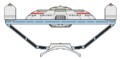
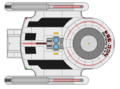
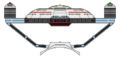
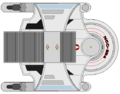
A more involving modification reintroduced the support pylons of the Oberths, this time lacking the plasma conduitry and instead reinforced to carry high structural loads. Extra fuel tanks were installed semi-internally and the resulting Fisher (NCC-xxx) light tugs were sent to replace the aging Ohio light tugs in Star Fleet service. The ships would haul single cargo pods or, sometimes, trains of empty or near-empty pods. The subclass of 93 was the most successful of all the Oberth spinoffs, and eased the workload on heavier tug designs significantly. The vessels were not decommissioned until the 2330s, by which time the standard cylindrar cargo pod had more or less been retired from all but Star Fleet use anyway. No direct successor design was thus needed for the Fishers.
The next step was a demonstration of the so-far theoretical procedure of conversion between podded and unpodded hull configurations. The Darwin was in 2293 equipped with a standard survey pod, her antimatter bunker relocated, and her interiors reworked to what amounted to showpiece standard. The resulting vessel was renamed to thematically match the Oberth subclass, becoming USS Thagard. The conversion process, performed largely on manufacturer expense, was a technological success and resulted in a celebrated starship, but saw no further operational applications.
Also in the early 2290s, two further variants under the general Garneau umbrella were introduced. First, the Fisher design was in 2292 hastily modified for military use in anticipation of a Klingon offensive, departing rather radically from the original Garneau aims. Some 62 Fisher hulls were finished to the Asmodeus light corvette configuration; the variant is described in Section II of this work.
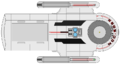
In 2293-2298, another 21 ships of Darwin descent were pressed to light supply duty. The Fjon (NCC-5063) subclass was to replace the fatigued Lena vessels, joining the heavier Pakokku (NCC-5046) and Krasnoyarsk (NCC-2350) supply ships in the effort of supporting Star Fleet across its suddenly increased regions of responsibility. To keep up with the growth, the Fjons were given a stretch: their cargo holds were enlarged significantly by extending Deck 4 aft by almost 40 meters, then up so that it faired smoothly with the saucer hull. The resulting two and a half decks of cargo space were given a large, single-piece dorsal loading door. The new spaces to both sides of engineering systems on Decks 2 and 3 were fitted as workshops and the rim of Deck 3 on the saucer was modified as well, eliminating the side docking ports and introducing a bow phaser bank. With the ability to carry almost four times the original cargo load, significant supercargo for crew rotation, and tooling for basic in situ repairs, the Fjons gained practical frontline tender capabilities.

The official maximum speed of warp 7 was regularly exceeded to meet the demanding schedules and the manufacturer limit was reset at the significantly faster warp 7.1 on the new scale in 2319, after the multiphasic breakthrough. None of the Fjons ever received multiphasic retuning, however; their engines kept pushing what internal diagnostics programs still defined as "warp 10+". The last Fjons were retired in 2329, and again replaced by higher-endurance Oberth derivatives, of Eyre subclass.
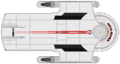
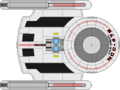
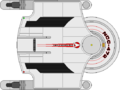
Some sources postulate a third 2290s subclass, the so-called "corsair" special operations vessel. Certain discrepancies between observed Fjon production numbers and Star Fleet documentation suggest that up to eight such vessels might have been completed, with either Lena or Fjon spaceframes but undisclosed special capabilities. Subclass name Greer, mentioned in several documents, may in fact be unrelated to this project, yet is believed to apply at least to a vessel of similar mission profile and general capabilities. While Star Fleet has confirmed the existence of other types of corsairs, such as the 2250s-70s Leonardo and Carbonare classes, major gaps still exist in records pertaining to 2280s-90s Star Fleet special operations.
The following century brought about a major change in the Garneau configuration, even if the basic subclass design was retained: double nacelles were installed on both sides for more malleable warp fields. Three subclasses utilized this configuration.
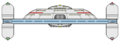
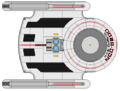
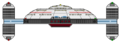
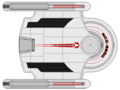
The Clarke supply ship was the simplest of the four-nacellers. Basically, she carried Lena internal gear, but with expanded fuel tanks, passenger quarters, a communications room, and a maximum security stowage facility built into the cargo holds. "Doubled-up" WD-3F engines on both sides increased cruise speed to modern warp 5 and allowed for dashes up to warp 7.9 in the courier missions that the ships were sometimes called to perform.
The so-called Todega deep space tug became the most popular light salvage vessel of the next five decades. Her impulse engines were doubled in power and in the number of nozzles, and a tractor beam and IMRF enveloping generator was suspended on the ventral pylons. The class possessed the capacity to tractor-tow ships up to Excelsior size at low warp speeds, yet Star Fleet only ordered the design in modest numbers. Its ambitions were set at greater speeds, ranges, and survivability offered by the Mediterranean class medium tugs. Two Fleet-operated Todegas were lost in deep space assignments during the border wars, one to a containment failure in the starship she was trying to recover, one to high speed debris in a post-battle wreckage field. There was some talk about arming the ships for the war zone, but the level of protection offered would have been minimal. No phasers were ever fitted, nor would there have been hardpoints, targeting systems, or even sufficient spare power for them.
The final four-nacelled variant was the Schmidt class salvage tug, adding even greater impulse muscle in the form of a dorsally-carried propulsion pod. The ventral tractoring system featured more compact field-enveloping generators, and a dedicated autopilot/datalink facilitated use of multiple tugs in the towing of the large modern starships, much in the fashion of the civilian ""superconvoy" operations.
Currently, none of the lightweight two-nacelled Oberth variants remain in Star Fleet service. A handful of Todega and Schmidt salvage vessels is kept in active service and larger numbers in reserve. Many civilian organizations still operate Fisher tugs, mainly for in-system cargo ops. Overall, the ships have been replaced in all Fleet roles by heavy Oberth derivatives, and they, in turn, by more modern, custom-built designs like the Nova class. Some consider the time ripe for the introduction of a new standardized lightweight starship family similar to the Garneau one, however, and major starship design agencies regularly pitch ideas to Star Fleet. At the moment, there is no definite Star Fleet requirement for such a family, but a major review of operational requirements is due after the analysis work on the Dominion conflict is completed. New economic realities stemming from adoption of replication technology may make it unnecessary or unwise to rely on a family of common-component ships.
Gallery
Other Images
-
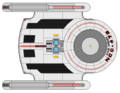
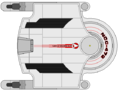
 Garneau, Lena, & Darwin subclasses
 -

-
-

-
-
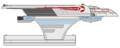 Fisher light tug
 -
-
-
-
-
 Fjon light supply ship
 -

-
-

-
-
 Greer special operations corsair
 -

-
-

-
-
 Clarke light supply ship
 -
-
-
-
-
 Todega deep space salvage tug
 -

-

-

-

-
 Schmidt deep space salvage tug
 -

-

-

-

_(bow).png)
_(dorsal).png)
_(stern).png)
_(ventral).png)
_(stbd).png)
_(bow).png)
_(dorsal).png)
_(stern).png)
_(ventral).png)
.png)
.png)
.png)
.png)
.png)
.png)
.png)
.png)
.png)
.png)
_(stbd).png)
_(bow).png)
_(dorsal).png)
_(stern).png)
_(ventral).png)
_(stdb).png)
_(bow).png)
_(dorsal).png)
_(stern).png)
_(ventral).png)
_(stdb).png)
_(bow).png)
_(dorsal).png)
_(stern).png)
_(ventral).png)
Notes
- Pre-creation of the article, this is what I've uncovered/decided, based on my reading of the Oberth and Garneau entries:
- The Garneau, Lena, & Darwin subclasses all share the same external features (and dimensions).
- Only one dozen Garneaus were constructed for Star Fleet; the other 22 were acquired by civilian concerns (presumably scientific organizations). The final operational year is 2279, as defined by the term "[t]owards the end of the 2270s".
- Darwin light surveyors complete a thorough core space resource mapping in the 2290s, ending Star Fleet’s need for light prospecting vehicles.[1]
- I decided the Lenas were fully decommissioned by 2302, with the arbitrary year of 2297 marking the start of the process.
- I've decided the Fisher started entering service in 2281, in preparation for the Ohio light fleet tugs' 2287 retirement (large quantities of both ships). The year 2335 was chosen (arbitrarily) for their own decommissioning in the "2330s". Also, while the Fisher could have been introduced pre-2271 (when the registry letter codes system was discontinued), that would mean they were operational at least 16 years before the Ohios were decommissioned, which is just far too early for a ship that is so small, its operational lifespan has been less than two decades (see the original Garneaus). Because of that, no Garneau-types will have registry letters.
- Unless Guide: Asmodeus indicates a new-build, the working presumption is that USS Asmodeus was the first Fisher subclass selected to undergo the tactical modification to the light corvette configuration.
- In 2286, the 23rd Darwin was completed. In 2293, USS Darwin was converted to the Oberth-type Gagarin subclass, leaving 22 Darwins. Between 2293 and 2298, 21 Darwins were converted to Fjon sublass. That leaves exactly one Darwin subclass vessel. Instead of having a single light surveyor continuing the original mission until...some time...I think it prudent to consider this unnamed ship as a casualty of some event, occurring no later than 2298, establishing 2298 as the end of the operational period of the Darwins.
- The Greer corsair subclass is not an urban myth. What I'm thinking is that the unnamed and leftover Darwin was originally the USS Greer, which served as a prototype for this special operator. Once that was approved, the seven most-capable Lenas were "decommissioned" and converted to Greer standards. I don't have a end operational date as-of-yet.
- The Clarke entered service in the first decade of the 24th century by my best understanding, so I arbitrarily chose 2304. I don't have a end operational date as-of-yet.
- The Todega served as "most popular light salvage vessel" for five decades. Since Timo takes the Hobbyist up until 2375, the range of decades is not wide. I've decided on an operational start date of 2309, which will cover most of that period (and the subclass remains active to the present time).
- The Schmidt is also a deep-space salvage tug, but apparently more modernized (relative to the Todega). Since it wouldn't necessarily be replacing the former, I'm envisioning it expanding the deep-space line of salvage vessels. So, to represent newer tech or unmet requirements, I'm thinking a minimum of 15 years from Todega production.
NCCs
- This is not stated anywhere in Timo, but the time frame for certain Garneau types means that these ships would have been originally commissioned with service ship letters in their registrations. Starting in 2271, they would be re-registered with standard NCCs. The following subclasses are so affected: Garneau & Lena.
- For the purposes of context, the following decisions regarding NCCs for the Garneau type are provided here:
- Garneau: These ships were originally categorized as "courier/scout" in the NCC registry, with the range of "Q582-Q593". In 2271, the range of "640-651" was assigned. For some reason, USS Garneau was the first ship built, but there is a preceding NCC (-640) that was applied to the subclass and given to a ship produced following her. In reality, it appears it was left open because the Oberth class USS Copernicus has both NCC-623 and -640 in fanon, with the former used in SFC. It may be explained away that an ordered ship was re-registered after the Garneau class was ordered.
- Lena: These ships were originally categorized as "transport/tug" in the NCC registry, with the range of "F1432-F1449". In 2271, the range of "5028-5045" was assigned.
Alt Sources
- Star Fleet Reference Manual v1, Fisher, pp. 142-145
- Star Fleet Reference Manual v2, Greer (as Orca?), pp. 60-63
- Star Fleet Reference Manual v3: Todega, pp 123-126
- Starfleet Protoype 2291-2292:
- Clarke, p 82
- Greer, p 81
- Schmidt, pp. 61-62
References