Guide:Okinawa: Difference between revisions
| (31 intermediate revisions by the same user not shown) | |||
| Line 4: | Line 4: | ||
|category= light frigate | |category= light frigate | ||
|years= [[2260]]-[[2299]] | |years= [[2260]]-[[2299]] | ||
* Okinawa (light frigate): [[2260]]-[[xxxx]] | * ''Okinawa'' (light frigate): [[2260]]-[[xxxx]] | ||
* Okinawa Flt II (light frigate): [[ | * ''Okinawa'' Flt II (light frigate): [[2271]]-[[2299]] | ||
* ''Okinawa'' Flt III (survey frigate): [[2290]]-[[2299]] | |||
|constructed= 44<br> | |constructed= 44<br> | ||
* Okinawa: | * ''Okinawa'': 44 (built [[2259]]-[[2264]]) | ||
* Okinawa Flt II: | * ''Okinawa'' Flt II: 22 (converted ''Okinawas'' [[2271]]-[[2272]]) | ||
* ''Okinawa'' Flt III: 4 (converted Flight IIs [[2290]]) | |||
|length= <br> | |length= <br> | ||
* Flt I: 164.2 m | * Flt I: 164.2 m | ||
* Flt II: 183.0 m | * Flt II/III: 183.0 m | ||
|beam= 90.0 m | |beam= 90.0 m | ||
|height= 20.4 m | |height= 20.4 m | ||
|mass= <br> | |mass= <br> | ||
* Flt I: 230,000 mt | * Flt I: 230,000 mt | ||
* Flt II: 411,000 mt | * Flt II/III: 411,000 mt | ||
|cruisespeed= w 5 | |cruisespeed= w 5 | ||
|towspeed= | |towspeed= | ||
|maxspeed= <br> | |maxspeed= <br> | ||
* Flt I: w 7 | * Flt I: w 7 | ||
* Flt II: w 8 | * Flt II/III: w 8 | ||
|endurance= 2 years | |endurance= 2 years | ||
|officers= 12 | |officers= 12 | ||
| Line 37: | Line 39: | ||
* 3x phaser V emitters (fwd/port/stbd bridge) | * 3x phaser V emitters (fwd/port/stbd bridge) | ||
* 1x phaser V emitter (ventral secondary hull) | * 1x phaser V emitter (ventral secondary hull) | ||
<u> | <u>Flight III (NCC-1257, 1269, 1285, 1292) ([[2290]])</u> | ||
* 3x phaser V emitters (fwd/port/stbd bridge) | * 3x phaser V emitters (fwd/port/stbd bridge) | ||
* 1x phaser V emitter (ventral secondary hull) | * 1x phaser V emitter (ventral secondary hull) | ||
* 4x phaser IV emitters (twin banks) (dorsal secondary hull flanks) | * 4x phaser IV emitters (twin banks) (dorsal secondary hull flanks) | ||
|missileweapons= <br> | |missileweapons= <br> | ||
<u>Flights I, III</u>: none <br> | |||
<u>Flight II</u> | <u>Flight II</u> | ||
* 2x medium torpedo tubes (w/ 10-20 photon torpedoes) (ventral secondary hull) | * 2x medium torpedo tubes (w/ 10-20 photon torpedoes) (ventral secondary hull) | ||
| Line 50: | Line 53: | ||
* 1x Navigational deflector dish (fwd secondary hull) | * 1x Navigational deflector dish (fwd secondary hull) | ||
* 2x Auxiliary navigational deflector emitters (bow) | * 2x Auxiliary navigational deflector emitters (bow) | ||
<u> | <u>Flights II, III</u> | ||
* 1-layer graviton/subspace globular forcefield | * 1-layer graviton/subspace globular forcefield | ||
* 1x Navigational deflector dish (fwd secondary hull) | * 1x Navigational deflector dish (fwd secondary hull) | ||
* 1x Auxiliary navigational deflector emitter (ventral primary hull) | * 1x Auxiliary navigational deflector emitter (ventral primary hull) | ||
|labs=<br> | |labs=<br> | ||
<u> | <u>Flights I, II</u>: none<br> | ||
<u> | <u>Flight III (NCC-1257, 1269, 1285, 1292) ([[2290]])</u> | ||
* 1x astrophysics/astrographics | * 1x astrophysics/astrographics | ||
|transporters=<br> | |transporters=<br> | ||
| Line 62: | Line 65: | ||
* 1x GP (3-pad); Mk III | * 1x GP (3-pad); Mk III | ||
* 1x emergency evacuation (22-pad); Mk III | * 1x emergency evacuation (22-pad); Mk III | ||
<u> | <u>Flights II, III</u> | ||
* 1x GP (6-pad); Mk IV | * 1x GP (6-pad); Mk IV | ||
* 1x emergency evacuation (22-pad); Mk IV | * 1x emergency evacuation (22-pad); Mk IV | ||
| Line 71: | Line 74: | ||
* ''USS Great Lakes / USS R. L. Stevenson'' (NCC-1281) | * ''USS Great Lakes / USS R. L. Stevenson'' (NCC-1281) | ||
* ''USS Lake Pontchartrain'' (NCC-1280) | * ''USS Lake Pontchartrain'' (NCC-1280) | ||
* ''USS Okinawa'' | |||
* ''USS Shikotan'' (NCC-1252) | * ''USS Shikotan'' (NCC-1252) | ||
* ''USS Uvs Nuur'' (NCC-1286) | * ''USS Uvs Nuur'' (NCC-1286) | ||
| Line 82: | Line 86: | ||
While the ''[[Guide: Achernar|Achernar]]'' project sought to directly expand [[Star Fleet]]’s reach through export sales, the | While the ''[[Guide: Achernar|Achernar]]'' project sought to directly expand [[Star Fleet]]’s reach through export sales, the | ||
New Light Frigate initiative of [[ | New Light Frigate initiative of [[2258]] made use of commercial processes in a less direct manner. The | ||
great success of the compact ''[[Guide: Procyon|Procyon]]''/''[[Guide: Centaurus|Centaurus]]'' corvettes had attracted the attention of several | great success of the compact ''[[Guide: Procyon|Procyon]]''/''[[Guide: Centaurus|Centaurus]]'' corvettes had attracted the attention of several | ||
foreign operators, and many of these had approached Star Fleet in order to secure contact with the | foreign operators, and many of these had approached Star Fleet in order to secure contact with the | ||
| Line 92: | Line 96: | ||
for its own use. | for its own use. | ||
Basic ''Procyon'' elements were retained in the enlarged design, including a potent, centrally mounted | Basic ''Procyon'' elements were retained in the enlarged design, including a potent, centrally mounted antimatter powerplant; a flat layout of a saucer primary hull, aft-extending engineering section and laterally rigged nacelles; and an armament of multiple heavy beam cannon. The combination of a 90-meter primary hull, twin SAE impulse engines and two PB-38 nacelles was extremely agile at sublight and swift at warp. There was power to burn from the [[RMR-8 dilithium-regulated reactor]], and two tactical applications to do the burning: one ventral and three single dorsal banks of Type V phasers, and a single Hycor forcefield generator. Essentially, the '''''Okinawa''''' (as the inaugural New Light Frigate was named at the October [[2260]] launch) approached the "half a frigate" doctrine of the perimeter ships from the opposite direction, being "twice a corvette" instead and sacrificing a little bit of firepower for superior endurance and versatility. | ||
antimatter powerplant; a flat layout of a saucer primary hull, aft-extending engineering section and | |||
laterally rigged nacelles; and an armament of multiple heavy beam cannon. The combination of a 90 | |||
and swift at warp. There was power to burn from the RMR-8 dilithium-regulated reactor, and two | |||
tactical applications to do the burning: one ventral and three single dorsal banks of Type V phasers, | |||
and a single Hycor forcefield generator. Essentially, the '''''Okinawa''''' (as the inaugural New Light | |||
Frigate was named at the October [[2260]] launch) approached the | |||
perimeter ships from the opposite direction, being | |||
bit of firepower for superior endurance and versatility. | |||
Star Fleet soon found that adding at least one torpedo launcher would be tactically desirable. | Star Fleet soon found that adding at least one torpedo launcher would be tactically desirable. | ||
| Line 108: | Line 103: | ||
would have watered down that escalation measure. With the originally chosen standard of equip, | would have watered down that escalation measure. With the originally chosen standard of equip, | ||
and with the perimeter ship program out of the way, the ''Okinawa'' could be constructed in significant | and with the perimeter ship program out of the way, the ''Okinawa'' could be constructed in significant | ||
numbers, 44 units being completed by [[2265]]. Four of these were dedicated to training, and featured | numbers, 44 units being completed by [[2264|2265]]. Four of these were dedicated to training, and featured | ||
added crew berthing but commensurately reduced sensors and analysis spaces. Others saw action in | added crew berthing but commensurately reduced sensors and analysis spaces. Others saw action in | ||
star system defense duty, more or less becoming ‘rich man’s ''Procyon''’ at priority theaters. | star system defense duty, more or less becoming ‘rich man’s ''Procyon''’ at priority theaters. | ||
Throughout the decade, the ''Okinawas'' still struggled to become more than system defenders. The | Throughout the [[2260s|decade]], the ''Okinawas'' still struggled to become more than system defenders. The | ||
levels of Klingon aggression and pirate activity varied unpredictably, and so did the need for | levels of Klingon aggression and pirate activity varied unpredictably, and so did the need for | ||
defenses – but there was a more or less constant need for fleet outriders and deep space escorts. | defenses – but there was a more or less constant need for fleet outriders and deep space escorts. | ||
| Line 141: | Line 136: | ||
cruiser forces on deployments, but rely greatly on starbase and tender support. In return, they would | cruiser forces on deployments, but rely greatly on starbase and tender support. In return, they would | ||
partake in some traffic control and spacelane protection; half the refitted force would in fact be | partake in some traffic control and spacelane protection; half the refitted force would in fact be | ||
flagged for the [[Federation Customs Service|FCS]]. These varied operations put a wide spectrum of strain on the spaceframes and | [[2275|flagged]] for the [[Federation Customs Service|FCS]]. These varied operations put a wide spectrum of strain on the spaceframes and | ||
engines. As was the lot of small starships of all designs, the ''Okinawa'' class was soon facing another | engines. As was the lot of small starships of all designs, the ''Okinawa'' class was soon facing another | ||
round of vitally important overhauls and refits. | round of vitally important overhauls and refits. | ||
| Line 155: | Line 150: | ||
Retirement for the veteran ''USS Avalon'' (NCC-1270) came in [[2299]]; she had not been the last to | Retirement for the veteran ''USS Avalon'' (NCC-1270) came in [[2299]]; she had not been the last to | ||
leave dockyards at [[Daran V]], but could thank an ultimately uneventful career for her longevity. | leave dockyards at [[Daran V]], but could thank an ultimately uneventful career for her longevity. | ||
Seven ''Okinawas'' had been lost during the [[2270s]] adventurism, one in the [[ | Seven ''Okinawas'' had been lost during the [[2270s]] adventurism, one in the [[2260s|preceding decade]] of | ||
defensive operations. In broad terms, Star Fleet had gotten exactly the sort of gap-filler it had hoped | defensive operations. In broad terms, Star Fleet had gotten exactly the sort of gap-filler it had hoped | ||
for when initiating production in [[ | for when initiating production in [[2259]], and the continuing ''Okinawa'' operations in the last two | ||
decades of the [[23rd century|century]] were an unexpected bonus. With similarly shaped but more optimally | decades of the [[23rd century|century]] were an unexpected bonus. With similarly shaped but more optimally | ||
configured perimeter ships and corvettes now in abundance, the post-Khitomer Star Fleet was happy | configured perimeter ships and corvettes now in abundance, the [[2293|post-Khitomer]] Star Fleet was happy | ||
to donate the surviving light frigate stock to use by UFP research organizations. Individual | to donate the surviving light frigate stock to use by UFP research organizations. Individual | ||
examples continue to serve in esoteric roles even as of this writing, thanks in part to the excessive | examples continue to serve in esoteric roles even as of this writing, thanks in part to the excessive | ||
| Line 171: | Line 166: | ||
File:Okinawa (dorsal).png | File:Okinawa (dorsal).png | ||
File:Okinawa (refit) (stbd).png|''Okinawa'' class (2271 refit) | File:Okinawa (refit) (stbd).png|''Okinawa'' class ([[2271]] refit) | ||
File:Okinawa (refit) (bow).png | File:Okinawa (refit) (bow).png | ||
File:Okinawa (refit) (dorsal).png | File:Okinawa (refit) (dorsal).png | ||
File:Patrol From Above.png|"Patrol From Above" | File:Patrol From Above.png|"Patrol From Above" | ||
File:Okinawa (2-view).png|2-view | |||
File:Okinawa (6-view).png|6-view | |||
</gallery> | </gallery> | ||
| Line 184: | Line 181: | ||
* As "New Light Frigate initiative" would seem to indicate a new policy that led to the development of the ''Okinawa'', I've moved this specific year back from [[2260]] to [[2258]]. | * As "New Light Frigate initiative" would seem to indicate a new policy that led to the development of the ''Okinawa'', I've moved this specific year back from [[2260]] to [[2258]]. | ||
* | * Clarification on the completion of the initial production of the first flight: the 44th was finished '''by''' [[2265]], so the range for production ends in [[2264]]. | ||
* The first caption says the "early production run" were named after "islands of conflict", while the second caption indicates the "latter half of the production run" is named after lakes. I've chosen to dictate that the first 22 built were the island-names, and the remainder after lakes. | |||
* The hull number (NCC-1250) for ''USS Okinawa'' is presumed, though it must fall before NCC-1252 (''USS Shikotan'') and would appear to be after NCC-1249, which may be reserved for the ''Benning'' class. | |||
* The ''USS R.L. Stevenson'' is, of course, named after Robert Louis Stevenson, author of ''Treasure Island''. The name change (from ''USS Great Lakes'') is arbitrarily determined to have taken place in [[2265]]. | |||
* The following ships are confirmed to have been refitted to Flight II configuration; the asterisk indicates later refitted to Flight III: | |||
** ''USS Okinawa'' (NCC-1250) | |||
** ''USS Shikotan'' (NCC-1252) | |||
** (NCC-1257)* | |||
** (NCC-1269)* | |||
** ''USS Avalon'' (NCC-1270) | |||
** ''USS Lake Pontchartrain'' (NCC-1280) | |||
** (NCC-1285)* | |||
** ''USS Uvs Nuur'' (NCC-1286) | |||
** (NCC-1292)* | |||
: A total of 22 ships are refitted to Flight II configuration. | |||
* | * "Star Fleet had gotten exactly the sort of gap-filler it had hoped for when initiating production in [[2260]]" is changed to [[2259]], to reflect when construction actually started. | ||
==References== | ==References== | ||
Latest revision as of 09:31, 5 August 2023
.png)
| |
| Okinawa | |
|---|---|
| Class Overview | |
| Category | light frigate |
| Operational | 2260-2299 |
| Constructed | 44 |
| Dimensions | |
| Length |
|
| Beam | 90.0 m |
| Height | 20.4 m |
| Mass |
|
| Performance | |
| Cruise Speed | w 5 |
| Max Speed |
|
| Endurance | 2 years |
| Complement | |
| Officers | 12 |
| Enlisted | 78
|
| Tactical Systems | |
| Beam Weapons | Flight I
Flight II
Flight III (NCC-1257, 1269, 1285, 1292) (2290)
|
| Missile Weapons | Flights I, III: none
|
| Shields | Flight I
Flights II, III
|
| Laboratories | Flights I, II: none
|
| Transporters | Flight I
Flights II, III
|
| Auxiliary Craft |
|
| Historical | |
| Ships of Note |
|
| Canonicity | |
| Design | SFC II, Klingon Academy |
| Name | SFC II, Klingon Academy |
| History | SFC II, Diane Carey, Diane Duane, own
|

While the Achernar project sought to directly expand Star Fleet’s reach through export sales, the New Light Frigate initiative of 2258 made use of commercial processes in a less direct manner. The great success of the compact Procyon/Centaurus corvettes had attracted the attention of several foreign operators, and many of these had approached Star Fleet in order to secure contact with the government team of designers and shipbuilders behind the Procyon. It was in Star Fleet’s interest to moderate the foreign access to such technologies, not to block it altogether. In the early 2250s, downgraded export models were created, with Star Fleet having a say in every design aspect and choosing to limit performance and growth potential. Towards the end of the decade, the design was allowed to grow in size, speed and power instead: Star Fleet now hoped to turn it into a light frigate for its own use.
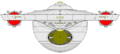
Basic Procyon elements were retained in the enlarged design, including a potent, centrally mounted antimatter powerplant; a flat layout of a saucer primary hull, aft-extending engineering section and laterally rigged nacelles; and an armament of multiple heavy beam cannon. The combination of a 90-meter primary hull, twin SAE impulse engines and two PB-38 nacelles was extremely agile at sublight and swift at warp. There was power to burn from the RMR-8 dilithium-regulated reactor, and two tactical applications to do the burning: one ventral and three single dorsal banks of Type V phasers, and a single Hycor forcefield generator. Essentially, the Okinawa (as the inaugural New Light Frigate was named at the October 2260 launch) approached the "half a frigate" doctrine of the perimeter ships from the opposite direction, being "twice a corvette" instead and sacrificing a little bit of firepower for superior endurance and versatility.
Star Fleet soon found that adding at least one torpedo launcher would be tactically desirable. Versatility in turn suffered from the lack of shuttle support facilities, but adding these would have negated the advantages of the program just as surely as installing a shuttlebay on a Kiaga PA ship would have watered down that escalation measure. With the originally chosen standard of equip, and with the perimeter ship program out of the way, the Okinawa could be constructed in significant numbers, 44 units being completed by 2265. Four of these were dedicated to training, and featured added crew berthing but commensurately reduced sensors and analysis spaces. Others saw action in star system defense duty, more or less becoming ‘rich man’s Procyon’ at priority theaters.
Throughout the decade, the Okinawas still struggled to become more than system defenders. The levels of Klingon aggression and pirate activity varied unpredictably, and so did the need for defenses – but there was a more or less constant need for fleet outriders and deep space escorts. Such assignments called for dedicated hardware: search for a suitable torpedo launcher went on in parallel with a quest for new engines. Instead of the dash prowess of PB-38, Defense Command now wanted deep space endurance; instead of the affordable reliability of the Mk 13 launchers of the gradually shaping escort fleet, it wanted decisive hitting power. As starships in this category were still being designed for export, Star Fleet could once again insert its requests for trying out various types of hardware. A series of foreign sales scandals seriously hampered this mode of search for optimal hardware, though.
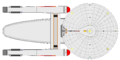
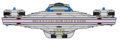
Perhaps this delay was for the better, as in the 2270s Star Fleet gained access to all-new propulsion technologies of great performance. Half the Okinawa force was recalled for the fitting of LN-23 linear excitation engines that would give them warp 8 dash speed and double their warp endurance. Simultaneously installed would be Mk 14 light torpedo armament, comprising two fast-firing launchers at secondary hull bottom.
The refits were less of a success than Star Fleet had expected. Unlike Cochrane Warp Dynamics’ LN- 61, the competing Pleshun engine was robustly over-engineered for high power, high speed applications, none of which would in fact emerge for it. There was too much coil mass, too little emphasis on economy, and subsequently most of the endurance gains failed to materialize. Increased dash speed was achieved at the cost of reduced sublight agility, despite the installation of a heavy duty IMRF system.
Thus not quite capable of independent deep space operations, yet too potent to remain tied down with system defense duty, vessels of this type became integral elements of defense fleets along the antispinward and rimward borders. Essentially serving as agile destroyers, they would accompany cruiser forces on deployments, but rely greatly on starbase and tender support. In return, they would partake in some traffic control and spacelane protection; half the refitted force would in fact be flagged for the FCS. These varied operations put a wide spectrum of strain on the spaceframes and engines. As was the lot of small starships of all designs, the Okinawa class was soon facing another round of vitally important overhauls and refits.
Technological development was not to be the salvation for the class, though, but its demise. During its decade of pedestrian performance on the substandard LN-23, modern perimeter ship and corvette designs had rushed past on both sides, and the definition of light frigate had crept up to the level of Daran class, leaving the Okinawa in definite Defense Command disfavor. The former first-rate fleet outriders mostly found themselves stuck with scouting and survey missions. On such duty, the installation of onboard laboratories on select vessels at least provided an edge over surveillance-tasked corvettes, allowing four of the light frigates to serve on past the 2287 détente cutbacks.
Retirement for the veteran USS Avalon (NCC-1270) came in 2299; she had not been the last to leave dockyards at Daran V, but could thank an ultimately uneventful career for her longevity. Seven Okinawas had been lost during the 2270s adventurism, one in the preceding decade of defensive operations. In broad terms, Star Fleet had gotten exactly the sort of gap-filler it had hoped for when initiating production in 2259, and the continuing Okinawa operations in the last two decades of the century were an unexpected bonus. With similarly shaped but more optimally configured perimeter ships and corvettes now in abundance, the post-Khitomer Star Fleet was happy to donate the surviving light frigate stock to use by UFP research organizations. Individual examples continue to serve in esoteric roles even as of this writing, thanks in part to the excessive robustness of the warp engine that cost them their original career.
Gallery
-
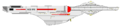 Okinawa class
 -
-
-
 Okinawa class (2271 refit)
 -
-

-
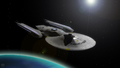 "Patrol From Above"
 -
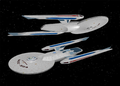 2-view
 -
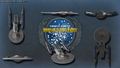 6-view
.png)
.png)
_(stbd).png)
_(bow).png)
_(dorsal).png)

.png)
.png)
Notes
- Adrasil: The "original" view does not seem appropriate for a light frigate. It should look like a TOS ship of the refitted version, especially in profile and bow views.
- As "New Light Frigate initiative" would seem to indicate a new policy that led to the development of the Okinawa, I've moved this specific year back from 2260 to 2258.
- Clarification on the completion of the initial production of the first flight: the 44th was finished by 2265, so the range for production ends in 2264.
- The first caption says the "early production run" were named after "islands of conflict", while the second caption indicates the "latter half of the production run" is named after lakes. I've chosen to dictate that the first 22 built were the island-names, and the remainder after lakes.
- The hull number (NCC-1250) for USS Okinawa is presumed, though it must fall before NCC-1252 (USS Shikotan) and would appear to be after NCC-1249, which may be reserved for the Benning class.
- The USS R.L. Stevenson is, of course, named after Robert Louis Stevenson, author of Treasure Island. The name change (from USS Great Lakes) is arbitrarily determined to have taken place in 2265.
- The following ships are confirmed to have been refitted to Flight II configuration; the asterisk indicates later refitted to Flight III:
- USS Okinawa (NCC-1250)
- USS Shikotan (NCC-1252)
- (NCC-1257)*
- (NCC-1269)*
- USS Avalon (NCC-1270)
- USS Lake Pontchartrain (NCC-1280)
- (NCC-1285)*
- USS Uvs Nuur (NCC-1286)
- (NCC-1292)*
- A total of 22 ships are refitted to Flight II configuration.
- "Star Fleet had gotten exactly the sort of gap-filler it had hoped for when initiating production in 2260" is changed to 2259, to reflect when construction actually started.
References