Guide:Centaurus

| |
| Centaurus | |
|---|---|
| Class Overview | |
| Category | courier/scout |
| Operational | 2244-2288 |
| Constructed | 40 (2244-2250) |
| Dimensions | |
| Length | 145.0 m |
| Beam | 69.7 m |
| Height | 20.8 m |
| Mass |
|
| Performance | |
| Max Speed | w 6.9 |
| Endurance | 3 months |
| Complement | |
| Officers | 3 |
| Enlisted | 26
|
| Passengers | 10 VIP (or 80 standard) |
| Cargo | 3,000 mt (in lieu of passengers) |
| Tactical Systems | |
| Beam Weapons | 1x phaser V emitter (ventral primary hull, fwd sensors)
|
| Shields |
|
| Transporters | 1 GP (2-pad); Mk II |
| Historical | |
| Ships of Note |
|
| Canonicity | |
| Design | Concordance / Brian Pimenta |
| Name | SD Perry “S31: Cloak”, LUG |
| History | Timo, SD Perry “S31: Cloak”, LUG
|
Project Procyon, Star Fleet’s effort to create a corvette capable of patrolling entire star systems, spawned in 2244 a breakthrough in small vessel warp propulsion. The PB-34 nacelles and the compact KR-05P antimatter powerplant were immediately earmarked for use in two other projects topical at the time: a high-warp courier for both diplomatic and military use, and a small scout or advance surveyor. Yet the development of new small starship classes was in the event deemed unnecessary. Highly positive early experiences from operating standard Procyons in these roles prompted a swift down-select to a type minimally modified from the corvette design. A smooth introduction of the mission-dedicated types in parallel construction ensured that by 2251, Star Fleet possessed forty thoroughly modern multi-purpose couriers and scouts, formally grouped under the class name Centaurus, despite the theoretical interchangeability of the three designs.
Naturally, in a spaceframe this cramped, configuring for one mission necessarily meant removing of all gear intended for other roles. Externally observable, but requiring a trained eye, were the omissions of the dorsal phasers and the revolving mine dispenser. Internally, the saucer was gutted of fire control and combat support hardware to provide improved accommodation. Endurance was boosted with the dedication of the faired-over mine dispenser berth to fuel storage, and the transporter room and surrounding facilities were modified.
In the courier role, accommodation and amenities for four VIP parties were provided, although the luxury facilities could be rapidly dismantled and stowed away to allow the ship to transport a maximum of 80 passengers or up to 3,000 tons of priority cargo. In scouting duty, all internal gear in the compartments was simply omitted to save weight. Actual scouting sensor payloads still remain largely classified.
Although the ventral phaser assembly was still carried, it was typical to shut down the phaser power feeds in flight, so that all power could be directed to warp propulsion. Different power allocation protocols were in the end the primary reason for the high top speed of the courier and scout versions in comparison with the corvettes. A Centaurus class courier could achieve warp 6.9 safely enough and sustain warp 6 for the duration of an interstellar journey. Dash speeds of warp 7.3 were reputedly reached during scouting missions.

The Centaurus couriers were among the long-lived classes that saw their mission-coded registries converted to regular NCC numbers, in this case simply by dropping the prefix letter. The last units were retired in the late 2280s, after decades of constant and demanding service. Many had succumbed to wear and tear along the way, but only two had met a violent end. USS Sphinx (NCC-D853) was sabotaged in 2265 by unidentified foreign operatives and burned out her powerplant at extreme warp, at which point the crew was already dead due to life support shutdown. USS Typhon (NCC-D867) in turn was, in 2286, ransacked by pirates readily identifiable as Elasi, and just as readily traceable to the Klingon intelligence payroll. As the result of the raid, data on Star Fleet defensive sensor networks in the Archanis sector was assumed compromised, and the whole Firechain tripwire system had to be abandoned at the worst possible moment.
On the positive side, scouting missions brought in significant intelligence on Klingon spacelanes and garrison chains, despite the limited range and speed of the small scouts. The original Centaurus force met Fleet short-range scouting needs through the Organian peace and well into the 2270s. A refit in 2279 would give some of the vessels a significant engine upgrade, described in a later entry.
Gallery
-
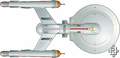 Dorsal
 -
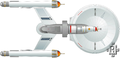 Ventral
.png)
.png)
Notes
- It is my opinion, based upon Timo's external description, that the Procyon does not have that dangling pod leading the secondary bow. I believe this feature is more likely to exist on the Centaurus class, instead.
- The Centaurus class is originally registered with the prefix "I", for "Intelligence ship"; in 2266, the remaining ships are re-registered as "D", for "courier/scout".
References
Alt Sources