Guide:Grayson: Difference between revisions
No edit summary |
|||
| (8 intermediate revisions by the same user not shown) | |||
| Line 14: | Line 14: | ||
|height= <br> | |height= <br> | ||
* 39.2 m (''Grayson, Finch'') | * 39.2 m (''Grayson, Finch'') | ||
* | * 39.0 m (''Andromakhe'') | ||
|mass= <br> | |mass= <br> | ||
* 116,300 tons (''Grayson'') | * 116,300 tons (''Grayson'') | ||
| Line 36: | Line 36: | ||
|crew= | |crew= | ||
|cargo= <br> | |cargo= <br> | ||
* | * 10 stored buoys (''Grayson'') | ||
* | * 20 stored buoys (''Finch, Andromakhe'') | ||
|beamweapons= <br> | |beamweapons= <br> | ||
<u>''Grayson''</u> | <u>''Grayson''</u><br> | ||
none | none<br> | ||
<u>''Finch, Andromakhe''</u> | <u>''Finch, Andromakhe''</u> | ||
* 1x phaser IV (dorsal bow) | * 1x phaser IV (dorsal bow) | ||
| Line 59: | Line 58: | ||
|auxcraft= 1x buoy recovery shuttle/drone | |auxcraft= 1x buoy recovery shuttle/drone | ||
|historicalships=<br> | |historicalships=<br> | ||
* ''USS Bollard'' (NCC-R731) | |||
* ''USS Grayson'' (NCC-R500) | * ''USS Grayson'' (NCC-R500) | ||
* ''USS Finch'' (NCC-R630) | * ''USS Finch'' (NCC-R630) | ||
| Line 66: | Line 66: | ||
|history= FASA | |history= FASA | ||
}} | }} | ||
Boosting the flow of physical materiel was but a preamble of the challenge thrown at | Boosting the flow of physical materiel was but a preamble of the challenge thrown at [[Star Fleet Logistics]] | ||
by Project Starship. Getting the Fleet deployed to the frontier called for more | |||
than just fuel and supplies: the bold new ships would be hopelessly lost without a network of | than just fuel and supplies: the bold new ships would be hopelessly lost without a network of | ||
sensors and communications relays, never in the right place at the right time. In 2240, the | sensors and communications relays, never in the right place at the right time. In [[2240]], the | ||
Federation had some six million communications buoys and two million sensor platforms in | [[Federation]] had some six million communications buoys and two million sensor platforms in | ||
operational condition. For operating the new fleet in an efficient manner, at least twenty million | operational condition. For operating the new fleet in an efficient manner, at least twenty million | ||
additional buoys would have to be sown, and regular maintenance performed on the network. | additional buoys would have to be sown, and regular maintenance performed on the network. | ||
To be sure, | To be sure, [[Star Fleet]] was not supposed to bear this burden alone, if at all. UFP Transit Authority, | ||
founded in 2171 to coordinate the maintenance of spacelanes outside the areas of responsibility of | founded in [[2171]] to coordinate the maintenance of spacelanes outside the areas of responsibility of | ||
individual star systems, had so far performed the task adequately. The traffic control net was still | individual star systems, had so far performed the task adequately. The traffic control net was still | ||
fragile and subject to local acts of sabotage, but most UFP systems were at least interconnected with | fragile and subject to local acts of sabotage, but most UFP systems were at least interconnected with | ||
| Line 84: | Line 84: | ||
The expanded theater of starship operations called for tripling of this capacity at the very least. It | The expanded theater of starship operations called for tripling of this capacity at the very least. It | ||
was obvious that the most significant UFP presence in the areas of expansion would be | was obvious that the most significant UFP presence in the areas of expansion would be Star Fleet’s, | ||
and that there would initially be little return from civilian investment there. The Council agreement | and that there would initially be little return from civilian investment there. The Council agreement | ||
of 2243 placed the responsibility of traffic control network erection and maintenance on exploration | of [[2243]] placed the responsibility of traffic control network erection and maintenance on exploration | ||
zones between 100 and 1,000 ly away squarely on | zones between 100 and 1,000 ly away squarely on Star Fleet, which delegated the chore to Logistics | ||
Command. The division chief, Rear | Command. The division chief, Rear Admiral Martela Nabo Ib, was aware that exploratory starships | ||
would be quite tied up with sowing military communications nets, and could not be tasked with | would be quite tied up with sowing military communications nets, and could not be tasked with | ||
traffic control buoy deployment, let alone maintenance. It therefore requested that a new type of | traffic control buoy deployment, let alone maintenance. It therefore requested that a new type of | ||
tender be developed and fielded for the task. | tender be developed and fielded for the task. | ||
The Denevan shipbuilder and designer AsTrans had gained a reputation as provider of good, solid | The [[Deneva|Denevan]] shipbuilder and designer [[AsTrans]] had gained a reputation as provider of good, solid | ||
working vessels suited for deep space. Until the mid-23rd century, these generally lacked in speed, | working vessels suited for deep space. Until the [[23rd century|mid-23rd century]], these generally lacked in speed, | ||
however. When | however. When Star Fleet made the solid-state PB-35 engine available to AsTrans, this was no | ||
longer a problem: the popular Karoo 118 m medium freighter could reach warp seven when | longer a problem: the popular ''Karoo'' 118 m medium freighter could reach warp seven when | ||
propelled by the military engine. With this vessel as the basis, AsTrans in 2247 formulated the | propelled by the military engine. With this vessel as the basis, AsTrans in [[2247]] formulated the | ||
desired buoy tender. Beyond the drive system upgrade, minimal modifications were needed, for the | desired buoy tender. Beyond the drive system upgrade, minimal modifications were needed, for the | ||
mission gear was carried in a separate section that took the place of the freight container. Thus, the | mission gear was carried in a separate section that took the place of the freight container. Thus, the | ||
| Line 109: | Line 109: | ||
ventral grapples. | ventral grapples. | ||
[[Image:No Photo Available.jpg|left|200px|thumb|Maintaining the Firechain. Two crew from USS Bollard (NCC-R731) of Finch | [[Image:No Photo Available.jpg|left|200px|thumb|Maintaining the Firechain. Two crew from ''USS Bollard'' (NCC-R731) of ''Finch'' subclass work on a stealthy sensor buoy ''in situ'', an atypical way of handling repairs on a seemingly intact and controllable device. Modern transporters offered rapid spacewalk access to buoys, though, and might provide the swiftest way to perform simple maintenance tasks. Speed was indeed of essence in keeping the approximately 800,000 sensor platforms of the Firechain operational from the [[2250s]] to the [[2280s]]. So was range, as the ''Bollard'' here is operating some forty lightyears from the nearest truly secure [[Star Fleet]] facility.]] | ||
The mission pod was a coffin shape 80 m long, 20 m wide and 14 m high. At the bow was an | The mission pod was a coffin shape 80 m long, 20 m wide and 14 m high. At the bow was an | ||
| Line 116: | Line 116: | ||
buoys could be recharged at a time, two manually repaired or overhauled on well equipped | buoys could be recharged at a time, two manually repaired or overhauled on well equipped | ||
workbenches, and ten stored for later deployment. The processing capacity thus was markedly | workbenches, and ten stored for later deployment. The processing capacity thus was markedly | ||
greater than on | greater than on in-system and short range interstellar tenders, yet not directly proportional to the size | ||
of the vessel. With a high percentage of the interior dedicated to spares, little room was left for | of the vessel. With a high percentage of the interior dedicated to spares, little room was left for | ||
undue loitering in the cramped workplace. Since the main body of the vessel offered few | undue loitering in the cramped workplace. Since the main body of the vessel offered few | ||
| Line 123: | Line 123: | ||
mission length. | mission length. | ||
Seventy of the tenders were ordered under the class name Grayson for the immediate needs of the | Seventy of the tenders were ordered under the class name '''''Grayson''''' for the immediate needs of the | ||
buoy deployment program, and crews were trained in a true ‘crash program’ that resulted in several | buoy deployment program, and crews were trained in a true ‘crash program’ that resulted in several | ||
bumps and bruises to the hardware. The first two years of operations exposed two main | bumps and bruises to the hardware. The first two years of operations exposed two main | ||
| Line 140: | Line 140: | ||
The enlarged and customized variant was nearly twice the mass and half again the price of the | The enlarged and customized variant was nearly twice the mass and half again the price of the | ||
original, yet was ordered in considerable numbers. Some 150 of the vessels, seldom called by the | original, yet was ordered in considerable numbers. Some 150 of the vessels, seldom called by the | ||
subclass name Finch, were manufactured at Deneva, Jaltus and Morena, at a rate matching the | subclass name '''''Finch''''', were manufactured at Deneva, [[Jaltus]] and [[Morena]], at a rate matching the | ||
demand for replacement hulls. While the original Graysons continued operations in areas where | demand for replacement hulls. While the original ''Graysons'' continued operations in areas where | ||
their lack of armament was of no serious concern, they were wearing down their PB-35Bs at an | their lack of armament was of no serious concern, they were wearing down their PB-35Bs at an | ||
alarming rate. The first original batch vessels to go to the reserves in 2262 were sent to mothballs | alarming rate. The first original batch vessels to go to the reserves in [[2262]] were sent to mothballs | ||
just three years later. Second batch units were also being relegated to reserves at the time, as the | just [[2265|three years later]]. Second batch units were also being relegated to reserves at the time, as the | ||
deployment phase of the new network was reaching completion. Engine troubles had resulted in | deployment phase of the new network was reaching completion. Engine troubles had resulted in | ||
delays in the schedule, however, and | delays in the schedule, however, and Star Fleet saw a continuing need for the vessels not only in | ||
tasks of maintenance, but of network expansion as well. | tasks of maintenance, but of network expansion as well. | ||
In 2270, | In [[2270]], Star Fleet fielded a modernized tender on its own, using the AsTrans spaceframe but adding | ||
the LN-61 engine and the associated external power systems. The latter necessitated expanding the | the LN-61 engine and the associated external power systems. The latter necessitated expanding the | ||
aft engineering assembly somewhat, and hull mass increased again, to a | aft engineering assembly somewhat, and hull mass increased again, to a destroyer-like total of 62,360 | ||
tons sans the coils. Overall mass was reduced, though, thanks to the neatly packaged linear engine | tons ''sans'' the coils. Overall mass was reduced, though, thanks to the neatly packaged linear engine | ||
that worked with 17 % less coil mass. Also gained in the process was a new dash speed of warp 8, | that worked with 17% less coil mass. Also gained in the process was a new dash speed of warp 8, | ||
and a 55% increase in endurance. On board now were the latest personnel and cargo transporter | and a 55% increase in endurance. On board now were the latest personnel and cargo transporter | ||
models and an augmented targeting system, perfectly adequate for using the vessels in patrol duties | models and an augmented targeting system, perfectly adequate for using the vessels in patrol duties | ||
in support of corvette assets. | in support of corvette assets. | ||
Production of the linear-engined Andromakhe subclass was confined to the Morena facilities, and | Production of the linear-engined '''''Andromakhe''''' subclass was confined to the Morena facilities, and | ||
continued till 2298, by which time 180 units had been built. As many as 200 tenders were active in | continued till [[2298]], by which time 180 units had been built. As many as 200 tenders were active in | ||
the 2270s, some 170 in the 2280s, and more than a hundred in the 2290s still. UFP Transit | the [[2270s]], some 170 in the [[2280s]], and more than a hundred in the [[2290s]] still. UFP Transit | ||
Authority resources were gradually catching up with their daunting task, and | Authority resources were gradually catching up with their daunting task, and Star Fleet tenders were | ||
increasingly directed to purely military duties. In riskiest assignments, the heavy Derf units were | increasingly directed to purely military duties. In riskiest assignments, the heavy ''[[Guide: Derf|Derf]]'' units were | ||
favored, but Andromakhes and Finches saw combat action as well. The former narrowly escaped | favored, but ''Andromakhes'' and ''Finches'' saw combat action as well. The former narrowly escaped | ||
losses, but eight of the latter succumbed to Klingon attacks, often in situations where high speed | losses, but eight of the latter succumbed to Klingon attacks, often in situations where high speed | ||
would have provided protection. Predictably, no enemy kills were ever scored by the tenders, | would have provided protection. Predictably, no enemy kills were ever scored by the tenders, | ||
despite the frequent use of the bow phaser on missions intended as non-aggressive. | despite the frequent use of the bow phaser on missions intended as non-aggressive. | ||
The bulk of the Andromakhe force was assigned to reserves in 2315. The networks projected in the | The bulk of the ''Andromakhe'' force was assigned to reserves in [[2315]]. The networks projected in the | ||
2240s were now in place and under civilian maintenance; the expansions ordered in the bellicose | [[2240s]] were now in place and under civilian maintenance; the expansions ordered in the bellicose | ||
eighties had either been completed or rendered unnecessary. Treaty Exploration Zones of vastly | [[2280s|eighties]] had either been completed or rendered unnecessary. Treaty Exploration Zones of vastly | ||
greater scope had opened up, yet the ships of Grayson descent could not hope to operate that far | greater scope had opened up, yet the ships of ''Grayson'' descent could not hope to operate that far | ||
away from their support bases. Increased power and range of shipboard sensors and communication | away from their support bases. Increased power and range of shipboard sensors and communication | ||
systems alleviated the problems of relay and sensor network maintenance, though. Furthermore, | systems alleviated the problems of relay and sensor network maintenance, though. Furthermore, | ||
Star Fleet did not plan on staking its claim to the zones through extensive fortifying. Simple | |||
communications lines were usually deemed sufficient, and the bold new cruiser fleet could sow its | communications lines were usually deemed sufficient, and the bold new cruiser fleet could sow its | ||
own ‘breadcrumb’ lines with minimal disruption to regular operations. This did not quite mean the | own ‘breadcrumb’ lines with minimal disruption to regular operations. This did not quite mean the | ||
retirement of the buoy tender mission class from | retirement of the buoy tender mission class from Star Fleet strength; it did mean that the successors | ||
to the Andromakhe class were built in modest numbers. The last of the Grayson family were paid | to the ''Andromakhe'' class were built in modest numbers. The last of the ''Grayson'' family were paid | ||
off in 2342. | off in [[2342]]. | ||
==Gallery== | ==Gallery== | ||
| Line 186: | Line 186: | ||
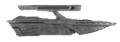
File:Grayson (bow).png | File:Grayson (bow).png | ||
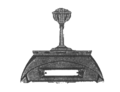
File:Grayson (dorsal).png | File:Grayson (dorsal).png | ||
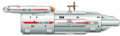
File:Grayson (alt) (stbd).png|''Grayson'' (alt image) (see note) | File:Grayson (alt) (stbd).png|''Grayson'' (alt image) (see note) | ||
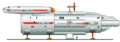
File:Ariel type surveyor.png|grounded (alt image) | File:Ariel type surveyor.png|grounded (alt image) | ||
File:Grayson notes.png|''Grayson'' & variant notes | |||
File:Grayson (class evolution).png|class evolution | |||
</gallery> | </gallery> | ||
Latest revision as of 04:42, 5 August 2023
.png)
| |
| Grayson | |
|---|---|
| Class Overview | |
| Category | buoy tender |
| Operational | 2247-2342 |
| Constructed | 400 total: |
| Dimensions | |
| Length |
|
| Beam | 38.9 m |
| Height |
|
| Mass |
|
| Performance | |
| Cruise Speed | w 6 |
| Max Speed |
|
| Endurance |
|
| Complement | |
| Officers | 2 |
| Enlisted |
|
| Cargo |
|
| Tactical Systems | |
| Beam Weapons | Grayson
|
| Shields |
|
| Transporters | Grayson, Finch
Andromakhe
|
| Auxiliary Craft | 1x buoy recovery shuttle/drone |
| Historical | |
| Ships of Note |
|
| Canonicity | |
| Design | FASA, dimensions corrected |
| Name | FASA |
| History | FASA
|
Boosting the flow of physical materiel was but a preamble of the challenge thrown at Star Fleet Logistics
by Project Starship. Getting the Fleet deployed to the frontier called for more
than just fuel and supplies: the bold new ships would be hopelessly lost without a network of
sensors and communications relays, never in the right place at the right time. In 2240, the
Federation had some six million communications buoys and two million sensor platforms in
operational condition. For operating the new fleet in an efficient manner, at least twenty million
additional buoys would have to be sown, and regular maintenance performed on the network.
To be sure, Star Fleet was not supposed to bear this burden alone, if at all. UFP Transit Authority, founded in 2171 to coordinate the maintenance of spacelanes outside the areas of responsibility of individual star systems, had so far performed the task adequately. The traffic control net was still fragile and subject to local acts of sabotage, but most UFP systems were at least interconnected with realtime or near-realtime commlinks and equipped with Class 1 or 2 approach control facilities. Much of this was achieved with the use of chartered transport vessels for occasional buoy maintenance runs, although some 200 purpose-built or converted buoy maintenance platforms were also in operation.
The expanded theater of starship operations called for tripling of this capacity at the very least. It was obvious that the most significant UFP presence in the areas of expansion would be Star Fleet’s, and that there would initially be little return from civilian investment there. The Council agreement of 2243 placed the responsibility of traffic control network erection and maintenance on exploration zones between 100 and 1,000 ly away squarely on Star Fleet, which delegated the chore to Logistics Command. The division chief, Rear Admiral Martela Nabo Ib, was aware that exploratory starships would be quite tied up with sowing military communications nets, and could not be tasked with traffic control buoy deployment, let alone maintenance. It therefore requested that a new type of tender be developed and fielded for the task.
The Denevan shipbuilder and designer AsTrans had gained a reputation as provider of good, solid working vessels suited for deep space. Until the mid-23rd century, these generally lacked in speed, however. When Star Fleet made the solid-state PB-35 engine available to AsTrans, this was no longer a problem: the popular Karoo 118 m medium freighter could reach warp seven when propelled by the military engine. With this vessel as the basis, AsTrans in 2247 formulated the desired buoy tender. Beyond the drive system upgrade, minimal modifications were needed, for the mission gear was carried in a separate section that took the place of the freight container. Thus, the actual hull of elegantly curved shapes only need house mission-unspecific utilities. Accommodation and support for the 15 crew lay on two upper decks, the navigational deflector and sensor suite were cradled beneath, and impulse engines, fuel tanks and stores for consumables were encased in or beneath drooping cheek flanges three decks high on both sides of the deflector array. The main dilithium power system was packaged astern, at the aft end of a narrow strongback that also supported the single dorsal nacelle on a short vertical pylon; both elements of the warp drive could be rapidly ejected in an emergency. The mission pod hung below the strongback on a series of ventral grapples.

The mission pod was a coffin shape 80 m long, 20 m wide and 14 m high. At the bow was an accessway for the crew, at the stern an entry bay for the tenants of the system. A single recovery shuttle could be employed to haul in the buoys, manned or remotely piloted. Two standard relay buoys could be recharged at a time, two manually repaired or overhauled on well equipped workbenches, and ten stored for later deployment. The processing capacity thus was markedly greater than on in-system and short range interstellar tenders, yet not directly proportional to the size of the vessel. With a high percentage of the interior dedicated to spares, little room was left for undue loitering in the cramped workplace. Since the main body of the vessel offered few compensating comforts, it was easy to predict disgruntlement on long mission sorties. Yet with the distances to be covered and the number of stops to be made, six months would be a minimum mission length.
Seventy of the tenders were ordered under the class name Grayson for the immediate needs of the buoy deployment program, and crews were trained in a true ‘crash program’ that resulted in several bumps and bruises to the hardware. The first two years of operations exposed two main shortcomings in the type. The crew discomfort issue was expected; more surprising was the need for self-protection, as the lone vessels full of modern technology and software attracted the attention of pirates and spies.
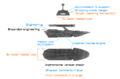
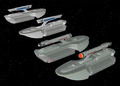
Both the problems required enlarging of the spaceframe as part of the solution. A longer, more acutely tapering forward section was designed, housing additional crew spaces and a forward phaser IV emitter. A combat shield generator was added on the aft hull. Also, the original mission pod was succeeded by a version of almost twice the beam and mass. Five more crew were brought aboard to manage the new equipment, but overall space per crew member had still been increased to tolerable standards. This despite the fact that the new mission pod was just as cramped as the original, having twice the number of buoy storage slots and a larger maneuvering propellant refueling system.
The enlarged and customized variant was nearly twice the mass and half again the price of the original, yet was ordered in considerable numbers. Some 150 of the vessels, seldom called by the subclass name Finch, were manufactured at Deneva, Jaltus and Morena, at a rate matching the demand for replacement hulls. While the original Graysons continued operations in areas where their lack of armament was of no serious concern, they were wearing down their PB-35Bs at an alarming rate. The first original batch vessels to go to the reserves in 2262 were sent to mothballs just three years later. Second batch units were also being relegated to reserves at the time, as the deployment phase of the new network was reaching completion. Engine troubles had resulted in delays in the schedule, however, and Star Fleet saw a continuing need for the vessels not only in tasks of maintenance, but of network expansion as well.
In 2270, Star Fleet fielded a modernized tender on its own, using the AsTrans spaceframe but adding the LN-61 engine and the associated external power systems. The latter necessitated expanding the aft engineering assembly somewhat, and hull mass increased again, to a destroyer-like total of 62,360 tons sans the coils. Overall mass was reduced, though, thanks to the neatly packaged linear engine that worked with 17% less coil mass. Also gained in the process was a new dash speed of warp 8, and a 55% increase in endurance. On board now were the latest personnel and cargo transporter models and an augmented targeting system, perfectly adequate for using the vessels in patrol duties in support of corvette assets.
Production of the linear-engined Andromakhe subclass was confined to the Morena facilities, and continued till 2298, by which time 180 units had been built. As many as 200 tenders were active in the 2270s, some 170 in the 2280s, and more than a hundred in the 2290s still. UFP Transit Authority resources were gradually catching up with their daunting task, and Star Fleet tenders were increasingly directed to purely military duties. In riskiest assignments, the heavy Derf units were favored, but Andromakhes and Finches saw combat action as well. The former narrowly escaped losses, but eight of the latter succumbed to Klingon attacks, often in situations where high speed would have provided protection. Predictably, no enemy kills were ever scored by the tenders, despite the frequent use of the bow phaser on missions intended as non-aggressive.
The bulk of the Andromakhe force was assigned to reserves in 2315. The networks projected in the 2240s were now in place and under civilian maintenance; the expansions ordered in the bellicose eighties had either been completed or rendered unnecessary. Treaty Exploration Zones of vastly greater scope had opened up, yet the ships of Grayson descent could not hope to operate that far away from their support bases. Increased power and range of shipboard sensors and communication systems alleviated the problems of relay and sensor network maintenance, though. Furthermore, Star Fleet did not plan on staking its claim to the zones through extensive fortifying. Simple communications lines were usually deemed sufficient, and the bold new cruiser fleet could sow its own ‘breadcrumb’ lines with minimal disruption to regular operations. This did not quite mean the retirement of the buoy tender mission class from Star Fleet strength; it did mean that the successors to the Andromakhe class were built in modest numbers. The last of the Grayson family were paid off in 2342.
Gallery
-
-
-

-
 Grayson (alt image) (see note)
 -
 grounded (alt image)
 -
 Grayson & variant notes
 -
 class evolution
.png)
.png)
_(stbd).png)


.png)
Notes
- Adrasil: Timo's Guide does not provide any imagery for the Grayson, but notes the design and name come from FASA. Since that version of the design is clearly from the TMP era (based upon the advanced nacelle), I substituted the Ariel image above, as modeled by Reverend Trigster. When this article is incorporated into the wiki and if the alt image is used, the ship's description will need to be modified. Edit: I would much prefer Adrasil's take on a pre-TOS version of this class over Reverend Trigster's alternate image.