Guide:Doppler (scout): Difference between revisions
No edit summary |
No edit summary |
||
| (29 intermediate revisions by the same user not shown) | |||
| Line 1: | Line 1: | ||
{{Sidebar Guide ship | {{Sidebar Guide ship | ||
|image=[[Image:Doppler scout. | |image= [[Image:Doppler scout.png|250px|Doppler scout]] | ||
|classname=Doppler | |classname= Doppler | ||
|category=scout | |category= scout | ||
|years=[[2157]] - [[2177]] | |years= [[2157]] - [[2177]] | ||
|constructed= 94 | |constructed= 94 | ||
|length= 150.0 m | |length= 150.0 m (w/o sensor dish)<br> | ||
|beam= | 162.0 m (w/ sensor dish) | ||
|height= | |beam= 46.1 m | ||
|mass= 99,100 | |height= 36.5 m (w/o ventral cannon)<br> | ||
|cruisespeed= w | 45.0 m (w/ ventral cannon) | ||
|maxspeed= w | |mass= 99,100 mt | ||
|cruisespeed= w 3 | |||
|maxspeed= w 4.1 | |||
|endurance= 6 months | |endurance= 6 months | ||
|officers= 8 | |officers= 8 | ||
| Line 20: | Line 22: | ||
|cargo= | |cargo= | ||
|beamweapons=<br> | |beamweapons=<br> | ||
* 1x | * 1x laser emitter (450 MW) (aft of bridge) | ||
* 4x | * 4x laser emitters (200 MW) (forward hull) | ||
* 1x | * 1x Type C phased particle cannon (100 GW) (optional ventral turret) | ||
|missileweapons= | |missileweapons= <br> | ||
* 2x torpedo tubes (w/20 photonic torpedoes) (optional ventral turret) | |||
|otherweapons= | |otherweapons= | ||
|shields= <br> | |shields= <br> | ||
* | * polarizable armor (main hull) (original) | ||
* 2-layer graviton/subspace globular forcefield (refit [[2161]]-[[2163|63]], select ships) | |||
* navigational deflector (forward hull) | |||
|labs= | |labs= | ||
|transporters= | |transporters= | ||
|auxcraft= 1x | |auxcraft= <br> | ||
* 1x reconnaissance pod | |||
|historicalships=<br> | |historicalships=<br> | ||
* '' | * ''UESS Appalachia'' (S-5902) | ||
|design= | * ''UESS Cordwainer'' | ||
|name= | * ''UESS Doppler'' | ||
|history= | * ''UESS Miramar'' | ||
* ''UESS Selyan’a'' | |||
|design= ''Spaceflight Chronology'' | |||
|name= ''Spaceflight Chronology'' | |||
|history= ''Spaceflight Chronology'' | |||
}} | }} | ||
==Background: ''Hobbyist's Guide''== | |||
The less than stellar record of the ''[[Guide:Mercury|Mercury]]'' scouts in obtaining information from behind [[Romulan]] lines was a major problem for the [[UESF]]. With the introduction of the ''[[Guide:Marshall|Marshall]]'' class, admirals finally had the tools to wage offensive war against the Romulan forces. But without detailed information from scouting missions, the enemy could not be located. Clearly, a more survivable scoutship type was needed to replace the ''Mercuries''. | |||
In [[2157]], modifications were performed on an as yet unnamed ''Mercury'' hull to boost its weapons capacity. The entire fire control system was changed, beginning with computer hard- and software upgrades and later expanding to a refit of all fire control sensors and laser emitters. Laser power conduits were redesigned for better endurance and peak power transmission. The three decks below bridge were all omitted and the bridge buried deeper inside the main pressure hull. Bow lasers were doubled in number and the navigational deflector replaced by a far larger assembly, sometimes capped by a sensor dish at the extreme bow. | |||
This tucking-in of vulnerable parts was but the passive element in increasing survivability. In a significant propulsive reconfiguring, impulse agility was boosted by replacing the centerline engine with two units smoothly cowled in armor on both sides of the pressure hull stern. Warp propulsion in turn was trimmed down by the adoption of a single centerline nacelle, its forward end again carefully armored beneath the stern. A rotating phased particle beam cannon and torpedo turret could be slung under the cowling and provided optional heavy fire support in multiple directions. | |||
Crew requirements went down to fifty, but accommodation standards could not be improved as total volume had gone down even more radically. Four lifeboats were still available in the new design and a 15-meter reconnaissance pod with full atmospheric capability was added, berthed on the upper stern of the pressure hull. A landing party of eight plus two flight crew could be stealthily inserted near enemy surface installations or a boarding team breached into an enemy hull, yet no such party ever returned to tell of the true nature of Romulan physique, let alone of tactically more significant issues. | |||
The final and most important survivability-increasing modification was the installation of an [[Andorian]] subspace shielding device, far humbler than the ''Marshall'' units, yet still far better than the heaviest EM shields or hull armor. The shield generator system was mounted in two side sponsons flanking the forward hull. | |||
The new scout was a much more survivable design than the original ''Mercury'' class. The prototype was quickly named ''UESS Doppler'' and sent to scout on Romulan carrier fleets in the Leo direction. The '''''Doppler''''' played only a humble part in the defensive intelligence operation that spread a net of monitoring vessels against Romulan flanking attempts and culminated in the interception of Romulan forces at the battle of [[Prantares]]. She was soon followed by more than fifty sister ships, however—and the increase in tactical and strategic information brought by these ships was decisive. [[Earth]] admirals now went for the offensive, sending large hunter fleets into Romulan space to search for naval bases, based on hints gleaned from the observing of Romulan naval movements. One such expedition paid off in [[2159]], when the old cruisers ''Halsey'', ''Gorshkov'', and ''Yamamoto'' managed to cripple a major offensive force replenishing on a planetary base. Others met with disaster in Romulan ambushes, but Earth was finally on the move now. After [[2159]], Romulans were on the defensive and the war became a race of finding and destroying enemy fleets and command outposts hiding in space. Planetary assaults and attacks on shipping dropped down to almost nil for the final stages of the war. | |||
The historically most-significant representative of the ''Doppler'' class by far was the vessel that revealed the position of a Romulan forward command post at [[Cheron]]. Although not realized at the time, the base served as the main subspace communications relay station for forward Romulan forces and the raid mounted against it virtually paralyzed Romulan attacks and collapsed their defense structure at a crucial moment. Curiously, there is disagreement as to which ''Doppler'' scout made the historic observation: ''UESS Cordwainer'', ''UESS Miramar'', and ''UESS Selyan’a'' all were operating in the area, all sent back coded reports, and all were lost with all hands before their next report. Moreover, UESF [[Forward Observation Outpost 22]] receiving the reports was destroyed only two days after relaying the information. | |||
[[Image:No Photo Available.jpg|left|300px|thumb|Pursued by a wing of missile boats, ''UESS Appalachia'' (S-5902) flees from [[198 Eridani]], soon to become the site of a major battle between the warfleets. Here, [[Romulans]] were successfully gathering ships for a flanking attack that would have cut off [[Vulcan]] from the main [[Earth]] forces. The routine patrol mission of the ''Appalachia'' revealed the intentions just in time for the 3rd Fleet to mount a preemptive attack. The Romulans retreated with light losses, but had to abandon 198 Eri for the duration of the war. Instead, [[Starfleet]] established a supply base on [[198 Eridani II]].]] | |||
The ''Dopplers'' suffered lighter losses than their ''Mercury'' forebears. Of the 94 ships built, only 22 were lost in action. Eighteen of the best-preserved survivors received NCC registries and forcefield | |||
generators for service in the joint [[UFP Star Fleet]] after [[2161]]; others were sold to allies as local defense vessels. Upgrades were harder to come by, since the technology aboard the ''Dopplers'' had become outdated already during the war. The last ''Dopplers'' ended their service in [[2177]] and were succeeded by small numbers of ''[[Guide:Placido|Placido]]'' multi-mission ships. No specimens were saved for the [[Fleet Museum]], but several ships were converted for civilian use. These can still be found in various planetary surplus depots in the [[UFP]] core area, in varying states of disrepair—although again, a few | |||
examples have been refurbished for competing in the [[Bolian]] regatta. | |||
==Gallery== | |||
<gallery> | |||
Image:Doppler.jpg|A ''Doppler'' without warp nacelle installed | |||
</gallery> | |||
==Star Fleet Registry== | |||
<div style="-moz-column-count:3; column-count:3;"> | |||
* NCC-L10 | |||
* NCC-L22 | |||
* NCC-L33 | |||
* NCC-L39 | |||
* NCC-L50 | |||
* NCC-L71 | |||
* NCC-L73 | |||
* NCC-L97 | |||
* NCC-L102 | |||
* NCC-L109 | |||
* NCC-L113 | |||
* NCC-L116 | |||
* NCC-L139 | |||
* NCC-L151 | |||
* NCC-L154 | |||
* NCC-L162 | |||
* NCC-L165 | |||
* NCC-L181 | |||
</div> | |||
==Notes== | |||
* The primary image for the ''Doppler'' was adapted from the one shown in ''Spaceflight Chronology'' and presented in ''Timo's Guide'' with the installed centerline nacelle. | |||
* The [[Ship Prefixes|prefix]] "USS" has been changed to "UESS" for ships of the [[United Earth Starfleet]]. | |||
* Eighteen ''Dopplers'' were registered in the [[UFP Star Fleet]] range for corvettes/scouts (NCC-L). | |||
<br><br> | |||
---- | ---- | ||
*[[Timo's Guide to | * [[Guide: Timo's Guide to Star Fleet|Back to the Table of Contents]] | ||
*[[2130-2161 - Into The Romulan War | * [[Guide: 2130-2161 - Into The Romulan War|Back to "Into The Romulan War"]] | ||
*[[Of Ship Statistics | * [[Guide: Of Ship Statistics|Appendix A: Of Ship Statistics]] | ||
*[[Glossary | * [[Guide: Glossary|Appendix B: Glossary]] | ||
*[[ | * [[Guide: Star Fleet Organization - General Outline|Appendix C: Star Fleet Organization - General Outline]] | ||
*[[Abbreviations From Outside | * [[Guide: Abbreviations From Outside|Appendix D: Abbreviations From Outside]] | ||
[[Category:Guide|{{PAGENAME}}]] | [[Category:Guide|{{PAGENAME}}]] | ||
Latest revision as of 06:25, 24 July 2023

| |
| Doppler | |
|---|---|
| Class Overview | |
| Category | scout |
| Operational | 2157 - 2177 |
| Constructed | 94 |
| Dimensions | |
| Length | 150.0 m (w/o sensor dish) 162.0 m (w/ sensor dish) |
| Beam | 46.1 m |
| Height | 36.5 m (w/o ventral cannon) 45.0 m (w/ ventral cannon) |
| Mass | 99,100 mt |
| Performance | |
| Cruise Speed | w 3 |
| Max Speed | w 4.1 |
| Endurance | 6 months |
| Complement | |
| Officers | 8 |
| Enlisted | 42
|
| Tactical Systems | |
| Beam Weapons |
|
| Missile Weapons |
|
| Shields | |
| Auxiliary Craft |
|
| Historical | |
| Ships of Note |
|
| Canonicity | |
| Design | Spaceflight Chronology |
| Name | Spaceflight Chronology |
| History | Spaceflight Chronology
|
Background: Hobbyist's Guide
The less than stellar record of the Mercury scouts in obtaining information from behind Romulan lines was a major problem for the UESF. With the introduction of the Marshall class, admirals finally had the tools to wage offensive war against the Romulan forces. But without detailed information from scouting missions, the enemy could not be located. Clearly, a more survivable scoutship type was needed to replace the Mercuries.
In 2157, modifications were performed on an as yet unnamed Mercury hull to boost its weapons capacity. The entire fire control system was changed, beginning with computer hard- and software upgrades and later expanding to a refit of all fire control sensors and laser emitters. Laser power conduits were redesigned for better endurance and peak power transmission. The three decks below bridge were all omitted and the bridge buried deeper inside the main pressure hull. Bow lasers were doubled in number and the navigational deflector replaced by a far larger assembly, sometimes capped by a sensor dish at the extreme bow.
This tucking-in of vulnerable parts was but the passive element in increasing survivability. In a significant propulsive reconfiguring, impulse agility was boosted by replacing the centerline engine with two units smoothly cowled in armor on both sides of the pressure hull stern. Warp propulsion in turn was trimmed down by the adoption of a single centerline nacelle, its forward end again carefully armored beneath the stern. A rotating phased particle beam cannon and torpedo turret could be slung under the cowling and provided optional heavy fire support in multiple directions.
Crew requirements went down to fifty, but accommodation standards could not be improved as total volume had gone down even more radically. Four lifeboats were still available in the new design and a 15-meter reconnaissance pod with full atmospheric capability was added, berthed on the upper stern of the pressure hull. A landing party of eight plus two flight crew could be stealthily inserted near enemy surface installations or a boarding team breached into an enemy hull, yet no such party ever returned to tell of the true nature of Romulan physique, let alone of tactically more significant issues.
The final and most important survivability-increasing modification was the installation of an Andorian subspace shielding device, far humbler than the Marshall units, yet still far better than the heaviest EM shields or hull armor. The shield generator system was mounted in two side sponsons flanking the forward hull.
The new scout was a much more survivable design than the original Mercury class. The prototype was quickly named UESS Doppler and sent to scout on Romulan carrier fleets in the Leo direction. The Doppler played only a humble part in the defensive intelligence operation that spread a net of monitoring vessels against Romulan flanking attempts and culminated in the interception of Romulan forces at the battle of Prantares. She was soon followed by more than fifty sister ships, however—and the increase in tactical and strategic information brought by these ships was decisive. Earth admirals now went for the offensive, sending large hunter fleets into Romulan space to search for naval bases, based on hints gleaned from the observing of Romulan naval movements. One such expedition paid off in 2159, when the old cruisers Halsey, Gorshkov, and Yamamoto managed to cripple a major offensive force replenishing on a planetary base. Others met with disaster in Romulan ambushes, but Earth was finally on the move now. After 2159, Romulans were on the defensive and the war became a race of finding and destroying enemy fleets and command outposts hiding in space. Planetary assaults and attacks on shipping dropped down to almost nil for the final stages of the war.
The historically most-significant representative of the Doppler class by far was the vessel that revealed the position of a Romulan forward command post at Cheron. Although not realized at the time, the base served as the main subspace communications relay station for forward Romulan forces and the raid mounted against it virtually paralyzed Romulan attacks and collapsed their defense structure at a crucial moment. Curiously, there is disagreement as to which Doppler scout made the historic observation: UESS Cordwainer, UESS Miramar, and UESS Selyan’a all were operating in the area, all sent back coded reports, and all were lost with all hands before their next report. Moreover, UESF Forward Observation Outpost 22 receiving the reports was destroyed only two days after relaying the information.

The Dopplers suffered lighter losses than their Mercury forebears. Of the 94 ships built, only 22 were lost in action. Eighteen of the best-preserved survivors received NCC registries and forcefield generators for service in the joint UFP Star Fleet after 2161; others were sold to allies as local defense vessels. Upgrades were harder to come by, since the technology aboard the Dopplers had become outdated already during the war. The last Dopplers ended their service in 2177 and were succeeded by small numbers of Placido multi-mission ships. No specimens were saved for the Fleet Museum, but several ships were converted for civilian use. These can still be found in various planetary surplus depots in the UFP core area, in varying states of disrepair—although again, a few examples have been refurbished for competing in the Bolian regatta.
Gallery
-
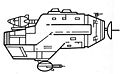 A Doppler without warp nacelle installed

Star Fleet Registry
- NCC-L10
- NCC-L22
- NCC-L33
- NCC-L39
- NCC-L50
- NCC-L71
- NCC-L73
- NCC-L97
- NCC-L102
- NCC-L109
- NCC-L113
- NCC-L116
- NCC-L139
- NCC-L151
- NCC-L154
- NCC-L162
- NCC-L165
- NCC-L181
Notes
- The primary image for the Doppler was adapted from the one shown in Spaceflight Chronology and presented in Timo's Guide with the installed centerline nacelle.
- The prefix "USS" has been changed to "UESS" for ships of the United Earth Starfleet.
- Eighteen Dopplers were registered in the UFP Star Fleet range for corvettes/scouts (NCC-L).