Guide:Rochester/Kitty Hawk/Taurus: Difference between revisions
No edit summary |
|||
| (15 intermediate revisions by the same user not shown) | |||
| Line 4: | Line 4: | ||
|category= cruiser | |category= cruiser | ||
|years= [[2231]]-[[2297]] | |years= [[2231]]-[[2297]] | ||
|constructed= 60 total:<br | |constructed= 60 total:<br> | ||
* 20 ''Rochester'' (built in [[2231]]-[[2241]]) | * 20 ''Rochester'' (built in [[2231]]-[[2241]]) | ||
* 20 ''Kitty Hawk'' (built in [[2231]]-[[2247]]) | * 20 ''Kitty Hawk'' (built in [[2231]]-[[2247]]) | ||
| Line 15: | Line 15: | ||
* 41.3 m (''Rochester'', ''Kitty Hawk'') | * 41.3 m (''Rochester'', ''Kitty Hawk'') | ||
* 33.8 m (''Taurus'', NCC-1552) | * 33.8 m (''Taurus'', NCC-1552) | ||
|mass= | |mass= <br> | ||
* 458,000 tons (''Rochester'') | * 458,000 tons (''Rochester'') | ||
* 459,800 tons (''Kitty Hawk'') | * 459,800 tons (''Kitty Hawk'') | ||
| Line 105: | Line 105: | ||
* 4x work pods | * 4x work pods | ||
|historicalships= <br> | |historicalships= <br> | ||
* ''USS Aries'' (NCC-1586) | |||
* ''USS Albert McKenzie'' (NCC-1551) | * ''USS Albert McKenzie'' (NCC-1551) | ||
* ''USS Kitty Hawk'' (NCC-1552) | * ''USS Kitty Hawk'' (NCC-1552) | ||
* ''USS Rochester'' | * ''USS Rochester'' (NCC-1540) | ||
* ''USS Scovil'' (NCC-1598) | |||
* ''USS Taurus'' (NCC-1558) | * ''USS Taurus'' (NCC-1558) | ||
* ''USS Trailblazer'' (NCC-1596) | |||
* ''USS Ventura'' (NCC-1585) | |||
* ''USS Virgo'' (NCC-1572) | |||
|design= Starfleet Academy movie project study drawing, LUG ‘Spacedock’ descriptions, John Byrne ‘Crew: Ghosts’ | |design= Starfleet Academy movie project study drawing, LUG ‘Spacedock’ descriptions, John Byrne ‘Crew: Ghosts’ | ||
|name= LA Graf ‘War Dragons’, LUG | |name= LA Graf ‘War Dragons’, LUG | ||
| Line 114: | Line 119: | ||
}} | }} | ||
Struggling through delays and hurdles, the ‘Great Awakening’ nevertheless came, in the successive | Struggling through delays and hurdles, the ‘Great Awakening’ nevertheless came, in the successive | ||
perfection of solid-state warp engines, dilithium foci, Mk II transporters and | perfection of solid-state warp engines, dilithium foci, Mk II transporters and duotronics…a | ||
veritable stampede of inventions that could only be corralled aboard the largest, most expensive | veritable stampede of inventions that could only be corralled aboard the largest, most expensive | ||
starships in its entirety. It was a far more demanding affair to try and fit the technologies aboard | starships in its entirety. It was a far more demanding affair to try and fit the technologies aboard | ||
existing vessels of humbler size, either wholly or in part. The Texas refits were | existing vessels of humbler size, either wholly or in part. The [[Guide: Texas refit|''Texas'' refits]] were simply incapable of taking part in the technological transcendence; the light cruiser and destroyer fleets still were in want of | ||
the technological transcendence; the light cruiser and destroyer fleets still were in want of | |||
appropriate new champions. Newbuilding was acknowledged as the only viable solution for the | appropriate new champions. Newbuilding was acknowledged as the only viable solution for the | ||
necessary | necessary fleet upgrades long before the first Starship sailed. | ||
Yet | Yet [[Star Fleet]] knew that the results would fall short of strategic demand. Given just one further | ||
decade, a dozen heavy and fifty light cruisers would be followed by an admittedly impressive fifty | decade, a dozen heavy and fifty light cruisers would be followed by an admittedly impressive fifty | ||
heavy and fifty medium frigates, resulting in a | heavy and fifty medium frigates, resulting in a fleet some eighty sufficiently modern cruisers and a | ||
hundred frigates strong. But this force was backed up by mere fifty destroyers of worth, leaving the | hundred frigates strong. But this force was backed up by mere fifty destroyers of worth, leaving the | ||
Fleet starving for attrition units. Even though massive production of advanced designs plus | Fleet starving for attrition units. Even though massive production of advanced designs plus | ||
improved Saladin variants was planned and budgeted for, there would be no dockyard slots at Sol or | improved ''[[Guide:Saladin|Saladin]]'' variants was planned and budgeted for, there would be no dockyard slots at [[Sol]] or | ||
Andor for these keels for the next five to ten years – and no real prospect of producing destroyers | [[Andor]] for these keels for the next five to ten years – and no real prospect of producing destroyers | ||
significantly faster than cruisers even beyond that date. The | significantly faster than cruisers even beyond that date. The Star Fleet procurement stratagem of | ||
favoring quality over quantity inevitably meant that multipurpose cruisers rather than dedicated | favoring quality over quantity inevitably meant that multipurpose cruisers rather than dedicated | ||
warships would be the attrition type of choice for the time being. | warships would be the attrition type of choice for the time being. | ||
Thus arose the fleet of medium and light cruisers that would dominate | Thus arose the fleet of medium and light cruisers that would dominate Star Fleet till the [[2270s]]. | ||
Estimates for the size of the ‘cruiser gap’ ranged from fifty to a hundred; erection of fifteen | Estimates for the size of the ‘cruiser gap’ ranged from fifty to a hundred; erection of fifteen | ||
extra-solar dockyards for an immediate production run of sixty cruisers was eventually deemed the | |||
prudent response, and a vessel between the clumsy Kearsarge and mighty Constitution in | prudent response, and a vessel between the clumsy ''[[Guide: Kearsarge |Kearsarge]]'' and mighty ''[[Guide: Constitution |Constitution]]'' in | ||
capabilities if not size the proper gapfiller design. With Sol involved in the aforementioned | capabilities if not size the proper gapfiller design. With Sol involved in the aforementioned | ||
programs, and Andor toiling with the Loknars, it fell to Alpha Centauri, Aldebaran and Daran (or | programs, and Andor toiling with the ''[[Guide: Loknar|Loknars]]'', it fell to [[Alpha Centauri]], [[Aldebaran]] and [[Daran]] (or | ||
primarily the human colonies there) to meet the cruiser order. | primarily the human colonies there) to meet the cruiser order. | ||
The engineering genius of Marvu Hreedenck of Alpha Centauri would play a central role in the | The engineering genius of Marvu Hreedenck of Alpha Centauri would play a central role in the | ||
creation of the modern dilithium-reactor cruisers. Significant construction facilities also already | creation of the modern dilithium-reactor cruisers. Significant construction facilities also already | ||
existed at Centaurus, but for the time being, they were slated for strategically crucial Larson | existed at Centaurus, but for the time being, they were slated for strategically crucial ''[[Guide: Larson|Larson]]'' | ||
production. Aldebaran had so far produced almost solely mercantile vessels; the first of the new | production. Aldebaran had so far produced almost solely mercantile vessels; the first of the new | ||
cruisers would be built there using modified commercial tooling, until proper Fleet facilities could | cruisers would be built there using modified commercial tooling, until proper Fleet facilities could | ||
be erected out of transportable components. The recently admitted member world Daran was | be erected out of transportable components. The recently admitted member world Daran was | ||
already a veteran producer responsible for several light cruisers based on the time-honored Texas | already a veteran producer responsible for several light cruisers based on the time-honored ''[[Guide: Texas|Texas]]'' | ||
template, and slated to build several more in the near future. To upgrade its production capability, | template, and slated to build several more in the near future. To upgrade its production capability, | ||
numerous collapsible box docks were likewise shipped in, and mobile fabricator stations were | numerous collapsible box docks were likewise shipped in, and mobile fabricator stations were | ||
anchored to local asteroids. | anchored to local asteroids. | ||
In March 2231, Daran could announce the launch of the inaugural “medium” cruiser of Rochester | |||
In March [[2231]], Daran could announce the launch of the inaugural “medium” cruiser of '''''Rochester''''' | |||
class, NCC-1540. In record time, and no small thanks to the innovative ideas on modular | class, NCC-1540. In record time, and no small thanks to the innovative ideas on modular | ||
construction by Dr Hreedenck, Arias-Mastac FY had thrown together a combat vessel combining | construction by Dr. Hreedenck, [[Arias-Mastac FY]] had thrown together a combat vessel combining | ||
hypermodern PB-45 propulsion with a fairly rudimentary early dilithium focus power system, | hypermodern PB-45 propulsion with a fairly rudimentary early dilithium focus power system, | ||
within a two-hull spaceframe roughly 75% the size of the heavy Constitutions and comparable to | within a two-hull spaceframe roughly 75% the size of the heavy ''Constitutions'' and comparable to | ||
the monohull Kearsarges. The smaller-diameter primary hull of the cruiser also diverged from the | the monohull ''Kearsarges''. The smaller-diameter primary hull of the cruiser also diverged from the | ||
Kearsarge in shape, with a prominent dorsal rim protrusion accommodating new shield machinery. | ''Kearsarge'' in shape, with a prominent dorsal rim protrusion accommodating new shield machinery. | ||
The stern engineering bulge was in turn extended aft to form a proper secondary hull, which could | The stern engineering bulge was in turn extended aft to form a proper secondary hull, which could | ||
hold a main powerplant twice as large and twice as powerful as the light cruiser one. The hull also | hold a main powerplant twice as large and twice as powerful as the light cruiser one. The hull also | ||
| Line 163: | Line 168: | ||
maximum martial gear. This consisted of a devastating Mk 2-3 triple torpedo launcher on lower | maximum martial gear. This consisted of a devastating Mk 2-3 triple torpedo launcher on lower | ||
bows, three paired Tesla laser banks divided between the surfaces, twin Type L phase cannon on the | bows, three paired Tesla laser banks divided between the surfaces, twin Type L phase cannon on the | ||
tall dorsal superstructure, and two shield generators, of the Hycor type carried in triplicate aboard | tall dorsal superstructure, and two shield generators, of the [[Hycor]] type carried in triplicate aboard | ||
the heavy cruisers. For advanced logistics, a single four-pad Mk II transporter was paired with a Mk | the heavy cruisers. For advanced logistics, a single four-pad Mk II transporter was paired with a Mk | ||
VI industrial fabricator in the saucer, and a pair of cargo units was provided in the engineering hull. | VI industrial fabricator in the saucer, and a pair of cargo units was provided in the engineering hull. | ||
| Line 169: | Line 174: | ||
research probes, nor were the two shuttles equipped for scientific survey. | research probes, nor were the two shuttles equipped for scientific survey. | ||
[[Image:No Photo Available.jpg|left|250px|thumb|One of the many quirks in Dr Hreedenck’s complicated plan for meeting the cruiser specifications manifests here in the | [[Image:No Photo Available.jpg|left|250px|thumb|One of the many quirks in Dr. Hreedenck’s complicated plan for meeting the cruiser specifications manifests here in the | ||
engine configuration of USS Kitty Hawk, her pylons angling down rather than up from the engineering hull. The Mk II | engine configuration of ''USS Kitty Hawk'', her pylons angling down rather than up from the engineering hull. The Mk II | ||
subclass otherwise adopted the same pronounced dihedral for the pylons as in the original Rochesters, while Mk III | subclass otherwise adopted the same pronounced dihedral for the pylons as in the original ''Rochesters'', while Mk III | ||
featured a much shallower angle for a more compact profile.]] | featured a much shallower angle for a more compact profile.]] | ||
In December 2231, Centaurus followed with the first Rochester Mk II, or Kitty Hawk, (NCC-1552). | In December [[2231]], Centaurus followed with the first ''Rochester'' Mk II, or '''''Kitty Hawk''''', (NCC-1552). | ||
The vessel featured a quintuple torpedo launcher, with the two additional tubes displacing the phase | The vessel featured a quintuple torpedo launcher, with the two additional tubes displacing the phase | ||
cannon and some of the lasers. Such an arrangement should have left even less space for exploration | cannon and some of the lasers. Such an arrangement should have left even less space for exploration | ||
gear than the Rochester design, and placed greater crew requirements as well. Yet the lean and mean | gear than the ''Rochester'' design, and placed greater crew requirements as well. Yet the lean and mean | ||
cruisers were fully furnished for survey and charting duty in deep space, and sported five to six | cruisers were fully furnished for survey and charting duty in deep space, and sported five to six | ||
laboratories and a range of planetary sensors, in addition to always carrying a number of probes in | laboratories and a range of planetary sensors, in addition to always carrying a number of probes in | ||
| Line 183: | Line 188: | ||
planetary forays as well. All this was necessary from the strategic point of view, as the expansive | planetary forays as well. All this was necessary from the strategic point of view, as the expansive | ||
Klingon front largely spanned unknown space. Awareness and understanding of the alien battlefield | Klingon front largely spanned unknown space. Awareness and understanding of the alien battlefield | ||
might yield the slight tactical advantage that the outnumbered | might yield the slight tactical advantage that the outnumbered Star Fleet did not dare overlook. | ||
In June 2236, the Aldebaran contribution, Rochester Mk III or Taurus (NCC-1558), rounded out the | In June [[2236]], the Aldebaran contribution, ''Rochester'' Mk III or '''''Taurus''''' (NCC-1558), rounded out the | ||
cruiser family. The triple Mk 2 ventral torpedo tube assembly was left ashore, its socket fitted with a | cruiser family. The triple Mk 2 ventral torpedo tube assembly was left ashore, its socket fitted with a | ||
deflector pod instead. A compact single Mk 3 launcher was carried in the dorsal position, another | deflector pod instead. A compact single Mk 3 launcher was carried in the dorsal position, another | ||
being squeezed in the lower stern of the secondary hull; the modifications liberated plenty of room | being squeezed in the lower stern of the secondary hull; the modifications liberated plenty of room | ||
for a second phase cannon and gave much better all-around weapons coverage for close quarters | for a second phase cannon and gave much better all-around weapons coverage for close quarters | ||
fighting. Significantly more complex combat management facilities and fire control computers were | fighting. Significantly more complex combat management facilities and fire control computers were | ||
introduced to handle multitargeting scenarios. Enough room remained for the inclusion of multiple | introduced to handle multitargeting scenarios. Enough room remained for the inclusion of multiple | ||
laboratories in this cruiser model as well. Outwardly the greatest distinguishing feature of the | laboratories in this cruiser model as well. Outwardly the greatest distinguishing feature of the | ||
variant was obvious: Dr Hreedenck’s modular propulsion design was configured for a nearly flat, | variant was obvious: Dr. Hreedenck’s modular propulsion design was configured for a nearly flat, | ||
maneuverable field and low silhouette by using greatly reduced dihedral on the warp engine pylons. | maneuverable field and low silhouette by using greatly reduced dihedral on the warp engine pylons. | ||
Despite appearances, the three cruiser types were not intended to cover for the tactical weaknesses | Despite appearances, the three cruiser types were not intended to cover for the tactical weaknesses | ||
of each other in combined action. The differing weapon suites merely reflected slightly dissimilar | of each other in combined action. The differing weapon suites merely reflected slightly dissimilar | ||
independent mission profiles, with the Kitty Hawks favoring long range warp armament for their | independent mission profiles, with the ''Kitty Hawks'' favoring long range warp armament for their | ||
deep space exploration sorties, and the Rochesters and Tauruses fighting at shorter ranges in their | deep space exploration sorties, and the ''Rochesters'' and ''Tauruses'' fighting at shorter ranges in their | ||
intended nearspace attack and patrol missions, respectively. | intended nearspace attack and patrol missions, respectively. | ||
Initially, twelve Rochester Mk Is and six members of each of the other classes were completed. | Initially, twelve ''Rochester'' Mk Is and six members of each of the other classes were completed. | ||
Successively larger batches followed, until twenty vessels of each type were in service. Thematic | Successively larger batches followed, until twenty vessels of each type were in service. Thematic | ||
naming was faithfully followed, the Rochesters commemorating | naming was faithfully followed, the ''Rochesters'' commemorating [[Earth]]’s military genius, the ''Kitty Hawks'' its aeronautical derring-do, and the ''Tauruses'' its longstanding traditions of astronomy. The | ||
Hawks its aeronautical derring-do, and the Tauruses its longstanding traditions of astronomy. The | irony was not lost on the extra-solar builders of the classes, who nevertheless valued the significant | ||
irony was not lost on the | |||
military protection afforded by the cruiser fleet – even if this did not constitute a rigid regional | military protection afforded by the cruiser fleet – even if this did not constitute a rigid regional | ||
defense. The ships would not stay behind to guard their originating systems, or even be assigned a | defense. The ships would not stay behind to guard their originating systems, or even be assigned a | ||
| Line 214: | Line 217: | ||
Admittedly, the cruise speed of warp 5 afforded by PB-45 was a disadvantage in deep space, | Admittedly, the cruise speed of warp 5 afforded by PB-45 was a disadvantage in deep space, | ||
compared with the warp 6 performance promised for Loknars, Constitutions and Mirandas. Yet | compared with the warp 6 performance promised for ''Loknars'', ''Constitutions'' and ''[[Guide: Miranda|Mirandas]]''. Yet | ||
there was little evidence that Klingons would be doing any better on the average, their numerous | there was little evidence that Klingons would be doing any better on the average, their numerous | ||
lighter vessel types typically cruising at no higher than warp 4. Routing maneuvers on a strategic | lighter vessel types typically cruising at no higher than warp 4. Routing maneuvers on a strategic | ||
scale were a distinct option for | scale were a distinct option for [[Star Fleet]], especially if the new cruisers were spearheading | ||
formations of destroyers capable of similar speeds. Future development and procurement of | formations of destroyers capable of similar speeds. Future development and procurement of | ||
logistics ships would decide the viability of such schemes; initially, the Rochester variants sailed | logistics ships would decide the viability of such schemes; initially, the ''Rochester'' variants sailed | ||
out either singly, or then in hunting packs featuring one or two light cruisers or medium frigates. | out either singly, or then in hunting packs featuring one or two light cruisers or medium frigates. | ||
[[File:456.png|left|250px|thumb|A few more views of a late standard Kitty Hawk, in this case the Ventura, veteran of the Eridani Gap. Plasma diffusers add | [[File:456.png|left|250px|thumb|A few more views of a late standard ''Kitty Hawk'', in this case the ''Ventura'', veteran of the [[Eridani Gap]]. Plasma diffusers add to stealth and give the PB-45 much more modern looks. Oh the other hand, the tall superstructure accommodating the dorsal torpedo launchers is still in evidence.]] | ||
to stealth and give the PB-45 much more modern looks. Oh the other hand, the tall superstructure accommodating the | |||
dorsal torpedo launchers is still in evidence.]] | |||
It was not until 2254 that the construction of the various Rochesters could be completed. By then, | It was not until [[2254]] that the construction of the various ''Rochesters'' could be completed. By then, | ||
major upgrades had already become topical. Laser armament was replaced by Type VII phaser | major upgrades had already become topical. Laser armament was replaced by Type VII phaser | ||
systems, but not without a major and time-consuming secondary plasma system upgrade. Older | systems, but not without a major and time-consuming secondary plasma system upgrade. Older | ||
phase cannon were removed from the Rochesters and Tauruses, and upper torpedoes from Kitty | phase cannon were removed from the ''Rochesters'' and ''Tauruses'', and upper torpedoes from ''Kitty Hawks''; the space on decks 2-3 was put to good use by incorporating computer cores compatible | ||
Hawks; the space on | |||
with the Duotronic III architecture. Tactical sensors were updated, engines overhauled, and a new | with the Duotronic III architecture. Tactical sensors were updated, engines overhauled, and a new | ||
warhead type introduced for the torpedoes. While crew requirements stayed the same, there was | warhead type introduced for the torpedoes. While crew requirements stayed the same, there was | ||
internal reshuffling towards a more exploration-oriented mission profile, mainly as a result of the | internal reshuffling towards a more exploration-oriented mission profile, mainly as a result of the | ||
post-Axanar Klingon passivity. | post-[[Axanar]] Klingon passivity. | ||
However, these upgrades were more modest in scope than the sweeping improvements that kept the | However, these upgrades were more modest in scope than the sweeping improvements that kept the | ||
Constitutions and Mirandas at the cutting edge of technology. Much like the Kearsarges, the tightly | ''Constitutions'' and ''Mirandas'' at the cutting edge of technology. Much like the ''Kearsarges'', the tightly | ||
packed “economy” cruisers risked semi-neglect of the kind that was already making the Baton | packed “economy” cruisers risked semi-neglect of the kind that was already making the ''Baton Rouge'' family uncombatworthy. When Klingon hostilities peaked once more in [[2266]], there was | ||
Rouge family uncombatworthy. When Klingon hostilities peaked once more in 2266, there was | difficulty in integrating the ''Rochesters'' into the C3I network, as well as a shortage of Mk 2-3 spares, | ||
difficulty in integrating the Rochesters into the C3I network, as well as a shortage of Mk 2-3 spares, | to the degree that some ''Rochesters'' shipped spare ''Miranda'' transceivers and datalinks to stay in | ||
to the degree that some Rochesters shipped spare Miranda transceivers and datalinks to stay in | |||
contact, and even dabbled in quickly dismounting the ‘Wolf’ launchers in favor of less capable but | contact, and even dabbled in quickly dismounting the ‘Wolf’ launchers in favor of less capable but | ||
more accessible ‘Awalt’ ones. | more accessible ‘Awalt’ ones. | ||
| Line 247: | Line 246: | ||
Post-Organian patrol duty saw the cruisers still operating their original gear, yet their propulsive | Post-Organian patrol duty saw the cruisers still operating their original gear, yet their propulsive | ||
disadvantage was becoming debilitating. The gradually yet inexorably expanding theater of | disadvantage was becoming debilitating. The gradually yet inexorably expanding theater of | ||
operations no longer was fit for the original 2240s generation of starships. The PB-45 was becoming | operations no longer was fit for the original [[2240s]] generation of starships. The PB-45 was becoming | ||
unserviceable even without the extra strain of the long range, high speed patrols, and several vessels | unserviceable even without the extra strain of the long range, high speed patrols, and several vessels | ||
had to be placed under envelope restrictions or outright sailing ban by 2268 already. One was | had to be placed under envelope restrictions or outright sailing ban by [[2268]] already. One was | ||
unlikely to meet any in deep space beyond that point; several began accumulating at key star | unlikely to meet any in deep space beyond that point; several began accumulating at key star | ||
systems, mainly seeing training use there. | systems, mainly seeing training use there. | ||
A massive withdrawing from service was effected between 2268 and 2277, first on the Rochester | A massive withdrawing from service was effected between [[2268]] and [[2277]], first on the ''Rochester'' | ||
and then on Kitty Hawk cruisers. Taurus units were retained for the time being, as a propulsive refit | and then on ''Kitty Hawk'' cruisers. ''Taurus'' units were retained for the time being, as a propulsive refit | ||
was planned (yet ultimately came to nought, for the lack of a suitably sized engine). Only the final | was planned (yet ultimately came to nought, for the lack of a suitably sized engine). Only the final | ||
four Kitty Hawks were in 2270 upgraded in some secrecy and transferred to TacFleet, apparently | four ''Kitty Hawks'' were in [[2270]] upgraded in some secrecy and transferred to TacFleet, apparently | ||
becoming commando support vessels; USS Trailblazer (NCC-1596) was rendered | becoming commando support vessels; ''USS Trailblazer'' (NCC-1596) was rendered un-spaceworthy | ||
and stricken within two years of the transfer, while USS Scovil (NCC-1598) served on a variety of | and stricken within two years of the transfer, while ''USS Scovil'' (NCC-1598) served on a variety of | ||
theaters until 2297. USS Virgo (NCC-1572) of the Taurus subclass had been lost in the course of | theaters until [[2297]]. ''USS Virgo'' (NCC-1572) of the ''Taurus'' subclass had been lost in the course of | ||
duty, of unknown causes while scouting in the direction of Zeta Persei in 2261 – the first and last | duty, of unknown causes while scouting in the direction of [[Zeta Persei]] in [[2261]] – the first and last | ||
operational loss after the Battle of Donatu that had claimed USS Aries (NCC-1586). Much like the | operational loss after the Battle of [[Donatu]] that had claimed ''USS Aries'' (NCC-1586). Much like the | ||
Kearsarges, the Rochesters bowed out unvanquished by the enemy, defeated only by their own | ''Kearsarges'', the ''Rochesters'' bowed out unvanquished by the enemy, defeated only by their own | ||
ranks. However, this time the increase in Fleet quality did not quite compensate for the decrease in | ranks. However, this time the increase in Fleet quality did not quite compensate for the decrease in | ||
numerical strength. No obvious successor arose to take the place of the Rochesters, and the 60 % | numerical strength. No obvious successor arose to take the place of the ''Rochesters'', and the 60% | ||
drop in cruiser numbers translated to at least 30 % loss of overall fighting capacity. Granted, | drop in cruiser numbers translated to at least 30% loss of overall fighting capacity. Granted, | ||
modern dreadnoughts supposedly provided so much reserve firepower that little or no factual drop | modern dreadnoughts supposedly provided so much reserve firepower that little or no factual drop | ||
occurred overall – but the performance of the active forces certainly began a downslide as the result | occurred overall – but the performance of the active forces certainly began a downslide as the result | ||
of the early 2270s decommissionings. | of the early [[2270s]] decommissionings. | ||
Unsuited for foreign sales due to their advanced armament and the general policy change, all the | Unsuited for foreign sales due to their advanced armament and the general policy change, all the | ||
Rochester and Kitty Hawk hulls were marked for scrapping between 2277 and 2280. Much of this | ''Rochester'' and ''Kitty Hawk'' hulls were marked for scrapping between [[2277]] and [[2280]]. Much of this | ||
work was completed at Aldebaran; the frontline world cast worried looks across the border every | work was completed at Aldebaran; the frontline world cast worried looks across the border every | ||
time a cruiser keel was cut, all too aware that its Klingon counterpart Amar was engaged in | time a cruiser keel was cut, all too aware that its Klingon counterpart [[Amar]] was engaged in | ||
operations of the opposite kind. Construction of eight to ten K’teremny class destroyers and four to | operations of the opposite kind. Construction of eight to ten ''K’teremny'' class destroyers and four to | ||
five K’t’inga cruisers was undeniably underway. Against such vessels, the Rochesters would of | five ''K’t’inga'' cruisers was undeniably underway. Against such vessels, the ''Rochesters'' would of | ||
course have been sorely outclassed, and their operating and maintenance funds and resources were | course have been sorely outclassed, and their operating and maintenance funds and resources were | ||
arguably better spent elsewhere. It is still with some regret that a starship enthusiast looks back at | arguably better spent elsewhere. It is still with some regret that a starship enthusiast looks back at | ||
the Rochester and Kitty Hawk classes, vessels that left virtually no mark in history. | the ''Rochester'' and ''Kitty Hawk'' classes, vessels that left virtually no mark in history. | ||
Not quite all Rochesters remained anonymous to the public, though – even if | Not quite all ''Rochesters'' remained anonymous to the public, though – even if [[Star Fleet]] would have | ||
preferred otherwise. It remains unclear to this day how a band of Anjiri secessionists managed to get | preferred otherwise. It remains unclear to this day how a band of Anjiri secessionists managed to get | ||
their hands on USS Albert McKenzie (NCC-1551) in 2290, at a time when she was supposed to be | their hands on ''USS Albert McKenzie'' (NCC-1551) in [[2290]], at a time when she was supposed to be | ||
mothballed and secured at the Big Horn lunar depot in the Aldebaran system. The vessel was used | mothballed and secured at the [[Big Horn]] lunar depot in the Aldebaran system. The vessel was used | ||
in Anjiri internecine fighting that first involved the Federation at DS 3, then the Klingons at Kreth; a | in Anjiri internecine fighting that first involved the [[Federation]] at [[Deep Space 3|DS 3]], then the Klingons at [[Kreth]]; a | ||
bloody altercation between the major empires was only barely avoided and the Anjiri factions | bloody altercation between the major empires was only barely avoided and the Anjiri factions | ||
brought to answer for their actions. Orion involvement in the debacle has been widely suspected, | brought to answer for their actions. Orion involvement in the debacle has been widely suspected, | ||
especially on the matter of the McKenzie theft. Somewhat ironically, the McKenzie is the only | especially on the matter of the ''McKenzie'' theft. Somewhat ironically, the ''McKenzie'' is the only | ||
surviving example of the Rochester lineage today, having been interned by the Klingons in 2290 | surviving example of the ''Rochester'' lineage today, having been interned by the Klingons in [[2290]] | ||
and discarded after brief study. Her evacuated and engine-less hull now resides in the | and discarded after brief study. Her evacuated and engine-less hull now resides in the [[Alpha Gaudianus]] | ||
system, in a stable orbit | system, in a stable orbit un-bothered by Klingon traffic and unreachable by outsiders. | ||
==Notes== | ==Notes== | ||
* The ''Rochester'' class (''et al'') were originally represented (only) by the single source material, a Marvel comic book about a ship of the class. The primary images now in use come from a vessel very much in the style of the original, but of much higher quality. | |||
| Line 299: | Line 299: | ||
File:Rochester (space).png| | File:Rochester (space).png| | ||
File:Rochester (sketch).png| | File:Rochester (sketch).png| | ||
File:USS Ventura.jpg| | |||
File:Ventura dorsal view.jpg| | |||
File:Ventura.png| | |||
File:Columbus inpayne (stbd).png|[[2256]] refit | |||
File:Columbus inpayne (dorsal).png|Dorsal view | |||
File:Columbus inpayne (stern).png|Stern view | |||
</gallery> | </gallery> | ||
---- | ---- | ||
* [[Guide: Timo's Guide to | * [[Guide: Timo's Guide to Star Fleet|Back to the Table of Contents]] | ||
* [[Guide: 2200-2240 - Way of the Warrior|Back to "Way of the Warrior"]] | * [[Guide: 2200-2240 - Way of the Warrior|Back to "Way of the Warrior"]] | ||
* [[Guide: Of Ship Statistics|Appendix A: Of Ship Statistics]] | * [[Guide: Of Ship Statistics|Appendix A: Of Ship Statistics]] | ||
* [[Guide: Glossary|Appendix B: Glossary]] | * [[Guide: Glossary|Appendix B: Glossary]] | ||
* [[Guide: | * [[Guide: Star Fleet Organization - General Outline|Appendix C: Star Fleet Organization - General Outline]] | ||
* [[Guide: Abbreviations From Outside|Appendix D: Abbreviations From Outside]] | * [[Guide: Abbreviations From Outside|Appendix D: Abbreviations From Outside]] | ||
[[Category:Guide|{{PAGENAME}}]] | [[Category:Guide|{{PAGENAME}}]] | ||
Latest revision as of 11:14, 18 November 2022
.png)
| |
| Rochester / Kitty Hawk / Taurus | |
|---|---|
| Class Overview | |
| Category | cruiser |
| Operational | 2231-2297 |
| Constructed | 60 total: |
| Dimensions | |
| Length |
|
| Beam | 95.0 m |
| Height |
|
| Mass |
|
| Performance | |
| Cruise Speed | w 5 |
| Max Speed | w 7 |
| Endurance | 2 years |
| Complement | |
| Officers |
|
| Enlisted |
|
| Tactical Systems | |
| Beam Weapons | Rochester, original:
Kitty Hawk, original:
Taurus, original:
Rochester and Kitty Hawk refit 2256-58:
|
| Missile Weapons | Rochester, original:
Kitty Hawk, original:
Taurus, original:
Rochester and Kitty Hawk refit 2256-58:
|
| Shields |
|
| Laboratories | Rochester
Kitty Hawk
Taurus
|
| Transporters | |
| Auxiliary Craft | Rochester
Kitty Hawk
Taurus
|
| Historical | |
| Ships of Note |
|
| Canonicity | |
| Design | Starfleet Academy movie project study drawing, LUG ‘Spacedock’ descriptions, John Byrne ‘Crew: Ghosts’ |
| Name | LA Graf ‘War Dragons’, LUG |
| History | LA Graf ‘War Dragons’, LUG, John Byrne ‘Crew: Ghosts’
|
Struggling through delays and hurdles, the ‘Great Awakening’ nevertheless came, in the successive
perfection of solid-state warp engines, dilithium foci, Mk II transporters and duotronics…a
veritable stampede of inventions that could only be corralled aboard the largest, most expensive
starships in its entirety. It was a far more demanding affair to try and fit the technologies aboard
existing vessels of humbler size, either wholly or in part. The Texas refits were simply incapable of taking part in the technological transcendence; the light cruiser and destroyer fleets still were in want of
appropriate new champions. Newbuilding was acknowledged as the only viable solution for the
necessary fleet upgrades long before the first Starship sailed.
Yet Star Fleet knew that the results would fall short of strategic demand. Given just one further decade, a dozen heavy and fifty light cruisers would be followed by an admittedly impressive fifty heavy and fifty medium frigates, resulting in a fleet some eighty sufficiently modern cruisers and a hundred frigates strong. But this force was backed up by mere fifty destroyers of worth, leaving the Fleet starving for attrition units. Even though massive production of advanced designs plus improved Saladin variants was planned and budgeted for, there would be no dockyard slots at Sol or Andor for these keels for the next five to ten years – and no real prospect of producing destroyers significantly faster than cruisers even beyond that date. The Star Fleet procurement stratagem of favoring quality over quantity inevitably meant that multipurpose cruisers rather than dedicated warships would be the attrition type of choice for the time being.
Thus arose the fleet of medium and light cruisers that would dominate Star Fleet till the 2270s. Estimates for the size of the ‘cruiser gap’ ranged from fifty to a hundred; erection of fifteen extra-solar dockyards for an immediate production run of sixty cruisers was eventually deemed the prudent response, and a vessel between the clumsy Kearsarge and mighty Constitution in capabilities if not size the proper gapfiller design. With Sol involved in the aforementioned programs, and Andor toiling with the Loknars, it fell to Alpha Centauri, Aldebaran and Daran (or primarily the human colonies there) to meet the cruiser order.
The engineering genius of Marvu Hreedenck of Alpha Centauri would play a central role in the creation of the modern dilithium-reactor cruisers. Significant construction facilities also already existed at Centaurus, but for the time being, they were slated for strategically crucial Larson production. Aldebaran had so far produced almost solely mercantile vessels; the first of the new cruisers would be built there using modified commercial tooling, until proper Fleet facilities could be erected out of transportable components. The recently admitted member world Daran was already a veteran producer responsible for several light cruisers based on the time-honored Texas template, and slated to build several more in the near future. To upgrade its production capability, numerous collapsible box docks were likewise shipped in, and mobile fabricator stations were anchored to local asteroids.
In March 2231, Daran could announce the launch of the inaugural “medium” cruiser of Rochester class, NCC-1540. In record time, and no small thanks to the innovative ideas on modular construction by Dr. Hreedenck, Arias-Mastac FY had thrown together a combat vessel combining hypermodern PB-45 propulsion with a fairly rudimentary early dilithium focus power system, within a two-hull spaceframe roughly 75% the size of the heavy Constitutions and comparable to the monohull Kearsarges. The smaller-diameter primary hull of the cruiser also diverged from the Kearsarge in shape, with a prominent dorsal rim protrusion accommodating new shield machinery. The stern engineering bulge was in turn extended aft to form a proper secondary hull, which could hold a main powerplant twice as large and twice as powerful as the light cruiser one. The hull also housed a proper shuttle hangar and landing bay at lower stern, freeing the primary hull interior for maximum martial gear. This consisted of a devastating Mk 2-3 triple torpedo launcher on lower bows, three paired Tesla laser banks divided between the surfaces, twin Type L phase cannon on the tall dorsal superstructure, and two shield generators, of the Hycor type carried in triplicate aboard the heavy cruisers. For advanced logistics, a single four-pad Mk II transporter was paired with a Mk VI industrial fabricator in the saucer, and a pair of cargo units was provided in the engineering hull. Only two general purpose laboratories were shipped, and the torpedo magazines normally held no research probes, nor were the two shuttles equipped for scientific survey.

In December 2231, Centaurus followed with the first Rochester Mk II, or Kitty Hawk, (NCC-1552). The vessel featured a quintuple torpedo launcher, with the two additional tubes displacing the phase cannon and some of the lasers. Such an arrangement should have left even less space for exploration gear than the Rochester design, and placed greater crew requirements as well. Yet the lean and mean cruisers were fully furnished for survey and charting duty in deep space, and sported five to six laboratories and a range of planetary sensors, in addition to always carrying a number of probes in the torpedo magazines. Their shuttles were equipped not just for general liaison, but for advanced planetary forays as well. All this was necessary from the strategic point of view, as the expansive Klingon front largely spanned unknown space. Awareness and understanding of the alien battlefield might yield the slight tactical advantage that the outnumbered Star Fleet did not dare overlook.
In June 2236, the Aldebaran contribution, Rochester Mk III or Taurus (NCC-1558), rounded out the cruiser family. The triple Mk 2 ventral torpedo tube assembly was left ashore, its socket fitted with a deflector pod instead. A compact single Mk 3 launcher was carried in the dorsal position, another being squeezed in the lower stern of the secondary hull; the modifications liberated plenty of room for a second phase cannon and gave much better all-around weapons coverage for close quarters fighting. Significantly more complex combat management facilities and fire control computers were introduced to handle multitargeting scenarios. Enough room remained for the inclusion of multiple laboratories in this cruiser model as well. Outwardly the greatest distinguishing feature of the variant was obvious: Dr. Hreedenck’s modular propulsion design was configured for a nearly flat, maneuverable field and low silhouette by using greatly reduced dihedral on the warp engine pylons.
Despite appearances, the three cruiser types were not intended to cover for the tactical weaknesses of each other in combined action. The differing weapon suites merely reflected slightly dissimilar independent mission profiles, with the Kitty Hawks favoring long range warp armament for their deep space exploration sorties, and the Rochesters and Tauruses fighting at shorter ranges in their intended nearspace attack and patrol missions, respectively.
Initially, twelve Rochester Mk Is and six members of each of the other classes were completed. Successively larger batches followed, until twenty vessels of each type were in service. Thematic naming was faithfully followed, the Rochesters commemorating Earth’s military genius, the Kitty Hawks its aeronautical derring-do, and the Tauruses its longstanding traditions of astronomy. The irony was not lost on the extra-solar builders of the classes, who nevertheless valued the significant military protection afforded by the cruiser fleet – even if this did not constitute a rigid regional defense. The ships would not stay behind to guard their originating systems, or even be assigned a specific homeport. Rather, in true cruiser fashion, they would be choreographed across a vast theater of operations in a flexible manner.
Admittedly, the cruise speed of warp 5 afforded by PB-45 was a disadvantage in deep space, compared with the warp 6 performance promised for Loknars, Constitutions and Mirandas. Yet there was little evidence that Klingons would be doing any better on the average, their numerous lighter vessel types typically cruising at no higher than warp 4. Routing maneuvers on a strategic scale were a distinct option for Star Fleet, especially if the new cruisers were spearheading formations of destroyers capable of similar speeds. Future development and procurement of logistics ships would decide the viability of such schemes; initially, the Rochester variants sailed out either singly, or then in hunting packs featuring one or two light cruisers or medium frigates.

It was not until 2254 that the construction of the various Rochesters could be completed. By then, major upgrades had already become topical. Laser armament was replaced by Type VII phaser systems, but not without a major and time-consuming secondary plasma system upgrade. Older phase cannon were removed from the Rochesters and Tauruses, and upper torpedoes from Kitty Hawks; the space on decks 2-3 was put to good use by incorporating computer cores compatible with the Duotronic III architecture. Tactical sensors were updated, engines overhauled, and a new warhead type introduced for the torpedoes. While crew requirements stayed the same, there was internal reshuffling towards a more exploration-oriented mission profile, mainly as a result of the post-Axanar Klingon passivity.
However, these upgrades were more modest in scope than the sweeping improvements that kept the Constitutions and Mirandas at the cutting edge of technology. Much like the Kearsarges, the tightly packed “economy” cruisers risked semi-neglect of the kind that was already making the Baton Rouge family uncombatworthy. When Klingon hostilities peaked once more in 2266, there was difficulty in integrating the Rochesters into the C3I network, as well as a shortage of Mk 2-3 spares, to the degree that some Rochesters shipped spare Miranda transceivers and datalinks to stay in contact, and even dabbled in quickly dismounting the ‘Wolf’ launchers in favor of less capable but more accessible ‘Awalt’ ones.
Post-Organian patrol duty saw the cruisers still operating their original gear, yet their propulsive disadvantage was becoming debilitating. The gradually yet inexorably expanding theater of operations no longer was fit for the original 2240s generation of starships. The PB-45 was becoming unserviceable even without the extra strain of the long range, high speed patrols, and several vessels had to be placed under envelope restrictions or outright sailing ban by 2268 already. One was unlikely to meet any in deep space beyond that point; several began accumulating at key star systems, mainly seeing training use there.
A massive withdrawing from service was effected between 2268 and 2277, first on the Rochester and then on Kitty Hawk cruisers. Taurus units were retained for the time being, as a propulsive refit was planned (yet ultimately came to nought, for the lack of a suitably sized engine). Only the final four Kitty Hawks were in 2270 upgraded in some secrecy and transferred to TacFleet, apparently becoming commando support vessels; USS Trailblazer (NCC-1596) was rendered un-spaceworthy and stricken within two years of the transfer, while USS Scovil (NCC-1598) served on a variety of theaters until 2297. USS Virgo (NCC-1572) of the Taurus subclass had been lost in the course of duty, of unknown causes while scouting in the direction of Zeta Persei in 2261 – the first and last operational loss after the Battle of Donatu that had claimed USS Aries (NCC-1586). Much like the Kearsarges, the Rochesters bowed out unvanquished by the enemy, defeated only by their own ranks. However, this time the increase in Fleet quality did not quite compensate for the decrease in numerical strength. No obvious successor arose to take the place of the Rochesters, and the 60% drop in cruiser numbers translated to at least 30% loss of overall fighting capacity. Granted, modern dreadnoughts supposedly provided so much reserve firepower that little or no factual drop occurred overall – but the performance of the active forces certainly began a downslide as the result of the early 2270s decommissionings.
Unsuited for foreign sales due to their advanced armament and the general policy change, all the Rochester and Kitty Hawk hulls were marked for scrapping between 2277 and 2280. Much of this work was completed at Aldebaran; the frontline world cast worried looks across the border every time a cruiser keel was cut, all too aware that its Klingon counterpart Amar was engaged in operations of the opposite kind. Construction of eight to ten K’teremny class destroyers and four to five K’t’inga cruisers was undeniably underway. Against such vessels, the Rochesters would of course have been sorely outclassed, and their operating and maintenance funds and resources were arguably better spent elsewhere. It is still with some regret that a starship enthusiast looks back at the Rochester and Kitty Hawk classes, vessels that left virtually no mark in history.
Not quite all Rochesters remained anonymous to the public, though – even if Star Fleet would have preferred otherwise. It remains unclear to this day how a band of Anjiri secessionists managed to get their hands on USS Albert McKenzie (NCC-1551) in 2290, at a time when she was supposed to be mothballed and secured at the Big Horn lunar depot in the Aldebaran system. The vessel was used in Anjiri internecine fighting that first involved the Federation at DS 3, then the Klingons at Kreth; a bloody altercation between the major empires was only barely avoided and the Anjiri factions brought to answer for their actions. Orion involvement in the debacle has been widely suspected, especially on the matter of the McKenzie theft. Somewhat ironically, the McKenzie is the only surviving example of the Rochester lineage today, having been interned by the Klingons in 2290 and discarded after brief study. Her evacuated and engine-less hull now resides in the Alpha Gaudianus system, in a stable orbit un-bothered by Klingon traffic and unreachable by outsiders.
Notes
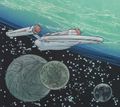
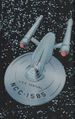
- The Rochester class (et al) were originally represented (only) by the single source material, a Marvel comic book about a ship of the class. The primary images now in use come from a vessel very much in the style of the original, but of much higher quality.
Gallery
-

-

-
-
-

-
 2256 refit
 -
 Dorsal view
 -
 Stern view
.png)
.png)


.png)
.png)
.png)