Guide:Stuart/Siebel/Neptune
.png)
| |
| Stuart/Siebel/Neptune | |
|---|---|
| Class Overview | |
| Category | Transport/strike transport/surveyor |
| Operational | 2118 - 2193 |
| Constructed | 73 total: |
| Dimensions | |
| Length |
|
| Beam | 25.2 m |
| Height |
|
| Mass |
|
| Performance | |
| Cruise Speed | w 1 |
| Max Speed |
|
| Endurance |
|
| Complement | |
| Officers |
|
| Enlisted |
|
| Troops | 100
|
| Cargo |
|
| Tactical Systems | |
| Beam Weapons | 2x TDM-8 plasma cannon, ventral fwd hull (FC-80, -100, select FC-50 and SV-50) |
| Other Weapons | select FC-50:
FC-80:
FC-100:
|
| Shields |
|
| Auxiliary Craft |
|
| Historical | |
| Ships of Note |
|
| Canonicity | |
| Design | ENT |
| Name | Timo |
| History | Timo
|
Background: The Hobbyist's Guide
Despite the best efforts of Starfleet and the commercial interests of the slowly uniting planet, the interstellar transports of Earth suffered from an almost debilitating lack of speed. There was little point in competing against extraterrestrial freight operators on the swift delivery of high credit to mass ratio goods; Earth freighters would have to rely on ore hauling, or then seek their fortunes in the languid-paced long range commerce. However, commerce rights within Sol system were fiercely defended by the native operators and they certainly possessed the full technological means for this.
The post-WW III Earth network of spaceports had been built with robust, independent spacecraft in mind. Virtually all the vessels flying from the dusty tarmacs on the equator were aerodynamically stable multi-purpose designs that could take off from and land on unprepared areas if necessary—including those of Mars, Ganymede or Pluto. They consumed common hydrogen isotopes and had sufficient range to shuttle between the inner planets with ease. Addition of warp engines to these ships generally resulted in compromised productivity, though, and the corporations seldom tried to bridge the gap between in-system vessels and those capable of interstellar operations.
Yet the alien visitors to Sol often flaunted just such jack-of-all-trades vessels. While not commercially worrisome, they gave pause to Starfleet Command and Military Command, both of which saw the obvious offensive applications of such technology. In 2112, the first steps were taken in providing Earth’s protectors with comparable means of rapid in-system and potential interstellar deployment of combat troops and equipment. A request for proposals was sent out for a 10,000- 15,000 ton armored vessel capable of moving a fully equipped mechanized platoon at warp 1.4 or better. It was only to be expected that existing spaceframes be used as the starting point, but the novel polarizable armor surfaces and compact warp propulsion systems required so much customizing that the eventual General Space Corp. Stuart design could well be considered revolutionary.
When prototyping in 2113 began, toothing problems could thus be expected. Little was problematic about the forward two-thirds of the vessel. A conventional wedgelike bow would house the navigational sensors and deflectors, rapidly broadening to a constant cross section midhull that would serve as the main payload area. Control systems and crew accommodation were neatly clustered atop the hull and amply armored. Lifting engines placed on lateral sponsons and fantail were also of proven technology and the main fusion reactor aft of the holds had seen sterling service aboard Monticello freight drones. However, mounting of the single GSC-1600 series nacelle high astern gave endless headache to the engineers. Choosing the level of radiation shielding would endanger either the onboard troops or the center of gravity. A propulsion system of lesser performance was applied on the initial production keels, with the grudging intent of primarily using these vessels for in-system tasks.

The later units were modified to incorporate more extensive stern structures, and sported twin rather than single stern landing support. Their maximum sustainable speed was the originally intended warp 1.6, in contrast to the warp 1.4 of the initial production run. Additional benefits came out of the change, including a rear gunnery control station. The Siebel assault transports were armed with twin multidirectional plasma cannon on the forward lift engine sponsons, and with numerous projectile guns in cylindrar turrets - powerful enough for close-in support of troops, although rather useless in space combat. The initial Stuart batch of lower performance usually omitted both kinds of armament, as they would have few applications in the in-system errands planned for the type. The projectile gun turrets themselves were still present, even if with limited or absent weaponry.
By 2120, Starfleet had in its possession ten fast Siebel transports to secure Sol against hostile takeover of outer planet assets; by 2125, a full twenty, enough to be spared for interstellar expeditions. Simultaneously, procurement of the Stuart for the odd in-system work continued, adding eight vessels of the special Neptune survey configuration by 2123. Significant commercial applications came in the wake of Starfleet operations, with three dozen slightly simplified Stuart units purchased to support mining operations on Luna and Mars and with numerous adapted versions sent to outer colonies. Starfleet frequently practiced Sol defense operations, and twice deployed Siebels to Alpha Sirius III and
[Ophiucus]] in exercises aimed at colony repossession. The latter mission type proved unrealistic, however: a transit time of up to a year put a great strain on the troops and gave far too much time for the invader to dig in. The maximum deployable force of a thousand soldiers would have been pitifully small in any case.

Far more practical were the "tertiary" in-system operations, including rapid disaster relief, scientific expedition support, and garrison supply. Two Stuart units, the UESS Livingstone (VC-51) and the UESS Fawcett (VC-54), were earmarked for support of the Terran Embassy on Vulcan; even though practical reasons usually dictated the use of Vulcan vessels for moving the ambassadorial staff, reasons of prestige necessitated the availability of Starfleet "counterparts" (in a rather broad sense of the word).
By 2156, two of the vessels had been lost: UESS Laing (SV-53) on an arctic assignment to an alien force only much later identified as the Borg, and UESS Kaiser (FC-87) to structural failure during Exercise Deep Vigil. Production was once again underway, however. To better protect off-Sol Human assets against the outbreak of piracy, Starfleet had decided to triple its strike transport force. The well-timed move put little strain on dockyards, as even the most austere facilities sufficed for construction of the robust type. The forty slightly uprated FC-100 transports produced under the Siebel name proved themselves in assorted support roles during the Romulan War. Still, they seldom saw the kind of action for which they had been designed. Their slow speed proved a strategic hindrance; their power output was insufficient for mounting advanced weaponry; and ground combat played a minimal role in the Romulan conflict in any case.
The immediate postwar decades saw the Siebel fleet divided evenly across the new, broad theater of UFP Star Fleet operations. The vessels no longer plied the interstellar routes, concentrating instead on trans-atmospheric operations that the significantly faster modern supply ship designs no longer catered. Numerous vessels were sold or donated to local civilian and government operators, which continued to employ them for SAR, disaster relief, and expedition support. The regular in-system logistics role slowly wore through the sturdy spaceframes, though; since no Star Fleet successor was forthcoming, civilian operators gave up the type as well. The last Star Fleet liaison vessels of FC-100 type were withdrawn from service in the 2190s.
Gallery
-
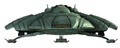 Bow
Bow -
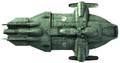 Dorsal
 -
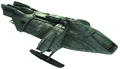 Dorsal bow angle
 -
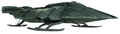 Starboard bow angle
 -
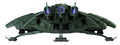 Stern
Stern -
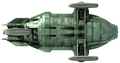 Ventral
 -
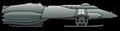 Neptune subclass surveyor
.png)
.png)
.png)
.png)
.png)
.png)

Star Fleet Registry
- NCC-K02
- NCC-K04
- NCC-K05
- NCC-K06
- NCC-K10
- NCC-K13
- NCC-K16
- NCC-K19
- NCC-K21
- NCC-K22
- NCC-K23
- NCC-K27
- NCC-K30
- NCC-K40
- NCC-K41
- NCC-K45
Notes
- The prefix "USS" has been changed to "UESS" for ships of the United Earth Starfleet.
- I really do not agree with these vessels serving in the (new) UFP Star Fleet, as it makes more sense (to me) that they stayed with Earth Fleet. However, the last sentence makes clear Timo intended they did transition.
- The end dates for the first three subclasses ended arbitrarily, with a range of 30 - 47 years. Only the fourth subclass, the Siebel FC-100 entered service with the UFP Star Fleet and limited to liaison (i.e., personnel transport) duties. (The Stuart subclass stayed with Earth Fleet.)
- The 16 UFP Star Fleet Siebels are registered in the NCC-K range. (None of the Timo-named ships—including the UESS Siebel herself—served in the new fleet.)