Guide:Nelson: Difference between revisions
No edit summary |
No edit summary |
||
| Line 166: | Line 166: | ||
disappointments in every respect, and ultimately returned to the more common standard | disappointments in every respect, and ultimately returned to the more common standard | ||
spearheaded by ''USS Sager'' (NCC-4483). The ships of this standard sported Type H shielding and a | spearheaded by ''USS Sager'' (NCC-4483). The ships of this standard sported Type H shielding and a | ||
pair of Armscor-Hindustan FH-7 destroyer phasers, and were perfectly capable of fending for | pair of [[Armscor]]-Hindustan FH-7 destroyer phasers, and were perfectly capable of fending for | ||
themselves even in areas of conflict. The modernization was completed by [[2264]], and several vessels | themselves even in areas of conflict. The modernization was completed by [[2264]], and several vessels | ||
were sent to accompany the second wave of ''Constitution'' exploration into the distant reaches of the | were sent to accompany the second wave of ''Constitution'' exploration into the distant reaches of the | ||
Revision as of 11:35, 2 March 2019
_(side).png)
| |
| Nelson | |
|---|---|
| Class Overview | |
| Category | scout / destroyer |
| Operational | 2240-2301 |
| Constructed | 26 total: |
| Dimensions | |
| Length |
|
| Beam |
|
| Height |
|
| Mass |
|
| Performance | |
| Cruise Speed |
|
| Max Speed |
|
| Endurance | 3 years |
| Complement | |
| Officers | 30 |
| Enlisted |
|
| Tactical Systems | |
| Beam Weapons | Nelson
Nelson refit, Sager, Moisanen
Paladin
Wilkerson
|
| Missile Weapons | Paladin
Wilkerson
|
| Shields |
|
| Laboratories | Nelson, Moisanen, Sager, Wilkerson
Paladin: none |
| Transporters | Nelson, Moisanen, Sager
Paladin
Wilkerson
|
| Auxiliary Craft |
|
| Historical | |
| Ships of Note |
|
| Canonicity | |
| Design | FASA, David George ‘Crucible' |
| Name | FASA, David George ‘Crucible' |
| History | FASA, David George ‘Crucible'
|
As soon as the first batch of PB-31–propelled Larson destroyers was approved for production,
Star Fleet repeated its 2220s move and set aside a number of registries at the high end of the range
intended for the combatants. These would again be dedicated scout companions to the destroyer
force, lavishly equipped for fleet coordination duties. Grand wheels were in motion to send Star Fleet
deeper into space than ever before, far beyond the fixed fortifications that could serve as command
assets; the Nelson scoutships would play an elemental role in keeping the Fleet together during this
great push into the unknown.
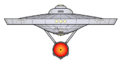
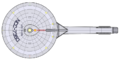
Close to a hundred Larsons were planned for; NCC numbers from 4480 to 4499 were to be painted on the scout companions, with about half coordinating the new destroyer formations, the other half accounting for Fleet assets of other types. Yet to meet the operational requirements, the scouts would not be mere carbon copies of the Larson design. Older Hermes units, already victims of attrition, would accompany the slower Saladin and Siva flotillas. The new Nelson class, propelled by the advanced solid-state PB-31C, was to enjoy a cruise speed of warp six from the outset, and hence keep up with the most modern units of the cruiser force if necessary.

The secret to achieving this great speed lay not in the PB-31C common with the modern destroyer force, but in the Kiratovani KR10-L dilithium double reactor customized for the type. To accommodate the paired linear system and its array of 6+6 antimatter bottles, the scout was constructed with two broad connector pylons, each with its own set of plasma expanders. Fuel consumption would be impressive, but so was the projected top speed: dashes at warp 9.9 were considered perfectly doable. The launch of USS Nelson in April 2240 proved the warp-propulsive capabilities. However, it also discredited the initial estimates on costs, and prompted Star Fleet to urgently downscale its procurement order. There would be fewer Larsons to escort, too, the first batch having been truncated at nineteen hulls. The appropriate number of Nelson companions was set at fourteen, all of which were completed by 2242 on the multiple destroyer dockyards reserved for the purpose.
In lieu of major flotilla maneuvers, the superfast units found themselves assigned solo duty. Their basic navigation gear was that of Larsons, with an integrated deflector system and the Mandor sensor suite. For fleet control, they received compact duotronic systems, leaving plenty of room for long and short range surveillance and survey sensors and making possible onboard, real-time analysis of a wide range of tactical situations and phenomena. Indeed, such was their utilizability that they were sent to deep space on missions of strategic reconnaissance and scientific survey rivaling those of Constitution cruisers, despite only sporting a pair of 130/.75 lasers forward of their ventral sensor cluster.
Klingon aggression in 2246-50 resulted in many near-disasters, out of which the Nelsons extracted themselves only thanks to their superior speed. The Valdez, less fortunate than her sisters, was captured in 2248 and apparently pressed to privateer duty for the Klingon Empire. An emergency refit program was launched that year to give the ships better protection, in the form of Prentice-Schafer Type F shields, a C-3 impulse propulsion system and, ultimately, light phaser armament. The program could not be completed before the end of the active Klingon campaign, and the scout force was back in operation in 2252 only. Despite the improvements, two back-to-back losses were soon suffered, as the Brazzaville and the Providence fell to forces associated with Tholians in 2254. For the following years, deep space was considered a high risk environment, preventing the Nelsons from achieving the sort of scientific results the 2240s had brought. Many acted as command units for Project Locust relatively close to home, wastefully idling their powerful engines.
Yet the class was considered a priority asset for the exploration program, and immediately received the PB-32 deep space engine when it became available in 2260. Two lines of modernization were pursued: USS Moisanen (NCC-4485) and USS Manzer (NCC-4489) were fitted with the advanced FIE-2 impulse system to compensate with the upward creep of total mass, but proved disappointments in every respect, and ultimately returned to the more common standard spearheaded by USS Sager (NCC-4483). The ships of this standard sported Type H shielding and a pair of Armscor-Hindustan FH-7 destroyer phasers, and were perfectly capable of fending for themselves even in areas of conflict. The modernization was completed by 2264, and several vessels were sent to accompany the second wave of Constitution exploration into the distant reaches of the galaxy.
This, however, was the full extent of refitting possible for the design. As the sixties brought about the promise of linear excitation warp technology, it was realized that a refit would be wasted on the already hyper-complicated and compromised Nelsons. The surviving contingent of nine, variously known as Nelson (III) or Sager class, was retired by November 2270 to comply with Organian commitments on the total number of heavy scouting units.
The vessels for which the retirement made room were Nelsons themselves, in a sense at least. The Paladin subclass had been constructed in 2258-59 for tactical purposes having little to do with the original fleet coordination mission, and even less with the independent exploration role of the multiply refitted original batch. The Paladins, rather more successfully mounting the FIE-2 impulse deck and also introducing a strengthened phaser armament of three Type VI emitters of the latest FH-8 model, were intended to act as the eyes and ears of the dreadnought fleet, either boldly scouting ahead or then quietly probing the battlefield with advanced sensors. Their engine type still was PB-32C, yet a second nacelle and double reactor were now carried on the dorsal side for a top speed of warp 11. There was no provision for exploration or survey duty, as laboratory spaces were omitted in favor of a single medium Mk 11 torpedo launcher, in effect making the Paladins the fastest and most agile destroyers in Star Fleet arsenal. The literal double pun for a subclass name, Paired Saladin, belied the fact that the new destroyers actually carried four times the propulsive power of that older near-lookalike class. The expensive Paladins were a welcome addition to the tactical scout force, a category to which all the surviving Hermes variants also belonged at this time of exploratory backpedaling.

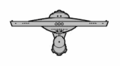
Given the low fatigue and as yet uncluttered internal layout of the Paladins, ten of the fourteen vessels were considered suitable recipients of a linear warp engine upgrade. The program, initiated with USS Wilkerson (NCC-4704) in 2270 already, was very different in structure from the other refits performed on that decade. Only one vessel at a time was processed, not so much in order to maintain constant force strength but to dedicate just one dockyard to the task in the middle of other, more pressing programs. The design of the power and propulsion systems of the scouts facilitated an exceptionally trouble-free installation of LN-63 engines, comparable to that of Larson re-engining. Moreover, the Larson (II) project had given the engineers ample warning of the problems ahead. Making use of subspace field interaction data from that project, a light Mk 14 launcher was installed at the very bow for deploying probes and another added astern, in place of the rear phaser. As the system was fully compatible with torpedoes as well, the vessels could in practice still be considered destroyers with a simple swap of ordnance. Organian treaty limitations naturally precluded public admission of such capabilities.
The Wilkerson vessels did officially concentrate on scouting tasks even when regularly practicing for destroyer deployments. It was not on one of the risky intelligence-gathering missions but on a routine military exercise that the first, disastrous casualties were suffered: at the end of the Solid Force maneuvers of 2274, USS Carmichael and USS Henley collided in a tractor beam misfire while pulling alongside a replenishment station. The scouts both lost containment, killing 730 personnel aboard and stationside. These were the only major losses during three decades of successful operations, though. Wilkerson units accompanied dreadnought deployments, performed independent scouting runs, and operated in concert with Larson (II), Akula and Cochise destroyer units in exercises. Yet none saw active combat with Klingons, mainly because the expensive ships were not risked on operational assignments in regions known to be hunting grounds for Klingon raiders.
The silver bullet nature of the various Nelson models, combined with their deep space deployment mode, kept them largely off the public eye. All types were well liked by their crews, but their basic philosophy was held suspect by a wide range of critics. Giving cruiser-standard engines to vessels of limited mission profiles was and remains a wasteful practice, in part explaining why scouting in support of primary fleet combatants is increasingly performed by the primary combatant types themselves.
Gallery
-
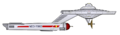 Nelson (2245)
 -
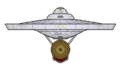
-
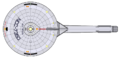
-
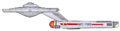 Nelson (2265)
 -
-
_(bow).png)
_(dorsal).png)
_(side).png)
_(bow).png)
_(dorsal).png)
-
 Timo's Nelson
 -
-
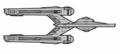 Timo's Paladin
 -
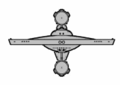
-
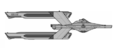 Timo's Wilkerson
.png)
.png)
.png)
.png)
.png)
Notes
- The number of Paladins converted to Wilkersons is reduced from 12 to 10, per the text.
- The NCC for USS Paladin (NCC-4700) is presumed, based upon that of USS Wilkerson (NCC-4703), which is (initially) of the same subclass.
- The sidebar is changed to reflect that the remaining original Nelsons were upgraded to Sager subclass 2 years later.
- The text's statement regarding the Sager subclass also being known as the Nelson (II) has been changed to (III), to reflect the earlier "emergency" upgrade (and to match the flight system of configurations).
- Variants:
- Nelson
- Flt II (2248 refit)
- Sager (Flt III)
- Moisanen (Flt IV)
- Paladin
- Wilkerson