Guide:Bader: Difference between revisions
| (16 intermediate revisions by the same user not shown) | |||
| Line 1: | Line 1: | ||
{{Sidebar Guide ship | {{Sidebar Guide ship | ||
|image=[[File:Bader (stbd).png|250px|'''Bader exploratory cruiser''']] | |image=[[File:Bader (stbd).png|250px|'''Bader exploratory cruiser''']] | ||
|classname= Bader | |classname= ''Bader'' | ||
|category= Exploratory | |category= Exploratory Cruiser | ||
|years= [[2264]] - [[2274]] | |years= [[2264]] - [[2274]] | ||
|constructed= 8 total: | |constructed= 8 total: | ||
* Flight I: 8 (built | * Flight I: 5 (built [[2262]]-[[2265]]) | ||
* Flight | * Flight II: 8 (built/upgraded) [[2265]]-[[2266]]) | ||
* Flight III: 1 (converted Flt II [[2272]]-[[2273]]) | |||
|length= <br> | |length= <br> | ||
* Flt I: 240.03 m | * Flt I/II: 240.03 m | ||
* Flt | * Flt III: 242.6 m | ||
|beam= <br> | |beam= <br> | ||
* Flt I: 150.2 m | * Flt I/II: 150.2 m | ||
* Flt | * Flt III: 152.0 m | ||
|height= <br> | |height= <br> | ||
* Flt I: 72.3 m | * Flt I/II: 72.3 m | ||
* Flt | * Flt III: 76.5 m | ||
|mass= <br> | |mass= <br> | ||
* Flt I: 609,950 mt | * Flt I: 609,950 mt | ||
* Flt II: 710,100 mt | * Flt II: [[TBD]] mt | ||
* Flt III: 710,100 mt | |||
|cruisespeed= <br> | |cruisespeed= <br> | ||
* Flt I: w 6 | * Flt I/II: w 6 | ||
* Flt | * Flt III: w 7 | ||
|towspeed= | |towspeed= | ||
|maxspeed= <br> | |maxspeed= <br> | ||
* Flt I: w 8 | * Flt I/II: w 8 | ||
* Flt | * Flt III: w 9 | ||
|endurance= 5 years | |endurance= 5 years | ||
|officers= 36 | |officers= 36 | ||
|enlisted= <br> | |enlisted= <br> | ||
* Flt I: 124 | * Flt I/II: 124 | ||
* Flt | * Flt III: 132 | ||
|troops= | |troops= | ||
|passengers= 30 (research staff, max) | |passengers= 30 (research staff, max) | ||
| Line 36: | Line 38: | ||
|crew= | |crew= | ||
|cargo= | |cargo= | ||
|beamweapons= 4x phaser | |beamweapons= <br> | ||
* Flt I: 4x phaser V emitters (twin banks) (dorsal primary hull) | |||
* Flt II: 4x phaser VII emitters (twin banks) (dorsal primary hull) | |||
* Flt III: 4x phaser VIII emitters (twin banks) (dorsal primary hull) | |||
|missileweapons= | |missileweapons= | ||
|otherweapons= | |otherweapons= | ||
|shields= <br> | |shields= <br> | ||
<u>Flight I</ | <u>Flight I/II</u> | ||
* 2-layer forcefields | * 2-layer forcefields | ||
* 2x navigational deflectors (hull extension bows) | * 2x navigational deflectors (hull extension bows) | ||
* 3x secondary navigational deflectors (fwd primary hull) | * 3x secondary navigational deflectors (fwd primary hull) | ||
<u>Flight II</ | <u>Flight II</u> | ||
* 2-layer forcefields | * 2-layer forcefields | ||
* 2x navigational deflectors (hull extension bows) | * 2x navigational deflectors (hull extension bows) | ||
| Line 55: | Line 60: | ||
|auxcraft= 4x medium shuttles | |auxcraft= 4x medium shuttles | ||
|historicalships= <br> | |historicalships= <br> | ||
* ''USS Bader'' | * ''USS Akela'' (NCC-1494) | ||
* ''USS Bader'' (NCC-1489) | |||
* ''USS Clifton'' (NCC-1495) | * ''USS Clifton'' (NCC-1495) | ||
* ''USS Crescent'' (NCC-1490) | |||
* ''USS Jones'' (NCC-1493) | |||
* ''USS Rover'' (NCC-1494) | |||
* ''USS Tombaugh'' (NCC-1492) | * ''USS Tombaugh'' (NCC-1492) | ||
* ''USS Wavell'' (NCC-1491) | |||
|design= FASA, dimensions altered | |design= FASA, dimensions altered | ||
|name= FASA | |name= FASA | ||
| Line 63: | Line 73: | ||
}} | }} | ||
Throughout the Klingon conflict, | Throughout the Klingon conflict, [[Star Fleet]] officially remained committed to the deep space exploration mission. At the earliest sign of the threat receding, [[Exploration Command]] assured, resources would again be diverted for long exploratory forays. While the signs in the early [[2260s]] remained as ominous as ever, the surge of low-cost ''[[Guide: Achernar|Achernar]]'' heavy cruisers alleviated the problems at the restless borders. A parallel program was thus put forth for creating similarly affordable vessels capable of deep space survey sorties. For the fiscal period of [[2262]]-[[2266|66]], resources were allocated for completing eight cruiser-sized vessels solely for exploratory purposes. | ||
vessels capable of deep space survey sorties. For the fiscal period of 2262-66, resources were allocated for completing eight cruiser-sized vessels solely for exploratory purposes. | |||
The exploratory cruisers would be lightly armed and protected, but would still outperform the long-serving Whorfin and Cahuya vessels in this and other respects. Dubbed the Bader class, they were to be based on the proven Ptolemy deep space tug design, recently integrated with the PB-32 engine. The Baders would receive additional ventral spaces housing exploratory shuttlecraft and survey gear as well as an advanced sensor suite and new conformal TaT MSAT navigational deflectors. The | The exploratory cruisers would be lightly armed and protected, but would still outperform the long-serving ''[[Guide: Whorfin|Whorfin]]'' and ''[[Guide: Cahuya|Cahuya]]'' vessels in this and other respects. Dubbed the '''''Bader''''' class, they were to be based on the proven ''[[Guide: Ptolemy|Ptolemy]]'' deep space tug design, recently integrated with the PB-32 engine. The ''Baders'' would receive additional ventral spaces housing exploratory shuttlecraft and survey gear as well as an advanced sensor suite and new conformal TaT MSAT navigational deflectors. The ability to carry a cargo pod would be retained, although the expected primary load would be outsize instrumentation. Issues of affordability soon dictated a transition to the newer PB-47 common with ''Achernar'' and modern frigates, however; the advantages of the integration work already done on the ''Ptolemy'' were lost. When the first ''Bader'' in early [[2264]] left construction dock, doomsayers predicted performance inferior to both the other PB-47 recipients and the original tug design. | ||
ability to carry a cargo pod would be retained, although the expected primary load would be outsize instrumentation. Issues of affordability soon dictated a transition to the newer PB-47 common with Achernar and modern frigates, however; the advantages of the integration work already done on the Ptolemy were lost. When the first Bader in early 2264 left construction dock, doomsayers predicted performance inferior to both the other PB-47 recipients and the original tug design. | |||
Against odds, the propulsion system of the Bader proved a relative success. As the powerplant was optimized for deep space economy rather than peak output, the superb acceleration figures of the new engine could not be exploited, but cruise and dash speeds were established at steady warp 6 and 8, respectively. Mission gear installation proceeded swiftly, and by August, the first vessel sported two pairs of FH-4 phasers, a full set of eight laboratories, and a complement of four medium | Against odds, the propulsion system of the ''Bader'' proved a relative success. As the powerplant was optimized for deep space economy rather than peak output, the superb acceleration figures of the new engine could not be exploited, but cruise and dash speeds were established at steady warp 6 and 8, respectively. Mission gear installation proceeded swiftly, and by August, the first vessel sported two pairs of FH-4 phasers, a full set of eight laboratories, and a complement of four medium shuttlecraft. A second hull was nearing completion, and all the remaining keels had been laid. | ||
shuttlecraft. A second hull was nearing completion, and all the remaining keels had been laid. | |||
Yet during the following two years of production, | Yet during the following [[2265|two years]] of production, Star Fleet’s commitment to the exploratory mission began to wane. Despite the growing numbers of combat starships, it was decided that a defensive role had to be imposed on the ''Baders'' as well. Technologically this meant that FH-4 was supplanted by FH-7 and a new fire control system installed, despite over-tasking the secondary power loop and the outdated M-2 mainframe. Operationally, the ''Baders'' were expected to become part of the scouting force, a role where the lack of acceleration, maneuverability and impulse power proved debilitating. [[Defense Command]]’s unfavorable experiences with the type put an end to the plan to procure a further eight ''Baders''. This proved an unfortunate decision indeed, as the [[Organia]]n truce soon reduced the pressures on Star Fleet and allowed the ''Bader'' force to resume its original role of exploration. | ||
In missions to uncontested deep space, nearly every vessel of the class attained fame and recognition. The Bader, Clifton and Tombaugh hosted a series of Sagan Award recipients between 2268 and 2274, while the Akela and Crescent retraced old survey routes in what amounted to popular media events. After obstruction problems with systems mounted in the centerline cargo grapple, the Wavell and Rover received vast and ungainly subspace aerials grafted onto their engine pylons for long baseline interferometry work. In effect, all the vessels steered clear of interstellar trouble or the vagaries of truly unexplored space. Thus, while the scientific community at large was elated at the new tool at their disposal, Exploration Command started to lose interest. | In missions to uncontested deep space, nearly every vessel of the class attained fame and recognition. The ''Bader'', ''Clifton'' and ''Tombaugh'' hosted a series of Sagan Award recipients between [[2268]] and [[2274]], while the ''Akela'' and ''Crescent'' retraced old survey routes in what amounted to popular media events. After obstruction problems with systems mounted in the centerline cargo grapple, the ''Wavell'' and ''Rover'' received vast and ungainly subspace aerials grafted onto their engine pylons for long baseline interferometry work. In effect, all the vessels steered clear of interstellar trouble or the vagaries of truly unexplored space. Thus, while the scientific community at large was elated at the new tool at their disposal, Exploration Command started to lose interest. | ||
Meanwhile, efforts continued to improve on the military potential of the vessels. The Jones was caught in the frenzy of linear engine refitting, and received LN-64 units for warp 7 cruising and warp 9 dash. The primary hull was also reworked to modern standards, and at a long last a suitably potent FIE-2 impulse engine was installed. The conversion process was an uneconomical one, however, and there was little practical gain from the improved warp performance. Plans to install torpedo tubes were dropped, and refitting of the remaining seven vessels was first postponed and then abandoned. By 2274, all the vessels had been relegated to transport use, and their crews transferred to more proper scouting vessels such as Wilkersons or more practical research units such as Oberths. | Meanwhile, efforts continued to improve on the military potential of the vessels. The ''Jones'' was caught in the frenzy of linear engine refitting, and received LN-64 units for warp 7 cruising and warp 9 dash. The primary hull was also reworked to modern standards, and at a long last a suitably potent FIE-2 impulse engine was installed. The conversion process was an uneconomical one, however, and there was little practical gain from the improved warp performance. Plans to install torpedo tubes were dropped, and refitting of the remaining seven vessels was first postponed and then abandoned. By [[2274]], all the vessels had been relegated to transport use, and their crews transferred to more proper scouting vessels such as ''[[Guide: Wilkerson|Wilkersons]]'' or more practical research units such as ''[[Guide: Oberth|Oberths]]''. | ||
For the next decade and a half, | For the next decade and a half, Star Fleet would be well stocked in exploratory cruisers, as its force of ''[[Guide: Tikopai|Tikopai]]'' vessels was augmented by the efforts of various multipurpose cruisers and frigates. Yet the ebbs and flows of the Klingon threat kept forcing Exploration Command’s course: by the late [[2280s]], new cruisers dedicated solely to scientific duties once again had to be fielded, to compensate for the dispatching of multipurpose units to the front lines. This time, affordability was sought not by recycling older Fleet designs, but by introducing commercial solutions and keeping ambitions at bay. The results were perhaps more satisfactory than the ''Bader'' experiment in terms of operability and affordability, but their mark in Star Fleet history is a lesser one. The distinct silhouette of a fully-rigged ''Bader'' still epitomizes the era when Star Fleet’s exploration role last was made subjugate to its defensive one. | ||
==Gallery== | ==Gallery== | ||
<gallery> | <gallery> | ||
File:Bader (stbd).png|''Bader'' Flight I | File:Bader (stbd).png|''Bader'' Flight I/II | ||
File:Bader w mission gear (bow).png|Bow (with mission gear) | File:Bader w mission gear (bow).png|Bow (with mission gear) | ||
File:Bader (stbd) (unk gear).png|Starboard (with unknown gear) | File:Bader (stbd) (unk gear).png|Starboard (with unknown gear) | ||
File:Bader Flt II (stbd).png|''USS Jones'' Flight | File:Bader Flt II (stbd).png|''USS Jones'' Flight III | ||
File:Bader Flt II w mission gear (bow).png|Bow (with mission gear) | File:Bader Flt II w mission gear (bow).png|Bow (with mission gear) | ||
File:Bader Flt II (stbd) (unk gear).png|Starboard (with unknown gear) | File:Bader Flt II (stbd) (unk gear).png|Starboard (with unknown gear) | ||
| Line 94: | Line 101: | ||
==Notes== | ==Notes== | ||
* Timo | * Timo radically & justifiably changed the structure from the FASA profile-only image (see: [[:File:Bader scout.jpg|''Bader'' scout]]). By doing so, he was able to spend little time warranting a visual feature and turned the class into a cruiser based off the ''Pompey'' design. | ||
* It appears the ships were struck from the roles and transferred to the [[Star Fleet Merchant Marine]] in [[2274]]. | |||
<br> | * Note the external modifications made to the nacelles on ''Wavell'' and ''Rover''. | ||
* The mass of the Flight II is TBD. Consider that the only differences were in the heavier phasers and a "a new fire control system". | |||
==Alt Sources== | |||
* [https://www.ststcsolda.space/federation/bader/bader.html STSTCSOLDA] | |||
<br><br> | |||
---- | ---- | ||
* [[Guide: Timo's Guide to Star Fleet|Back to the Table of Contents]] | * [[Guide: Timo's Guide to Star Fleet|Back to the Table of Contents]] | ||
Latest revision as of 14:52, 10 August 2024
.png)
| |
| Bader | |
|---|---|
| Class Overview | |
| Category | Exploratory Cruiser |
| Operational | 2264 - 2274 |
| Constructed | 8 total: |
| Dimensions | |
| Length |
|
| Beam |
|
| Height |
|
| Mass |
|
| Performance | |
| Cruise Speed |
|
| Max Speed |
|
| Endurance | 5 years |
| Complement | |
| Officers | 36 |
| Enlisted |
|
| Passengers | 30 (research staff, max)
|
| Tactical Systems | |
| Beam Weapons |
|
| Shields | Flight I/II
Flight II
|
| Laboratories | 8 (varying configurations) |
| Transporters |
|
| Auxiliary Craft | 4x medium shuttles |
| Historical | |
| Ships of Note |
|
| Canonicity | |
| Design | FASA, dimensions altered |
| Name | FASA |
| History | FASA
|
Throughout the Klingon conflict, Star Fleet officially remained committed to the deep space exploration mission. At the earliest sign of the threat receding, Exploration Command assured, resources would again be diverted for long exploratory forays. While the signs in the early 2260s remained as ominous as ever, the surge of low-cost Achernar heavy cruisers alleviated the problems at the restless borders. A parallel program was thus put forth for creating similarly affordable vessels capable of deep space survey sorties. For the fiscal period of 2262-66, resources were allocated for completing eight cruiser-sized vessels solely for exploratory purposes.
The exploratory cruisers would be lightly armed and protected, but would still outperform the long-serving Whorfin and Cahuya vessels in this and other respects. Dubbed the Bader class, they were to be based on the proven Ptolemy deep space tug design, recently integrated with the PB-32 engine. The Baders would receive additional ventral spaces housing exploratory shuttlecraft and survey gear as well as an advanced sensor suite and new conformal TaT MSAT navigational deflectors. The ability to carry a cargo pod would be retained, although the expected primary load would be outsize instrumentation. Issues of affordability soon dictated a transition to the newer PB-47 common with Achernar and modern frigates, however; the advantages of the integration work already done on the Ptolemy were lost. When the first Bader in early 2264 left construction dock, doomsayers predicted performance inferior to both the other PB-47 recipients and the original tug design.
Against odds, the propulsion system of the Bader proved a relative success. As the powerplant was optimized for deep space economy rather than peak output, the superb acceleration figures of the new engine could not be exploited, but cruise and dash speeds were established at steady warp 6 and 8, respectively. Mission gear installation proceeded swiftly, and by August, the first vessel sported two pairs of FH-4 phasers, a full set of eight laboratories, and a complement of four medium shuttlecraft. A second hull was nearing completion, and all the remaining keels had been laid.
Yet during the following two years of production, Star Fleet’s commitment to the exploratory mission began to wane. Despite the growing numbers of combat starships, it was decided that a defensive role had to be imposed on the Baders as well. Technologically this meant that FH-4 was supplanted by FH-7 and a new fire control system installed, despite over-tasking the secondary power loop and the outdated M-2 mainframe. Operationally, the Baders were expected to become part of the scouting force, a role where the lack of acceleration, maneuverability and impulse power proved debilitating. Defense Command’s unfavorable experiences with the type put an end to the plan to procure a further eight Baders. This proved an unfortunate decision indeed, as the Organian truce soon reduced the pressures on Star Fleet and allowed the Bader force to resume its original role of exploration.
In missions to uncontested deep space, nearly every vessel of the class attained fame and recognition. The Bader, Clifton and Tombaugh hosted a series of Sagan Award recipients between 2268 and 2274, while the Akela and Crescent retraced old survey routes in what amounted to popular media events. After obstruction problems with systems mounted in the centerline cargo grapple, the Wavell and Rover received vast and ungainly subspace aerials grafted onto their engine pylons for long baseline interferometry work. In effect, all the vessels steered clear of interstellar trouble or the vagaries of truly unexplored space. Thus, while the scientific community at large was elated at the new tool at their disposal, Exploration Command started to lose interest.
Meanwhile, efforts continued to improve on the military potential of the vessels. The Jones was caught in the frenzy of linear engine refitting, and received LN-64 units for warp 7 cruising and warp 9 dash. The primary hull was also reworked to modern standards, and at a long last a suitably potent FIE-2 impulse engine was installed. The conversion process was an uneconomical one, however, and there was little practical gain from the improved warp performance. Plans to install torpedo tubes were dropped, and refitting of the remaining seven vessels was first postponed and then abandoned. By 2274, all the vessels had been relegated to transport use, and their crews transferred to more proper scouting vessels such as Wilkersons or more practical research units such as Oberths.
For the next decade and a half, Star Fleet would be well stocked in exploratory cruisers, as its force of Tikopai vessels was augmented by the efforts of various multipurpose cruisers and frigates. Yet the ebbs and flows of the Klingon threat kept forcing Exploration Command’s course: by the late 2280s, new cruisers dedicated solely to scientific duties once again had to be fielded, to compensate for the dispatching of multipurpose units to the front lines. This time, affordability was sought not by recycling older Fleet designs, but by introducing commercial solutions and keeping ambitions at bay. The results were perhaps more satisfactory than the Bader experiment in terms of operability and affordability, but their mark in Star Fleet history is a lesser one. The distinct silhouette of a fully-rigged Bader still epitomizes the era when Star Fleet’s exploration role last was made subjugate to its defensive one.
Gallery
-
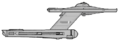 Bader Flight I/II
 -
 Bow (with mission gear)
 -
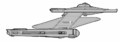 Starboard (with unknown gear)
 -
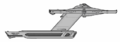 USS Jones Flight III
 -
 Bow (with mission gear)
 -
 Starboard (with unknown gear)
.png)
_(unk_gear).png)
.png)
.png)
_(unk_gear).png)
Notes
- Timo radically & justifiably changed the structure from the FASA profile-only image (see: Bader scout). By doing so, he was able to spend little time warranting a visual feature and turned the class into a cruiser based off the Pompey design.

- It appears the ships were struck from the roles and transferred to the Star Fleet Merchant Marine in 2274.
- Note the external modifications made to the nacelles on Wavell and Rover.
- The mass of the Flight II is TBD. Consider that the only differences were in the heavier phasers and a "a new fire control system".
Alt Sources