Guide:Taholsin: Difference between revisions

From Starfleet Command
Jump to navigation Jump to search
created
 
 
(20 intermediate revisions by the same user not shown)
Line 3: Line 3:
|classname= ''Taholsin''
|classname= ''Taholsin''
|category= Destroyer
|category= Destroyer
|years= [[2146]] - [[2179]]
|years= [[2148]] - [[2172]]
|constructed= 49
|constructed= 103 (built [[2148]] - [[2155]])
|length= 168.3 m
|length= 131.2 m
|beam= 159.5 m
|beam= 76.0 m
|height= 28.0 m
|height= 22.0 m
|mass= 198,800 tons
|mass= 85,200 mt
|cruisespeed= w 2.0
|cruisespeed= w 3
|maxspeed= w 3.0
|maxspeed= w 5.4
|endurance= 1 year
|endurance= 6 months
|officers= 9
|officers= 3
|enlisted= 55
|enlisted= 22
|troops=
|troops=
|passengers=
|passengers=
Line 20: Line 20:
|cargo=
|cargo=
|beamweapons=<br>
|beamweapons=<br>
<u>Original</u>
* 2x phased particle beam emitters (2.0 GW) (wingtip mounts)
* 2x laser emitters (600 MW) (ventral forward hull)
* 1x laser emitters (450 MW) ''or'' 1x plasma cannon (2.0 GW) (dorsal midhull)
* 2x laser emitters (450 MW) or 2x plasma cannon (2.0 GW) (ventral aft hull)
<u>[[2152]] refit</u>
* 2x Type A phased particle cannon (500 GW) (ventral forward hull)
* 1x Type B phased particle cannon (200 GW) (dorsal midhull)
* 2x plasma cannon (2.0 GW) (ventral aft hull)
|missileweapons=
|missileweapons=
|otherweapons=<br>
|otherweapons=
<u>Original</u>
* 6x mine tubes (w/ 150 fusion mines) (stern)
|shields=<br>
|shields=<br>
<u>Original</u>
* Four navigational deflectors on dorsal bow
* Polarizable armor on hull
<u>[[2157]] refit</u>
* 1-layer graviton/subspace globular forcefield
* Navigational deflector (ventral midhull)
* Auxiliary navigational deflector (ventral bow)
|labs=
|labs=
|transporters=<br>
|transporters=
* 1 GP (1-pad)
* Mk I (refitted to select ships in [[2153]]-[[2154|54]])
|auxcraft=<br>
|auxcraft=<br>
* 1 atmospheric shuttle (original)
* 2x work pods
* None (typical, 2153 onwards)
|historicalships=
|historicalships=<br>
|design= Timo
* ''USS Baikal''
|name= FASA
* ''USS Cooper''
|history= FASA
* ''USS Erie'' (NDD-1053)
* ''USS Ganges'' (NDD-1000)
* ''USS Keflov'' (NDD-1032)
* ''USS Maryland''
* ''USS San Esteban'' (NDD-1021)
* ''USS Tanganjika'' (NDD-1047)
|design= ENT
|name= Christopher Bennett
|history= own
}}
}}
In the [[2140s]], the enemy stalking [[Earth]]’s transports and lone patrol vessels remained as faceless as
==Background: ''The Hobbyist's Guide''==
ever, yet was beyond any doubt a formidable one. A military confrontation was a distinct possibility,
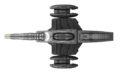
The final element in the propulsive modernization of the [[Andorian Imperial Guard]] fleet was a fighting vessel for attrition purposes, a destroyer about twice the size of the ''[[Tanathooef]]'' frigates. Reliant on the same warp engine that propelled the ''[[Kumari]]'' battle cruiser, even if carrying shortened sets of coils and a much humbler powerplant, and featuring shared hull components and armaments, the '''''Taholsin''''' was built only partially out of a perceived strategic need; mostly, it was built because it could.
yet few measures were taken to prepare for a full-scale war this early on – for a good practical
reason. From the viewpoint of the [[24th century]], it is easy to forget that a [[22nd century]] ship built for
offensive military action would be unsuited for hunting pirates or protecting colonies, let alone
performing missions of exploration or diplomacy. Harsh choices thus had to be made concerning
Earth’s limited resources; certain mission categories had to be ignored to allow others to receive
equipment. Instead of a generic warfleet, the [[UESF]] desired at least a dozen high profile cruisers to bluff
its way to interstellar respect. What little remained had to be allocated to defensive rather than offensive forces – and the defenders would have to be able to cover both the star system and deep
space battlefields.


The first type of combat theater was familiar enough to the UESF. The aerodynamically shaped
The apparently inevitable large scale war between [[Vulcania]] and [[Andoria]] was already well catered for in terms of cruisers and their escorts and the AIG could press civilian freighters to service in sufficient numbers to support the conquest of Vulcan colonial planets and satellites, perhaps even an invasion of the hated [[Vulcans|Vulcan]] homeworld itself. Yet the war would need its heroic casualties and those should not include the expensive battle cruisers. The Empire was gambling big time, constructing a masterpiece of a war plan before even knowing the true dimensions of the playing board or the pawns of the opponent: the very hardware being built for the plan was a game strategy unto itself. The ''Kumari'' was designed with modularity in mind, so that once the dockyards had produced the required number of battle cruisers, they could smoothly shift to producing destroyers out of much the same components.
''[[Guide:Emmette|Emmette]]'' destroyers provided a sturdy template for a system defender. Adding of recent innovations
in armaments and defenses would result in a capable in-system combatant with minimal expenses.
Out-system duties would be a wholly different challenge, though. The ''Emmettes'' could be considered
‘warp-augmented’ at best; the new destroyer would have to mount practical deep space engines of
full warp three performance. This would be a major investment in R&D, construction and systems
integration alike.


There was one final ‘border condition’ defining the new destroyer. Military tradition suggested
[[File:No Photo Available.jpg|left|300px|thumb|A formation of ''Taholsin'' destroyers maneuvers near [[Indarax]], home to ultraconservative [[Andorian]] colonists and, not coincidentally, the celebrated martial arts training hub of all [[Andoria]]. After the formal withdrawal of Andoria from the Romulan conflict in early [[2156]], [[Earth]] attempted direct talks with Indarax; this image is in fact from the mission of ''UES Fomalhaut'' (NCV-80) to carry Admiral [[Edgardo Palmieri]] to such discussions. While little came of the talks, the [[UFP Star Fleet]] currently maintains a liaison and training center on the planet.]]
organizing the harassed transports into convoys protected by escorting spacecraft – yet as space was
vast and the number of transport runs needed to support interstellar colonies quite staggering,
hundreds of escort vessels would be needed to effectively secure Earth’s commerce. The UESF thus was
forced to specify an austere design that could be fitted with various sensor and weapon
combinations as the situation warranted. This decision was truly serendipitous, considering that any
fixed equipment standard initially considered for the escort mission would have been quite useless
in the actual wars that followed.


[[File:Destroyer design submissions.png|left|300px|thumb|The original destroyer proposal and its competition. Both proposals were designed around the same propulsion system, with the more conventional Vickers destroyer ultimately winning on aerodynamic merits of arguably low relevance.]]
The battle cruisers had featured impulse-powered sub-hulls for planetary assault—potentially quite useful in attacks against Vulcan colonial holdings where speed and surprise would be key to victory, and the total volume of troops a secondary concern, never mind sustainable logistics. Each 94-meter hull would now form the main body of a destroyer with a warp coil nacelle grafted above and below the aft end and a new matter/antimatter reactor installed forward of the original fusion system. Lateral wings would support the heavy phase gun armament.


Experimental modifications on available ''Emmette'' spaceframes began almost immediately after the
The ''Taholsin'' destroyers had a typically minimal crew of 25 and omitted all extraneous gear, such as multipurpose auxiliary craft, transporters, or drone deployment systems. This left room for up-to-date shield generators, fuel, and consumable reserves that helped boost the endurance of the vessels. A strictly defensive role in protection of the thirteen Andorian colonies was intended, though, not a deep space one—even though few on Andor believed Vulcans capable of an offensive as audacious as the one planned against Vulcanian outer holdings. Old ''[[Zheusal]]'' battle cruisers would also remain in reserve at the colonies, just in case.
[[2141]] issuing of the relevant Fleet Requirement. Based on these, [[Empress]] and [[Vickers]] yards at Earth
and [[Mars]] began construction of actual flight articles, somewhat larger in overall size and generally
streamlined and simplified to facilitate modern armoring. The after half of the hull was expected to
see the greatest changes, as outdated power and propulsion systems would be supplanted by
completely differently dimensioned modern counterparts. The two competing entries were presented
by the end of the year, with Empress offering a narrow-hulled design with a swappable combat bow,
and Vickers going for a more conventional flying delta.


Certain key features were dictated to appear on both entrants. Two twin reaction engine nozzle
The monomaniacal focus of the Andorians on their plan of aggression might have placed them at a strategic disadvantage. There was nary a thought spared for protecting shipping lanes and the gathering of intelligence was at the whim of Guard units monopolizing deep space combat vessels. In retrospect, though, the fleet constructed by the Empire represented the perfect balance for the needs of the late [[2150s]] and early [[2160s]]: high speed cruisers were Andor’s fitting contribution to the final year of the [[Romulan War]] and to the [[UFP Star Fleet]], while a wholly separate rear guard could be dedicated to the local needs of the Andorian realm in both situations.
assemblies were to be mounted astern on extended, swiveling structures that allowed their use in
lifting as well as forward propulsion tasks. Between them was the main reactor, ejectable in extreme
emergencies but mainly mounted this far abaft due to center-of-mass considerations. Atop the
reactor assembly would sit an IMRF stabilizer serving the two broadly outriggered, 80,000 ton warp
nacelles. In combination, the propulsion system would provide full access to and from terrestrial
planets, linear accelerations up to 800 gravities, warp two sustained and warp three flank speeds,
and sufficient maneuverability in all three operational realms.


The Vickers design was selected in February [[2142]], its conservatism the obvious winning point.
Star Fleet nevertheless obtained a wing of ''Taholsins'' for defending the Romulan Neutral Zone. These vessels were retired in [[2172]] when Andor committed to new warp propulsion technology; no replacement was ever deployed, as Star Fleet interest in the quiet border quickly waned. On the other hand, the ''Taholsins'' remained in production for [[2166|eighteen years]], and supported the self-defenses of the AIG through years of transition to the use of more or less commonalized hardware.
Internally, the ship was divided into ten decks, most of which were taken up by massive fuel tanks
and power generation subsystems. The bridge dome at the bow, mere six meters across, was
equipped with armor-shuttered windows opening directly into space for situational awareness in the
close-quarters fights expected in convoy service. The level below housed a quartet of navigational
deflectors and a sensor array forward, and main command and control facilities beneath the
navigation bridge. Crew quarters and various support systems were clustered within the lifting body
hull in a manner that paid little heed to ergonomy or safety. Major systems breaching the polarizable
hull armor included aft ventral semi-recessed berthing for one twenty-person atmospheric shuttle,
six ventrally mounted twin lifting engines and four landing gear bays, a centralized computer
system, and a ventral domed array of medium range sensors.


Primary armament in two ventral banks just below the bridge structures was clustered with the
==Gallery==
associated targeting sensors, resulting in two rectangular points of weakness. All-new 600 MW
<gallery>
main lasers were developed by Lockheed; these were intended to be carried only on select missions
due to their complexity and power requirements. Normally, the stations were to be fitted with 45
MW laser emitters and/or plasma guns. Secondary ventral weapons stations were crammed in next
to the aftmost lift engine pairs, each capable of holding one plasma cannon or light laser turret. A
single dorsal station was available aft of the bridge. In addition, two sets of three mine tubes astern
could spew up to 150 thermonuclear mines for system defense, or for discouraging pursuit in
convoy escort duty.


[[Image:No Photo Available.jpg|left|200px|thumb|''USS Ganges'' (NDD-1000) flies in formation with two Tellarite frigates of ''Degbaxis'' class in the Fleet review of [[2161]]. A survivor of countless defensive and offensive battles, the ''Ganges'' has both combat wounds and upgrades to show for her years of service – both rather carefully hidden, however.]]
File:Taholsin (dorsal).png|''Taholsin'' (dorsal)


The first six ''Ganges'' units were launched in [[2146]] and equipped with four 450 MW lasers and two 2
</gallery>
GW plasma cannon turrets. After barely two months of validation trials, operational testing was
initiated: ''USS Erie'' and ''USS Keflov'' were sent to escort a group of medium freighters carrying
weapons components, including orbital fortress and space tank modules and much-needed excitator
coils for system defense vessel laser emitters, to [[Earth Colony Six]]. The results were nothing short of
tragic. Somehow, Romulans had found out about the delivery, and mounted a raiding party that
penetrated into nominally Earth-patrolled space and engaged the convoy. The lasers of the
destroyers worked as planned, cutting to pieces one alien missile boat per minute – but in less than
three minutes, the ships had been overrun and their relatively light armor peeled open by superior
numbers of attackers. There were no survivors aboard the destroyers, and only one of the freighters
managed to escape into high warp. Until [[2164]], the raid was labeled the work of Nausicaans, until
sensor data from the surviving ''SS Tupac Amaru'' was properly reanalyzed to reveal classic Romulan
duplicity.
 
Even the initial post-mission analysis called for a stepping up of response, though. Not only had the
rate of fire of the destroyers been found insufficient, but the range of engagement with the
secondary lasers was too close for the safety of the convoy. The heavy 600 MW laser was clearly
needed even against adversaries as puny-looking as pirate missile boats.


Subsequent deployments of ''Ganges'' escorts eventually resulted in all ships carrying the maximum
==Star Fleet Registry==
weapons load, with a 50/50 balance of lasers and plasma turrets on the secondary mounts. Still, the
<div style="-moz-column-count:3; column-count:3;">
first truly efficient combat fit had to wait until [[2152]] and the introduction of phased particle beam
* ''USS '' (NCC-82)
weaponry. A pair of Type A phase cannon at the bow was the initial fit, followed by a Type B
* ''USS '' (NCC-79)
cannon on the dorsal mount; mines and most plasma cannon were omitted. The shuttlecraft was
* ''USS '' (NCC-179)
disembarked, as in its exposed position it presented an explosion hazard for little practical return. A
* ''USS '' (NCC-188)
Mk I transporter was soon added in compensation, its emitter array positioned in the shuttle berth.
* ''USS '' (NCC-257)
* ''USS '' (NCC-266)
* ''USS '' (NCC-271)
* ''USS '' (NCC-304)


A total of 49 ''Ganges'' were built during the period when random Romulan raids changed into
</div>
systematic interception of transports in preparation for a major attack. Several of the destroyers saw
initial service in anti-Xindi and anti-Klingon operations in the [[Sol]] system, based off Mars where the
ships could operate from surface bases. Moving of operations out to deep space began after the
delivery of the tenth unit, gradually, haltingly: the [[2149]] Nausicaan scare and again the [[2151]] Klingon
incidents made Starfleet hesitate, but shipping protection ultimately received the majority of the
''Ganges'' force.


Homogeneous spreading of the destroyers to interstellar space would have been folly. On the most
==Notes==
endangered shipping lanes, convoying was in [[2156]] changed from constant escort to relay tactics. A
* While this destroyer was referenced in the FASA ''Star Trek Role Playing Game'' game canon, its design is kitbashed from parts of the ''[[Guide: Kumari|Kumari]]'' class battle cruiser by Timo and (independently) myself.  
group of destroyers followed a convoy for two to three lightyears, then handed it over to the next destroyer group; random links of the relay chain were watched over by a cruiser, but most were left
completely unprotected. The tactical aim was to keep the Romulans guessing, and to be able to
confront them with decisive force when they guessed wrong. This enormously demanding system
taxed the ''Ganges'' fleet to the extreme, but at least kept the forward colonies and outposts from
becoming totally isolated. A downside was the complete unavailability of escort vessels for any of
the secondary trade routes.


As the Romulans began their main attack, the front lines nevertheless faced a siege of
* I removed a part of the sentence in the final paragraph, about the use of the ''Taholsins'' as being non-typical ("...a rare non-Guard Andorian contribution to the interstellar defense effort."), as it doesn't properly reflect the role of the Andorians in creating the [[Defense Command]].
overwhelming force. The low warp speeds of the ''Ganges'' no longer mattered, as they were pressed
to system defense service and began to fight their battles under impulse power. While the cruiser
and modern destroyer fleets fought in deep space hunting Romulan carriers, ''Ganges'' teams were
used to ambush raiding parties and to wear down assault forces before they entered planetary
bombardment range. Starfleet’s efforts to boost planetary defenses were still hampered by
Romulans constantly intercepting shipments of material intended for this purpose, and there no
longer were destroyers to spare for convoy escort; ''Ganges'' production was terminated in favor of the
more affordable ''[[Guide:Daedalus|Daedalus]]'' corvettes.


[[Image:No Photo Available.jpg|left|200px|thumb|The wreckage of ''USS Tripoli'' being surveyed by the destroyers ''Cooper'' and ''Maryland''. The battle at [[Altair VI]] was the first in the Romulan War where Starfleet managed to send modern destroyers to augment the deep space cruiser force. Compensating for each other’s severe deficiencies, the jointly operating elements managed to reduce casualties, making Altair VI the first engagement in which no stopgap ''Daedalus'' vessels were lost. Planetary defense and assault remained an ''Ganges'' forte throughout the war.]]
* The USS prefix and NCC registration codes of ''Fomalhaut'' have been changed to "UESS" and "NCV", respectively, to reserve their use for the [[UFP Star Fleet]].


Desperate tactics of providing lone freighters or small convoys with single-pilot escort fighters had
* "Admiral Palmieri" has received a SFC-derived first name (Edgardo). This is (presumably) the Admiral Palmieri referenced in the ''Enterprise'' novel, ''The Good That Men Do''.<ref name=MB_Palmieri>[https://memory-beta.fandom.com/wiki/Palmieri_(Admiral) Memory Beta: "Palmieri (Admiral)"]</ref>
no practical effect. Popularly called ‘cochranes’, the dartlike fighters usually consisted of nothing
more than a cockpit and a handful of laser or plasma cannon scabbed onto a bulky warp sustainer
feeding from the warp field of the freighter. Some four hundred were produced between [[2147]] and
[[2159]], but a stupefying 289 lost during the first year of operation. While a 1940s CAM pilot might
have felt close kinship to a ‘cochrane jockey’, the majority of UESF personnel considered this
suicidal method of fighting fit only for saints or fools. It well reflects the desperation of the times
that the line of people waiting for their chance to climb into a cochrane cockpit only grew longer
with each incoming casualty report.


[[Image:No Photo Available.jpg|left|200px|thumb|Two ''[[Guide:Arrow/Galliant/Dagger|Galliant]]'' and two ''Arrow'' class cochranes travel in the wake of ''USS Baikal'' of ''Ganges'' class, in protection of convoy XR-72 to [[Earth Colony Six]]. The destroyer was somewhat ill fitted to serve as a battle control center, lacking in sensors and command and communications facilities. It was therefore typical for one of the transports to be rigged for command duty, with a ranking UESF officer aboard to liaison with the civilian Convoy Commodore, leaving the destroyers and cochranes to concentrate on actual fighting. Such a team could be a deadly opponent to raiders, but usually the cochranes had to make do with partners lesser than ''Ganges''.]]
* UFP Star Fleet "obtained a wing of ''Taholsins'' for defending the Romulan Neutral Zone." Unfortunately, "wing" is not defined and is not a nautical term. I've gone with squadron, ''i.e.'', 3 to 10 ships, instead. Even 10 ships seems too small to "defend the Romulan Neutral Zone"; then again, it's not as if they are operating by themselves.


Despite such bravery, by [[2158]] it began to seem that almost a hundred of the forward colonies and
* I've decided eight ''Taholsins'' went into Star Fleet service as destroyers, in the standard NCC range.
outposts would have to be abandoned and new defense lines formed closer to Earth. Clearly, a
purely defensive strategy would finally lead to complete destruction.


When Earth’s long-awaited move to the offensive came, it was not merely system- or theaterwide,
* The final year of production for the class was established by DD.
but simultaneously affected every single UESF unit involved in the fighting. As is typical of
fledging interstellar powers, both combatants still thought in terms of lines of battle, and the
Romulans thus could not conceive of the kind of free-roaming operations that would retain the
initiative on the defending force. Instead, they mirrored Earth’s desperation from the preceding
years and withdrew from their challenged forward positions to what they considered a defensible
line. By classic Earth doctrines, this called for the uprooting of all UESF defenses and their
utilization for ceaseless assaults that would prevent the Romulans from ‘digging in’. Thus, the
''Ganges'' destroyers were mainly used as perimeter guards for battle fleets in the final phase of the
war.


Still, even in retreat, the Romulans were a threat to colonies and mining outposts: a Romulan unit
==References==
cut away from a main force was likely to perform a suicide run at an enemy planet rather than try
<references/>
and fight its way back to Romulan-controlled space. Local defense missions could thus still be of
essence, and for example the mining colony of [[Lalande 8]] can thank ''USS Tanganyika'' (NDD-1047)
for its continued existence. The ''Tanganyika'' was used as a decoy, luring a suicidal Romulan
auxiliary carrier into ramming an abandoned mining station instead of an inhabited one, as well as
for rendering harmless twelve fightercraft launched by the carrier. ''USS San Esteban'' (NDD-1021)
was the only UESF ship lost with all hands in the final Romulan plunge at [[a Omega B]] in [[2161]],
taking with her two Romulan stormwings but unable to prevent the massacre of more than 20,000
people on the planetary settlement.
 
In the shadow of the cruisers that dictated the outcome of the war, the story of the ''Ganges'' was one
of forgotten glory. Dull patrol duty along the newly established Neutral Zone awaited [[Starfleet]]
combat forces after the signing of the peace. The compact destroyers were less than ideal for
standing the long vigil far away from planetary surfaces or other fixed assets. A handful were
pressed to intra-Federation traffic protection duties, another few kept for system protection – but as
with many ship types of the Romulan War, no specimen were preserved for posterity. Instead, the
last ''Ganges'' serving under the Federation Starfleet flag were in [[2179]] grounded at colonial starports,
never to be reactivated. As the main threat changed from Romulans back to Klingons in the [[2220s]],
even the best preserved ''Ganges'' were only fit for swift recycling into construction material.
 
 
==Note==
* This is referred to as the ''Neptune'' class in some fan-canon. In ''Enterprise'', there is an unseen ''Neptune'' type survey ship in the [[UESF]], but the images used here match the ''[http://memory-alpha.wikia.com/wiki/Unnamed_Earth_starships#.22Warp_Delta.22 Warp Delta]'' (so called because of production notes) seen in three ''Enterprise'' episodes. Timo originally named the class ''Iceland''; however he updated his ''Guide'' to re-name the class ''Ganges''.
 
==Gallery==
<gallery>
Image:Iceland.jpg|Starboard aspect
File:Iceland (bow aspect).png|Bow aspect
File:Iceland (dorsal aspect).png|Dorsal aspect
File:Iceland (stern aspect).png|Stern aspect
File:Iceland (ventral aspect).png|Ventral aspect
File:Triton warship (dorsal view).png|Dorsal view
File:Triton warship (forward dorsal view).png|Forward dorsal view
File:Warp delta by jetfreak 7-d4del5b.png|Patrolling an asteroid field
</gallery>


<br><br>
----
----
*[[Guide: Timo's Guide to Starfleet|Back to the Table of Contents]]
* [[Guide: Timo's Guide to Star Fleet|Back to the Table of Contents]]
*[[Guide: 2130-2161 - Into The Romulan War|Back to "Into The Romulan War"]]
* [[Guide: 2130-2161 - Into The Romulan War|Back to "Into The Romulan War"]]
*[[Guide: Of Ship Statistics|Appendix A: Of Ship Statistics]]
* [[Guide: Of Ship Statistics|Appendix A: Of Ship Statistics]]
*[[Guide: Glossary|Appendix B: Glossary]]
* [[Guide: Glossary|Appendix B: Glossary]]
*[[Guide: Starfleet Organization - General Outline|Appendix C: Starfleet Organization - General Outline]]
* [[Guide: Star Fleet Organization - General Outline|Appendix C: Star Fleet Organization - General Outline]]
*[[Guide: Abbreviations From Outside|Appendix D: Abbreviations From Outside]]
* [[Guide: Abbreviations From Outside|Appendix D: Abbreviations From Outside]]


[[Category:Guide|{{PAGENAME}}]]
[[Category:Guide|{{PAGENAME}}]]

Latest revision as of 12:09, 26 July 2023

Taholsin class destroyer
Taholsin
Class Overview
Category Destroyer
Operational 2148 - 2172
Constructed 103 (built 2148 - 2155)
Dimensions
Length 131.2 m
Beam 76.0 m
Height 22.0 m
Mass 85,200 mt
Performance
Cruise Speed w 3
Max Speed w 5.4
Endurance 6 months
Complement
Officers 3
Enlisted 22


Tactical Systems
Beam Weapons
  • 2x phased particle beam emitters (2.0 GW) (wingtip mounts)


Shields
  • 1-layer graviton/subspace globular forcefield
  • Navigational deflector (ventral midhull)
  • Auxiliary navigational deflector (ventral bow)
Auxiliary Craft
  • 2x work pods
Canonicity
Design Timo
Name FASA
History FASA


Background: The Hobbyist's Guide

The final element in the propulsive modernization of the Andorian Imperial Guard fleet was a fighting vessel for attrition purposes, a destroyer about twice the size of the Tanathooef frigates. Reliant on the same warp engine that propelled the Kumari battle cruiser, even if carrying shortened sets of coils and a much humbler powerplant, and featuring shared hull components and armaments, the Taholsin was built only partially out of a perceived strategic need; mostly, it was built because it could.

The apparently inevitable large scale war between Vulcania and Andoria was already well catered for in terms of cruisers and their escorts and the AIG could press civilian freighters to service in sufficient numbers to support the conquest of Vulcan colonial planets and satellites, perhaps even an invasion of the hated Vulcan homeworld itself. Yet the war would need its heroic casualties and those should not include the expensive battle cruisers. The Empire was gambling big time, constructing a masterpiece of a war plan before even knowing the true dimensions of the playing board or the pawns of the opponent: the very hardware being built for the plan was a game strategy unto itself. The Kumari was designed with modularity in mind, so that once the dockyards had produced the required number of battle cruisers, they could smoothly shift to producing destroyers out of much the same components.

A formation of Taholsin destroyers maneuvers near Indarax, home to ultraconservative Andorian colonists and, not coincidentally, the celebrated martial arts training hub of all Andoria. After the formal withdrawal of Andoria from the Romulan conflict in early 2156, Earth attempted direct talks with Indarax; this image is in fact from the mission of UES Fomalhaut (NCV-80) to carry Admiral Edgardo Palmieri to such discussions. While little came of the talks, the UFP Star Fleet currently maintains a liaison and training center on the planet.

The battle cruisers had featured impulse-powered sub-hulls for planetary assault—potentially quite useful in attacks against Vulcan colonial holdings where speed and surprise would be key to victory, and the total volume of troops a secondary concern, never mind sustainable logistics. Each 94-meter hull would now form the main body of a destroyer with a warp coil nacelle grafted above and below the aft end and a new matter/antimatter reactor installed forward of the original fusion system. Lateral wings would support the heavy phase gun armament.

The Taholsin destroyers had a typically minimal crew of 25 and omitted all extraneous gear, such as multipurpose auxiliary craft, transporters, or drone deployment systems. This left room for up-to-date shield generators, fuel, and consumable reserves that helped boost the endurance of the vessels. A strictly defensive role in protection of the thirteen Andorian colonies was intended, though, not a deep space one—even though few on Andor believed Vulcans capable of an offensive as audacious as the one planned against Vulcanian outer holdings. Old Zheusal battle cruisers would also remain in reserve at the colonies, just in case.

The monomaniacal focus of the Andorians on their plan of aggression might have placed them at a strategic disadvantage. There was nary a thought spared for protecting shipping lanes and the gathering of intelligence was at the whim of Guard units monopolizing deep space combat vessels. In retrospect, though, the fleet constructed by the Empire represented the perfect balance for the needs of the late 2150s and early 2160s: high speed cruisers were Andor’s fitting contribution to the final year of the Romulan War and to the UFP Star Fleet, while a wholly separate rear guard could be dedicated to the local needs of the Andorian realm in both situations.

Star Fleet nevertheless obtained a wing of Taholsins for defending the Romulan Neutral Zone. These vessels were retired in 2172 when Andor committed to new warp propulsion technology; no replacement was ever deployed, as Star Fleet interest in the quiet border quickly waned. On the other hand, the Taholsins remained in production for eighteen years, and supported the self-defenses of the AIG through years of transition to the use of more or less commonalized hardware.

Gallery

Star Fleet Registry

  • USS (NCC-82)
  • USS (NCC-79)
  • USS (NCC-179)
  • USS (NCC-188)
  • USS (NCC-257)
  • USS (NCC-266)
  • USS (NCC-271)
  • USS (NCC-304)

Notes

  • While this destroyer was referenced in the FASA Star Trek Role Playing Game game canon, its design is kitbashed from parts of the Kumari class battle cruiser by Timo and (independently) myself.
  • I removed a part of the sentence in the final paragraph, about the use of the Taholsins as being non-typical ("...a rare non-Guard Andorian contribution to the interstellar defense effort."), as it doesn't properly reflect the role of the Andorians in creating the Defense Command.
  • The USS prefix and NCC registration codes of Fomalhaut have been changed to "UESS" and "NCV", respectively, to reserve their use for the UFP Star Fleet.
  • "Admiral Palmieri" has received a SFC-derived first name (Edgardo). This is (presumably) the Admiral Palmieri referenced in the Enterprise novel, The Good That Men Do.[1]
  • UFP Star Fleet "obtained a wing of Taholsins for defending the Romulan Neutral Zone." Unfortunately, "wing" is not defined and is not a nautical term. I've gone with squadron, i.e., 3 to 10 ships, instead. Even 10 ships seems too small to "defend the Romulan Neutral Zone"; then again, it's not as if they are operating by themselves.
  • I've decided eight Taholsins went into Star Fleet service as destroyers, in the standard NCC range.
  • The final year of production for the class was established by DD.

References